
Finding Strength Through Bible Verses for Sober Living
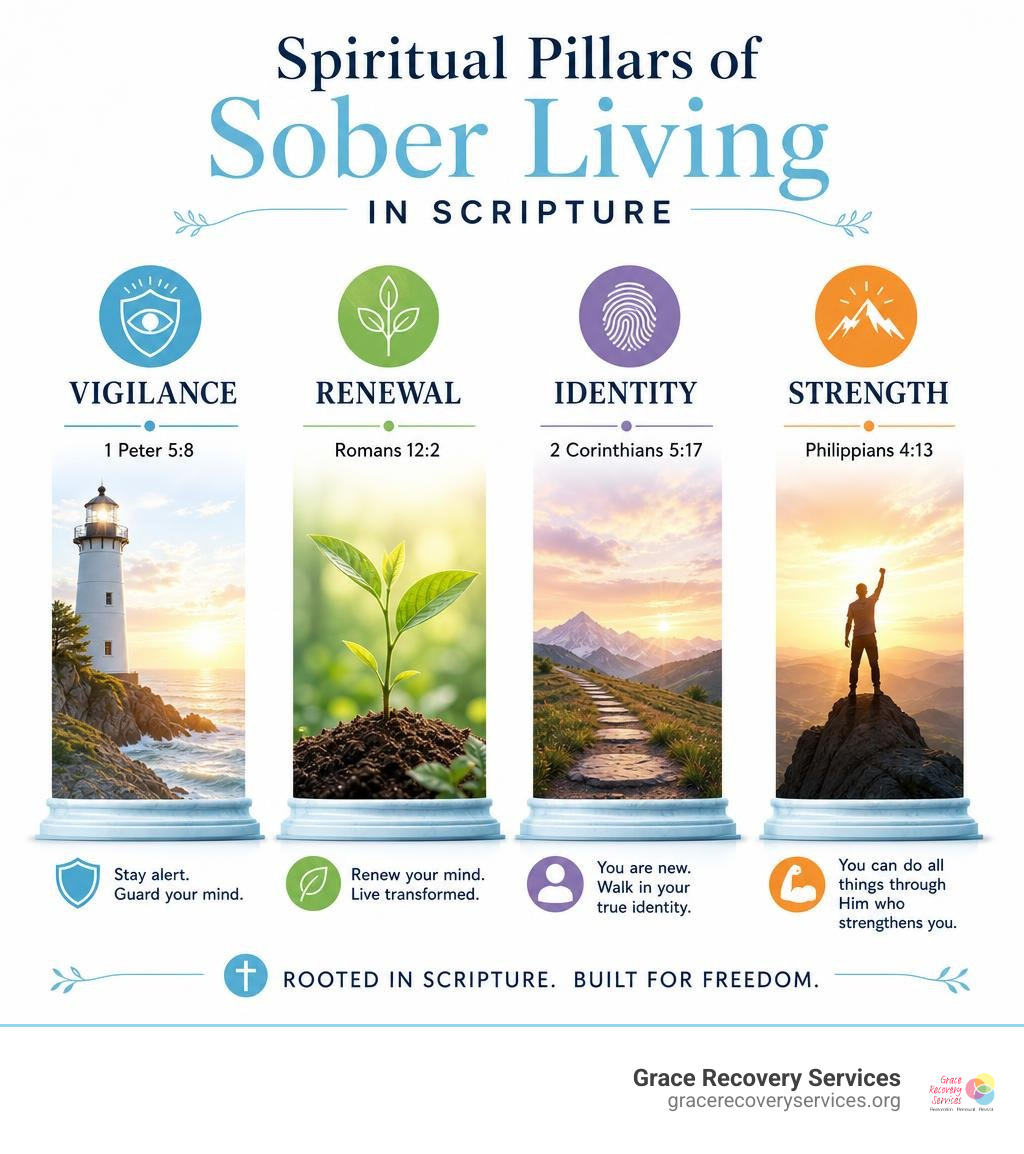
Bible verses for sober living give anyone in recovery a dependable framework for mental clarity, emotional peace, and daily resilience. When managing cravings or stress, scripture provides direct spiritual and cognitive tools to protect your progress:
- 1 Peter 5:8: Calls for clear-minded vigilance to spot triggers before they escalate.
- Romans 12:2: Encourages renewing the mind to replace destructive habits with healthy thought patterns.
- Philippians 4:13: Reminds us that enduring strength comes through spiritual reliance during difficult moments.
- 1 Corinthians 10:13: Reassures that no temptation is inescapable and that a way through always exists.
- 2 Corinthians 5:17: Affirms a renewed identity, releasing past guilt and shame.
Sustaining long-term recovery is about much more than physical abstinence—it is about cultivating a sound mind and establishing a stable, meaningful daily life. Initiatives like “Dry January” or SAMHSA’s Substance Use Treatment Month prompt many people to reflect on their health, but lasting change requires ongoing care for the whole person: spirit, mind, and body.
Integrating Scripture into your daily routine helps anchor your thoughts, reduce anxiety, and reinforce positive behaviors. Paired with professional outpatient counseling and a supportive community, these biblical truths serve as daily stepping stones toward lasting peace and purposeful living.
Basic Bible verses sober living glossary:
What Does Scripture Teach About Sober-Mindedness and Addiction?
When we examine the biblical concept of sobriety, the scriptures speak to far more than just refraining from wine or intoxicating substances. In the original Greek of the New Testament, two primary words describe this state: nēphein (meaning to be free from the influence of intoxicants, clear-headed, and watchful) and sōphron (meaning to possess a sound, disciplined mind, exercise self-control, and exercise prudent judgment).
To be biblically sober is to possess emotional stability, sound judgment, and spiritual vigilance. It means having an unclouded mind capable of perceiving reality accurately and making decisions aligned with truth. At Grace Recovery Services, we often explore 10 sober minded bible verses to guide you today during our Christian counseling sessions across Western PA, showing how spiritual clarity forms the bedrock of sustainable healing.
Biblical Sobriety vs. Physical Abstinence
Physical abstinence from substances is a vital, necessary starting line, but biblical sobriety encompasses the entire inner thought life. A person can abstain from alcohol or drugs yet still live in the grip of anxiety, anger, resentment, or compulsive thinking.
Scripture frames sobriety as a spiritual posture of wakefulness and protection:
“So then let us not sleep, as others do, but let us keep awake and be sober… putting on the breastplate of faith and love, and for a helmet the hope of salvation.” — 1 Thessalonians 5:6, 8
In this passage, Paul equates sobriety with putting on spiritual armor. A sober mind acts as a mental helmet, shielding our emotional peace from toxic thought loops. Learning how God’s Word actively shields our cognitive processes reveals 10 undeniable reasons why sober bible verses work to maintain emotional stability and prevent impulsive reactions to life stress.
Understanding Bible verses sober living on Freedom and Bondage
Substance use disorders often start as an attempt to find relief, celebrate, or cope with pain, but they can quickly evolve into spiritual and physical entrapment. Scripture directly addresses this dynamic of progressive control:
“All things are lawful for me, but not all things are helpful. All things are lawful for me, but I will not be dominated by anything.” — 1 Corinthians 6:12
The word “dominated” here translates from the Greek exousiazō, which means to be brought under the power, authority, or mastery of something. When a substance or compulsive habit begins dictating a person’s priorities, schedule, relationships, and peace of mind, it exercises mastery over them. As detailed in this helpful biblical study on What the Bible Says About Addiction – 1 Corinthians 6:12, anything that usurps God’s place as our primary source of comfort and guidance becomes a form of spiritual bondage.
The Old Testament echoes this reality: “A man without self-control is like a city broken into and left without walls” (Proverbs 25:28). Without emotional boundaries and spiritual clarity, our inner life becomes vulnerable. Paul acknowledged this intense internal warfare in Romans 7:15: “For I do not understand my own actions. For I do not do what I want, but I do the very thing I hate.” Acknowledging this struggle is not a sign of failure—it is the humble beginning of inviting God’s grace into our recovery.
Essential Bible Verses Sober Living Foundations for Recovery

Developing daily spiritual disciplines provides practical stability. At our offices in Pittsburgh (Penn Hills area) and North Huntingdon, our outpatient counselors guide clients through intentional scripture reflection to build daily resilience. Engaging deeply with scripture and sobriety provides structural support when navigating life transitions.
Here are core scriptural anchors every person in recovery can lean on:
- 1 Peter 5:8 – “Be sober-minded; be watchful. Your adversary the devil prowls around like a roaring lion, seeking someone to devour.” Sobriety is active vigilance against relapse triggers.
- Romans 12:2 – “Do not be conformed to this world, but be transformed by the renewal of your mind…” True transformation happens as our thought patterns are reshaped.
- Philippians 4:13 – “I can do all things through him who strengthens me.” Divine empowerment sustains us when human willpower reaches its limit.
- 1 Corinthians 10:13 – “No temptation has overtaken you that is not common to man. God is faithful, and he will not let you be tempted beyond your ability…” You are never trapped without an exit strategy.
- 2 Corinthians 5:17 – “Therefore, if anyone is in Christ, he is a new creation. The old has passed away; behold, the new has come.” Past choices do not define your identity in God’s eyes.
Scriptural Pillars for Spiritual Strength and Alertness
The New Testament reminds us that our bodies are sacred vessels designed for purpose and fellowship with God:
“Or do you not know that your body is a temple of the Holy Spirit within you, whom you have from God? You are not your own, for you were bought with a price. So glorify God in your body.” — 1 Corinthians 6:19-20
Treating the physical body with care, nourishment, rest, and sobriety honors God. When cravings strike or anxiety mounts, we do not have to operate from fear. As 2 Timothy 1:7 declares, “For God gave us a spirit not of fear but of power and love and self-control.” From these sober strength bible verses 7 encouraging picks helps clients replace feelings of helplessness with spiritual confidence and self-discipline.
Applying Key Bible verses sober living to Overcome Triggers
In modern clinical therapy, Cognitive Behavioral Therapy (CBT) focuses on identifying negative automatic thoughts and reframing them with objective truth. This clinical process directly mirrors what scripture taught thousands of years ago: “For as he thinketh in his heart, so is he” (Proverbs 23:7, KJV).
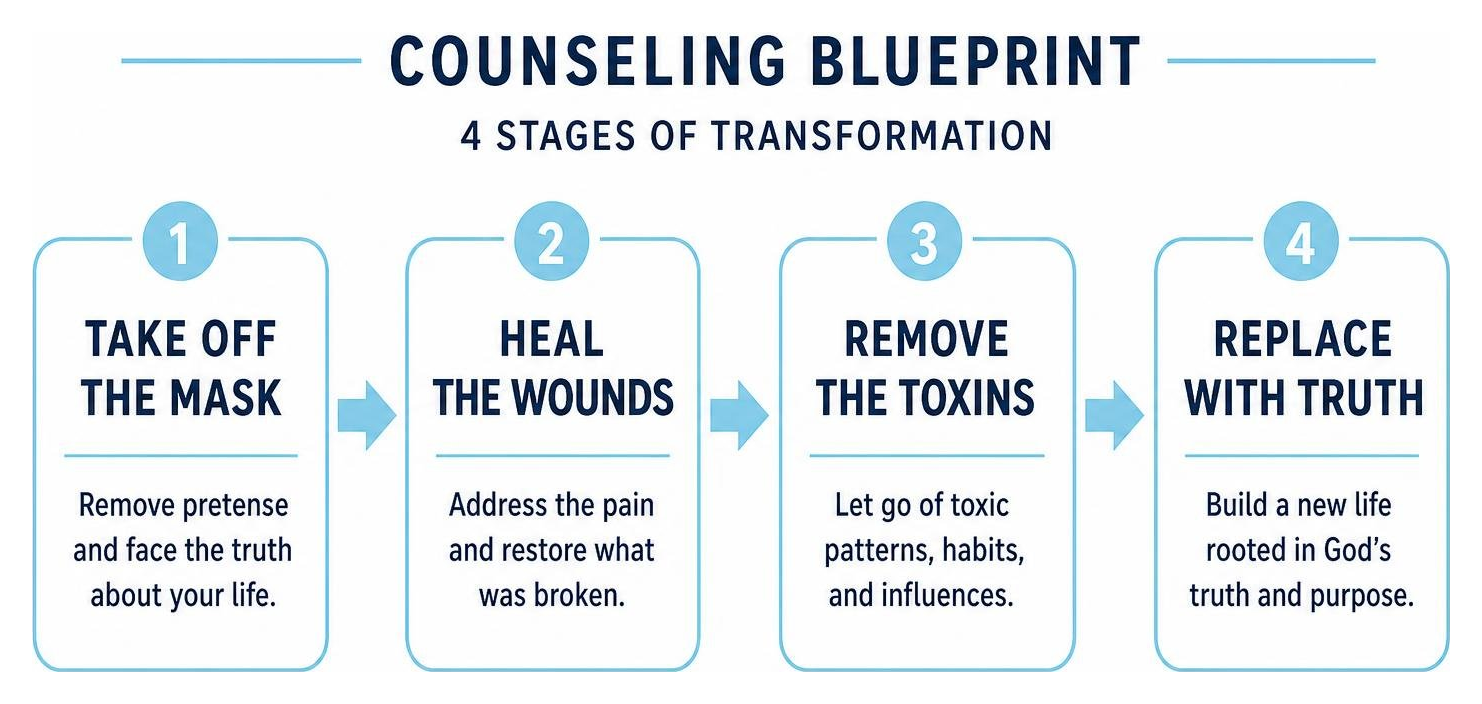
Through neuroplasticity, our brains can form healthy neural pathways when we intentionally interrupt toxic thought spirals. In our outpatient programs, we utilize our Counseling Blueprint—a four-stage journey:
- Take Off the Mask: Acknowledging the struggle honestly without denial.
- Heal the Wounds: Processing the underlying trauma and emotional pain.
- Remove the Toxins: Letting go of destructive coping mechanisms and bitter resentments.
- Replace with Truth: Embedding scripture into daily thinking.
| Automatic Destructive Thought | Underlying Trigger / Lie | Biblical Truth & Scripture Replacement | Practical Relapse Prevention Action |
|---|---|---|---|
| “I’ve had a terrible week; I deserve a drink to take the edge off.” | Believing substances are the only reliable source of immediate comfort. | “Come to me, all who labor and are heavy laden, and I will give you rest.” (Matthew 11:28) | Pause, engage in 5 minutes of deep breathing, and call an accountability partner. |
| “I’ve messed up so many times, I will inevitably relapse anyway.” | Hopelessness and shame-based identity. | “The righteous falls seven times and rises again.” (Proverbs 24:16) | Journal personal progress and review 2 Corinthians 5:17 to reaffirm present identity. |
| “Nobody understands how isolated and stressed I feel right now.” | Isolation and emotional withdrawal. | “Fear not, for I am with you; be not dismayed, for I am your God.” (Isaiah 41:10) | Attend an outpatient peer group or Christian recovery meeting to break isolation. |
| “This craving is too overwhelming; I cannot fight it.” | Catastrophizing cravings as uncontrollable demands. | “God is faithful… he will also provide the way of escape.” (1 Corinthians 10:13) | Implement a 15-minute urge surfing technique and recite Philippians 4:8. |
Philippians 4:8 instructs us: “Finally, brothers, whatever is true, whatever is honorable, whatever is just, whatever is pure, whatever is lovely, whatever is commendable… think about these things.” Grounding our minds in what is wholesome and true redirects the brain’s attention away from impulsive triggers. Learning practical daily application is essential when figuring out how to stay sober after rehab and settling into long-term outpatient recovery.
Moderation, Abstinence, and Spiritual Health in Recovery
Recovery is a comprehensive process addressing the whole person—biological, psychological, social, and spiritual. When someone experiences a substance use disorder, physiological changes in the brain’s reward pathways often make casual moderation impossible.
Recognizing personal health boundaries is an empowering act of wisdom. Total abstinence provides the mental clarity required to heal emotional wounds and grow spiritually. Experiencing the tangible physical, mental, and spiritual benefits of sobriety reinforces a renewed passion for life.
What the Bible Says About Drinking Alcohol
Scripture presents a clear distinction between cultural contexts in antiquity and the dangers of intoxication:
“And do not get drunk with wine, for that is debauchery, but be filled with the Spirit…” — Eph_5:18 – Bible Gateway
Drunkenness and chemical intoxication consistently lead to loss of self-control, impaired judgment, and spiritual vulnerability. While passages like 1 Timothy 5:23 – Bible Gateway reference ancient medicinal use (“use a little wine for the sake of your stomach”), and Proverbs 31:6 – Bible Gateway touches upon ancient palliative relief for those who are perishing, the Bible strongly warns against intoxication in daily living (Proverbs 20:1, Galatians 5:21).
As explored in Faith & Sobriety: What The Bible Says About Drinking Alcohol, for anyone in recovery from substance use disorder, complete abstinence is the safest, healthiest, and most biblically prudent path to protecting spiritual and physical life.
Faith, Prayer, and Christian Community Support
Addiction thrives in isolation and secrecy. Biblical recovery requires transparent community where burdens are shared and healing is nurtured together:
“Brothers, if anyone is caught in any transgression, you who are spiritual should restore him in a spirit of gentleness. Keep watch on yourself, lest you too be tempted. Bear one another’s burdens, and so fulfill the law of Christ.” — Galatians 6:1-2
“Therefore, confess your sins to one another and pray for one another, that you may be healed.” — James 5:16
Being part of a healthy faith community or specialized Christian outpatient peer support group eliminates the stigma that keeps so many silent. Whether navigating recovery as a family or finding your footing while sober and single, surrounding yourself with encouraging, clear-minded peers provides daily accountability and safety.
Overcoming Relapse: Hope, Grace, and Renewing the Mind

One of the most dangerous emotional traps in recovery is shame following a setback or slip. If a person stumbles, negative self-talk often whispers, “You’ll never get this right; you might as well give up.” Scripture confronts this lie with the reassuring reality of God’s restorative grace:
“For the righteous falls seven times and rises again, but the wicked stumble in times of calamity.” — Proverbs 24:16
Falling does not define a person’s character; getting back up in faith does. Romans 5:3-5 reminds us that adversity is not the end of our story: “Not only that, but we rejoice in our sufferings, knowing that suffering produces endurance, and endurance produces character, and character produces hope, and hope does not put us to shame…”
God holds a redemptive plan for your future: “For I know the plans I have for you, declares the Lord, plans for welfare and not for evil, to give you a future and a hope” (Jeremiah 29:11). Utilizing these biblical sobriety encouragement verses for strength allows clients to dismantle shame and return to active recovery with confidence and humility.
Frequently Asked Questions About biblical Sobriety
Does the Bible say drinking alcohol is always a sin?
Scripture acknowledges the historical presence of wine in ancient culture and occasional medicinal applications (such as Paul’s advice in 1 Timothy 5:23). However, the Bible explicitly and repeatedly condemns drunkenness, debauchery, and losing self-control (Ephesians 5:18, Proverbs 20:1). Furthermore, Romans 14:21 advises against consuming anything that causes a brother or sister to stumble. For anyone managing a substance use disorder, total abstinence is the healthiest and most spiritually protective choice.
How does renewing the mind help prevent addiction relapse?
Romans 12:2 calls believers to be transformed by renewing their minds. In clinical terms, this practice aligns with cognitive reframing and neuroplasticity. When we consciously identify cognitive distortions (like catastrophic thinking, emotional reasoning, or rationalizing substance use) and intentionally replace them with scriptural truth, we build new mental and emotional pathways that decrease impulsive behaviors and foster calm problem-solving.
What should I do according to scripture if I experience a relapse?
First, reject paralyzing shame. First John 1:9 assures us that “if we confess our sins, he is faithful and just to forgive us.” Proverbs 24:16 encourages the righteous to get back up after falling. Immediately reach out to your outpatient counselor, sponsor, or Christian support system. Transparency breaks the cycle of secrecy. View the event not as a total failure, but as an opportunity to identify unaddressed triggers, refine your relapse prevention plan, and lean into God’s grace.
Conclusion: Walking in Faith and Sustainable Sobriety
A life of sober living is an ongoing journey of spiritual renewal, personal growth, and deepening purpose. By anchoring your daily thoughts in scripture, renewing your mind, honoring your body, and leaning on a supportive community, you cultivate lasting freedom from substance dependence.
If you or a loved one in Western Pennsylvania are seeking guidance, support, and professional care, our team at Grace Recovery Services is here for you. We provide trauma-informed, outpatient Christian counseling and intensive outpatient programs across our offices in Pittsburgh (Penn Hills area) and North Huntingdon (Westmoreland County).
Take the next step in your healing journey. Reach out to our compassionate team today to schedule a confidential, personalized assessment through our faith-based outpatient recovery services and discover how whole-person healing can transform your life.
This article was researched with AI and heavily edited by Stephen Luther for accuracy and relevance.
Stephen Luther is the Executive Director and Founder of Grace Christian Counseling, Grace Recovery Services, WPA Counseling, NuWell Online Counseling and Coaching, and NuWell Health. He holds a Master’s degree in Education from the University of Georgia and a Master’s degree in Marriage and Family Therapy from Duquesne University. He is a licensed professional counselor in Pennsylvania.
Since 1997, Steve has been helping children, adolescents, and adults overcome a wide range of emotional and relational challenges. He specializes in working with hurting families, including those with foster, adopted, or traumatized children. Steve uses Attachment-Based Therapy, Splankna Healing, and Therapeutic Parent Coaching to support healing and restoration.
This guide is for educational and spiritual encouragement and is not a substitute for personalized professional counseling. If you are in crisis, please reach out for immediate help.