
Some people reach a point where weekly counseling feels too thin, but residential treatment feels too disruptive. They are trying to stay sober, keep working, care for children, or sleep in their own bed, yet the pull of addiction, trauma, anxiety, or depression keeps breaking through. For many believers, there is another layer of pain. They do not want treatment that ignores their faith, but they also do not want spiritual language used as a substitute for real clinical care. They want both truth and skill. Prayer and practice. Scripture and sound therapy. That is where Christian Intensive Outpatient treatment can make sense. It offers a level of support built for people who need more structure than standard outpatient care, while still living at home and actively applying recovery tools in daily life.
When Your Soul and Sobriety Need More Support
A person may be doing “all the right things” on paper. One counseling session a week. A few meetings. Good intentions on Monday. By Thursday, the old triggers return. Shame gets loud. Cravings or emotional numbness come back. The cycle starts to feel stronger than the plan.
That middle space is hard. You may not need to leave home for full-time treatment. But you may know deep down that what you are doing now is not enough.
In our work at Grace Recovery Services, we regularly meet individuals and families who are doing weekly counseling yet still feel overwhelmed by triggers and shame. Many tell us they need more structure without stepping away from work or family responsibilities.

Christian Intensive Outpatient treatment meets people in that exact gap. It gives more frequent support, more accountability, and more room to work on root issues like trauma, grief, distorted thinking, and spiritual exhaustion. It also lets you remain connected to real life, where recovery has to function every day.
For some, the struggle is alcohol or drugs. For others, substance use sits on top of panic, depression, or old wounds that never healed. In a faith-integrated setting, treatment can address both the clinical problem and the deeper questions underneath it, including identity, guilt, forgiveness, and hope.
If you are clinging to God but still feel stuck, resources like these Bible verses for sobriety can encourage you. Still, encouragement alone is not the whole plan. Sometimes healing needs a stronger structure around it.
Key takeaway: Needing a higher level of care is not failure. It often means you are being honest about the level of support recovery requires.
What Exactly Is Christian Intensive Outpatient Treatment
Think of Christian Intensive Outpatient treatment as clinical and spiritual scaffolding. Scaffolding does not build the house for you. It supports the work while healing and rebuilding happen.
What does intensive outpatient mean?
In Christian treatment contexts, IOPs typically involve 9-15+ hours per week of therapy, while allowing clients to live at home, according to Recovery.com’s overview of Christian rehab and IOP levels of care. That makes IOP a step down from PHP, which requires more daily treatment time, and a step up from standard outpatient care, which often involves 1 to 3 sessions weekly in the same source.
That structure matters because recovery is not only about insight. It is about repetition. People need enough contact during the week to interrupt harmful patterns before those patterns retake control.
What does Christian treatment mean?
The word Christian can confuse people. In a healthy IOP, it should not mean sermons replacing therapy. It should mean that faith is integrated in a thoughtful, clinically appropriate way.
That can include:
-
Pastoral support or prayer when desired
-
Scripture reflection that supports treatment themes like truth, identity, forgiveness, and perseverance
-
A whole-person view that takes spiritual pain seriously alongside emotional and physical health
The point is not to force a spiritual performance. The point is to bring faith into the places where addiction and trauma often do their most serious damage.
The Clinical and Spiritual Components of Healing
A strong Christian IOP does not treat faith as decoration. It uses faith as a clinical catalyst in evidence-based care.

How therapy and faith work together
One of the clearest examples is Cognitive Behavioral Therapy, or CBT. CBT helps a person identify unhealthy thoughts, test whether they are true, and replace them with more accurate and useful beliefs.
In Christian IOP settings, that process can be paired with biblical truth. A client might begin with a trauma-shaped belief like, “I am ruined,” “I am unlovable,” or “I will never change.” The therapist does not tell them to “have more faith.” Instead, the therapist helps them examine the belief, notice how it shapes emotions and behavior, and practice replacing it with truth grounded in both clinical reality and Christian conviction.
In our Christian counseling sessions at Grace Recover Services, we often help clients examine trauma-shaped beliefs like “I am ruined” or “I will never change,” then gently replace them with truth grounded in both clinical insight and Scripture.
What this looks like in practice
A session may include several layers of work:
-
Psychoeducation: learning how trauma, stress, and substance use affect the brain and body
-
Group therapy: naming patterns out loud and receiving feedback from others in recovery
-
Individual counseling: working on personal triggers, losses, or family history
-
Faith integration: exploring how shame, fear, and identity struggles intersect with one’s relationship with God
Someone who wants a closer look at this model can review Christian integrated addiction treatment, which describes how faith can be included where it is clinically and culturally appropriate.
A short overview can help make this concrete.
| Component | Clinical purpose | Faith-integrated example |
|---|---|---|
| CBT | Challenge distorted thinking | Compare self-condemning beliefs with biblical truth about worth and responsibility |
| Group therapy | Build accountability and reduce isolation | Practice honesty, confession, and encouragement in community |
| Trauma-informed care | Address root wounds safely | Explore how fear, grief, and control affect both recovery and trust in God |
| Relapse prevention | Plan for triggers and high-risk moments | Add prayer, scripture, and supportive relationships to the coping plan |
Here is a brief visual explanation of how integrated treatment can work in daily life.
Why this approach helps some people go deeper
Addiction often feeds on fragmentation. A person may think one way in therapy, another way in church, and another way alone at night. Integrated care reduces that split. It allows the same person to work on nervous system regulation, relapse prevention, confession, grief, and renewed identity in one coherent process.
Tip: Faith works best in treatment when it supports honesty, not denial. Real healing grows when clients can admit pain clearly, receive skilled care, and bring that pain before God without pretending.
Finding the Right Level of Care for Your Recovery
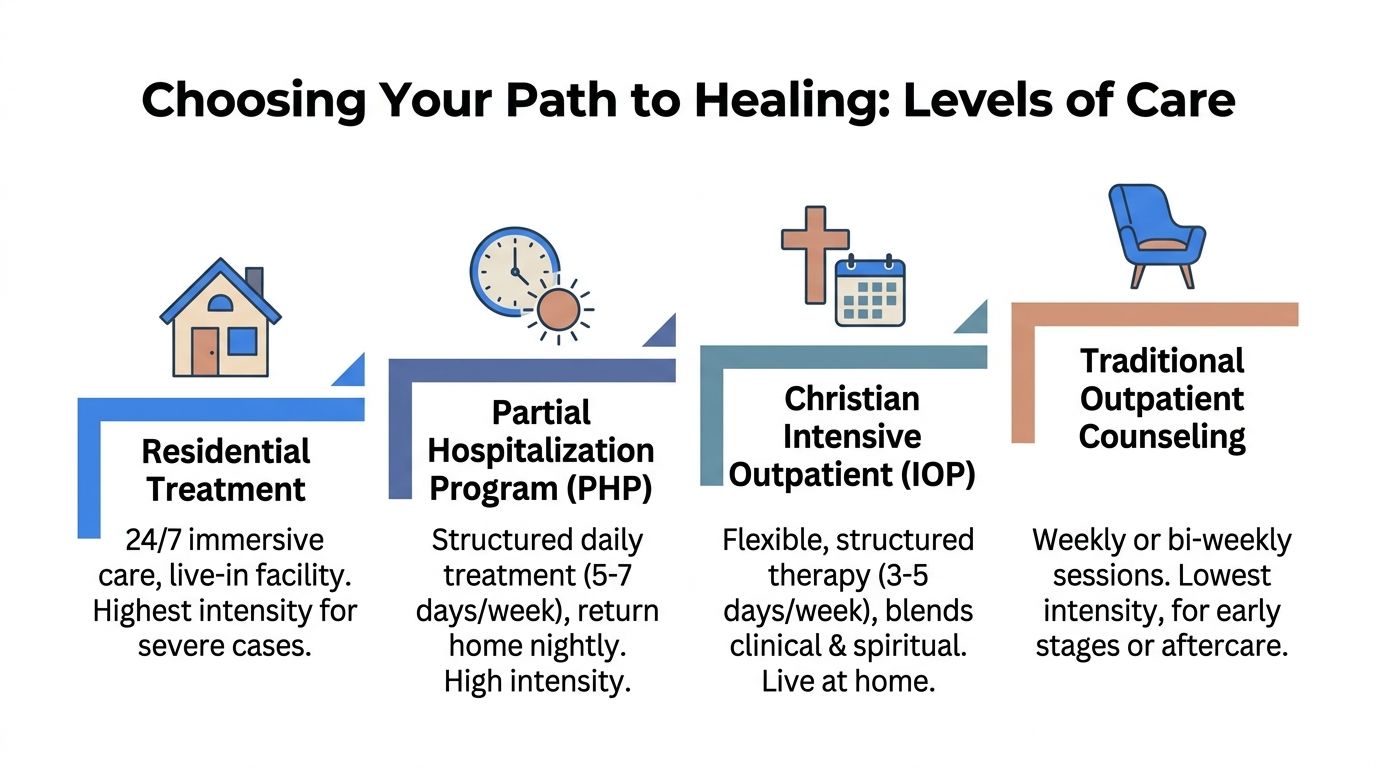
Choosing care is less about picking the “strongest” option and more about finding the right fit for your present condition. A person who cannot stay safe may need a higher level. A person who is medically stable but keeps relapsing between weekly sessions may need IOP.
A simple way to think about the options
Residential treatment is the most immersive. It removes someone from everyday triggers and provides live-in support.
PHP is still highly structured, but clients generally return home at night. IOP gives substantial therapy during the week while preserving more flexibility. Traditional outpatient counseling offers lighter support and often fits best for early concerns, maintenance, or aftercare.
A practical comparison can help:
| Level of care | Best fit when | Living situation |
|---|---|---|
| Residential treatment | Safety, severe instability, or need for full separation from daily triggers | Live-in facility |
| PHP | Need for a strong daily structure without overnight stays | Home at night |
| Christian IOP | Need more than weekly therapy, but still able to function in daily life with support | Live at home |
| Traditional outpatient | Stable enough for less frequent support | Live at home |
If you are trying to sort through these choices, this guide on outpatient vs inpatient addiction treatment can help you ask better questions.
Signs IOP may fit
-
You are not in crisis, but weekly care is not enough.
-
You need structure, especially around triggers, relapse patterns, or emotional swings.
-
You want to practice recovery at home rather than only in a controlled environment.
-
You are ready for active work, not just supportive conversation.
Lasting Benefits of a Faith-Centered IOP Program
Sobriety matters. But many individuals are asking not only, “How do I stop using?” They are also asking, “How do I live differently once I stop?”
That is one reason faith-centered IOP can be powerful. It treats recovery as more than symptom control. It aims at renewed thinking, restored relationships, and meaningful daily life.
Many faith-integrated IOP programs report strong longer-term outcomes, with some studies and programs showing sustained recovery rates and meaningful reductions in anxiety when evidence-based care is paired with spiritual support. Programs are commonly designed around 6 to 12 weeks based on individual progress.
Clients in our faith-centered programs frequently report stronger emotional regulation and renewed hope as they learn to connect recovery skills with their relationship with God.
What “lasting” often looks like
Lasting change usually grows through ordinary things repeated over time:
-
Better emotional regulation so stress does not immediately turn into substance use
-
Healthier relationships because honesty and boundaries improve
-
Stronger purpose because recovery connects with values, calling, and service
-
More durable hope because setbacks no longer define identity
Faith adds something important here. It gives language for repentance without hopelessness, responsibility without condemnation, and perseverance without pretending the road is easy.
Key takeaway: A faith-centered program does not only ask whether you are abstaining. It asks whether you are healing in mind, body, and spirit.
How Grace Recovery Services Supports Your Journey
When you evaluate any provider, ask clear questions. Do they assess both substance use and trauma? Do they individualize care? Is faith integrated thoughtfully, or added generically? How do they plan for life after discharge?
Those questions matter because no two recovery stories are identical.
What to look for in a provider
A useful starting checklist includes:
-
Assessment quality: Do they look beyond the substance and ask about trauma, mental health, family strain, and relapse history?
-
Treatment mix: Do they offer group therapy, individual counseling, and practical relapse-prevention work?
-
Faith approach: Is Christian integration optional and appropriate to the client, rather than assumed for everyone?
-
Aftercare planning: Do they help build support beyond the program itself?
Grace Recovery Services is one provider in Pennsylvania that offers IOP and outpatient care for substance use disorders with attention to co-occurring trauma recovery. Its published approach emphasizes individualized planning, a relational care model, and optional Christian faith-based principles where culturally and clinically appropriate.
Questions worth asking on the first call
When someone reaches out to a program, these questions can lower confusion:
-
What level of care do you recommend after the assessment?
-
How do you address trauma alongside addiction?
-
How is family involved when appropriate?
-
How do you handle optional faith integration?
-
What does the transition plan look like after IOP?
A good program should answer plainly, without pressure or vague promises.
Sustaining Your Recovery with Aftercare and Relapse Prevention
Recovery does not end when the formal schedule ends. It changes shape. The structure becomes lighter, but the need for intention remains.
A thoughtful aftercare plan usually includes ongoing counseling, support groups, healthy routines, trusted relationships, and a written strategy for triggers. In Christian recovery, it may also include regular prayer, church support, scripture meditation, and accountability with mature believers.
According to Faithful Love Christian Counseling Center’s intensive counseling process, Christian IOPs report 70 to 80% sustained recovery rates at 6-month follow-ups using evidence-based relapse prevention. The same source says faith can function as a protective factor, and that integrating scripture exploration can reduce anxiety by 50%.
What relapse prevention really means
Relapse prevention is not just “trying harder.” It means learning to notice the chain before it tightens.
A person might learn to identify:
-
the stressful event
-
the thought that follows
-
the emotion that surges
-
the urge to escape
-
the behavior that usually comes next
When that chain becomes visible, intervention becomes possible. A call can be made. A meeting can be attended. A coping skill can be used. A truth can be spoken out loud before the lie takes over.
Why aftercare matters spiritually
Aftercare keeps recovery from becoming a short burst of effort followed by isolation. It helps people stay connected to community, correction, and encouragement.
Tip: The goal of aftercare is not dependence on a program. It is growing the habits, supports, and spiritual stability that let recovery continue in ordinary life.
Frequently Asked Questions About Christian IOP
Some questions come up almost every time someone considers Christian Intensive Outpatient treatment. Clear answers can remove a lot of fear.
| Question | Answer |
|---|---|
| Do I have to be a Christian to attend a Christian IOP? | Not always. Some programs offer optional faith integration and aim to respect each client’s background. Ask how the provider handles spiritual content and whether it is culturally and clinically appropriate for you. |
| Can I live at home while in treatment? | Yes. That is one of the defining features of IOP. Clients receive structured care while continuing to live at home. |
| Is Christian IOP only for addiction? | No. Many programs also address co-occurring concerns such as trauma, anxiety, or depression alongside substance use. |
| What if I want evidence-based therapy, not just Bible study? | A healthy Christian IOP should provide both. Clinical therapies such as CBT, group therapy, trauma-informed care, and relapse prevention remain central. Faith supports that work rather than replacing it. |
| How much time does it take each week? | It depends on the program. Christian IOP commonly involves multiple therapy sessions across the week, with a stronger structure than standard outpatient care. |
| Can family be involved? | Often yes. Many programs include family participation when it is appropriate and helpful to the recovery plan. |
| How long do people usually stay in IOP? | Length varies by need and progress. Programs are commonly designed around several weeks of care, then adjusted based on clinical recommendations. |
| Is asking for this level of help a sign that I failed? | No. It is often a sign of honesty. Many people need more support for a season so they can build a stronger long-term recovery foundation. |
Christian Intensive Outpatient treatment works best when it is both clinically serious and spiritually honest. If a program can help you face root issues, practice new skills, and reconnect with God without pretending healing is instant, it may be the right next step.
If you are considering care, Grace Recovery Services offers information about outpatient treatment, trauma-informed recovery, and optional Christian-integrated support. Reaching out can help you clarify what level of care fits your situation and what a practical next step could look like.
This article was researched with AI and heavily edited by Stephen Luther for accuracy and relevance.
Stephen Luther is the Executive Director and Founder of Grace Christian Counseling, Grace Recovery Services, WPA Counseling, NuWell Online Counseling and Coaching, and NuWell Health. He holds a Master’s degree in Education from the University of Georgia and a Master’s degree in Marriage and Family Therapy from Duquesne University. He is a licensed professional counselor in Pennsylvania.
Since 1997, Steve has been helping children, adolescents, and adults overcome a wide range of emotional and relational challenges. He specializes in working with hurting families, including those with foster, adopted, or traumatized children. Steve uses Attachment-Based Therapy, Splankna Healing, and Therapeutic Parent Coaching to support healing and restoration.