Outpatient Addiction Treatment Services in Western Pennsylvania
Outpatient addiction treatment, IOP, and co-occurring care
Outpatient addiction treatment services let you get scheduled care while you keep living at home. Grace Recovery Services offers standard outpatient care, intensive outpatient care (IOP), and treatment for co-occurring mental health needs. Our care is Christ-centered and trauma-informed, and faith practices are always your choice. The right option depends on your safety, withdrawal risk, health, support at home, and how much structure you need. You don’t have to pick a program before you contact us.
Need help right now? GRS phone, text, and email are not emergency services. Call 911 for a possible overdose, severe intoxication, trouble breathing, a seizure, loss of consciousness, violence, or any other immediate danger.
For a mental health, suicide, or substance use crisis in the U.S., call or text 988. For free, confidential treatment referral information any time, call the SAMHSA National Helpline at 1-800-662-HELP (4357).
Compare Outpatient Addiction Treatment Services
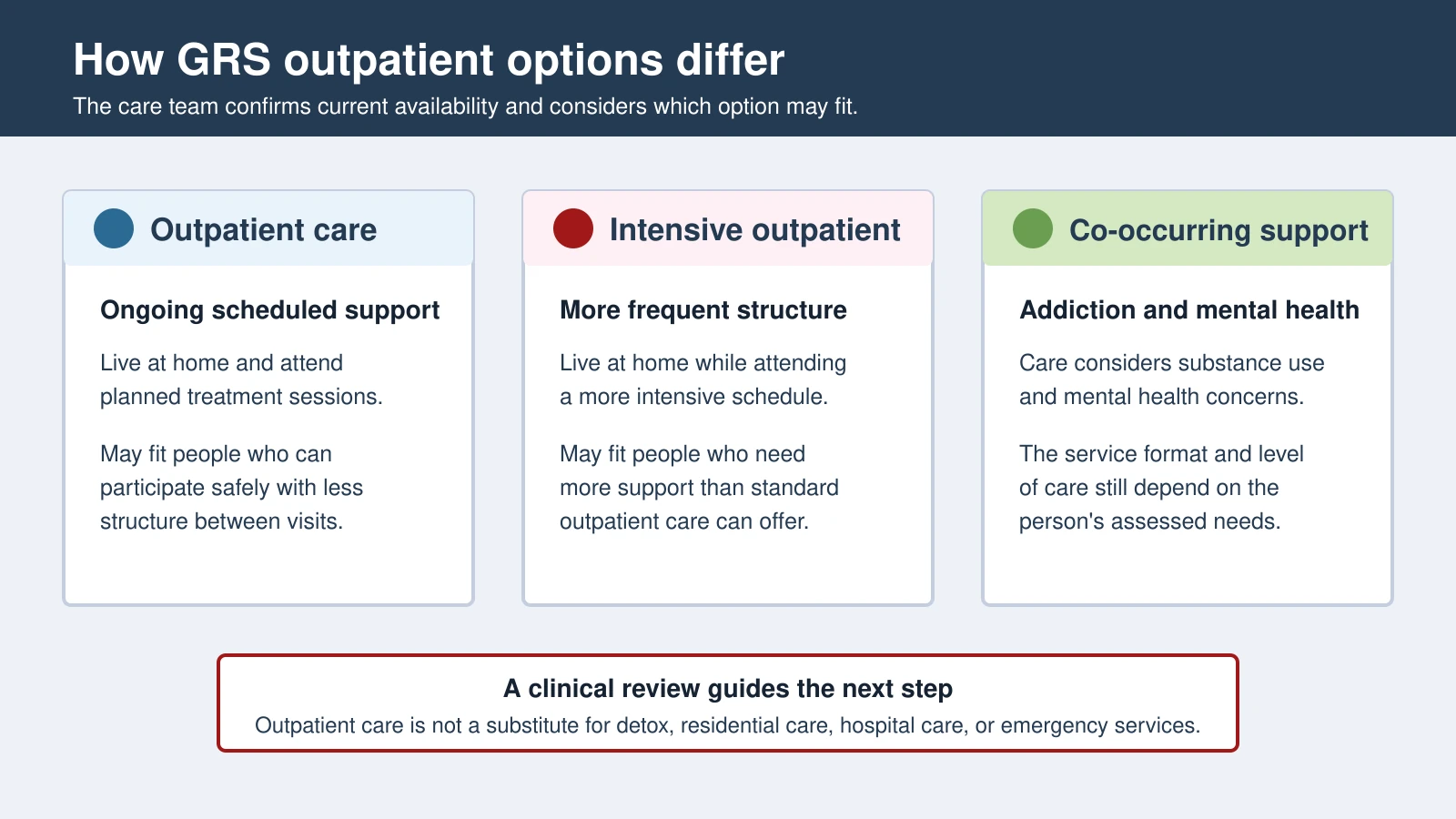
Outpatient treatment is a broad category. For example, standard outpatient care and intensive outpatient care both let you live at home. However, they differ in how often you attend and how much structure you get. Co-occurring care describes how addiction and mental health concerns are treated together. It is not a separate level of care on its own.
A qualified professional should look at your needs before recommending a setting. The American Society of Addiction Medicine describes level-of-care decisions as based on a multidimensional assessment, with regular reassessment as needs change. In other words, convenience matters, but it shouldn’t replace a safety and clinical review.
Outpatient Program
Scheduled counseling and ongoing support while you live at home and keep up with work, school, or family. It often fits people who can stay safe with less structure between visits, or who are stepping down from more intensive care.
Intensive Outpatient Program
More frequent and longer sessions than standard outpatient care, while you continue to live at home. IOP may fit someone who needs more structure but does not need round-the-clock residential or hospital care.
Co-occurring Addiction and Mental Health Care
Substance use often comes with depression, anxiety, trauma, or other mental health concerns. We treat both as part of one plan instead of treating either as an afterthought. If you also need another provider or level of care, we’ll tell you.
Looking for ongoing Christian counseling during or after treatment? Our sister practice, Grace Christian Counseling, offers it as a separate service with its own intake.
How We Help You Choose Outpatient Addiction Treatment
No online checklist can decide your level of care. When you talk with us, a clinician may consider:
- Recent substance use and any risk of intoxication or withdrawal
- Physical health, medications, and immediate safety concerns
- Depression, anxiety, trauma-related symptoms, or other mental health needs
- Past treatment and what happened before, during, and after it
- Housing, transportation, work, school, caregiving, and support at home
- Whether you can stay safe between appointments
Needs change, and so can your care
Your recommendation can change as you do. You might step down to less frequent care, stay at the same level, or need more support for a while. Reassessment is a normal part of good treatment, not a sign of failure.
When Outpatient Addiction Treatment Is Not Enough
GRS is an outpatient provider. We do not provide medical detox, residential treatment, hospital inpatient care, or emergency services. You may need another setting first if there is unsafe withdrawal risk, a medical emergency, a need for round-the-clock support, or another concern that can’t be managed safely in outpatient care.
For this reason, please don’t use this page to plan a home detox or taper. Stopping alcohol or benzodiazepines suddenly can be dangerous, so get prompt medical guidance if physical dependence or withdrawal is possible. For more, read Do I Need Detox Before Outpatient Treatment?
How Christian Faith Is Part of Care
Christian faith shapes how we see every person: with dignity, grace, and hope for restoration. If you want faith included, your care may include prayer, Scripture, or Christian conversation. You decide whether and how to take part, and people of any belief, or none, are welcome.
“Come to me, all you who are weary and burdened, and I will give you rest.”
Matthew 11:28 (NIV)At the same time, faith does not replace medical evaluation, withdrawal care, emergency care, or clinical treatment. Needing a different level of care is not a spiritual failure. You can always ask how faith is included, say no to any spiritual practice, and expect that choice to be respected.
Questions From Family Members
If you’re worried about someone you love, you can contact GRS to ask general questions about our programs and possible next steps. Tell us what you’ve noticed and ask what kinds of help are available.
Family support is different from access to a client’s treatment information. Family involvement in someone’s care depends on that person’s consent, what is clinically appropriate, and confidentiality law.
What to Expect When You Contact GRS
- 1
Tell us what’s going on
Call, text, or email. You don’t need to know which program to ask for.
- 2
Talk through your needs
We’ll ask about safety, substance use, mental health, past treatment, practical needs, and whether you want faith included.
- 3
Get a recommended next step
We’ll explain which GRS service may fit, or whether another type or level of care makes sense first.
Our two offices, in North Huntingdon (Irwin) and Penn Hills, offer the same services. Reaching out doesn’t commit you to anything. It also doesn’t guarantee admission, a start date, a particular counselor, or a treatment result. Referring a client? See our information for referral partners.
Questions About Outpatient Addiction Treatment
How do I know whether outpatient care or IOP is right for me?
You do not need to choose alone. A qualified clinician considers current safety, withdrawal risk, physical and mental health needs, the home environment, available support, the ability to participate between sessions, and other factors. Needs can change, so the level of care should be reviewed over time.
Does GRS provide detox or residential treatment?
No. GRS is an outpatient provider and does not provide medical detox, residential treatment, hospital inpatient care, or emergency services. The care team can discuss whether a different service should come before outpatient treatment.
Is Christian participation required?
No. Christian faith is central to who we are, but prayer, Scripture, and other spiritual practices are guided by client choice. People are welcome regardless of belief, and spiritual practices do not replace clinical care.
Can a family member receive information about a client’s treatment?
A family member may ask general questions and may be involved when the client consents and involvement is appropriate. Contacting GRS does not provide access to another person’s confidential treatment information.
Do both GRS offices offer the same outpatient addiction treatment services?
Yes. Our North Huntingdon (Irwin) and Penn Hills offices offer the same services. The care team can help you choose the office that works best for you.
Talk With Our Care Team
Have a non-emergency question about outpatient addiction treatment? Reach out and we’ll explain your options and what we need to know to suggest a next step.
Call 724-345-2411 | Text 724-515-9120 | careteam@gracerecoveryservices.org
In an emergency, call 911. For a crisis, call or text 988.