
Detox and outpatient treatment do different jobs
“Detox” is the familiar word, but Pennsylvania guidance uses the more precise term withdrawal management. Withdrawal management focuses on safely assessing and managing intoxication or withdrawal. It may occur at different levels of care, from medically supervised ambulatory services to inpatient medical settings, depending on the person’s risk and needs.[1]
Outpatient addiction treatment has a different purpose. Standard outpatient care and intensive outpatient programs support the continuing work of recovery through scheduled clinical services while a person lives at home. Completing withdrawal management does not complete addiction treatment, and entering outpatient treatment does not automatically make withdrawal safe.
The safest sequence is the one that matches the person’s current clinical needs. For some people, professional evaluation may lead directly to outpatient care. For others, withdrawal management or another level of care may need to come first, followed by OP, IOP, residential care, or another service as clinically appropriate.
How do I know whether I need detox before outpatient treatment?
Do not try to answer this from a checklist alone. A clinician may consider:
- What substances you have been using, and how recently and how often
- Whether you have had withdrawal before
- Your medical conditions and current medications
- Use of more than one substance
- Current mental health symptoms and immediate safety
- The support available where you live
- Your ability to participate safely between appointments
The American Society of Addiction Medicine describes placement as a multidimensional process, not a judgment based on one symptom or on convenience.[2] Needs can also change. A person may require a more intensive setting now and step down later, or may need reassessment if risks increase. If you are weighing settings more broadly, our guide to outpatient vs. inpatient addiction treatment explains the differences.
Why alcohol and benzodiazepine withdrawal need special caution
Other substances also require individualized evaluation. The absence of dramatic symptoms does not prove that outpatient care is safe, and feeling frightened does not mean you have failed. Asking for assessment is a responsible first step.
A safer pathway toward outpatient treatment
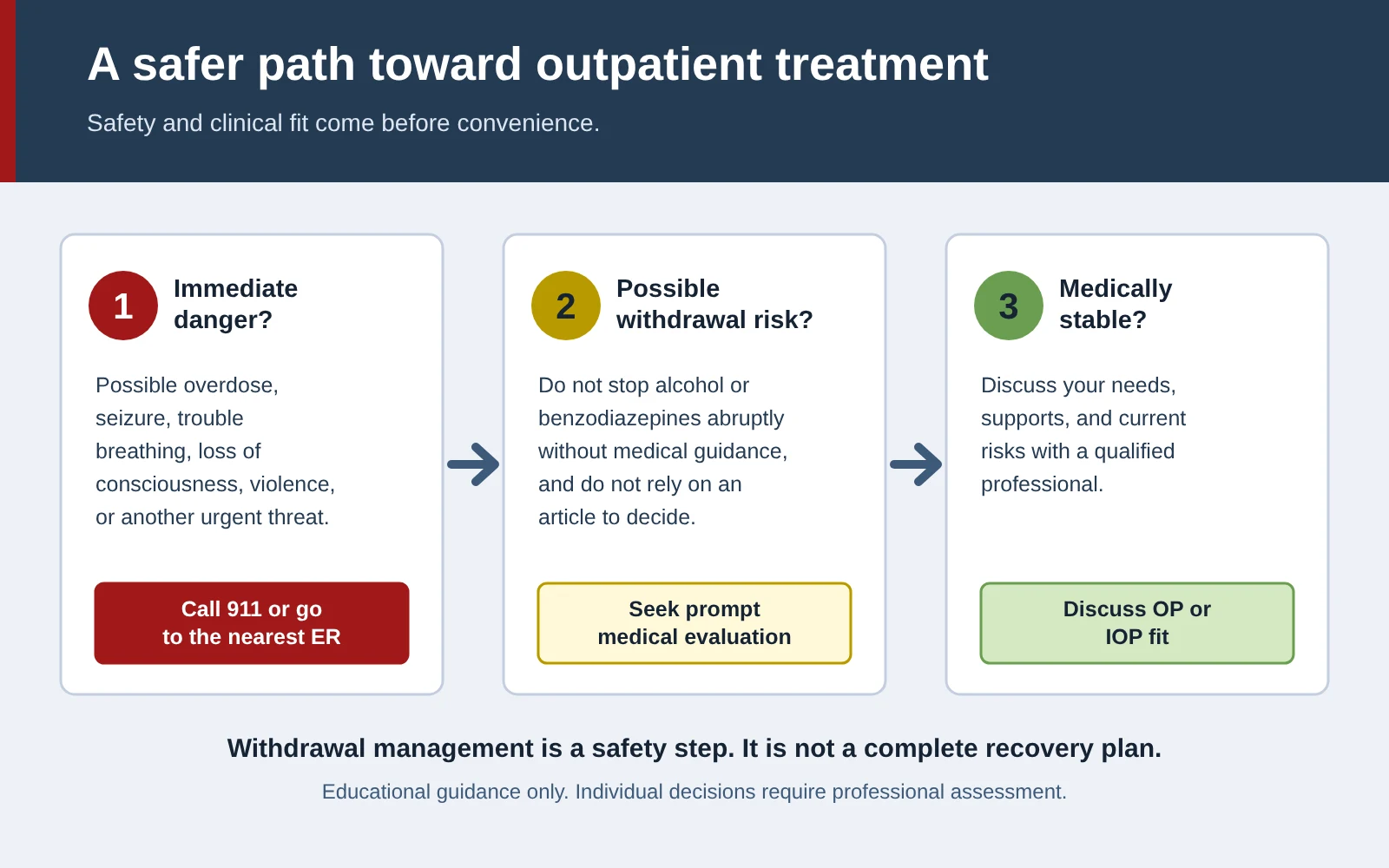
- 1Immediate danger: Call 911 or go to the nearest emergency department for a possible overdose, seizure, trouble breathing, loss of consciousness, violence, or another urgent threat to life or safety.
- 2Possible withdrawal risk: Seek prompt medical evaluation. Do not abruptly stop alcohol or benzodiazepines without medical guidance, and do not rely on an online article to choose a withdrawal-management setting.
- 3Medically stable for ongoing care: Discuss whether standard outpatient treatment, IOP, or another level of care fits your needs, supports, risks, and recovery environment.
What can happen after withdrawal management?
Withdrawal management is a safety step, not a complete recovery plan. Pennsylvania’s guidance emphasizes a continuum of care and links withdrawal management with counseling, psychiatric or medical support when needed, and continuing treatment.[1] The next step should be discussed before discharge whenever possible so that a person is not left to navigate the transition alone.
Depending on clinical recommendations, the next step could include standard outpatient treatment, IOP, residential treatment, medication services, peer recovery support, or coordinated mental health care. No single sequence fits everyone. What matters is that the next service matches current needs and can be adjusted as those needs change.
When outpatient or IOP may be discussed
Outpatient care may be considered when a person can be treated safely without round-the-clock medical or residential support and can participate reliably while living at home. An intensive outpatient program generally offers more structure and frequency than a standard outpatient program. Work, family, school, transportation, housing, mental health, recovery supports, and risk between sessions can all matter, but schedule convenience alone should not determine the level of care.
A professional assessment should also make room for mental health concerns alongside substance use. Trauma may be an important part of someone’s story, but it should not be assumed to cause every addiction, and deeper trauma processing should not be rushed before safety and stabilization are established.
How Grace Recovery Services may fit
GRS does not currently offer medical detox or withdrawal-management services. Reaching out begins a conversation about what brings you here, available options, and an appropriate next step. It does not guarantee admission, a particular program, a start date, or a clinical outcome. If another level or type of care may be needed first, that safety question should be addressed before outpatient placement.
Christian faith can support care without replacing medicine
Needing medical care is not evidence of weak faith or failure. A Christ-centered response can make room for both prayer and prudent clinical care, without shame and without asking a person to prove readiness by facing withdrawal alone.
Questions to ask before starting outpatient treatment
- How will you assess intoxication and withdrawal risk before recommending a level of care?
- Does this program provide withdrawal management? If not, what should happen if an assessment suggests I need it?
- What medical or psychiatric support is available or coordinated?
- How will my treatment plan account for my home environment, transportation, work, family responsibilities, and recovery support?
- How are co-occurring mental health concerns addressed?
- If faith matters to me, how can it be included? If I do not want spiritual practices, how will that choice be respected?
- How will the team reassess me if my symptoms, safety, or support needs change?
Frequently asked questions
Does everyone need detox before outpatient addiction treatment?
No. Some people can begin outpatient treatment without a separate withdrawal-management episode. Others need medically supervised withdrawal care first. A qualified professional should assess the substance involved, withdrawal potential, medical and mental health needs, supports, and current risks.
Can I detox at home before I start IOP?
Do not make that decision from an article. Some withdrawal can be dangerous, especially after chronic heavy alcohol use or with benzodiazepines. Seek medical guidance before stopping or reducing use when dependence or withdrawal is possible. Call 911 for a seizure, trouble breathing, loss of consciousness, possible overdose, or another immediate danger.
Is detox the same as addiction treatment?
No. Withdrawal management focuses on immediate stabilization and safety. Ongoing addiction treatment addresses the behavioral, psychological, relational, social, and recovery needs that continue after withdrawal. A person may transition from withdrawal management into outpatient, intensive outpatient, residential, or another appropriate service.
What if I am not sure where to start?
You do not need to diagnose yourself or choose your own level of care. In an emergency, call 911. For a crisis, call or text 988. For treatment information or referrals, call SAMHSA’s National Helpline at 1-800-662-HELP (4357). For a non-emergency question about GRS outpatient options, use the Contact page to Talk With Our Care Team.
Sources
- 1Guidance for the Application of ASAM Withdrawal Management in Pennsylvania’s Adult SUD Treatment System. Pennsylvania Department of Drug and Alcohol Programs (Rev. July 2022).
- 2About the ASAM Criteria. American Society of Addiction Medicine.
- 3Alcohol Use Disorder: From Risk to Diagnosis to Recovery. National Institute on Alcohol Abuse and Alcoholism.
- 4National Helpline for Mental Health, Drug, Alcohol Issues. Substance Abuse and Mental Health Services Administration.
- 5Mental Health and Substance Use Helplines (988 Suicide & Crisis Lifeline). Substance Abuse and Mental Health Services Administration.
- 6FDA Requiring Boxed Warning Updated to Improve Safe Use of Benzodiazepine Drug Class. U.S. Food and Drug Administration (September 2020).