
What Are IOP Program Requirements? A Clear Starting Point
IOP program requirements are the clinical and logistical criteria a person must meet to enter and successfully participate in an Intensive Outpatient Program — a structured level of care that sits between standard weekly therapy and more intensive day programs.
Here is a quick overview of the core requirements:
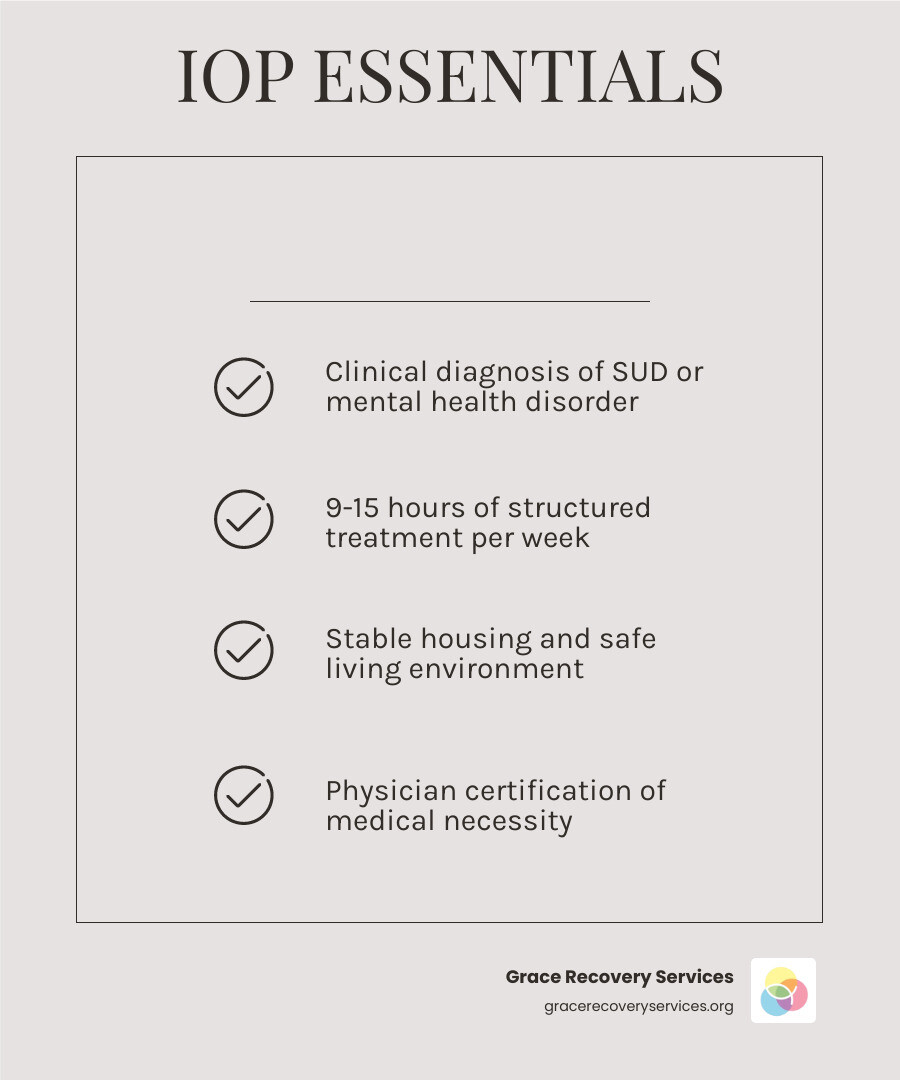
| Requirement | What It Means |
|---|---|
| Clinical diagnosis | A diagnosed mental health or substance use disorder from a licensed clinician |
| Medical necessity | Symptoms must significantly impact daily functioning (work, relationships, school) |
| Minimum hours | At least 9 hours of structured treatment per week |
| Stable housing | A safe, supportive living environment outside of treatment |
| Motivation to participate | Willingness to engage in group and individual therapy |
| Physician certification | A doctor or clinician must certify the need for this level of care |
| Ability to function | Cognitive functioning and safety level appropriate for outpatient care |
If you are somewhere in between — needing more than a weekly therapy appointment but not requiring round-the-clock care — an IOP may be exactly where healing begins.
At Grace Recovery Services, we see this every day. People arrive carrying real weight — addiction, trauma, anxiety, grief — and discover that structured, compassionate care can meet them right where they are, without pulling them completely out of their lives.
Recovery is not a one-size-fits-all journey. And understanding whether IOP is the right fit starts with knowing what it actually requires.
I’m Stephen A. Luther, MSEd, MEd, LPC, Executive Director and Founder of Grace Recovery Services in Western Pennsylvania, and I’ve spent decades guiding individuals through IOP program requirements and trauma-informed addiction treatment using both evidence-based clinical practices and faith-integrated care. In this guide, I’ll walk you through everything you need to know — from eligibility and scheduling to insurance and specialized tracks — so you can take the next step with clarity and confidence.
Navigating the Essentials of IOP Program Requirements
When we talk about the “essentials,” we are looking at the American Society of Addiction Medicine (ASAM) Level 2.1 criteria. In behavioral health, an Intensive Outpatient Program (IOP) is designed to provide a high level of support while allowing you to sleep in your own bed at night. It is often described as the “sweet spot” of recovery—offering enough structure to create real change, but enough flexibility to maintain your family and work life in Western Pennsylvania.
The standard IOP program requirements dictate a commitment of 9 to 15 hours of structured treatment per week. This isn’t just “hanging out”; it is a clinical intervention. At Grace Recovery Services, we focus on intensive outpatient services that integrate evidence-based therapies with the healing power of faith.
For many of our clients in Pittsburgh and North Huntingdon, IOP serves two vital roles:
- Step-down support: After a client completes a more restrictive program, like a Partial Hospitalization Program (PHP), IOP helps them transition back into daily life without losing the momentum of their recovery.
- Step-up intervention: When standard once-a-week therapy isn’t enough to manage escalating symptoms or cravings, IOP provides the necessary reinforcement to prevent a full relapse or the need for a higher level of care.
Before starting IOP, some people need withdrawal management first. If you are unsure, read Do I Need Detox Before Outpatient Addiction Treatment?
The goal is clinical stability. We want to see our clients moving toward a place where they can manage their symptoms, address their trauma, and walk in the freedom that God intended for them.

Clinical Eligibility: Who is a Candidate for Intensive Care?
Not everyone who struggles with a substance use disorder (SUD) or mental health challenge is a fit for an IOP. To “make the grade,” a client must meet specific clinical eligibility markers.
First and foremost, a person must have a formal diagnosis of a substance use disorder or a mental health condition (like MDD, GAD, or PTSD). Beyond the diagnosis, insurance companies and clinical teams look for “medical necessity.” This means your symptoms must be severe enough that they are interfering with your ability to work, go to school, or maintain healthy relationships.
Key candidate traits include:
- Stable Housing: You must have a safe place to live that is conducive to recovery. If your home environment is active with drug use or is unsafe, a higher level of care might be required first.
- Motivation: While we don’t expect you to have everything figured out, a willingness to participate in group and individual therapy is essential.
- Cognitive Functioning: You need to be able to follow the curriculum and engage in the “process” of therapy.
According to scientific research on clinical IOP standards, the program is most effective for those who do not require 24-hour medical supervision but do need more than the occasional check-in. At Grace Recovery Services, we specialize in trauma-informed care, recognizing that many of our clients are not just fighting addiction, but are also carrying deep emotional wounds that require a gentle, grace-filled approach.
Clinical Eligibility and Admission IOP Program Requirements
The path to admission usually begins with a thorough initial evaluation. This is where we sit down with you to hear your story, assess your needs, and determine if our program is the right fit. A key part of the IOP program requirements is physician certification. A licensed medical professional or clinician must certify that the treatment is necessary and that the client is physically and mentally stable enough for outpatient care.
We often get asked about the difference between staying in a facility versus coming to us. You can find more info about outpatient vs inpatient addiction treatment on our website, but the core difference is the level of autonomy. In IOP, you are the one putting your new skills to the test in the “real world” every single evening.
The admission process involves:
- Referral: This can come from a doctor, a therapist, or even a self-referral if you feel you are slipping.
- Documentation: We collect medical history, previous treatment records, and current symptoms.
- Individualized Care Plan: Once admitted, we don’t just put you in a “generic” program. We develop a plan of care tailored to your specific struggles and your faith journey.
Scheduling and Time Commitment in IOP Program Requirements
Let’s talk logistics. To meet the IOP program requirements, you must be able to commit to the schedule. Most programs, including ours in Westmoreland County and Allegheny County, follow a structured format:
- Session Length: Usually 3 hours per session.
- Frequency: 3 to 5 days per week.
- Total Hours: A minimum of 9 hours per week is required for it to be considered “Intensive Outpatient” by most insurance standards, including Medicare.
- Duration: Most clients stay in IOP for 4 to 12 weeks, though this varies based on individual progress.

We understand that you have a life. That’s why many programs offer evening options or daytime schedules to accommodate working professionals or parents. At Grace Recovery Services, we believe that your recovery should enhance your life, not make it impossible to fulfill your God-given responsibilities to your family and community.
Comparing Levels of Care: Finding Your “Sweet Spot”
Understanding where IOP fits in the continuum of care can be confusing. It is helpful to think of it as a middle ground. Standard outpatient care is like a weekly check-up, while a Partial Hospitalization Program (PHP) is more like a full-time job focused on recovery.
| Feature | Standard Outpatient | Intensive Outpatient (IOP) | Partial Hospitalization (PHP) |
|---|---|---|---|
| Hours per week | 1–3 hours | 9–15+ hours | 20–30+ hours |
| Duration | Ongoing | 4–12 weeks | 3–6 weeks |
| Living Arrangement | Home | Home | Home or Sober Living |
| Medical Support | Minimal | Moderate | High |
| Flexibility | Very High | Moderate | Low |
IOP is often the best choice for those who have completed a higher level of care or those whose symptoms are escalating but haven’t reached a crisis point. It offers a level of outpatient program support that is both cost-effective and clinically robust.
Specialized Tracks: Faith, Family, and Perinatal Care
At Grace Recovery Services, we know that addiction doesn’t happen in a vacuum. It affects mothers, fathers, adolescents, and entire families. That is why specialized tracks are so important in meeting diverse IOP program requirements.
For example, some programs offer perinatal care for women experiencing mood disorders during or after pregnancy. Others focus on adolescents who are struggling with mood dysregulation and co-occurring substance use.
Our unique focus is on faith-based outpatient addiction treatment. We believe that true healing involves the spirit. Our Christian counseling track allows clients to integrate their faith into their recovery, using biblical principles of hope and redemption alongside evidence-based practices like Cognitive Behavioral Therapy (CBT) and Dialectical Behavior Therapy (DBT).
Specialized services often include:
- Trauma-Informed Care: Using “Seeking Safety” protocols to address PTSD and SUD simultaneously.
- Family Counseling: Healing the relational wounds caused by addiction.
- Medication Management: Working with psychiatrists to ensure any co-occurring mental health issues are medically stabilized.
Insurance, Medicare, and Documentation Standards
Navigating the financial side of treatment can be daunting, but understanding the billing and documentation requirements can make it easier.
As of April 2026, Medicare has clear guidelines for IOP coverage. One of the most important technical IOP program requirements for providers is the use of Condition Code 92 on claims. This code indicates that the services provided meet the intensive outpatient criteria established by CMS.
Medicare and most commercial insurance plans require:
- Physician Supervision: The program must be overseen by a doctor who reviews the plan of care regularly.
- Minimum Service Hours: As mentioned, you must receive at least 9 hours of service per week.
- Active Treatment: The program cannot just be “social” or “recreational.” It must involve active, multimodal treatment aimed at a specific diagnosis.
For those looking into the professional side of these standards, scientific research on graduate training in psychology highlights the importance of having licensed, highly trained clinicians leading these groups to ensure the highest standard of care.
When you apply for admission, we handle the admissions requirements and documentation process, working with your insurance provider to verify coverage and ensure that all “medical necessity” markers are documented correctly. This takes the burden off you, so you can focus on getting well.
Frequently Asked Questions about IOP
What is the difference between IOP and PHP?
The primary difference is the time commitment. PHP (Partial Hospitalization) usually requires 5 to 6 hours a day, 5 days a week. It is a full-time commitment. IOP is “intensive” but usually only requires 3 hours a day, 3 to 5 days a week, allowing more time for work or family.
Can I work while attending an IOP?
Yes! In fact, many of our clients in Western Pennsylvania choose IOP specifically because it allows them to maintain their employment. We offer schedules designed to fit around a traditional work day.
How long does a typical IOP program last?
While every journey is different, most clients meet their initial goals within 4 to 12 weeks. After that, many “step down” to standard outpatient therapy (one hour a week) to maintain their progress.
Conclusion
Making the grade with IOP program requirements isn’t about being perfect; it’s about being ready. It’s about recognizing that you need a higher level of support to overcome the hurdles of addiction and mental health challenges, and being willing to show up for yourself—and for the life God has planned for you.
At Grace Recovery Services, we are proud to serve the communities of Pittsburgh, Penn Hills, Irwin, and North Huntingdon. We provide a sanctuary where clinical excellence meets Christian compassion. Whether you are stepping down from a hospital stay or stepping up from weekly therapy, our team is here to help you navigate the requirements and start your path toward restoration.
Recovery is a journey of the mind, body, and spirit. If you or a loved one are ready to take that next step, we invite you to reach out. There is no shame in needing help—only hope in finding it.
Start your journey with Intensive Outpatient care today. Let us walk with you toward the renewal and revival you deserve.
This article was researched with AI and heavily edited by Stephen Luther for accuracy and relevance.
Stephen Luther is the Executive Director and Founder of Grace Christian Counseling, Grace Recovery Services, WPA Counseling, NuWell Online Counseling and Coaching, and NuWell Health. He holds a Master’s degree in Education from the University of Georgia and a Master’s degree in Marriage and Family Therapy from Duquesne University. He is a licensed professional counselor in Pennsylvania.
Since 1997, Steve has been helping children, adolescents, and adults overcome a wide range of emotional and relational challenges. He specializes in working with hurting families, including those with foster, adopted, or traumatized children. Steve uses Attachment-Based Therapy, Splankna Healing, and Therapeutic Parent Coaching to support healing and restoration.
This guide is for educational and spiritual encouragement and is not a substitute for personalized professional counseling. If you are in crisis, please reach out for immediate help.