
Why Bible Principles for Substance Recovery Can Change Everything
Bible principles substance recovery offers a powerful, time-tested foundation for healing — one that addresses not just the behavior, but the heart behind it.
Here are the core biblical principles that guide recovery:
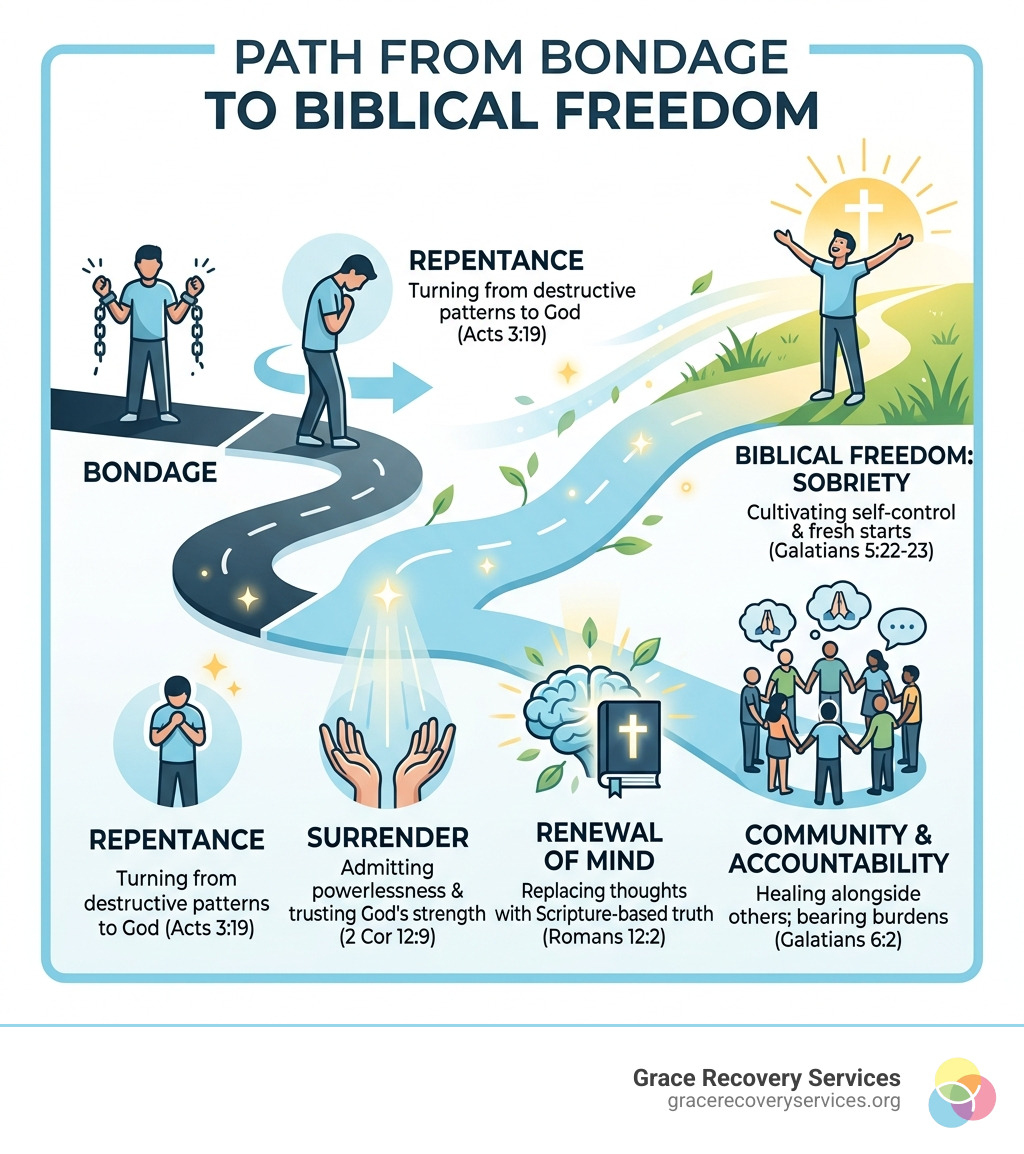
- Repentance — Turning away from destructive patterns and toward God (Acts 3:19)
- Renewal of the mind — Replacing addictive thinking with Scripture-based truth (Romans 12:2)
- Surrender — Admitting powerlessness and trusting God’s strength (2 Corinthians 12:9)
- Community and accountability — Healing alongside others who bear your burdens (Galatians 6:2)
- Grace over shame — Accepting God’s forgiveness as the foundation for a fresh start (Romans 8:1)
- Self-control — Cultivating sobriety as a fruit of the Spirit (Galatians 5:22-23)
- Prayer — Staying connected to God daily to resist temptation (1 Corinthians 10:13)
Addiction touches every part of a person — body, mind, relationships, and spirit. For people of faith, the Bible isn’t just a comfort during that struggle. It’s a roadmap. Research supports this too: studies show that religion and spirituality play a meaningful role in both preventing substance abuse and supporting long-term sobriety.
Whether you’re in the middle of the struggle yourself or walking alongside someone you love, the good news is this — no one is too far gone for grace.
I’m Stephen A. Luther, MSEd, MEd, LPC, Executive Director and Founder of Grace Recovery Services in Western Pennsylvania, and I’ve spent decades helping clients integrate Bible principles substance recovery with trauma-informed, evidence-based treatment. In this guide, I’ll walk you through what Scripture actually says about addiction — and how those truths translate into real, lasting freedom.
Understanding the biblical View of Addiction and Grace
When we look at the Bible, we don’t find the word “addiction” in the modern clinical sense, but we find a deep understanding of human struggle, bondage, and the search for peace in all the wrong places. At its core, the biblical view of addiction involves a “crisis of faith” where a substance or behavior has displaced God as the primary source of comfort or control.
Sin vs. Struggle
In our work at Grace Recovery Services, we often discuss the nuance between sin and struggle. While the Bible warns against the behaviors associated with substance abuse (like drunkenness or lying), it also treats the person trapped in these patterns with immense compassion. We see addiction as a form of spiritual bondage. It is a weight that entangles, but it is also a condition that responds to the transformative power of grace. How faith helps with addiction is by shifting the focus from our failures to God’s faithfulness.
“Pharmakeia” and Spiritual Warfare
The Greek word pharmakeia is used in the New Testament (often translated as “sorcery” or “witchcraft”). Historically, this term referred to the use of drugs in pagan rituals to alter the mind. This suggests that substance abuse has a spiritual dimension — it can open doors to spiritual oppression and keep a person in a cycle of “spiritual warfare.” Recognizing that your battle isn’t just with a chemical, but with a spiritual stronghold, is a vital part of What the Bible says about addiction.
The Body as God’s Temple
One of the most sobering yet empowering principles is found in 1 Corinthians 6:19-20: “Do you not know that your bodies are temples of the Holy Spirit… therefore honor God with your bodies.” Addiction defiles the temple, but grace restores it. When we view our bodies as sacred space, recovery becomes an act of worship. It moves from “I have to stop” to “I want to honor the God who lives in me.”
Idolatry of the Heart
biblically, addiction can be viewed as a form of idolatry. An idol is anything we turn to for what only God can provide — peace, joy, or relief from pain. Ezekiel 14:3 speaks of people setting up “idols in their hearts.” Recovery involves identifying these heart-idols and returning to the “Living Water” that truly satisfies.
Core Bible Principles Substance Recovery Strategies
To achieve lasting freedom, we must move beyond mere behavior modification. We need a strategy that transforms the heart. Here in Western PA, we utilize these strategies to help clients find a “higher purpose” in their sobriety.
Repentance and Confession
Repentance isn’t just saying “I’m sorry”; it’s a change of mind that leads to a change of direction. It starts with an honest confession. James 5:16 tells us to “confess your sins to each other and pray for each other so that you may be healed.” There is a specific kind of healing that only happens when we bring our secrets into the light of a safe, godly community.
Heart Transformation and Renewing the Mind
Secular science calls it “neuroplasticity,” but the Bible called it “renewing the mind” thousands of years ago. Romans 12:2 instructs us, “Do not conform to the pattern of this world, but be transformed by the renewing of your mind.” By renewing your mind with these powerful Bible verses, you are literally rewiring your brain to choose truth over the lies of addiction.

Self-Control and Holy Spirit Empowerment
Many people try to get sober through sheer willpower, but willpower is a finite resource. The Bible offers a better way: empowerment through the Holy Spirit. Self-control is listed as a “fruit of the Spirit” (Galatians 5:22-23). This means that as you grow in your relationship with God, He produces the strength in you that you couldn’t produce on your own. It is his power working in our weakness.
Aligning the 12 Steps with biblical Truth
It’s a little-known fact that the 12 Steps of Alcoholics Anonymous actually have deep Christian roots, tracing back to an evangelical Bible study group called the Oxford Group. Programs like Celebrate Recovery have brought these steps back to their scriptural foundations. At Grace Recovery Services, we believe that the 12 Steps are essentially a roadmap for the biblical journey of conversion and maturation.
By looking at the best Bible verses for recovering addicts and alcoholics, we can see how each step aligns with God’s Word.
Applying Bible principles substance recovery to Step One
Step One is about admitting powerlessness. This aligns perfectly with the first Beatitude: “Blessed are the poor in spirit, for theirs is the kingdom of heaven” (Matthew 5:3). To be “poor in spirit” is to admit your spiritual bankruptcy. It’s the humble realization that you cannot save yourself. Christian integrated addiction treatment starts here — at the point of total surrender.
Bible principles substance recovery through fellowship and accountability
Addiction thrives in isolation, but recovery lives in community. Ecclesiastes 4:9-10 says, “Two are better than one… if either of them falls down, one can help the other up.”
In our faith-based rehab Pittsburgh programs, we emphasize that you were never meant to carry this burden alone. Godly community provides the “iron sharpening iron” (Proverbs 27:17) that is necessary for long-term sobriety. Accountability isn’t about being “policed”; it’s about being loved enough to be told the truth.
Practical Steps for Daily Renewal and Relapse Prevention
Sobriety is maintained one day at a time through consistent spiritual disciplines. As we navigate the streets of Pittsburgh or North Huntingdon, we must have our “spiritual armor” on.
- Daily Prayer: Prayer isn’t just a religious ritual; it’s a lifeline. Research shows that prayer activates the brain’s reward system, which is often damaged by addiction. It provides a natural “reset” for your dopamine levels and connects you to your Higher Power.
- Scripture Memorization: When temptation hits, you need truth ready at a moment’s notice. Memorizing a Bible verse for sobriety like 1 Corinthians 10:13 gives you a “way of escape” when cravings feel overwhelming.
- Avoiding Triggers and “Bad Company”: The Bible is very practical. 1 Corinthians 15:33 warns that “bad company corrupts good character.” Part of understanding substance abuse through biblical wisdom is recognizing that we must radically “cut off” the environments and relationships that lead us back to the “wreckage of the past.”
- Service to Others: Step 12 is about carrying the message. When we shift our focus from our own problems to helping someone else, we experience a “higher purpose” that makes relapse much less appealing.

Frequently Asked Questions about biblical Recovery
Is addiction considered a sin or a disease in the Bible?
This is one of the most common questions we hear. In the biblical context, it isn’t an “either/or” situation. While the Bible addresses the sinful nature of certain behaviors (like intoxication and idolatry), it also recognizes that we are “enslaved” to things we cannot stop on our own.
We view it as a holistic struggle. There is a biological component (the brain’s reward system), a psychological component (trauma and emotional pain), and a spiritual component (the need for God). Our Christian recovery services address all three, offering a compassionate, heart-transforming response rather than a judgmental one.
How does prayer contribute to the brain’s recovery process?
It’s fascinating to see how modern science is catching up with the Bible. Studies have shown that silent prayer and meditation can actually help repair the neural pathways that addiction destroys. By focusing on God’s love and grace, you are regulating your nervous system and reducing the “fight or flight” response that often leads to cravings. Faith-based outpatient addiction treatment utilizes this “theology of the brain” to help clients heal from the inside out.
What does the Bible say about enabling a loved one?
Helping is not the same as enabling. Galatians 6:1-5 tells us to “restore [the person] gently” and “carry each other’s burdens,” but it also says “each one should carry their own load.” biblically, enabling is often a failure of boundaries. Speaking the truth in love means allowing a loved one to experience the natural consequences of their choices, which God often uses to bring a person to the “end of themselves” (like the Prodigal Son).
Conclusion: Finding Your Path to Freedom in Western PA
Recovery is a journey of restoration, and at Grace Recovery Services, we are honored to walk that path with you. Whether you are in Pittsburgh, North Huntingdon, or anywhere in Westmoreland County, our mission is to provide a safe, trauma-informed space where you can experience the intersection of clinical excellence and biblical truth.
We don’t just want to see you “stop using”; we want to see you revived. Through our Christian addiction recovery Pittsburgh programs, we offer intensive outpatient support that treats you as a whole person — mind, body, and spirit.
If you’re ready to trade shame for grace and bondage for a higher purpose, we are here to help. Start your journey with our intensive outpatient program today. There is hope, there is healing, and there is a community waiting to welcome you home.
This article was researched with AI and heavily edited by Stephen Luther for accuracy and relevance.
Stephen Luther is the Executive Director and Founder of Grace Christian Counseling, Grace Recovery Services, WPA Counseling, NuWell Online Counseling and Coaching, and NuWell Health. He holds a Master’s degree in Education from the University of Georgia and a Master’s degree in Marriage and Family Therapy from Duquesne University. He is a licensed professional counselor in Pennsylvania.
Since 1997, Steve has been helping children, adolescents, and adults overcome a wide range of emotional and relational challenges. He specializes in working with hurting families, including those with foster, adopted, or traumatized children. Steve uses Attachment-Based Therapy, Splankna Healing, and Therapeutic Parent Coaching to support healing and restoration.