The Power of Scripture for Healing and Recovery
Scripture for healing and recovery offers a powerful source of hope, strength, and restoration for anyone walking through pain, addiction, or trauma. Here are some of the most meaningful scriptures to hold onto:
| Scripture | Theme | Key Promise |
|---|---|---|
| Psalm 147:3 | Emotional Healing | God heals the brokenhearted |
| Isaiah 41:10 | Strength | God upholds you in fear and weakness |
| Psalm 103:2-3 | Wholeness | God forgives and heals all your diseases |
| James 5:14-15 | Prayer & Recovery | The prayer of faith restores the sick |
| Isaiah 53:5 | Redemption | By His wounds we are healed |
| Jeremiah 17:14 | Spiritual Healing | God alone saves and heals completely |
| Revelation 21:4 | Ultimate Restoration | No more pain, death, or mourning |
nHealing — whether physical, emotional, or spiritual — is one of the Bible’s most consistent themes. From the Psalms to the Gospels, God is revealed as a Healer, a Sustainer, and a Restorer of broken lives.
If you or someone you love is struggling with addiction, trauma, or deep emotional wounds, these scriptures aren’t just ancient words. They are living promises that can anchor you through the hardest seasons of recovery.
At Grace Recovery Services in Western Pennsylvania, we see this truth play out in real lives every day — where faith and clinical care work together to bring lasting healing.
I’m Stephen A. Luther, MSEd, MEd, LPC, Executive Director and Founder of Grace Recovery Services, and I’ve spent over two decades helping clients and families in the Pittsburgh region find healing through trauma-informed, faith-integrated care. My clinical work is grounded in the belief that scripture for healing and recovery isn’t separate from evidence-based treatment — it’s a vital part of it. In this guide, we’ll walk through the scriptures that offer the most comfort, strength, and hope for those on the recovery journey.
When we face the heavy weight of addiction or the sharp sting of trauma, our minds often become a battlefield. Negative thoughts, shame, and despair can feel like they are “hardwired” into our brains. This is why we believe so strongly in the power of God’s Word to act as a catalyst for change.
The Bible introduces us to God not just as a distant creator, but as the Great Physician. This isn’t just a poetic title; it describes His active role in our lives. Healing in a biblical sense is multifaceted. It isn’t always about an immediate physical cure; often, it is about the deep, internal work of renewing your mind with these powerful Bible verses.
By meditating on Bible verses for healing, we begin to replace the lies of addiction—”I’m not worth it,” or “I’ll never change”—with the truth of God’s grace. Scripture acts as spiritual “medicine” that can soothe an anxious heart and provide the mental clarity needed to engage in clinical treatment.
The Significance of Jesus’ Ministry
The New Testament is essentially a record of healing. Jesus didn’t just preach; He moved through crowds, touching the “untouchable” and restoring those who were cast out by society. His ministry demonstrates that God’s heart is moved by our suffering.
Beyond the physical miracles, the ultimate act of healing occurred at the cross. Isaiah 53:5 tells us that “by His wounds we are healed.” This atonement provides the foundation for our recovery. It means that our past mistakes, our sins, and our deepest wounds have been paid for. In the context of recovery, this offers a path to redemption where shame no longer has the final say.
God’s Role in the Restoration Process
In our Western Pennsylvania offices—from Penn Hills to North Huntingdon—we often talk about God as the Sustainer. Recovery is rarely a straight line; it has peaks and valleys. During the “valleys,” God serves as our Comforter.
His role in restoration involves:
- Forgiveness: Clearing the wreckage of the past so we can move forward.
- Grace: Providing the strength we don’t have on our own.
- Sovereignty: Giving us the peace of knowing that even when life feels out of control, He is still in charge.
Key Bible Verses for Emotional and Spiritual Restoration

Emotional wounds are often “invisible,” but they can be just as debilitating as physical ailments. For many of our clients in Pittsburgh, the journey to sobriety begins with healing a broken heart.
One of the most foundational verses we use is Psalm 147:3, which promises that God “heals the brokenhearted and binds up their wounds.” This imagery is powerful—it suggests that God is like a gentle nurse, carefully tending to the parts of us that have been shattered by life’s circumstances.
Comfort for the Brokenhearted
When you are in the thick of a struggle, you need to know that you aren’t alone. Psalm 34:18 reminds us that “The LORD is close to the brokenhearted and saves those who are crushed in spirit.” This is a promise of divine empathy.
Jesus also offers a direct invitation in Matthew 11:28: “Come to me, all you who are weary and burdened, and I will give you rest.” For someone battling the exhaustion of substance use, this “rest” is a spiritual reprieve that allows the healing process to begin.
Strength for the Weary Soul
Recovery requires immense resilience. There are days when the “cravings” or the “triggers” feel too strong to handle. In those moments, we look to:
- Isaiah 40:31: “But those who hope in the LORD will renew their strength. They will soar on wings like eagles…”
- Philippians 4:13: “I can do all things through Christ who strengthens me.”
These aren’t just slogans; they are affirmations of a strength that comes from a Higher Power when our own human willpower is depleted.
biblical principles for Overcoming Addiction and Trauma

At Grace Recovery Services, we integrate biblical principles for addiction with trauma-informed clinical care. We believe that true deliverance comes when we address the spirit as well as the mind and body.
The Bible provides a roadmap for sobriety that emphasizes honesty, community, and reliance on God. We often point clients to the best Bible verses for recovering addicts to help them find a sense of purpose that is larger than their struggle.
Using Scripture for Healing and Recovery in Addiction Treatment
In our Intensive Outpatient Programs (IOP), we use a person-first approach. We don’t see “addicts”; we see clients created in the image of God who are currently experiencing a substance use disorder.
Specific Bible verses for sobriety like 1 Corinthians 10:13 remind us that no temptation is too great to overcome with God’s help. By incorporating these truths into Christian counseling, we help clients build a “spiritual toolkit” they can use when they leave our doors in Irwin or Pittsburgh.
The Role of Faith and Prayer in Clinical Care
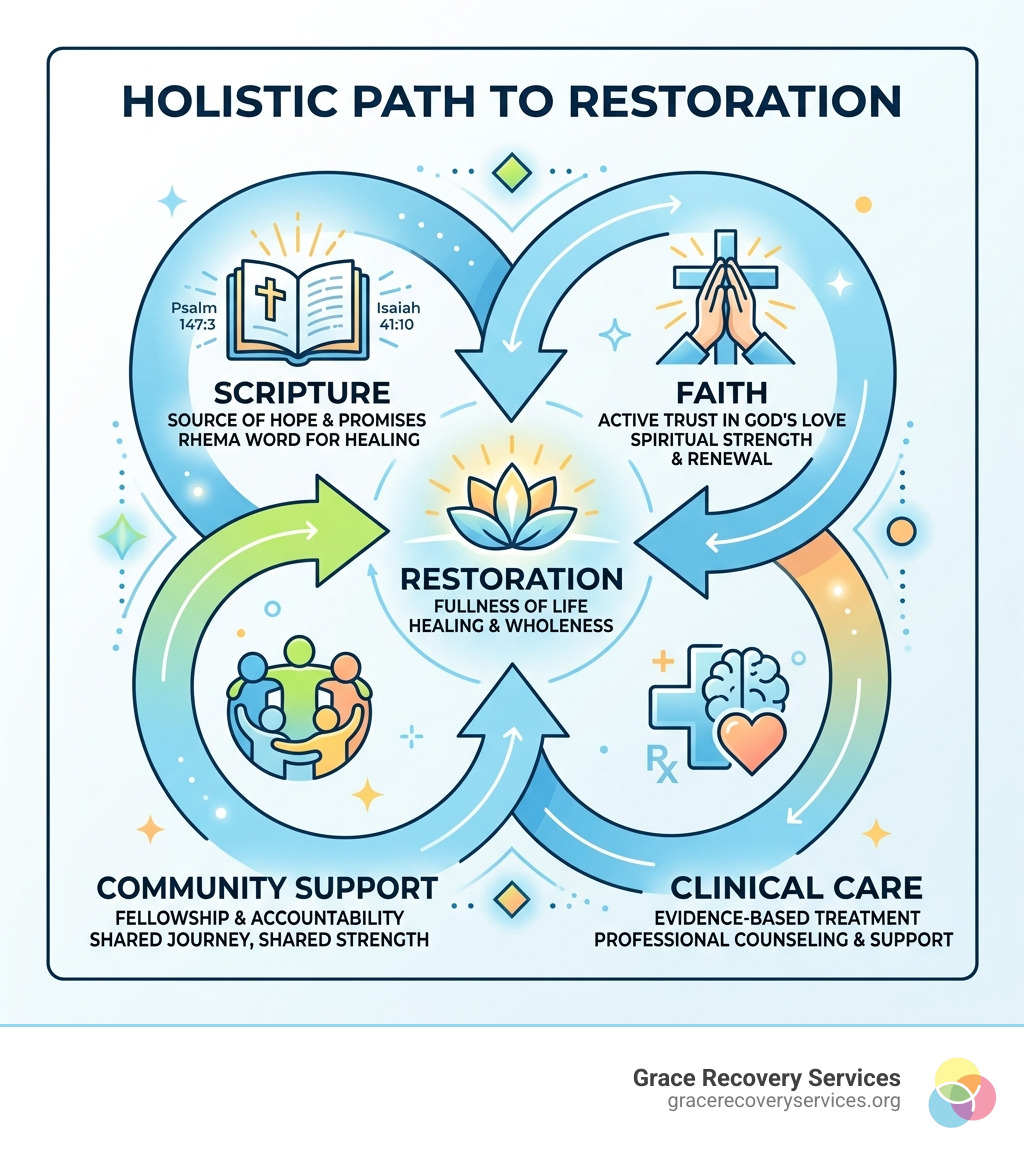
We don’t just use faith as a “side dish” to treatment; it is woven into the fabric of our evidence-based practices. Research shows that spiritual integration can improve recovery outcomes by providing:
- Community: A sense of belonging within the Body of Christ.
- Hope: A forward-looking perspective that believes change is possible.
- Purpose: Understanding that God has a plan for your life, as Jeremiah 29:11 declares.
Practical Application of Healing Scriptures in Daily Life
Knowing the verses is one thing; applying them when life gets messy is another. We encourage our clients to treat scripture for healing and recovery like daily medication—it needs to be taken consistently to be effective.
Meditating on Scripture for Healing and Recovery Daily
A solid morning routine can set the tone for the entire day. This might include:
- Morning Prayer: Asking for the strength to stay sober for the next 24 hours.
- Scripture Affirmations: Speaking verses out loud. For example, “God has not given me a spirit of fear, but of power, love, and a sound mind” (2 Timothy 1:7).
- Mindfulness: Taking five minutes to sit in silence and reflect on a single word from a verse, like “Peace” or “Rest.”
Applying God’s Word During Times of Crisis
When a crisis hits—perhaps a loss of a job or a relational conflict—the risk of relapse increases. This is when we lean on “emergency” scriptures. 2 Corinthians 12:9 is a favorite: “My grace is sufficient for you, for my power is made perfect in weakness.”
Acknowledging our weakness isn’t a failure; it’s the first step toward receiving God’s strength. We also look to Lamentations 3:22-23, which reminds us that God’s mercies are “new every morning.” No matter what happened yesterday, today is a fresh start.
Frequently Asked Questions about Healing Scriptures
What is the most powerful Bible verse for healing?
While many verses are powerful, Psalm 103:2-3 is often cited as a cornerstone for restoration: “Praise the LORD, my soul, and forget not all his benefits—who forgives all your sins and heals all your diseases.” This verse connects spiritual forgiveness with physical and emotional wholeness, covering the entire person.
Why does the Bible say healing may not be immediate?
The Bible often describes healing as a process or a “walk.” In James 1:2-4, we are told that the testing of our faith produces perseverance. Sometimes, the “delay” in immediate healing is where our character is built and our reliance on God is deepened. It’s not about God withholding a blessing; it’s about Him walking with us through a transformation that lasts.
How can I use scripture to support a loved one in recovery?
The best way is through non-judgmental encouragement. Galatians 6:2 tells us to “Carry each other’s burdens.” Instead of quoting verses to “fix” them, use scripture to show empathy. Share verses that emphasize God’s love and presence, like Zephaniah 3:17, which says God “will take great delight in you” and “quiet you with his love.”
Conclusion
At Grace Recovery Services, we are dedicated to helping the people of Western Pennsylvania find their way back to a life of purpose and joy. Whether you are in Pittsburgh, North Huntingdon, or the surrounding Allegheny and Westmoreland counties, you don’t have to walk this path alone.
Our holistic approach addresses the mind, body, and spirit through trauma-informed care and Christian counseling. We believe that through the right clinical support and the timeless truth of scripture for healing and recovery, anyone can experience a true revival of the soul.
If you’re ready to take that first step toward restoration, we are here to listen. Start your journey to faith-based recovery today and discover the grace that makes all things new.
This article was researched with AI and heavily edited by Stephen Luther for accuracy and relevance.
Stephen Luther is the Executive Director and Founder of Grace Christian Counseling, Grace Recovery Services, WPA Counseling, NuWell Online Counseling and Coaching, and NuWell Health. He holds a Master’s degree in Education from the University of Georgia and a Master’s degree in Marriage and Family Therapy from Duquesne University. He is a licensed professional counselor in Pennsylvania.
Since 1997, Steve has been helping children, adolescents, and adults overcome a wide range of emotional and relational challenges. He specializes in working with hurting families, including those with foster, adopted, or traumatized children. Steve uses Attachment-Based Therapy, Splankna Healing, and Therapeutic Parent Coaching to support healing and restoration.
This guide is for educational and spiritual encouragement and is not a substitute for personalized professional counseling. If you are in crisis, please reach out for immediate help.