
Why Scriptures for Addiction Recovery Can Change Everything
Scriptures for addiction recovery offer something that willpower alone rarely can — a deep, unshakeable source of strength, hope, and identity when the road feels impossible.
Here are some of the most powerful Bible verses people turn to in recovery:
| Scripture | Core Message |
|---|---|
| Isaiah 41:10 | God gives strength and holds you up |
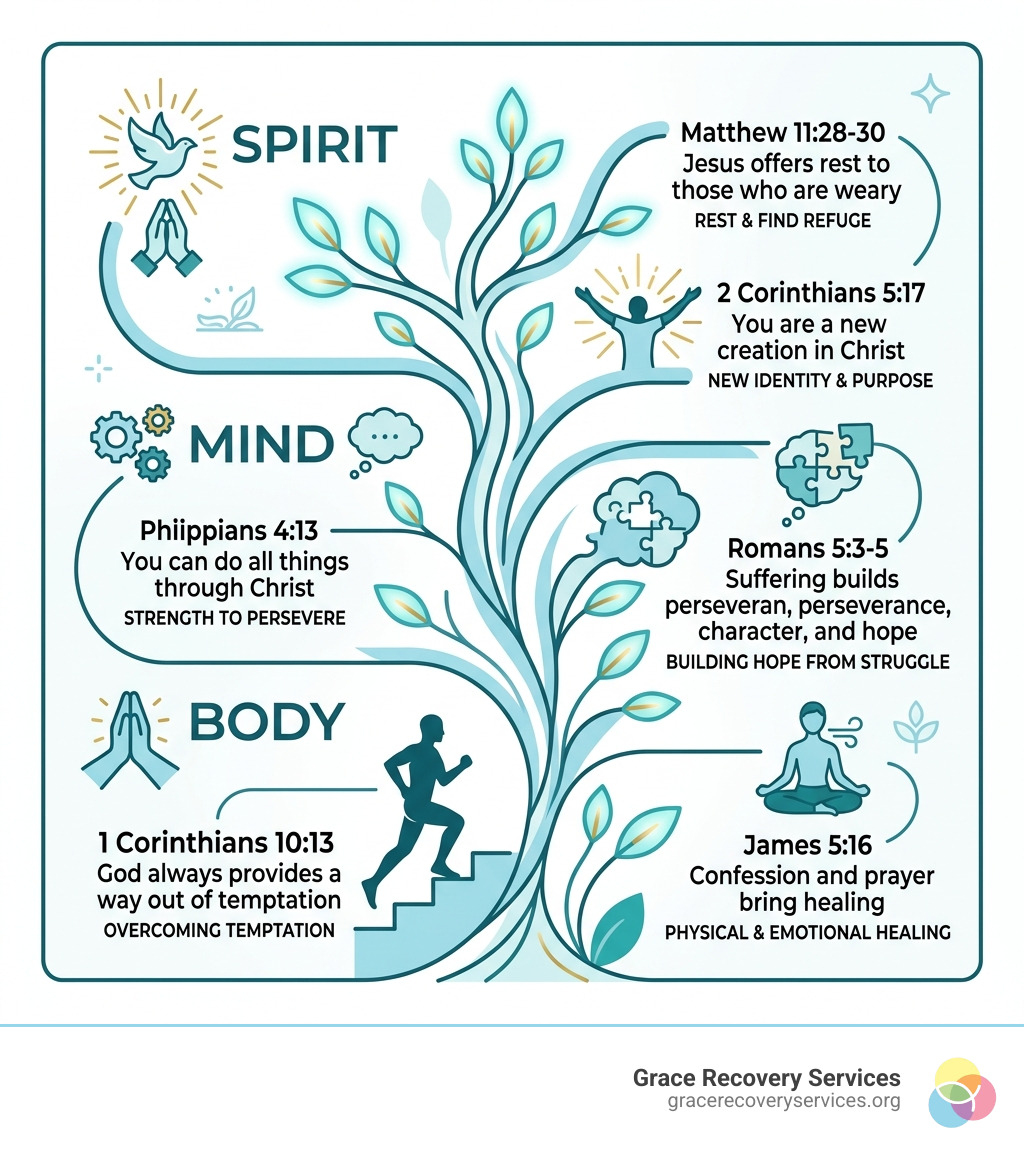
| Philippians 4:13 | You can do all things through Christ |
| 1 Corinthians 10:13 | God always provides a way out of temptation |
| Romans 5:3-5 | Suffering builds perseverance, character, and hope |
| 2 Corinthians 5:17 | You are a new creation in Christ |
| James 5:16 | Confession and prayer bring healing |
| Matthew 11:28-30 | Jesus offers rest to those who are weary |
Addiction is a physical, emotional, and spiritual struggle. That’s not just a faith statement — it’s a clinical reality. Healing often requires more than detox or therapy alone. Many people in recovery find that anchoring their journey in God’s Word gives them a foundation that nothing else can replace.
Whether you are personally navigating substance use, or you love someone who is, you are not alone. And you are not without hope.
In April 2026, at Grace Recovery Services here in Western Pennsylvania, we continue to see what faith can do alongside evidence-based care. The combination is powerful — and it is available to you.
I’m Stephen A. Luther, MSEd, MEd, LPC, Executive Director and Founder of Grace Recovery Services, and for over two decades I have worked at the intersection of trauma-informed clinical treatment and biblical principles of grace and restoration, integrating scriptures for addiction recovery into counseling with clients across the Pittsburgh region. Let’s walk through exactly how these verses can anchor and sustain your recovery, one day at a time.
The Role of Faith and Scriptures for Addiction Recovery
When we talk about a spiritual foundation in recovery, we aren’t just talking about abstract ideas. We are talking about a lifeline. For many of our clients in the Penn Hills and North Huntingdon areas, faith is the “engine” that drives their clinical progress.
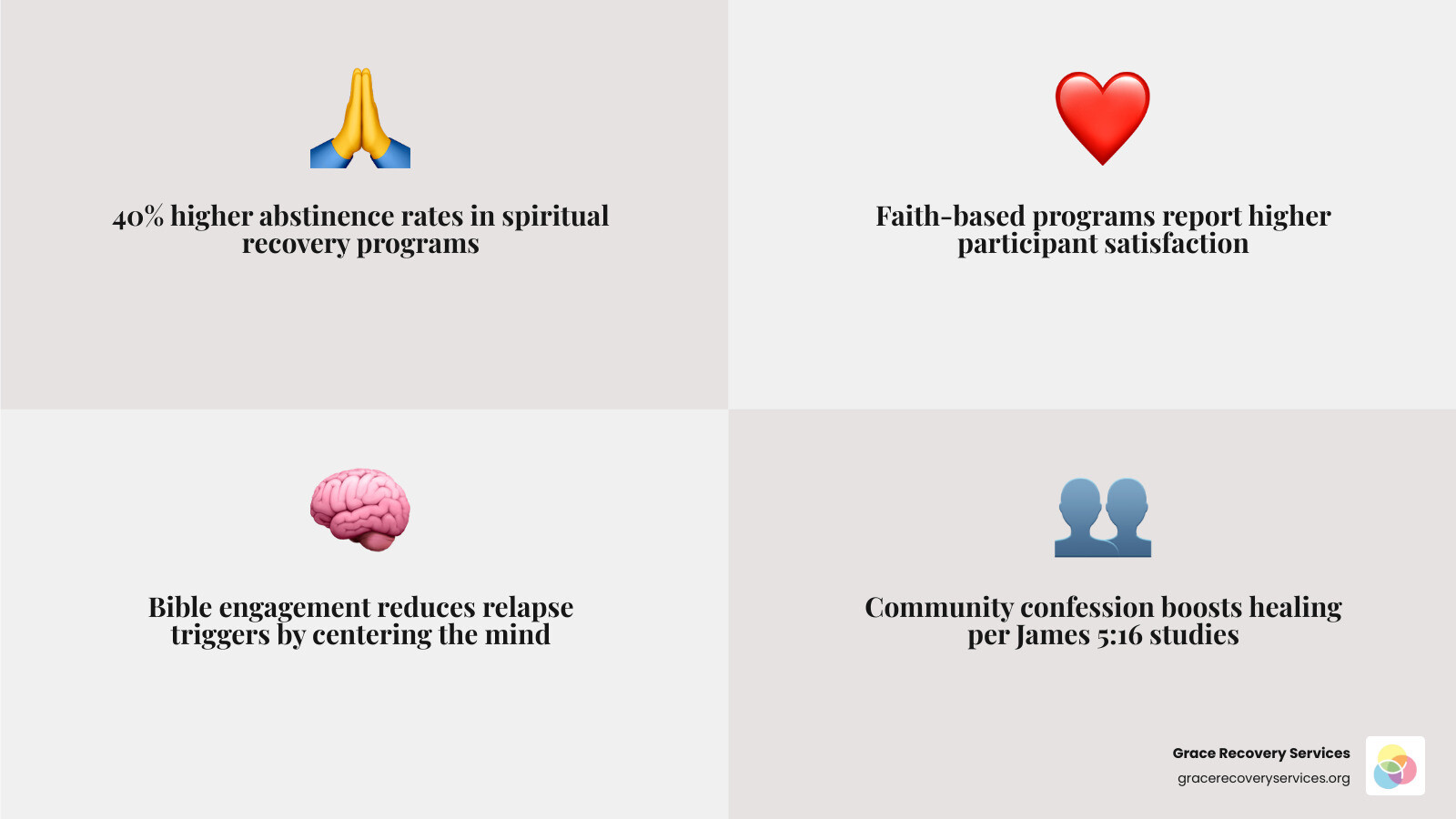
Research consistently backs this up. Statistics show that clients who complete spiritual programs report a forty-percent abstinence rate after treatment. Furthermore, those who integrate faith into their journey report significantly higher satisfaction with their recovery process. Why? Because scriptures for addiction recovery address the “why” behind the struggle, not just the “what.”
At Grace Recovery Services, we believe in Higher Power Higher Purpose biblical principles for addiction. This approach recognizes that while addiction impacts the brain’s chemistry and the body’s health, it also wounds the spirit. Scripture acts as a “spiritual medicine,” providing emotional safety and a renewed sense of hope.
It’s important to understand that faith-based recovery isn’t about “praying away” a medical condition. It is about using the Word of God to support trauma-informed care. For instance, a 7 Days of Healing From Addiction reading plan can provide the daily structure and clinical credibility needed to keep a person focused when cravings hit hard. By combining clinical excellence with biblical truth, we create a space for Restoration, Renewal, and Revival.
Essential Bible Verses for Strength and Hope

If you are currently feeling weak, the Bible is filled with stories of people who felt exactly the same way. We often point our clients toward The Best Bible Verses for Recovering Addicts and Alcoholics to help them find their footing. Here are several key verses that serve as pillars of strength:
Finding Your “Rock”
Psalm 18:2-6 describes God as a rock, a fortress, and a deliverer. In the depths of addiction, life feels like shifting sand. This verse reminds us that we have a solid place to stand. When you feel like you’re drowning in triggers or old habits, you can cry out to the Lord, and He will hear you from His temple.
Strength Beyond Your Own
Philippians 4:13 is perhaps the most famous Bible Verse for Sobriety. It says, “I can do all things through Christ who strengthens me.” In recovery, “all things” includes getting through the next hour without a drink or a pill. It’s not about your willpower; it’s about His power working through you.
Overcoming Fear
Isaiah 41:10 is a direct command from God: “So do not fear, for I am with you; do not be dismayed, for I am your God. I will strengthen you and help you; I will uphold you with my righteous right hand.” Addiction thrives on fear—fear of the future, fear of failure, fear of what people think. God’s promise to uphold you can quiet that noise.
The Purpose in the Pain
Romans 5:3-5 gives us a perspective shift that is vital for long-term sobriety. It tells us to “glory in our sufferings, because we know that suffering produces perseverance; perseverance, character; and character, hope.” Your struggle isn’t wasted. Every day you choose sobriety, you are building a character that is stronger than the person you were before the addiction started.
A Spirit of Power
2 Timothy 1:7 reminds us that “God has not given us a spirit of fear, but of power and of love and of a sound mind.” Addiction often makes our minds feel “unsound”—scattered, anxious, and obsessed. This scripture promises that through Christ, we can regain a sound, self-controlled mind.
Overcoming Temptation and Finding a New Identity
One of the biggest hurdles in recovery is the “shame cycle.” You feel bad about what you’ve done, so you use to numb the pain, which makes you feel worse, so you use again. Breaking this cycle requires a radical shift in how you see yourself.
We encourage our clients to Renew Your Mind with These Powerful Bible Verses to replace the lies of addiction with the truth of God’s Word.
2 Corinthians 5:17 is the ultimate identity-shifter: “Therefore, if anyone is in Christ, the new creation has come: The old has gone, the new is here!” You are not an “addict” as your primary identity. You are a new creation. The mistakes of your past in Pittsburgh or Westmoreland County do not define your future in April 2026.
Hebrews 4:16 invites us to “approach God’s throne of grace with confidence, so that we may receive mercy and find grace to help us in our time of need.” In the past, you might have hidden from God when you messed up. In recovery, we learn to run toward Him. He is our High Priest who empathizes with our weaknesses.
Overcoming Temptation and Preventing Relapse with Scriptures for Addiction Recovery
Relapse prevention is a core part of our outpatient programs. We use Sobriety Scriptures to arm our clients against the inevitable “moments of weakness.”
- 1 Corinthians 10:13: “No temptation has overtaken you except what is common to mankind. And God is faithful; he will not let you be tempted beyond what you can bear. But when you are tempted, he will also provide a way out so that you can endure it.” This is a promise. There is always a way out—a phone call to a sponsor, a prayer, or simply walking away from a triggering situation.
- James 4:7: “Submit yourselves, then, to God. Resist the devil, and he will flee from you.” Recovery is a form of spiritual warfare. By submitting your day to God every morning, you gain the strength to resist the “lies” that tell you one drink won’t hurt.
- 1 Corinthians 15:33: “Do not be misled: ‘Bad company corrupts good character.'” This is a very practical piece of advice. If you want to stay sober, you have to change your “playground and your playmates.” Surrounding yourself with people who support your new identity is crucial.
- 1 Peter 5:8: “Be alert and of sober mind. Your enemy the devil prowls around like a roaring lion looking for someone to devour.” Staying “alert” means knowing your triggers—whether it’s stress at work in Irwin or driving past an old haunt in Penn Hills.
Integrating Biblical Principles into Your Daily Recovery Journey

Knowing the verses is one thing; living them is another. How do we practically integrate scriptures for addiction recovery into a busy life in Western PA?
One practice we love is “Breathe the Word.” It’s simple: pick a promise from scripture. As you inhale, think of the first half of the verse (e.g., “The Lord is my shepherd…”). As you exhale, think of the second half (“…I shall not want”). This helps slow down the nervous system and re-centers the mind on God’s presence during a craving.
Another powerful tool is the Psalm 151 (a Psalm of Addicts). This is a modern prayer of powerlessness that helps individuals articulate their struggle to God. It’s okay to be raw and honest with Him. He already knows your heart; He just wants you to invite Him into the struggle.
Daily habits that make a difference:
- Morning Devotionals: Start your day with a reading plan like the 7 Days of Healing From Addiction – Day 1 of 7.
- Journaling: Write down a verse and then write two lines: “What is God saying to me?” and “How will I respond today?”
- Lock-Screen Reminders: Take a photo of a verse and set it as your phone’s background so you see it dozens of times a day.
- Confession and Prayer: James 5:16 says, “Confess your sins to each other and pray for each other so that you may be healed.” Secrecy is the fuel of addiction. Confession is the fire extinguisher.
The Importance of Community and Professional Support
While individual faith is vital, we weren’t meant to recover in isolation. Addiction is a disease of “loneliness,” and the church and recovery communities offer a “family” of support.
At Grace Recovery Services, we help people connect biblical truth with proven clinical care. Faith does not have to compete with treatment. It can support it, strengthen it, and give deeper meaning to the recovery process. We offer:
- Christian counseling: Support that respects your beliefs while helping you work through real emotional pain.
- Trauma-informed treatment: Care that looks beneath substance use to issues like family conflict, grief, shame, and past wounds.
- Outpatient recovery support: Structured treatment that helps you get care while continuing daily responsibilities in the Pittsburgh and Western Pennsylvania area.
- Holistic healing: Recovery that cares for body, mind, and spirit through practical tools, counseling, prayer, and Scripture-centered encouragement.
Our offices in North Huntingdon and the Penn Hills area are staffed by people who understand the local landscape of Westmoreland and Allegheny Counties. We know the specific challenges of this region, and we are here to offer non-judgmental, compassionate support.
Conclusion
Recovery is rarely a straight line. It’s often a series of small wins, occasional setbacks, and a lot of grace. If you are struggling today, please hear this: your past does not disqualify you from God’s future.
At Grace Recovery Services, we are dedicated to helping you find that future. Whether you need a Faith-Based Outpatient Addiction Treatment plan or just someone to talk to about your options in Western Pennsylvania, we are here. Our approach is built on the belief that every person is a candidate for Restoration, Renewal, and Revival.
Don’t wait for “someday” to get help. April 2026 can be the month everything changes for you. Reach out to us today for a personalized assessment. Let’s see how we can combine the best of clinical care with the timeless power of scriptures for addiction recovery.
Frequently Asked Questions about Scriptures for Addiction Recovery
How can the Bible help with cravings? Scripture helps by shifting your focus. When a craving hits, your brain is “locked” on the substance. Reciting a verse or practicing “breath prayer” creates a cognitive break, reminding you of your “why” and connecting you to a power greater than the craving. It acts as “mental first aid.”
Can faith-based recovery work alongside clinical therapy? Absolutely. In fact, we recommend it. Faith provides the motivation and the moral framework, while clinical therapy (like EMDR or CBT) provides the tools to heal the brain and process trauma. They are two sides of the same coin of healing.
What does the Bible say about relapse and forgiveness? The Bible is a book of “second chances” (and third, and fourth). While it encourages us to stay sober and alert, it also offers infinite grace through Christ. If you slip, the biblical response is not to wallow in shame, but to confess, repent, and “approach the throne of grace” to get back on the path. Relapse is a chapter in some stories, but it doesn’t have to be the end of the book.
Is faith-based treatment covered by insurance? Many insurance plans cover the clinical portions of our treatment (like IOP) because they are led by licensed medical and mental health professionals. While they may not specifically “pay for” the Bible study aspect, they cover the evidence-based care that we integrate with our faith-based philosophy.
If you or a loved one are ready to take the first step toward freedom, contact Grace Recovery Services today. We serve the Pittsburgh, Penn Hills, North Huntingdon, and Westmoreland County areas with compassionate, trauma-informed outpatient care.
This article was researched with AI and heavily edited by Stephen Luther for accuracy and relevance.
Stephen Luther is the Executive Director and Founder of Grace Christian Counseling, Grace Recovery Services, WPA Counseling, NuWell Online Counseling and Coaching, and NuWell Health. He holds a Master’s degree in Education from the University of Georgia and a Master’s degree in Marriage and Family Therapy from Duquesne University. He is a licensed professional counselor in Pennsylvania.
Since 1997, Steve has been helping children, adolescents, and adults overcome a wide range of emotional and relational challenges. He specializes in working with hurting families, including those with foster, adopted, or traumatized children. Steve uses Attachment-Based Therapy, Splankna Healing, and Therapeutic Parent Coaching to support healing and restoration.
This guide is for educational and spiritual encouragement and is not a substitute for personalized professional counseling. If you are in crisis, please reach out for immediate help.