
Some nights in Western Pennsylvania feel very quiet. A spouse is asleep upstairs. A phone is face down on the kitchen table. Someone sits alone wondering, “Why do I keep doing this when I want my life back?” They may have tried to stop before. They may even have gone to counseling before. But something still feels incomplete. If this is you, Western PA Christian addiction counseling is worth considering.
For many people, that missing piece is spiritual. They don’t want a recovery path that asks them to leave faith outside the room. They want honest clinical help for cravings, habits, trauma, and mental health. They also want space for prayer, Scripture, confession, grace, and hope.
That desire isn’t unusual. It’s part of a broad pattern in addiction care. Across the United States, 73% of addiction treatment programs incorporate a spirituality-based element, which shows how common it is for recovery settings to make room for faith as a meaningful part of healing (PMC review).
Finding a Path to Healing That Honors Your Faith
A lot of people looking for Western PA Christian addiction counseling are carrying two fears at once.
One fear says, “If I go to treatment, nobody will understand my faith.”
The other says, “If I go somewhere Christian, will I get real clinical care?”
Both fears make sense.
When recovery feels split in two
Some people have sat in counseling sessions where faith was treated like a side topic. Others have been in church settings where addiction was discussed mostly as a moral failure, with little attention to trauma, anxiety, or the way the nervous system gets stuck in survival patterns.
Neither approach tells the whole truth.
Addiction affects the mind, body, relationships, and spirit. So healing often works best when care does too. Christian addiction counseling can offer that kind of whole-person support. It takes suffering seriously without reducing someone to a diagnosis. It also takes sin, shame, forgiveness, and spiritual longing seriously without pretending prayer alone replaces treatment.
Sometimes the first relief a person feels is simple. “I don’t have to choose between faith and therapy.”
A gentle place to begin
If you're in a dark stretch right now, you may need small, steady reminders of God’s presence before you can even think about next steps. Some people find comfort in brief devotional resources like Jesus Walks With Me Through Dark Times, especially when fear and exhaustion make it hard to find words.
In practice, a faith-honoring recovery path can look calm and grounded. You meet with a counselor. You talk openly about substance use. You explore what triggers it. You look at patterns from family history, grief, trauma, or isolation. And if you want to, you also talk about prayer, guilt, God’s character, and what restoration could mean in your life.
In our years of walking with people in recovery at Grace Recovery Services, we’ve learned that many individuals in dark seasons first need safety and steady presence more than they need a detailed recovery plan. When counseling provides both clinical structure and gentle space for faith — without pressure or shame — clients often begin to experience small but meaningful shifts: reduced isolation, renewed hope, and the ability to take the next right step, even when everything still feels heavy.
That’s why so many people in this region keep searching for care that feels clinically solid and spiritually honest. They’re not asking for less treatment. They’re asking for treatment that sees the whole person.
What Christian Addiction Counseling Really Means
Christian addiction counseling isn't the same thing as a Bible study, and it isn't only pastoral advice. It’s a form of professional care where a trained counselor uses established treatment methods while also making room for Christian belief, spiritual practices, and biblical truth when that fits the client’s needs.
A simple way to picture it is a two-handed approach.
In our clinical work at Grace Recovery Services and NuWell Health, we’ve seen that the most effective Christian addiction counseling happens when these two hands work together. Clients who receive solid clinical tools for relapse prevention, trauma processing, and emotional regulation — while also being invited to bring their faith, shame, and spiritual struggles into the conversation — consistently show better engagement and longer-term recovery progress than those who receive either clinical care or spiritual advice alone.
Clinical skill in one hand
A counselor still does the work you'd expect in quality addiction treatment. That includes assessment, treatment planning, relapse prevention, coping skills, emotional regulation, family dynamics, and support for co-occurring mental health concerns.
This is healthcare. It should be thoughtful, ethical, and structured.
Spiritual wisdom in the other
Faith enters the process as a source of meaning and strength, not as pressure. A counselor may help a client notice how shame distorts identity, how forgiveness differs from denial, or how prayer can support honesty and surrender. If you want a broader overview of that approach, Christian counseling and faith-based healing offers a helpful introduction.
For readers exploring this connection in addiction recovery, this guide on how faith can support healing is also useful: https://www.gracerecoveryservices.org/how-faith-helps-with-addiction/
What it is and what it isn't
| Approach | What it offers | What it may miss on its own |
|---|---|---|
| Purely secular therapy | Strong clinical tools | Limited space for spiritual meaning if faith matters deeply to you |
| Pastoral support alone | Prayer, community, biblical encouragement | May not provide full addiction treatment or trauma-focused clinical care |
| Christian addiction counseling | Clinical treatment plus faith integration | Depends on the provider’s training, methods, and boundaries |
A good counselor won't force spiritual language into every conversation. They also won't treat addiction as only a bad habit or only a spiritual issue. They understand that people can love God and still need structured help with cravings, trauma responses, emotional pain, and ingrained behavior patterns.
Practical rule: Ask whether the provider is licensed, how they treat substance use clinically, and how faith is included in session. Those three questions reveal a lot.
That’s the heart of Western PA Christian addiction counseling when it’s done well. It respects both professional treatment and the healing role faith can play.
Blending Faith with Evidence-Based Trauma Treatment
Many people use substances to numb something deeper. Sometimes that deeper issue is grief. Sometimes it’s fear. Sometimes it’s trauma that never had words.
In Appalachian regions like Western PA, up to 59% of adults with a substance use disorder also have co-occurring PTSD, yet only 12% receive care that properly integrates trauma treatment (Start Your Recovery summary). That gap matters because a person can stop using for a while and still feel overwhelmed by the pain underneath.
How therapy and faith can work together
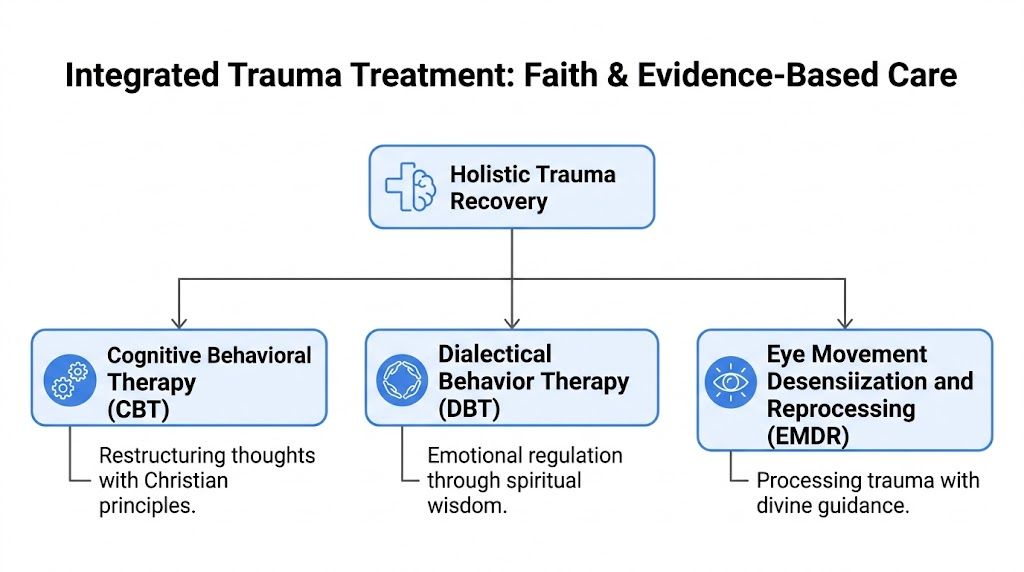
Evidence-based treatment gives structure to recovery. Faith gives meaning, identity, and a place to bring suffering.
That integration can look like this:
-
CBT for thought patterns helps a client identify distorted beliefs such as “I’ll never change” or “I’m too damaged.” In a Christian setting, that work can sit alongside biblical truth about worth, repentance, and renewal.
-
DBT for emotional regulation teaches distress tolerance and interpersonal skills. A faith-aware counselor may connect those skills with practices like prayerful pause, humility, confession, and wise community support.
-
Trauma-informed care helps the client feel safe enough to process painful experiences without becoming flooded or shut down. Faith can support that process by offering language for lament, mercy, and hope.
What a session may sound like
A counselor might say, “When that memory gets triggered, what happens in your body first?” That’s trauma-informed care.
Later, if the client wants faith integrated, the conversation may turn to identity. “When shame tells you that you're beyond repair, what do you believe God says about you?” That’s spiritual integration.
Both matter. One helps calm the nervous system. The other helps rebuild the inner story a person lives by.
Healing often begins when a person learns that their reactions make sense in light of what they’ve lived through, and that those reactions don't have to define their future.
Why this matters in outpatient care
Outpatient settings are where many people try to rebuild daily life while staying connected to treatment. They still go home. They still face stress, conflict, reminders, and old patterns. That’s why integrated care can be so helpful. It doesn’t only aim at stopping substance use. It helps people understand what drives it, what soothes it, and what can replace it.
For someone seeking Western PA Christian addiction counseling, this kind of care can make the process feel less stressful. Clinical methods address trauma with skill. Faith helps the person hold pain without losing hope.
The Transformative Power of Integrated Healing
Recovery is bigger than abstinence. A person may stop using and still feel empty, angry, numb, or disconnected. Real healing reaches further.

When faith and treatment are integrated well, people often begin to recover pieces of life that addiction damaged. They start telling the truth sooner. They repair routines. They notice triggers before acting on them. They become more present with their children, spouse, parents, or church community. They feel less ruled by shame.
Change you can feel in daily life
One person may notice that evenings no longer feel impossible. Another may realize they can sit with grief without immediately reaching for a substance. Someone else may begin to pray again, not because they’re pretending everything is fixed, but because they feel honest enough to come before God as they are.
That kind of change has practical value. Program evaluations show that faith-based 12-step adaptations can result in 40-50% lower relapse rates over 6-10 weeks compared to non-faith programs when Scriptural support reinforces recovery principles.
For readers who want to explore a local model of this kind of care, https://www.gracerecoveryservices.org/christian-integrated-addiction-treatment/ explains how Christian-integrated addiction treatment can be structured in practice.
Revival, not just restraint
Integrated healing aims for more than behavior control. It aims for a life that becomes steadier, more truthful, and more connected.
Some of the fruits people look for include:
-
Restored trust at home after a pattern of secrecy or broken promises
-
Stronger emotional awareness so stress gets named before it becomes a crisis
-
A renewed sense of purpose that isn't built around survival
-
Spiritual honesty instead of hiding from God in shame
This brief video can help put that hope into words.
No program can promise a simple road. But counseling that engages the soul as well as the symptoms often gives people something sturdier than willpower alone. It gives them a framework for rebuilding.
Finding the Right Christian Counselor in Western PA
Not every provider who uses Christian language offers the same kind of care. Some are strong clinically but don't address trauma thoroughly. Others are spiritually warm but vague about addiction treatment. Asking direct questions can save time and reduce disappointment.
Questions worth asking
When you call a provider, listen for clarity.
-
How do you integrate faith into treatment? A strong answer should explain whether prayer, Scripture, and spiritual discussion are optional, collaborative, and adapted to the client's needs.
-
What is your experience with trauma and substance use together? You want to know whether the provider understands the overlap between addiction, PTSD, anxiety, grief, and family history.
-
What level of care do you offer? Some people need standard outpatient counseling. Others may need a more structured outpatient program.
-
Do you work with insurance or Medicaid? Cost and coverage matter, and it's okay to ask early.
-
How do you handle relapse prevention and aftercare? Recovery support shouldn't stop after a few sessions.
What to look for beyond the website
You don't need perfect wording from a provider. You do need signs of competence.
| What to check | Why it matters |
|---|---|
| Licensure and credentials | Shows the counselor has formal clinical training and accountability |
| Trauma-informed approach | Reduces the risk of treating symptoms while missing underlying pain |
| Clear faith integration | Helps you know whether spiritual support is thoughtful or superficial |
| Treatment options | Confirms whether the provider fits your level of need |
| Insurance transparency | Makes it easier to plan realistically |
If a provider can’t explain how they treat addiction, trauma, and faith in plain language, keep asking questions.
A good fit should feel both safe and honest
Pay attention to your gut during the first contact. Did the person sound rushed or dismissive? Did they welcome your concerns? Did they speak respectfully about both clinical care and faith?
A good fit doesn’t mean instant comfort. Hard work is still hard. But you should sense that the counselor knows what they’re doing, understands your goals, and won’t ask you to split your spiritual life from your healing process.
How Our Trauma-Informed Programs Serve Western PA
The need in this region is practical. People need outpatient care that can address substance use, trauma, schedules, transportation barriers, and spiritual concerns without turning any one of those issues into the whole story.

Why outpatient access matters right now
Current demand makes accessibility especially important. Post-2025 reforms in Pennsylvania were associated with a 25% enrollment increase in SUD outpatient services via Medicaid and a 40% rise in telehealth claims in rural Western PA, which highlights why accessible outpatient models matter for the region’s needs.
That matters because many adults can’t step away from work, caregiving, court obligations, or family responsibilities for a residential setting. They need care that helps them recover while still living real life.
How this model addresses the gap
Grace Recovery Services offers IOP and outpatient care in North Huntingdon and Penn Hills with a trauma-informed approach and an optional faith-based track. That combination directly addresses a common local gap. Many people can find addiction counseling. Many can find Christian support. Far fewer find a setting that intentionally brings addiction treatment, trauma care, and Christian integration together in outpatient practice.
The program model includes:
-
Thorough assessment so treatment starts with the person’s actual needs, not assumptions
-
Individual counseling and group therapy for skill-building, accountability, and deeper processing
-
Trauma-informed care that pays attention to emotional wounds, nervous system responses, and triggers
-
Optional Christian integration for clients who want faith included in a clinically appropriate way
-
Aftercare and relapse planning to support long-term stability beyond discharge
For readers who want to understand trauma more clearly, https://www.gracerecoveryservices.org/trauma-informed-care/ gives a direct overview.
Why the optional faith track matters
Optional faith integration protects trust. It means spiritual care is available, but not imposed. That matters for people at many different places spiritually. Some arrive with strong church involvement. Some feel close to God but distant from organized religion. Some are angry, confused, or unsure what they believe right now.
A trauma-informed Christian model should make room for those differences. It should invite, not pressure. It should support healing with honesty.
Taking Your First Step Toward Restoration and Renewal
If you’re looking for Western PA Christian addiction counseling, you’re probably not looking for slogans. You’re looking for a real path forward. You want care that understands addiction, respects trauma, and doesn’t treat faith like an embarrassment or an afterthought.
That kind of healing is possible.
You don’t have to have everything figured out before reaching out. You don’t need a perfect explanation of what you’re feeling. The first step can be simple. A confidential conversation. A question about treatment. A short message asking about the available options.
Recovery often starts before sobriety is steady. It starts when a person tells the truth and lets someone help.
Common Questions About Faith-Based Recovery
Do I have to be a strong Christian to start?
No. Many people begin treatment feeling unsure, hurt, distant from God, or curious. Faith-based recovery can meet people where they are.
Will counseling only focus on prayer and Scripture?
Not if it is done well. Christian addiction counseling should include real clinical treatment for substance use, mental health, and trauma. Spiritual support complements therapy. It doesn’t replace it.
Can faith be optional in treatment?
Yes. In many outpatient settings, spiritual integration is available for clients who want it. That allows care to stay respectful and clinically appropriate.
What if trauma is part of the problem?
Bring that up early. Trauma can shape cravings, avoidance, fear, and relapse patterns. A counselor who understands both trauma and addiction can help you work on the roots, not only the symptoms.
Is outpatient care enough?
Sometimes yes, sometimes no. It depends on substance use severity, safety, home environment, relapse history, and co-occurring mental health needs. A proper assessment helps determine the right level of care.
If you or someone you love is ready to talk, Grace Recovery Services offers a place to start with compassion, clarity, and confidentiality. Reaching out doesn’t commit you to anything. It opens the door to honest help and the possibility of restoration.
This article was researched with AI and heavily edited by Stephen Luther for accuracy and relevance.
Stephen Luther is the Executive Director and Founder of Grace Christian Counseling, Grace Recovery Services, WPA Counseling, NuWell Online Counseling and Coaching, and NuWell Health. He holds a Master’s degree in Education from the University of Georgia and a Master’s degree in Marriage and Family Therapy from Duquesne University. He is a licensed professional counselor in Pennsylvania.
Since 1997, Steve has been helping children, adolescents, and adults overcome a wide range of emotional and relational challenges. He specializes in working with hurting families, including those with foster, adopted, or traumatized children. Steve uses Attachment-Based Therapy, Splankna Healing, and Therapeutic Parent Coaching to support healing and restoration.