
Finding Christian Recovery Near Irwin PA: What You Need to Know
If you or someone you love is searching for Christian recovery near Irwin PA, you are not alone — and real help is closer than you might think.
Here is a quick overview of what is available:
- Grace Recovery Services (Irwin/North Huntingdon) — Faith-integrated outpatient addiction treatment including IOP, OP, co-occurring disorder care, and Christian counseling. Accepts UPMC, Highmark, UHC/Optum, CCBH, and sliding scale/self-pay.
- Christian Counseling & Therapy — Individualized spiritual and clinical support to address underlying trauma and mental health.
- Intensive Outpatient Programs (IOP) — Structured therapy that fits around your daily work and family schedule.
- Local Peer Support Groups — Faith-connected community gatherings and 12-step meetings in the Irwin area.
Westmoreland County has seen a troubling rise in substance use challenges in recent years. Yet for many people in and around Irwin, standard clinical treatment alone does not feel like enough. Something deeper is needed — a sense of purpose, identity, and belonging that goes beyond managing symptoms.
That is exactly what faith-integrated recovery offers.
True healing runs deeper than symptom management. Christian recovery programs combine evidence-based clinical care — like cognitive behavioral therapy and trauma-informed treatment — with the spiritual foundations of grace, forgiveness, and redemption. The result is a whole-person approach that addresses mind, body, and spirit together.
At Grace Recovery Services, we serve individuals and families in Irwin, North Huntingdon, and the broader Western Pennsylvania area with compassionate, faith-integrated outpatient care. Whether you are in early recovery or working to maintain long-term sobriety, there is a path forward — and you do not have to walk it alone.
Understanding Christian Recovery Near Irwin PA
What makes a faith-based approach to recovery distinct from secular treatment? While secular clinical programs do an excellent job of addressing the physical and psychological components of addiction, they often overlook the spiritual dimension. In contrast, Christian recovery programs view addiction through a holistic lens, recognizing that lasting healing requires restoring a person’s identity, purpose, and relationship with God.
Addiction frequently leaves individuals carrying heavy burdens of guilt, shame, and isolation. Many describe a feeling of spiritual emptiness—what is often referred to as a “God-shaped hole”—that they tried to fill with substances. By integrating biblical truth with clinical science, faith-based programs help clients shift their core identity. Instead of viewing themselves through the lens of defeat (“I am just an addict”), they learn to see themselves through the eyes of grace (“I am a child of God in recovery”).
According to a scientific research on faith-based recovery published by Liberty University, integrating spiritual practices into clinical treatment dramatically improves long-term outcomes. In fact, studies show that:
- Clients who actively integrate spiritual practices into their treatment are 50% more likely to maintain long-term sobriety compared to those in purely secular programs.
- Approximately 65% of individuals in faith-based recovery cite spiritual support as a critical factor in their decision to seek and complete treatment.
- In Pennsylvania, about 40% of substance use treatment facilities now offer some form of faith-based or spiritually integrated programming to meet this growing demand.
At Grace Recovery Services, we believe that spiritual transformation is a powerful mechanism of change. It provides sustained motivation when internal willpower fails. By exploring Christian recovery services close to home, individuals in Westmoreland County can access care that honors their values while delivering top-tier clinical support.
Core Levels of Outpatient Care in Western Pennsylvania
As of May 2026, outpatient programs have become the preferred choice for many individuals seeking recovery. Outpatient care allows clients to receive intensive, professional treatment while continuing to live at home, care for their families, and maintain their employment. This real-world application is incredibly valuable, as it allows clients to practice their coping skills and spiritual habits in their daily environments immediately.
In Western Pennsylvania, there are three primary levels of outpatient care designed to meet clients wherever they are on their journey:
- Partial Hospitalization Program (PHP): This represents the most intensive level of outpatient care. Clients typically attend treatment for 5 to 8 hours per day, 4 to 5 days per week. It is ideal for those who need structured, daily clinical support but do not require 24-hour medical supervision.
- Intensive Outpatient Program (IOP): Operating as a step down from PHP, an IOP involves 9 to 20 hours of therapy per week, spread across 3 to 5 days. This level of care is perfect for individuals transitioning from a higher level of care or those who need robust support while balancing work, school, or family commitments.
- Outpatient Program (OP): General outpatient care is a lower-intensity option, usually consisting of 1 to 5 hours of therapy per week. It focuses on long-term maintenance, relapse prevention, and ongoing spiritual and emotional growth.
| Level of Care | Weekly Time Commitment | Clinical Focus | Ideal For |
|---|---|---|---|
| PHP | 20–35 hours/week | Intensive stabilization, daily group therapy, medical monitoring | Early recovery, severe symptoms, transitioning from detox |
| IOP | 9–20 hours/week | Coping skills, trauma processing, relapse prevention, group support | Balancing recovery with work/school, moderate symptoms |
| OP | 1–5 hours/week | Long-term maintenance, individual counseling, ongoing accountability | Stable recovery, long-term sobriety maintenance |
For those looking to build a strong spiritual and clinical foundation without leaving their community, exploring Western PA Christian addiction counseling is an excellent starting point.
Finding the Right Christian Recovery Near Irwin PA for Your Needs
No two recovery journeys are identical. A program that works wonders for one person might not address the unique challenges of another. This is why individualized care is so critical. When searching for Christian recovery near Irwin PA, look for programs that refuse to use a cookie-cutter approach.
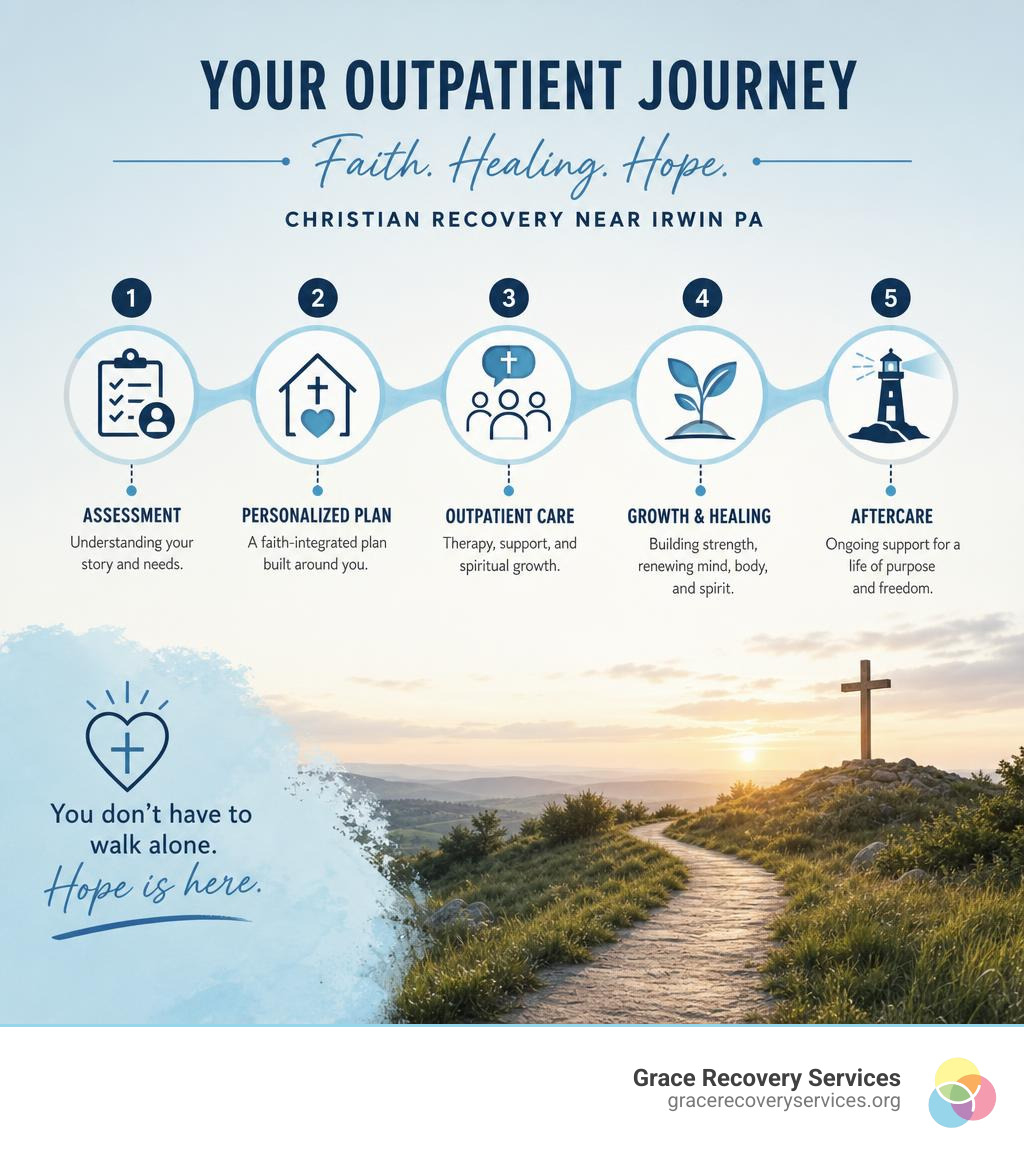
A high-quality faith-based program should offer a thorough clinical and spiritual assessment at intake. This assessment helps design a personalized treatment plan that addresses your specific physical, emotional, and spiritual needs. True clinical excellence means that biblical principles are not used as a substitute for professional therapy, but rather as a beautiful framework that enhances evidence-based modalities. If you want to explore how these elements blend seamlessly together, you can learn more about faith-based rehab in Pittsburgh.
Overcoming Barriers with Telehealth and Local Support
For individuals living in Westmoreland County, accessing high-quality care can sometimes feel challenging due to transportation, health concerns, or busy schedules. This geographic barrier is particularly concerning given that Westmoreland County saw a 12% increase in drug overdose deaths between 2021 and 2022, highlighting the urgent need for accessible, local recovery services.
Fortunately, modern recovery programs have adapted to meet these needs. Many local providers now offer comprehensive telehealth options. Telehealth allows you to participate in intensive outpatient therapy, group sessions, and individual Christian counseling from the comfort and privacy of your own home in Irwin.
By leveraging technology alongside local, in-person support, clients can stay connected to their clinical team and peer community without interruption. If you are ready to take that first step locally, you can read about how to get your spirit in gear with North Huntingdon Christian IOP.
Integrating Clinical Excellence with Biblical Truth
There is a common misconception that faith-based recovery consists solely of prayer and Bible study. While spiritual disciplines are vital, premier Christian recovery programs integrate these practices with rigorous, state-licensed clinical care. This is where science meets spirit.
For example, Cognitive Behavioral Therapy (CBT) teaches clients to identify and change negative, distorted thought patterns that lead to unhealthy behaviors. In a Christian counseling setting, this clinical tool aligns beautifully with scripture, such as Romans 12:2 (“Be transformed by the renewing of your mind”) and 2 Corinthians 10:5 (“Take every thought captive to obey Christ”).
Similarly, Dialectical Behavior Therapy (DBT) helps clients develop emotional regulation and mindfulness—practices that mirror biblical meditation and the pursuit of the peace of God. By combining these proven psychological tools with scripture, prayer, and pastoral support, clients receive a highly comprehensive form of care. You can research further details on Pennsylvania Christian rehabs to see how these programs are structured across the state, or discover more about our local approach to Christian rehab in Pittsburgh.
Healing Co-Occurring Disorders and Trauma
It is incredibly common for substance use disorders to co-occur with mental health conditions like depression, anxiety, or post-traumatic stress disorder (PTSD). In the recovery field, this is known as a dual diagnosis. Approximately 50% of people struggling with addiction also experience a co-occurring mental health condition.
At Grace Recovery Services, we recognize that substance use is often an attempt to self-medicate deep, unresolved trauma. If you only treat the physical addiction without healing the underlying emotional wounds, the risk of relapse remains high. That is why our clinical blueprint focuses heavily on trauma-informed care through a gentle, four-phase process:
- Take Off the Mask: Creating a safe, non-judgmental space where clients can drop their defenses and be honest about their pain.
- Heal the Wounds: Utilizing trauma-informed therapies (such as EMDR and somatic techniques) alongside spiritual counseling to process past abuse, neglect, or loss.
- Remove the Toxins: Addressing the toxic lies, shame, and guilt that clients carry about themselves and replacing them with God’s truth.
- Replace with the Truth: Rebuilding a healthy self-image, establishing strong relational boundaries, and walking in spiritual freedom.
To understand more about how we address dual diagnoses through a faith-based lens, explore our resources on faith-based recovery in Pittsburgh.
The Role of Community in Christian Recovery Near Irwin PA
Addiction thrives in isolation, but recovery flourishes in community. One of the greatest advantages of pursuing Christian recovery near Irwin PA is the immediate access to a warm, supportive fellowship of believers who share your values and goals.
In a faith-based recovery setting, community goes beyond simple accountability. It becomes a reflection of the body of Christ, where individuals bear one another’s burdens (Galatians 6:2) and walk out the journey of forgiveness and reconciliation together. Whether through group therapy sessions, local church partnerships, or Christian 12-step groups like Celebrate Recovery, having a sober, faith-filled network is a cornerstone of long-term success. If you are looking for local counseling options that emphasize this relational healing, you can find Christian counseling in Penn Hills to help rebuild your support system.
Navigating Insurance and Accessibility in Westmoreland County
We understand that one of the most stressful parts of seeking treatment is figuring out how to pay for it. Fortunately, under the Affordable Care Act (ACA), addiction treatment and mental health services are classified as essential health benefits. This means that most private health insurance plans, as well as state-funded programs, provide coverage for substance use disorder treatment.
At Grace Recovery Services, we believe that financial barriers should never stand in the way of life-saving care. We work diligently to make our programs accessible to as many families as possible in Westmoreland County. We accept a variety of payment and insurance options, including:
- UPMC Health Plan
- Highmark / Blue Cross Blue Shield
- UnitedHealthcare / Optum
- Community Behavioral Health (CCBH) and other Medicaid options
- Sliding scale fees and self-pay plans for individuals without insurance
Our admissions team is always available to perform a free, confidential benefits check to help you understand your coverage. To learn more about local accessibility and navigating your options, read our guide on faith-based rehabs in Irwin.
Frequently Asked Questions About Faith-Based Treatment
Do I have to be a practicing Christian to attend a faith-based program?
Absolutely not. At Grace Recovery Services, our doors and hearts are open to individuals from all walks of life, regardless of where they are on their spiritual journey. While our program is built on Christian principles and the teachings of Jesus Christ, we practice a grace-centered approach.
We never force our beliefs on anyone. Spiritual elements are always available for those who want them, and they are set aside for those who do not feel comfortable with them. We meet you exactly where you are with love, dignity, and respect. For more information about our local philosophy and services, visit our page on Irwin recovery options.
How does trauma-informed care fit into Christian addiction recovery?
Trauma-informed care fits perfectly with the heart of Christian recovery because both focus on compassion, safety, and deep healing rather than condemnation. A trauma-informed approach recognizes that addictive behaviors are often symptoms of deeper, painful wounds like abuse, loss, or abandonment.
Instead of asking, “What is wrong with you?” we ask, “What happened to you?” By combining professional trauma therapies with the healing message of the Gospel, we provide a safe environment where clients can process their trauma without shame. Discover more about this integrated approach by reading about Christian addiction recovery in Pittsburgh.
What are the benefits of outpatient Christian recovery?
Outpatient Christian recovery offers the perfect balance of clinical structure, spiritual growth, and personal flexibility. Unlike programs that require you to put your life on hold or live away from home, outpatient care allows you to:
- Stay connected to your family, children, and local church community.
- Maintain your job or educational commitments.
- Immediately apply the coping strategies and spiritual tools you learn in therapy to real-world situations.
- Transition smoothly into long-term independent living with an established local support network.
Conclusion
If you are struggling with substance use or co-occurring mental health challenges, please know that your story is not over. No matter how dark things may seem right now, no one is too far gone for God’s grace, and no addiction is too strong for His power.
At Grace Recovery Services, our mission is to foster hope, healing, and long-term recovery through a compassionate, whole-person approach. We are here to walk with you through every step of your journey toward restoration, renewal, and revival.
Take the first step toward freedom today. Reach out to our warm and professional team for a confidential conversation. To help keep your mind focused on hope and healing as you take this step, we encourage you to read our guide on sober-minded scripture passages to find strength for the journey ahead. Your revival begins here.
This article was researched with AI and heavily edited by Stephen Luther for accuracy and relevance.
Stephen Luther is the Executive Director and Founder of Grace Christian Counseling, Grace Recovery Services, WPA Counseling, NuWell Online Counseling and Coaching, and NuWell Health. He holds a Master’s degree in Education from the University of Georgia and a Master’s degree in Marriage and Family Therapy from Duquesne University. He is a licensed professional counselor in Pennsylvania.
Since 1997, Steve has been helping children, adolescents, and adults overcome a wide range of emotional and relational challenges. He specializes in working with hurting families, including those with foster, adopted, or traumatized children. Steve uses Attachment-Based Therapy, Splankna Healing, and Therapeutic Parent Coaching to support healing and restoration.
This guide is for educational and spiritual encouragement and is not a substitute for personalized professional counseling. If you are in crisis, please reach out for immediate help.