Finding the Right Penn Hills Christian Counseling for You
Penn Hills Christian counseling brings together two powerful forces — professional mental health care and deep, faith-rooted healing — in one of Western Pennsylvania’s most accessible communities.
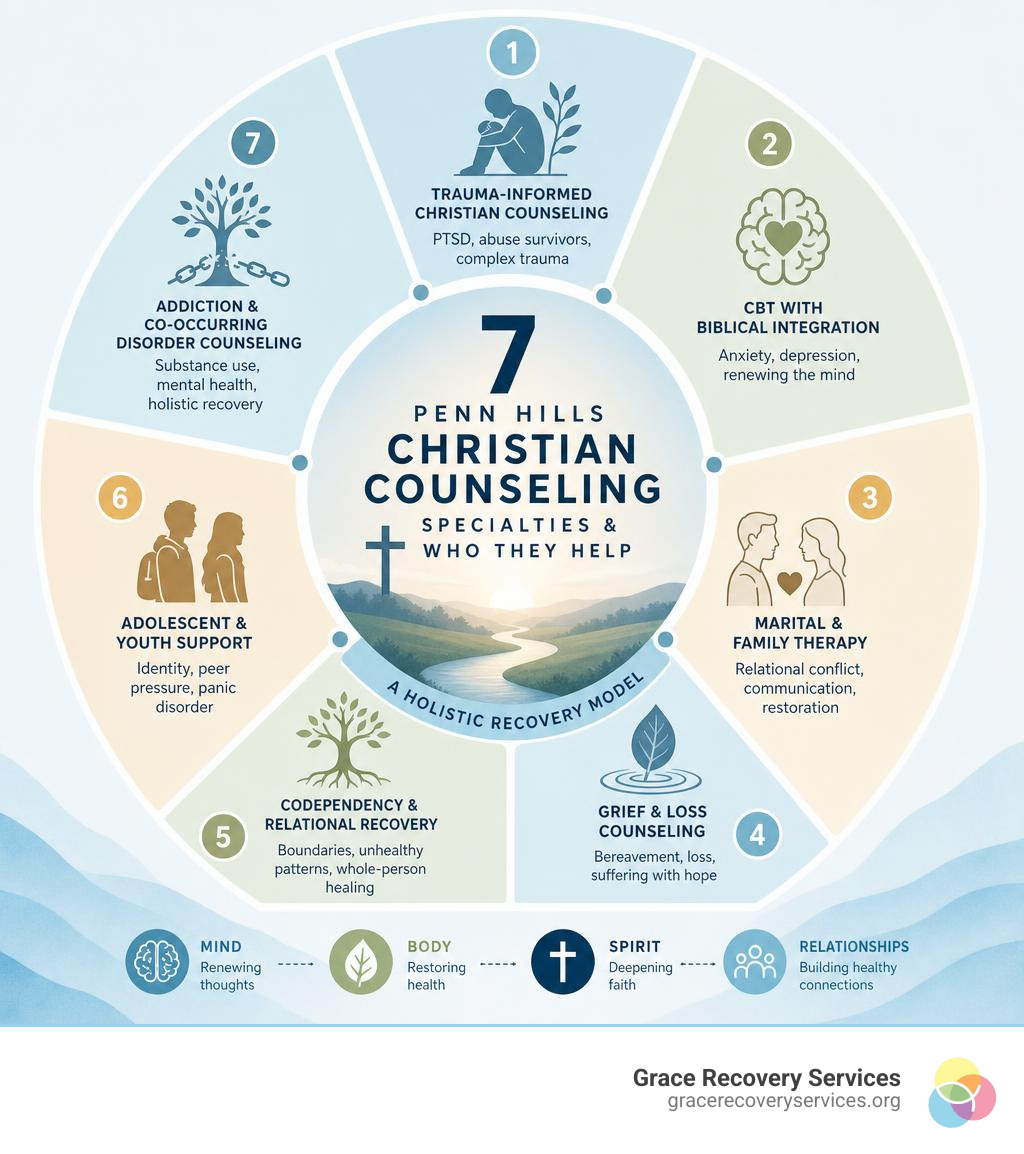
If you’re looking for a quick answer, here are the top Christian counseling options and specialties available in the Penn Hills area:
| Specialty | Who It Helps |
|---|---|
| Trauma-Informed Christian Counseling | PTSD, abuse survivors, complex trauma |
| CBT with biblical integration | Anxiety, depression, renewing the mind |
| Marital & Family Therapy | Relational conflict, communication, restoration |
| Grief & Loss Counseling | Bereavement, loss, suffering with hope |
| Codependency & Relational Recovery | Boundaries, unhealthy patterns, whole-person healing |
| Adolescent & Youth Support | Identity, peer pressure, panic disorder |
| Addiction & Co-Occurring Disorder Counseling | Substance use, mental health, holistic recovery |
Finding the right counselor can feel overwhelming — especially when you’re already carrying something heavy.
Maybe you’re a parent watching someone you love struggle. Maybe you’re the one in the middle of it, unsure where to turn. You’re not alone in this. Research shows that just over half of people will experience at least one traumatic event in their lives, and many of those people carry unresolved wounds that quietly shape everything — relationships, behavior, faith, and sense of self.
What makes Christian counseling in Penn Hills different is this: it doesn’t just treat symptoms. It asks deeper questions about identity, purpose, and healing from the inside out.
At Grace Recovery Services, we understand that recovery — whether from addiction, trauma, or relational pain — is more than a clinical process. It’s a restoration of the whole person: mind, body, and spirit.
This guide walks you through the seven most important Christian counseling specialties available in Penn Hills, so you can find the right fit for where you are right now.
Understanding Penn Hills Christian Counseling

When we look for life-changing mental health support, we want to know that our deepest values will be respected. For many in Western Pennsylvania, faith isn’t just a Sunday routine; it is the lens through which we view the entire world.
Choosing Christian Counseling in Penn Hills means choosing a therapeutic journey where your spiritual life is treated as an asset, not an afterthought. In this integrated environment, clinical science and biblical truth work hand-in-hand to help you find lasting freedom.
The Role of Faith in Penn Hills Christian Counseling
At its core, faith-based counseling recognizes that we are spiritual beings. When we experience emotional distress, anxiety, or a crisis of identity, the struggle often reaches deep into our spiritual lives.
Our approach to Penn Hills Christian counseling emphasizes grace over shame. Instead of feeling judged for your struggles, you are met with the unconditional love and hope of Christ. In a typical session, this faith integration might look like:
- Scripture-Based Reflection: Grounding your identity in what God says about you, rather than your past mistakes or current struggles.
- Prayer: Inviting the Holy Spirit into the therapeutic space to bring comfort and supernatural peace.
- Grace-Based Care: Deconstructing toxic shame and religious trauma, replacing them with the truth of redemption and unconditional grace.
Clinical Modalities Used in Penn Hills Christian Counseling
Some people worry that choosing a faith-based approach means sacrificing clinical quality. In reality, the best Christian counseling practices utilize the exact same evidence-based clinical modalities as secular clinics—they simply build them upon a solid biblical foundation.
Think of clinical strategies as the sturdy foundation and walls of a house, while faith is the protective roof and the warm hearth inside. Some of the highly effective, evidence-based therapies we integrate include:
- Cognitive Behavioral Therapy (CBT): Helping you identify negative, distorted thought patterns and replace them with healthy, truth-based perspectives (aligning closely with the biblical call to “renew your mind”).
- Dialectical Behavior Therapy (DBT): Teaching distress tolerance, emotional regulation, and interpersonal skills to handle life’s storms.
- Eye Movement Desensitization and Reprocessing (EMDR): A powerful, trauma-informed therapy that helps the brain reprocess painful memories, taking the emotional sting out of past trauma.
- Acceptance and Commitment Therapy (ACT): Encouraging values-based living and psychological flexibility, helping you move forward in your calling even when challenging emotions arise.
Comparing the Top 7 Christian Counseling Specialties in Penn Hills
In the Penn Hills area, including our surrounding communities like North Huntingdon and the wider Pittsburgh region, various licensed professionals bring distinct specialties to the table. Licensed Professional Counselors (LPCs), Licensed Social Workers (LSWs), and clinical psychologists offer targeted support depending on what you are walking through.
Let’s break down the seven most impactful Christian counseling specialties so you can see how they address specific mental health, relational, and behavioral needs.
1. Trauma-Informed Christian Counseling
Trauma has a way of fragmenting our sense of safety and distorting our view of God. Whether it stems from childhood neglect, chronic abuse, sexual violence, or sudden loss, trauma leaves deep wounds.
Trauma-informed Christian counseling provides a safe, non-judgmental environment where you can process your story at your own pace. Instead of asking, “What is wrong with you?” a trauma-informed counselor asks, “What happened to you, and how can we invite God’s healing presence into those broken places?”
By pairing clinical trauma treatments like EMDR with the biblical truths of redemption and safety in Christ, clients can safely untangle the physical and emotional grip of trauma. This dual approach helps you move from a state of constant survival and hypervigilance to a place of peace, rest, and emotional freedom.
2. Cognitive Behavioral Therapy (CBT) with Biblical Integration
Our thoughts dictate our emotions, and our emotions shape our choices. When struggles like anxiety, panic disorder, or depression take hold, they often flood our minds with lies: “You are helpless,” “Things will never get better,” or “You are a failure.”
CBT is a gold-standard clinical therapy designed to catch these negative cognitive loops, challenge them, and restructure them. When integrated with a biblical worldview, CBT becomes incredibly powerful. It directly mirrors Romans 12:2: “Do not conform to the pattern of this world, but be transformed by the renewing of your mind.”
A Christian CBT counselor helps you look at your thoughts under the light of scripture. You learn to take anxious thoughts captive, replace toxic self-talk with the truth of God’s grace, and build practical daily coping skills that keep you emotionally grounded.
3. Marital and Family Christian Therapy
Relationships are where our deepest joys and our sharpest pains occur. Over time, marriages and families can fall into destructive communication loops, resentment, and emotional distance.
Marital and family Christian therapy views the family through the lens of God’s design for community and covenant. Utilizing family systems theories, counselors help couples and families identify the hidden patterns maintaining their conflict.
Whether you are seeking premarital counseling to build a strong foundation, trying to save a hurting marriage, or navigating complex parenting dynamics, this specialty offers a structured path back to connection. Counselors provide practical tools for active listening, forgiveness, and boundary-setting, helping restore the peace and unity God desires for your home.
4. Grief and Loss Christian Counseling
Grief is a heavy, disorienting journey. Often, after a major loss, friends and family offer intense support for a few weeks, but as their lives return to normal, the grieving individual is left feeling incredibly isolated.
Grief and loss Christian counseling provides a dedicated space where you don’t have to “put on a brave face.” It acknowledges that sorrow is a natural, healthy response to loss.
A Christian grief counselor walks beside you through the darkness, helping you process the painful questions that arise when our hearts are broken. This specialty combines compassionate clinical support with the eternal hope of the Gospel, assuring you that while your pain is real, death and loss do not have the final say.
5. Codependency and Relational Recovery
It is easy to lose yourself when you are constantly trying to fix, manage, or please the people around you. Codependency often develops as a coping mechanism in response to growing up in a chaotic environment or loving someone who struggles with active addiction.
Codependency recovery focuses on helping you rebuild a healthy, whole-person approach to life. In Christian relational recovery, counselors help you understand that your ultimate worth is found in Christ, not in your ability to save others.
Through this therapy, you will learn to:
- Establish healthy, loving boundaries.
- Break free from people-pleasing and enabling behaviors.
- Differentiate your own emotions and responsibilities from those of others.
- Cultivate relationships built on mutual respect rather than control.
6. Adolescent and Youth Christian Support
Growing up in today’s world presents unprecedented challenges. From intense academic pressure and social media comparison to peer influence and identity confusion, adolescents are facing high rates of anxiety, panic disorder, and depression.
Adolescent Christian counseling provides teenagers with a safe, confidential outlet outside of their immediate family to discuss their struggles. Counselors meet youth right where they are, using age-appropriate, creative therapeutic techniques.
The primary goal is to help young people discover their true identity in Christ, build emotional resilience, and develop practical coping mechanisms to navigate peer pressure and mental health hurdles with confidence.
7. Integrated Addiction and Co-Occurring Disorder Counseling
Addiction is never just a physical problem; it is a complex disease that impacts the mind, body, and spirit. Often, substance use is an attempt to self-medicate deeper, unresolved wounds like trauma, depression, or severe anxiety.
Integrated addiction counseling addresses both the substance use and the underlying mental health conditions (known as co-occurring disorders) simultaneously. At Grace Recovery Services, we specialize in this holistic, dual-diagnosis care.
By combining evidence-based clinical treatments with deep spiritual restoration, we help clients break the cycle of addiction. Rather than focusing solely on relapse prevention, we aim for total transformation—helping you reclaim your identity, repair your relationships, and step boldly into the purposeful life God has planned for you.
Addressing Mental Health and Addiction Holistically

True healing cannot happen in a silo. If we only treat the physical symptoms of a substance use disorder without addressing the emotional trauma beneath it, the foundation remains shaky. Similarly, if we address the mental health challenges but ignore the spiritual hunger for purpose and connection, the recovery is incomplete.
This is why holistic care is so vital. It treats the whole person. This whole-person approach also aligns with broader public health guidance from SAMHSA, which recognizes the importance of addressing co-occurring mental health and substance use conditions together rather than separately.
Statistics highlight just how powerful this integration is:
- Approximately 73% of substance abuse treatment programs in the United States include spiritual elements, most frequently through faith-integrated and 12-Step models.
- Faith-based recovery support contributes an estimated $316.6 billion in annual savings to the U.S. economy by reducing healthcare costs, criminal justice expenses, and lost workplace productivity.
At Grace Recovery Services, we offer comprehensive Christian Recovery Services and Christian Integrated Addiction Treatment right here in Western Pennsylvania. Our outpatient programs, including our Intensive Outpatient Program (IOP), provide a structured, supportive environment where you can receive top-tier clinical therapy while staying connected to your family, work, and community.
Through individual therapy, family restoration, and peer support groups, we walk alongside you on every step of your journey from healing to long-term thriving.
Frequently Asked Questions About Christian Counseling
Choosing a counselor is a personal decision, and it is completely normal to have questions before taking that first step. Here are some of the most common questions we hear from individuals looking for Penn Hills Christian counseling.
How does Christian counseling differ from secular therapy?
While secular therapy and Christian counseling utilize many of the same evidence-based clinical tools (such as CBT or EMDR), their foundational worldviews differ. Secular therapy typically views the human experience through a strictly psychological or biological lens.
Christian counseling, however, recognizes that we are created by God and for God. It views emotional and mental struggles not just as clinical symptoms, but as opportunities for spiritual growth and restoration. It addresses the spiritual crises—such as guilt, shame, unforgiveness, and identity—that are often at the absolute center of mental health and addiction struggles, inviting the healing power of the Holy Spirit into the clinical process.
Do local Christian counselors accept insurance or Medicaid?
Yes, many Christian counseling providers in Western Pennsylvania accept major health insurance plans. Because mental health and addiction treatment are recognized as essential health benefits, your insurance policy may cover a significant portion of your care.
At Grace Recovery Services, we work diligently to keep our services financially accessible. We accept a variety of commercial insurance plans and can help you navigate your benefits. We highly recommend reaching out to our intake team for a confidential benefit verification so you can understand your coverage before starting treatment.
Is telehealth or online Christian counseling available?
Absolutely. We understand that transportation challenges, busy work schedules, childcare needs, or health concerns can sometimes make it difficult to attend in-person sessions in Penn Hills or North Huntingdon.
To ensure you can get the help you need when you need it, we offer convenient, secure, and fully HIPAA-compliant telehealth options. You can connect with our licensed Christian counselors from the comfort and privacy of your own home anywhere in Pennsylvania.
If you are looking for local support in Western Pennsylvania, our team at Grace Recovery Services is here to help guide you toward the right resources and clinical support for your unique journey.
Conclusion
No matter how dark things may seem right now, there is hope. Your struggles, your past, and your wounds do not define you. Through professional, faith-integrated care, you can experience true renewal and step into the abundant life God has for you.
If you or a loved one is struggling with mental health challenges, trauma, or a substance use disorder, please know that you do not have to carry this burden alone. We are here to help.
At Grace Recovery Services, we offer compassionate, outpatient-focused care designed to heal the mind, body, and spirit. To learn more about how a faith-rooted approach can guide you or your loved one to lasting freedom, read our guide on How Faith Helps with Addiction.
Whenever you are ready to take that first courageous step toward healing, we are ready to walk with you. Reach out to our warm, non-judgmental team today on our Contact page to schedule a confidential assessment.
This article was researched with AI and heavily edited by Stephen Luther for accuracy and relevance.
Stephen Luther is the Executive Director and Founder of Grace Christian Counseling, Grace Recovery Services, WPA Counseling, NuWell Online Counseling and Coaching, and NuWell Health. He holds a Master’s degree in Education from the University of Georgia and a Master’s degree in Marriage and Family Therapy from Duquesne University. He is a licensed professional counselor in Pennsylvania.
Since 1997, Steve has been helping children, adolescents, and adults overcome a wide range of emotional and relational challenges. He specializes in working with hurting families, including those with foster, adopted, or traumatized children. Steve uses Attachment-Based Therapy, Splankna Healing, and Therapeutic Parent Coaching to support healing and restoration.
This guide is for educational and spiritual encouragement and is not a substitute for personalized professional counseling. If you are in crisis, please reach out for immediate help.