
Why a biblical approach to recovery offers real hope
A biblical approach to recovery is one of the most complete frameworks available for people seeking lasting freedom from addiction — not just sobriety, but genuine transformation of the heart, mind, and spirit.
If you want a quick answer, here is what a biblical approach to recovery looks like in practice:
A biblical approach to recovery involves:
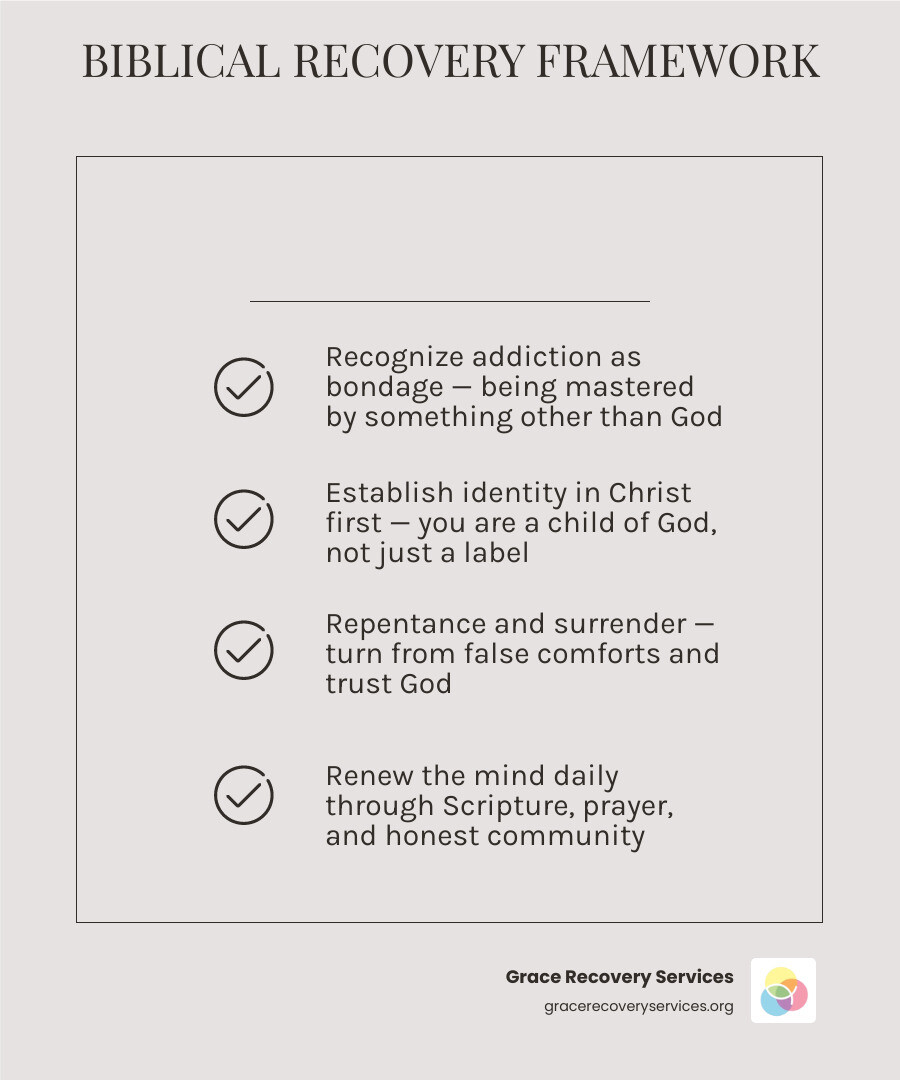
- Recognizing addiction as bondage — Scripture describes it as being “mastered” or enslaved by something other than God (1 Corinthians 6:12)
- Establishing identity in Christ first — You are a child of God, not just an addict or a label
- Repentance and surrender — Turning from false sources of comfort and trusting God with the battle
- Renewing the mind daily — Through Scripture, prayer, and honest community
- Discipleship over symptom management — Growing in Christlikeness, not just maintaining sobriety
- Local church and accountability — Bearing burdens together, confessing struggles, and walking alongside mature believers
- Integrating clinical care where needed — Addressing trauma, co-occurring mental health struggles, and physical safety alongside spiritual growth
The statistics are sobering. As of 2023, over 46 million Americans met the criteria for substance use disorder — yet only about 14.6% received any treatment at all. And for those who do enter recovery programs, relapse rates remain painfully high, with some studies suggesting 40–60% of people relapse while still in a program.
Something deeper is needed.
At Grace Recovery Services in Western Pennsylvania, we have seen what happens when faith is woven into the recovery process — not as a checkbox, but as the foundation. The Bible does not use the word “addiction,” but it speaks powerfully about bondage, false refuge, and the kind of freedom that only comes through Christ.
This guide walks through the core biblical principles that shape genuine recovery: what Scripture says about why people stay stuck, how to fight without turning against yourself, what identity in Christ means for someone in the middle of a struggle, and how practical daily steps — combined with compassionate, trauma-informed care — can move someone from chains to freedom.
You do not have to have it all figured out to start. The next right step is enough.
What a biblical approach to recovery really means
When we talk about a biblical approach to recovery, we are looking at the world through a lens of restoration. This is not about following a rigid set of rules to “be better.” Instead, it is about a biblical worldview that sees each person as made in the image of God, worthy of dignity, compassion, and care even in the middle of struggle. We believe true freedom is found in Christ, moving from a life of idolatry, where substances become a source of comfort, toward a life of worship, where hope, identity, and healing are rooted in God.
The core difference between common clinical frameworks and a biblical approach to recovery
In many clinical settings, addiction is understood primarily through brain chemistry, behavior patterns, and environmental risk factors. At Grace Recovery Services, we respect those realities and the importance of evidence-based care. At the same time, a biblical approach to recovery asks deeper questions about the heart, suffering, meaning, and the ways people seek refuge when life feels overwhelming.
This approach does not remove personal dignity or agency. Instead, it recognizes that a person may be impacted by trauma, cravings, and physical dependence while still being invited into repentance, healing, and spiritual renewal. Our trauma-informed, faith-based model in Western Pennsylvania seeks to care for the whole person: mind, body, and spirit.
| Feature | Common Clinical Framework | Biblical Discipleship Framework |
|---|---|---|
| Primary View | Person with a substance use disorder | Child of God in need of healing and discipleship |
| Core Focus | Symptoms, behaviors, and contributing factors | Heart, worship, suffering, and spiritual formation |
| Goal | Stabilization and long-term recovery support | Spiritual renewal alongside lasting recovery |
| Tools | Counseling, coping strategies, and evidence-based support | Grace, truth, repentance, Scripture, prayer, and community |
| Identity | Struggle may become central to self-understanding | Identity is rooted first in Christ, not past patterns |
How Scripture describes addiction, bondage, and being mastered
The Bible uses vivid language that speaks powerfully to what many people experience in addiction. In 1 Corinthians 6:12, Paul writes, “All things are lawful for me, but I will not be dominated by anything.” That picture of being ruled or mastered by something outside of God’s will closely reflects the loss of freedom so many clients describe.
Scripture also speaks of slavery to sin in Romans 6. Many people turn to substances as a false refuge, trying to numb pain, trauma, grief, anxiety, or shame. What begins as relief can slowly become bondage. For more insight into these patterns, you can read what the Bible says about substance abuse and explore 1 Corinthians 6:12 to understand the nature of being mastered.
Why people keep doing what they do not want to do
If you have ever felt the frustration of wanting to stop but finding yourself returning to the same pattern, you are not alone. Romans 7 describes this inner conflict with honesty and compassion: “For I do not do the good I want, but the evil I do not want is what I keep on doing.”
In real life, that struggle is often shaped by more than willpower alone. Trauma triggers, family dynamics, learned coping patterns, anxiety, depression, and shame can all intensify the cycle. At Grace Recovery Services, we use a trauma-informed approach that helps clients understand cravings and self-protective behaviors without excusing harm or feeding shame. Healing begins when truth and compassion meet.

Biblical approach to recovery and the battle within
Recovery is not a one-time event; it is a process of sanctification. This involves the “renewal of the mind” (Romans 12:2), where we learn to replace the lies of addiction with the truth of God’s Word.
Fighting sin without becoming divided against yourself
One common mistake in recovery is trying to “fight” yourself. If you view yourself as the enemy, you create a “house divided” that cannot stand. In a biblical approach to recovery, we learn to stop fighting against our own resources and start leaning into God’s. Galatians 5:17 tells us the flesh and Spirit are in opposition, but Romans 8 reminds us that there is “no condemnation for those who are in Christ Jesus.” We don’t fight for victory; we fight from the victory Christ has already won.
Spiritual warfare, temptation, and the armor of God
Addiction thrives in the dark. It uses lies (“You’ll never change”), accusation (“You’re a failure”), and isolation (“No one understands”) to keep people stuck. This is spiritual warfare. Ephesians 6 instructs us to put on the full armor of God—truth, righteousness, peace, faith, and the Word of God. Being “sober-minded” is a frequent command in the New Testament because a clear mind is essential for spiritual vigilance. You can find 25 be sober-minded scripture passages to keep you sharp on our blog to help in this daily battle.
“The battle is the Lord’s” and personal responsibility both matter
There is a beautiful tension in recovery: we must surrender completely to God, yet we must also take personal responsibility for our choices. We say “the battle is the Lord’s” (2 Chronicles 20:15) to acknowledge that we cannot save ourselves. However, God empowers us to flee temptation and set wise boundaries. It’s not “I do it” or “God does it,” but rather “God does it through me as I walk in obedience.”

Identity in Christ, repentance, and discipleship for lasting freedom
One of the most powerful answers to the shame that often surrounds addiction is a renewed identity. When someone believes their struggle is the truest thing about them, hopelessness can deepen. But when identity is grounded in Christ, recovery begins to include dignity, belonging, and real hope.
Why believers should not be defined only by labels or past patterns
In Christ, you are a “new creation” (2 Corinthians 5:17). That does not erase the real work of recovery, but it does mean your story is not limited to your worst days. At Grace Recovery Services, we use person-first language because we want clients and families to hear this clearly: a diagnosis, a relapse, or a painful past is not the whole of who you are.
This shift matters. It reduces shame, supports honest accountability, and helps people move forward with courage rather than condemnation. We focus on higher power and higher purpose to help clients see that their past does not have to define their future.
The role of repentance, surrender, and renewing the mind
Repentance is more than saying “sorry.” It is a change of mind and direction. In recovery, that often means turning away from the substances, habits, and false comforts we have leaned on and turning toward God with honesty and surrender.
Renewing the mind is part of that daily process. Scripture, prayer, Christian counseling, and wise support from others help replace lies with truth. This is especially important for clients carrying trauma, grief, or deep self-criticism. We often encourage clients to meditate on renewing your mind with powerful Bible verses as part of building healthier thought patterns rooted in grace and truth.
Key biblical truths that guide recovery day by day
Lasting freedom is built through daily reminders of what is true. These truths can steady a person when emotions feel loud and circumstances feel heavy:
- Grace over shame: God’s mercy meets us honestly and lovingly.
- God’s faithfulness: He provides help, wisdom, and a way forward in moments of temptation.
- Endurance: Growth is often gradual, and perseverance matters.
- No condemnation in Christ: A setback does not cancel God’s care or the value of getting back up.
- Renewal is possible: Through support, discipleship, and treatment, people really can change.
For those looking for a structured way to engage with these truths, resources like 52 Truths for Conquering Addiction can provide a year-long roadmap for discipleship.
The local church, accountability, and practical biblical recovery care
We were never meant to walk this path alone. Addiction often grows in secrecy and isolation, but recovery is strengthened through safe relationships, honest support, and consistent care.
Why community and accountability are essential in a biblical recovery process
Galatians 6:2 tells us to “bear one another’s burdens.” In our Western Pennsylvania communities, from the Pittsburgh area to North Huntingdon and surrounding areas, we see how healing deepens when clients are supported by trusted people who offer prayer, encouragement, and accountability.
Accountability is not about policing or shaming someone. It is about loving them enough to ask honest questions, notice warning signs, and stay present when the road is hard. Healthy community can also support families who are carrying exhaustion, fear, or relational wounds of their own. You can learn more about how faith helps with addiction through the support of a healthy church family.
How churches can implement a biblical model of recovery
Churches can play an important role in recovery by equipping mature leaders in biblical care, trauma awareness, and compassionate support. Rather than offering only informal encouragement, churches can build thoughtful discipleship pathways, mentor relationships, referral partnerships, and practical help for individuals and families affected by substance use.
Resources like Addiction and the Local Church can help church leaders think through how to provide gospel-centered care that is wise, safe, and connected to appropriate clinical support when needed.
Integrating biblical care with trauma-informed and evidence-based support
At Grace Recovery Services, we believe biblical care and clinical excellence belong together. Our team provides Christian integrated addiction treatment that is trauma-informed, evidence-based, and centered on healing the whole person.
That includes support for co-occurring concerns such as anxiety, depression, and trauma-related struggles, along with faith-based outpatient treatment designed for clients in Western Pennsylvania. Through Christian counseling, outpatient programming, and aftercare support, we help clients pursue recovery that is both spiritually grounded and clinically informed.
Practical biblical recovery steps you can start today
You don’t need to wait for a “perfect” moment to start. Freedom begins with small, faithful rhythms.
A simple week of biblical recovery steps for clients and families
If you’re feeling overwhelmed, try this simple seven-step starter week:
- Morning Prayer: Start the day by surrendering your will to God.
- Scripture Reading: Spend 15 minutes in the Psalms or Proverbs. Check out these Bible verses for strength in recovery.
- Connect: Call one trusted Christian friend or mentor just to check in.
- Attend Church: Join a local body of believers in Western PA for worship.
- Journal: Write down three things you are grateful for and one area where you saw God’s grace.
- Trigger Planning: Identify one person or place to avoid this week and share it with your accountability partner.
- Rest: Prioritize 8 hours of sleep and a healthy meal, honoring your body as a temple of the Holy Spirit.
Bible passages to pray, memorize, and return to in moments of temptation
Keep these “emergency” verses in your heart or on your phone:
- Romans 8:1: “There is therefore now no condemnation for those who are in Christ Jesus.”
- 1 Corinthians 10:13: God is faithful and will provide a way of escape.
- Psalm 51: A beautiful prayer for restoration after a fall.
- Matthew 11:28: Jesus’ invitation to the weary to find rest.
For a deeper list, see our guide on scriptures to help with addiction or the best Bible verses for recovering addicts.
When to seek additional support beyond personal devotion alone
While personal devotion is vital, sometimes the “chains” are heavy enough that you need professional, structured help. You should reach out for clinical support if:
- Your substance use is escalating despite your best efforts to stop.
- You are experiencing physical withdrawal symptoms (which can be dangerous).
- Your mental health is declining, or you feel hopeless.
- Your addiction is causing severe strain on your family or job.
Frequently Asked Questions About a Biblical Approach to Recovery
Is addiction only a spiritual issue, or should Christians also seek clinical help?
Addiction is holistic—it affects the spirit, the mind, and the body. While the root is often spiritual, the damage is often physical and psychological. We believe in “whole-person care.” Seeking help from a licensed Christian counselor or an Intensive Outpatient Program (IOP) is not a lack of faith; it is a wise use of the tools God has provided through common grace and medical science.
Can someone love Jesus and still struggle with addiction?
Absolutely. Many of the greatest figures in the Bible struggled with deep-seated sins and failures. Being a Christian doesn’t mean you’re perfect; it means you’re forgiven and in the process of being changed. There is no shame in admitting you need help to overcome a “besetting sin.”
What should I do if I have relapsed?
First, do not let shame drive you into hiding. That is exactly what the enemy wants. Immediately confess the slip to God and your accountability partners. Safety is the priority—if you are in physical danger, seek medical help. Then, re-engage with your community and look at the “triggers” that led to the relapse as a learning opportunity, not a final failure.
Conclusion: Your Journey to Restoration Starts Here
A biblical approach to recovery is not about trying harder; it’s about trusting more. It’s about realizing that the same power that raised Jesus from the dead is at work in you, breaking the chains of addiction and restoring what the locusts have eaten.
At Grace Recovery Services, we are committed to walking this road with you. Whether you are in Pittsburgh, Penn Hills, North Huntingdon, or anywhere in Western Pennsylvania, our team is here to provide compassionate, trauma-informed, and faith-centered care. From our Christian intensive outpatient treatment to our individual counseling, we are dedicated to your holistic healing.
You don’t have to carry this burden alone. Reach out to us today for a compassionate assessment. Let’s take the next right step together.
This article was researched with AI and heavily edited by Stephen Luther for accuracy and relevance.
Stephen Luther is the Executive Director and Founder of Grace Christian Counseling, Grace Recovery Services, WPA Counseling, NuWell Online Counseling and Coaching, and NuWell Health. He holds a Master’s degree in Education from the University of Georgia and a Master’s degree in Marriage and Family Therapy from Duquesne University. He is a licensed professional counselor in Pennsylvania.
Since 1997, Steve has been helping children, adolescents, and adults overcome a wide range of emotional and relational challenges. He specializes in working with hurting families, including those with foster, adopted, or traumatized children. Steve uses Attachment-Based Therapy, Splankna Healing, and Therapeutic Parent Coaching to support healing and restoration.
This guide is for educational and spiritual encouragement and is not a substitute for personalized professional counseling. If you are in crisis, please reach out for immediate help.