
Family support in addiction recovery can make a meaningful difference when it is steady, respectful, and grounded in safety. Helpful support does not mean controlling another adult’s treatment, absorbing every consequence, or receiving private clinical information. It means listening without shame, offering concrete help, keeping clear boundaries, and knowing when a situation needs emergency care.
If you are worried about someone you love, you do not need the perfect words or a complete treatment plan before asking for guidance. You can begin with what you have noticed, what feels unsafe, and what kind of next step you are willing to support.
What family support in addiction recovery can look like
A useful starting point is to separate support from control. You can influence the conditions around a conversation and the help you offer. You cannot guarantee that another person will accept treatment, stay in recovery, disclose information, or rebuild trust on your timeline.
| Support | Control or rescue |
|---|---|
| Describe specific changes you have noticed | Assign a label or argue about someone’s character |
| Offer to help make a call, arrange transportation, or write down questions | Choose a program for another adult and demand agreement |
| Set limits on your own money, home, time, and participation | Use threats you cannot or will not carry out |
| Let the person decide whether faith practices are part of care | Use Scripture, prayer, guilt, or church authority to force treatment |
| Ask what information the person wants shared with family | Assume love creates a right to confidential treatment details |
The goal is not to become the treatment team. It is to make honest, safer choices in your own role while leaving clinical decisions to qualified professionals and respecting the other person’s dignity.
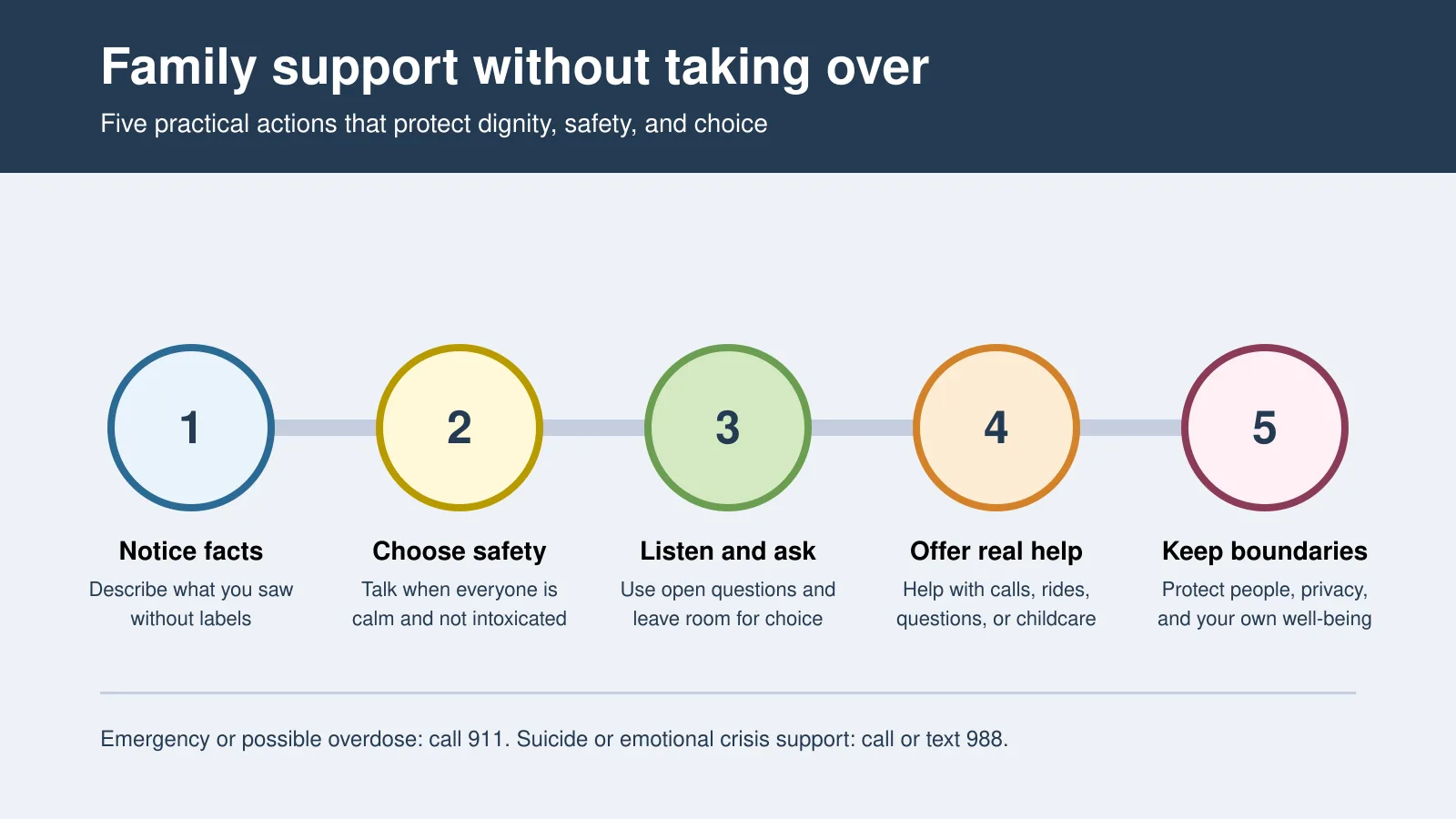
- 1Notice facts. Describe what you saw without labels.
- 2Choose safety. Talk when everyone is calm and no one is intoxicated.
- 3Listen and ask. Use open questions and leave room for choice.
- 4Offer real help. Help with calls, rides, questions, or childcare.
- 5Keep boundaries. Protect people, privacy, and your own well-being.
Five practical ways to help
1. Start with a calm, specific conversation
Choose a private time when the person is not intoxicated, withdrawing, driving, or in the middle of an escalating conflict. Name observable facts instead of diagnosing: “I noticed you missed work twice and seemed unsteady last night. I am concerned about you.” Then ask an open question such as, “What has this been like for you?”
Listen for what the person says about substance use, stress, grief, anxiety, depression, trauma, relationships, and faith. Trauma may be part of the story, but family members should not assume it caused the addiction or press for disclosure. A safety-first conversation leaves room for choice and does not require someone to explain painful experiences before they are ready. If you are still at this early stage, our guide to starting a conversation about treatment goes deeper.
2. Offer help with the next step, not the whole future
A smaller offer is often easier to accept than a sweeping demand. You might offer to sit with the person while they call a treatment provider, help list insurance questions, provide transportation to an assessment, or arrange childcare for an appointment. A professional assessment can help determine whether outpatient treatment, intensive outpatient treatment, withdrawal management, residential care, hospital care, or another service may be appropriate.
3. Set boundaries around your own participation
A boundary describes what you will do, not how you will force someone else to behave. It may sound like: “I will not provide cash, but I can buy groceries directly,” “I will leave the conversation if I am threatened,” or “Substances may not be used in my home.” The safest boundary depends on the relationship, living situation, children in the home, financial realities, and any risk of violence or retaliation.
Boundaries are not a test of love and should not be used as punishment. When abuse, stalking, threats, child safety, or coercive control is present, prioritize safety planning with an appropriate local professional rather than confronting the person alone.
4. Know the difference between a treatment question and an emergency
Ordinary questions about programs, insurance, scheduling, or what happens during an assessment belong with a provider’s care team. A possible overdose, immediate danger, severe intoxication, violence, or suicidal behavior is an emergency. Call 911. If an opioid overdose is possible and naloxone is available, use it according to its instructions and still call 911. Naloxone can reverse an opioid overdose when given in time, and it is available over the counter in every state.[3]
Alcohol, benzodiazepines, and some other substances can involve medically dangerous withdrawal. Do not advise someone to stop abruptly or attempt detox at home based on an online article. Seek urgent professional evaluation when severe withdrawal or medical instability may be present.
5. Protect your own health and support system
Family members can become exhausted by monitoring moods, covering responsibilities, and preparing for the next crisis. Your sleep, medical care, counseling, friendships, work, parenting, worship, and ordinary routines still matter. Support groups, individual counseling, pastoral support, or family counseling may help you decide what belongs to you and what does not.
Caring for yourself is not abandoning the person you love. It can help you respond with more consistency and less fear. SAMHSA encourages families to be open to support groups, family therapy, and counseling, and notes that caregivers should take steps to protect their own health.[4][5]
When your loved one enters treatment
Ask the person what kind of involvement they want and what the program allows. Possibilities may include providing history during an assessment, participating in an education session, joining a family meeting when clinically appropriate, helping with transportation, or supporting a discharge plan. Participation should have a clear purpose and should not become surveillance. For the season after treatment begins, see how to support someone in recovery.
Trust and access do not return automatically because treatment has started. Restoring a relationship may require time, consistent behavior, accountability, counseling, and attention to safety. Forgiveness, reconciliation, renewed contact, and restored financial or household access are not identical decisions.
How Christian faith can guide support without pressure
Christian faith can shape a family’s posture through compassion, truthfulness, hope, patience, and respect for each person’s God-given dignity. Galatians 6:2 calls believers to “carry each other’s burdens,” and only a few verses later, Galatians 6:5 adds that “each one should carry their own load.” As a pastoral application, families can offer real help while recognizing that they cannot do another person’s recovery work for them.
What families can ask Grace Recovery Services
Grace Recovery Services provides Christ-centered, trauma-informed outpatient addiction treatment, including outpatient and intensive outpatient programs and care for co-occurring mental health needs. You can compare GRS services before you call, and our care team can confirm current availability and fit.
A family member may contact GRS to ask:
- What treatment options are currently available
- What information is helpful to share at first contact
- How a loved one can explore an assessment
- How family involvement works when the client consents and it is clinically appropriate
Contacting the program does not create access to another person’s records or guarantee admission. For ongoing or complementary counseling, Grace Christian Counseling, our affiliated Christian counseling practice, may also be an option when appropriate and available.
Frequently asked questions
Can family support make someone accept addiction treatment?
No. A family can communicate concern, offer practical help, change its own responses, and seek professional guidance, but it cannot guarantee that another adult will accept or benefit from treatment. Laws and emergency procedures vary, so get qualified local guidance when immediate safety or involuntary evaluation is at issue.
Can a treatment provider tell me whether my loved one is a client?
Often, the provider cannot confirm treatment or share clinical information without the person’s permission unless a legal exception applies. Substance use disorder records may have protections under 42 CFR Part 2 in addition to HIPAA. You may still be able to give the provider information, but that does not guarantee the provider can share information in return.
Does forgiveness mean I must restore trust or contact?
No. Forgiveness, reconciliation, trust, and access are different decisions. Christian faith should not be used to pressure someone to ignore harm or resume unsafe contact. Trust may need to be rebuilt through time, accountability, consistent behavior, and attention to safety.
Sources
- 1988 Suicide & Crisis Lifeline. Substance Abuse and Mental Health Services Administration.
- 2SAMHSA’s National Helpline. Substance Abuse and Mental Health Services Administration.
- 3Lifesaving Naloxone. Centers for Disease Control and Prevention.
- 4Helping Families Cope with Mental Health and Substance Use Disorders. Substance Abuse and Mental Health Services Administration.
- 5TIP 39: Substance Use Disorder Treatment and Family Therapy. Substance Abuse and Mental Health Services Administration (updated 2020).
- 6Understanding Confidentiality of Substance Use Disorder (SUD) Patient Records or “Part 2”. U.S. Department of Health and Human Services, Office for Civil Rights.