What Are the Different Types of Substance Use Disorders?
The main types of substance use disorders recognized in the DSM-5 are:
| Type | Primary Substance(s) |
|---|---|
| Alcohol Use Disorder | Beer, wine, liquor |
| Opioid Use Disorder | Heroin, prescription pain relievers, fentanyl |
| Stimulant Use Disorder | Cocaine, methamphetamine, Adderall |
| Cannabis Use Disorder | Marijuana, THC products |
| Tobacco/Nicotine Use Disorder | Cigarettes, vaping, chewing tobacco |
| Sedative Use Disorder | Benzodiazepines, sleeping pills |
| Hallucinogen Use Disorder | LSD, psilocybin, PCP |
| Inhalant Use Disorder | Glue, solvents, aerosols |
| Polysubstance Use Disorder | Two or more substances combined |
If you or someone you love is struggling, you are not alone — and there is real, lasting hope.
In 2023, more than 1 in 10 U.S. adults said they had experienced a substance use problem at some point in their lives. Of those, more than 7 in 10 considered themselves to be in recovery or recovered, according to the 2023 National Survey on Drug Use and Health. That is a powerful number. Recovery is possible — and it happens every day.
Substance use disorders are not a sign of weakness or moral failure. They are complex medical conditions that affect the brain, behavior, and every area of a person’s life — from relationships and work to physical health and spiritual well-being. Understanding the different types is the first step toward getting the right help.
At Grace Recovery Services, we serve clients and families across the Pittsburgh area and Western Pennsylvania who are walking through exactly this — and we believe healing of mind, body, and spirit is always within reach.
My name is Stephen A. Luther, MSEd, MEd, LPC, Executive Director and Founder of Grace Recovery Services, and I have spent over two decades providing trauma-informed, faith-integrated care for people facing all types of substance use disorders. In this guide, I will walk you through each type clearly and compassionately, so you can find the path forward that is right for you or your loved one.
Defining Substance Use Disorder: From DSM-IV to DSM-5
To understand the types of substance use disorders we see today, it’s helpful to look at how the medical community’s understanding has evolved. For many years, clinicians used the DSM-IV, which separated substance issues into two distinct categories: “abuse” and “dependence.”
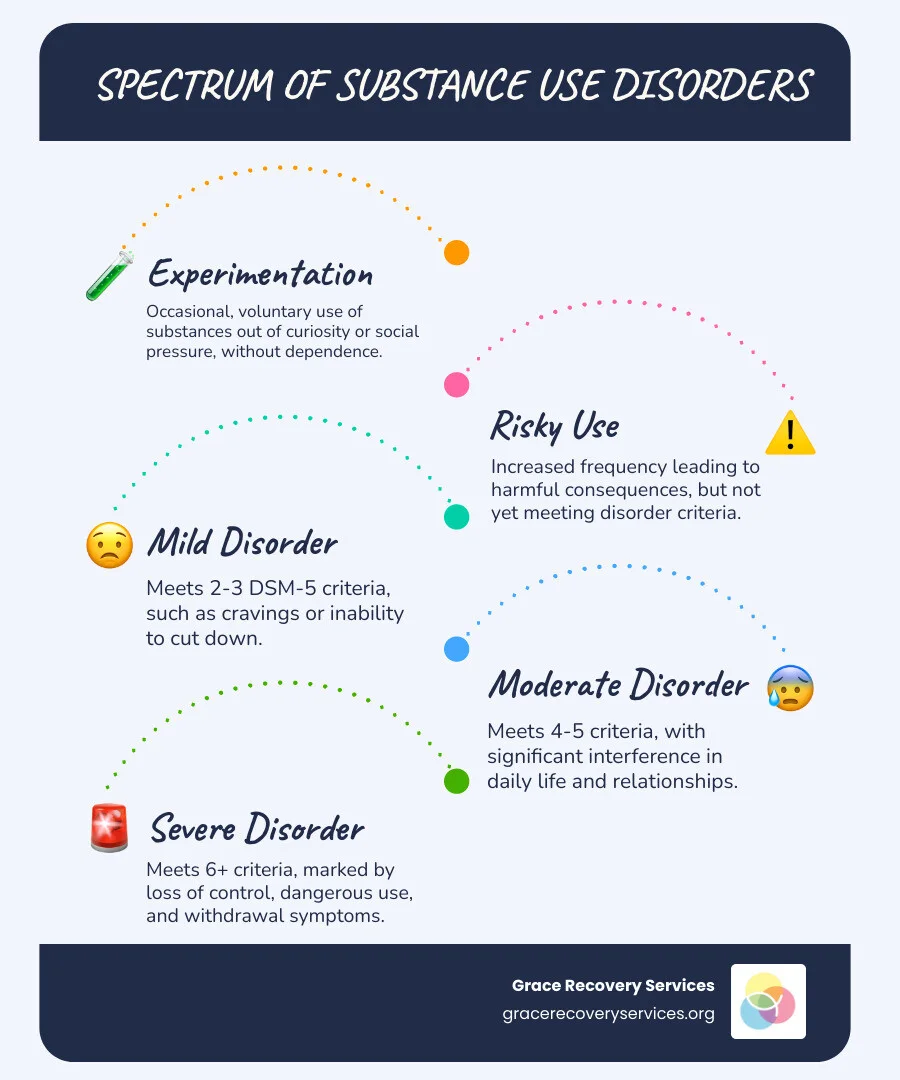
However, in 2013, the American Psychiatric Association updated this to the DSM-5. This was a major shift. Instead of two separate boxes, we now view these challenges as a single continuum. This change reflects the reality that addiction isn’t an “on or off” switch; it’s a spectrum that can range from mild to life-threatening.
The 11 Diagnostic Criteria
Under the current Table 3, DSM-5-TR Criteria for Diagnosing and Classifying Substance Use Disorders [a,b] – Substance Use Screening, Risk Assessment, and Use Disorder Diagnosis in Adults – NCBI Bookshelf, there are 11 core symptoms used to identify a disorder. These are generally grouped into four categories:
- Impaired Control: Using more than intended, wanting to cut down but being unable to, spending a lot of time obtaining the substance, and experiencing “craving” (an intense urge to use).
- Social Impairment: Neglecting responsibilities at work, school, or home; continuing use despite relationship problems; and giving up important social or recreational activities.
- Risky Use: Using the substance in physically dangerous situations (like driving) and continuing use even when you know it’s causing physical or psychological harm.
- Pharmacological Effects: Developing “tolerance” (needing more to get the same effect) and experiencing “withdrawal” symptoms when stopping use.
Severity Levels
One of the most helpful parts of the DSM-5 is how it helps us understand the severity of the situation. We don’t just say someone “has an addiction”; we look at how many of those 11 criteria they meet:
- Mild: 2 to 3 symptoms
- Moderate: 4 to 5 symptoms
- Severe: 6 or more symptoms
This nuanced approach allows us at Grace Recovery Services to tailor our Facts of Addiction education and treatment plans to exactly where a client is. It’s also worth noting that the “legal problems” criterion from the old manual was removed because it wasn’t a reliable indicator for everyone, while “craving” was added because it is such a central part of the brain’s struggle during recovery.
Exploring the Different Types of Substance Use Disorders

When we talk about the different types of substance use disorders, we are usually categorizing them by the primary substance being misused. Each substance interacts with the brain’s reward system in a unique way, but they all share a common thread: they hijack the brain’s natural ability to feel pleasure and make healthy decisions.
It is important to remember that while a person might have a “primary” substance, Substance Use Disorder (SUD): Symptoms & Treatment often involves more than one. In our North Huntingdon and Penn Hills offices, we use person-first language because we believe you are a child of God first, and your struggle is a condition you are facing, not your identity.
Whether you are looking for Types of Substance Use Disorders and How to Treat Them, understanding the specific nuances of each can help demystify the path to restoration.
Common Types of Substance Use Disorders in Adults
In the adult population across Western Pennsylvania, we see several prevalent types of SUDs.
Alcohol Use Disorder (AUD) Alcohol is the most commonly misused legal substance in the U.S. It’s often socially acceptable, which can make it hard to recognize when use has crossed the line into a disorder. AUD involves a pattern of drinking that results in distress or harm. In 2023, about 28.9 million people aged 12 and older in the U.S. had an alcohol use disorder, according to the 2023 National Survey on Drug Use and Health.
Opioid Use Disorder (OUD) This includes both illegal drugs like heroin and prescription pain relievers (such as oxycodone or hydrocodone). The opioid crisis has hit Pennsylvania hard. OUD is particularly dangerous because of the high risk of overdose and the rapid way these substances change brain chemistry—sometimes in as little as five days of misuse.
Stimulant Use Disorder This category covers substances like cocaine, “crack,” and methamphetamines, as well as prescribed medications for ADHD like Adderall when used non-medically. Stimulants create a “high” by flooding the brain with dopamine, but the “crash” that follows often leads to a devastating cycle of use.
Sedative, Hypnotic, or Anxiolytic Use Disorder This refers to the misuse of benzodiazepines (like Xanax or Valium) and sleeping pills. These are often prescribed for anxiety or insomnia, but they can be highly addictive, and withdrawing from them without medical supervision can be dangerous.
Tobacco/Nicotine Use Disorder While often viewed differently than “hard drugs,” nicotine is incredibly addictive.
Identifying Types of Substance Use Disorders in Adolescents
Adolescents in our Westmoreland County and Allegheny County communities face unique vulnerabilities. Because the teen brain is still developing—especially the areas responsible for decision-making and impulse control—substance use can have long-lasting effects.
Cannabis Use Disorder Marijuana is the most common substance (after alcohol and nicotine) used by teens. Many people believe it’s “natural” and therefore harmless, but modern cannabis is significantly more potent than it was decades ago. In one study, about 34% of frequent cannabis users reported three or more withdrawal symptoms, such as irritability and sleep problems (Hasin et al., 2008).
Nicotine and Vaping The rise of e-cigarettes has created a new generation of nicotine dependence. Many teens who would never touch a cigarette are now struggling with high-concentration nicotine vapes.
Inhalant and Hallucinogen Use While less common, these still pose a major threat. Inhalants (like glue or aerosols) are often “household” items, making them accessible. Hallucinogens (like LSD or mushrooms) don’t typically have a physical withdrawal syndrome, but they can cause profound psychological distress.
If you notice a sudden drop in school performance, social withdrawal, or hidden paraphernalia, these could be Signs of Substance Abuse. Early intervention is key—it’s like treating a health condition in its early stages rather than waiting for a crisis.
Recognizing the Signs and Symptoms of Substance Misuse

How do you know if use has become a disorder? It’s rarely about a single “rock bottom” moment. In fact, the idea that someone must hit rock bottom before they can get help is a dangerous myth. The earlier we intervene, the better the outcome.
Behavioral and Physical Signs
Common Addiction Signs include:
- Tolerance: Needing more of the substance to achieve the same “buzz” or relief.
- Withdrawal: Feeling sick, shaky, anxious, or depressed when the substance wears off.
- Neglect of Duties: Missing work at a job in Pittsburgh or failing to keep up with family obligations in North Huntingdon.
- Social Secrecy: Withdrawing from friends or spending time with a new, different social circle.
The Role of Craving and Withdrawal
One of the biggest changes in how we view Substance Use Disorders – Psychiatry – Merck Manual Professional Edition is the emphasis on craving. Craving is that intense, intrusive thought where you feel like you must have the substance just to feel “normal.”
Withdrawal has also been more clearly defined for substances like cannabis. It’s not just “in your head”—it includes physical symptoms like decreased appetite, night sweats, and tremors. Recognizing these signs as part of a medical condition can help reduce the shame that often keeps people from seeking help.
Risk Factors and the Path to Holistic Recovery
Why do some people develop an SUD while others don’t? There is no single cause. Instead, it’s a combination of biology, environment, and development.
- Biology: Genetics account for about half of the risk for addiction.
- Environment: Stress, trauma, family dynamics, and peer pressure play huge roles.
- Development: The earlier a person starts using, the more likely they are to develop a disorder.
At Grace Recovery Services, we specialize in Co-Occurring Disorders. Many of our clients are not just struggling with a substance; they are also dealing with untreated trauma, anxiety, or depression. We provide Integrated Treatment for Addiction and Mental Health because you cannot heal one without addressing the other.
Our approach is rooted in Grace. We combine evidence-based clinical practices with spiritual renewal. We believe that long-term sobriety is not just about “quitting a drug”; it’s about a total renewal of the mind, body, and spirit. Through Christian counseling and trauma-informed care, we help you address the “why” behind the use, leading to true restoration.
Frequently Asked Questions about Substance Use
What is the difference between substance abuse and a substance use disorder?
In the past, “abuse” referred to using drugs in a way that caused problems, while “dependence” meant physical addiction. Today, we use the term substance use disorder to cover the entire spectrum. This reflects that even “mild” misuse is a medical concern that deserves attention before it progresses.
How does polysubstance use disorder differ from single-substance disorders?
Polysubstance use disorder occurs when someone regularly misuses two or more substances (for example, alcohol and cocaine, or opioids and benzodiazepines). This is very common. It makes treatment more complex because the substances can interact with each other, but our team is highly experienced in managing these overlapping challenges.
Can someone recover from a severe substance use disorder?
Yes. Absolutely. While SUD is a chronic condition, it is treatable. Just like managing diabetes or heart disease, recovery is a process of change. More than 70% of U.S. adults who have had a substance use problem consider themselves to be in recovery or recovered, according to the 2023 National Survey on Drug Use and Health. There is no such thing as “too far gone” in the eyes of God or in clinical recovery.
Finding Hope and Healing in Western Pennsylvania
If you are looking for help in the Penn Hills or North Huntingdon area, Grace Recovery Services is here for you. We offer a safe, non-judgmental space where you are treated with the dignity you deserve.
Our services include:
- Intensive Outpatient Programs (IOP): Structured support that allows you to live at home while receiving high-level care.
- Partial Hospitalization Programs (PHP): A more intensive level of outpatient care for those needing more frequent clinical support.
- Christian Counseling: Integrating biblical principles of hope and redemption with professional therapy.
- Trauma-Informed Care: Addressing the underlying wounds that often drive substance use.
We utilize Evidence-Based Addiction Treatment because we want you to have the very best tools for your journey. Whether you are in Pittsburgh, Irwin, or anywhere in Westmoreland County, our Services are designed to bring about renewal and revival in your life.
Don’t wait for “rock bottom.” Reach out today. Let us walk with you as you move toward the life of peace and purpose you were created for.
Contact Grace Recovery Services today to schedule a confidential assessment and start your journey toward restoration.
This article was researched with the help of AI and reviewed and edited by Stephen Luther, MEd, MSEd, LPC, for accuracy, Scripture references, and consistency with Grace’s clinical standards.
Stephen Luther, MEd, MSEd, LPC, is the Executive Director and Founder of Grace Christian Counseling, Grace Recovery Services, WPA Counseling, NuWell Online Counseling and Coaching, and NuWell Health. He holds a Master’s degree in Education from the University of Georgia and a Master’s degree in Marriage and Family Counseling from Duquesne University, and is a licensed professional counselor in Pennsylvania.
Since 1997, Steve has helped children, adolescents, adults, and families work through emotional and relational challenges.
This guide is for educational and spiritual encouragement and is not a substitute for personalized professional counseling. If you are in crisis, please reach out for immediate help.