
When Faith Meets Recovery: A Guide to Christian Alcohol Recovery Programs
If you’re looking for a Christian alcohol recovery program, it is essential to find a path that integrates professional clinical care with a foundation of faith. At Grace Recovery Services, we provide specialized outpatient options designed to meet you where you are:
| Program Level | Focus | Key Benefit |
|---|---|---|
| Partial Hospitalization (PHP) | Intensive daily clinical care | High structure with the ability to return home |
| Intensive Outpatient (IOP) | Relapse prevention & spiritual growth | Flexibility for work and family commitments |
| Christian Counseling | Trauma-informed, biblical guidance | Healing for deep-seated emotional wounds |
| Aftercare Support | Long-term maintenance | Ongoing community and accountability |
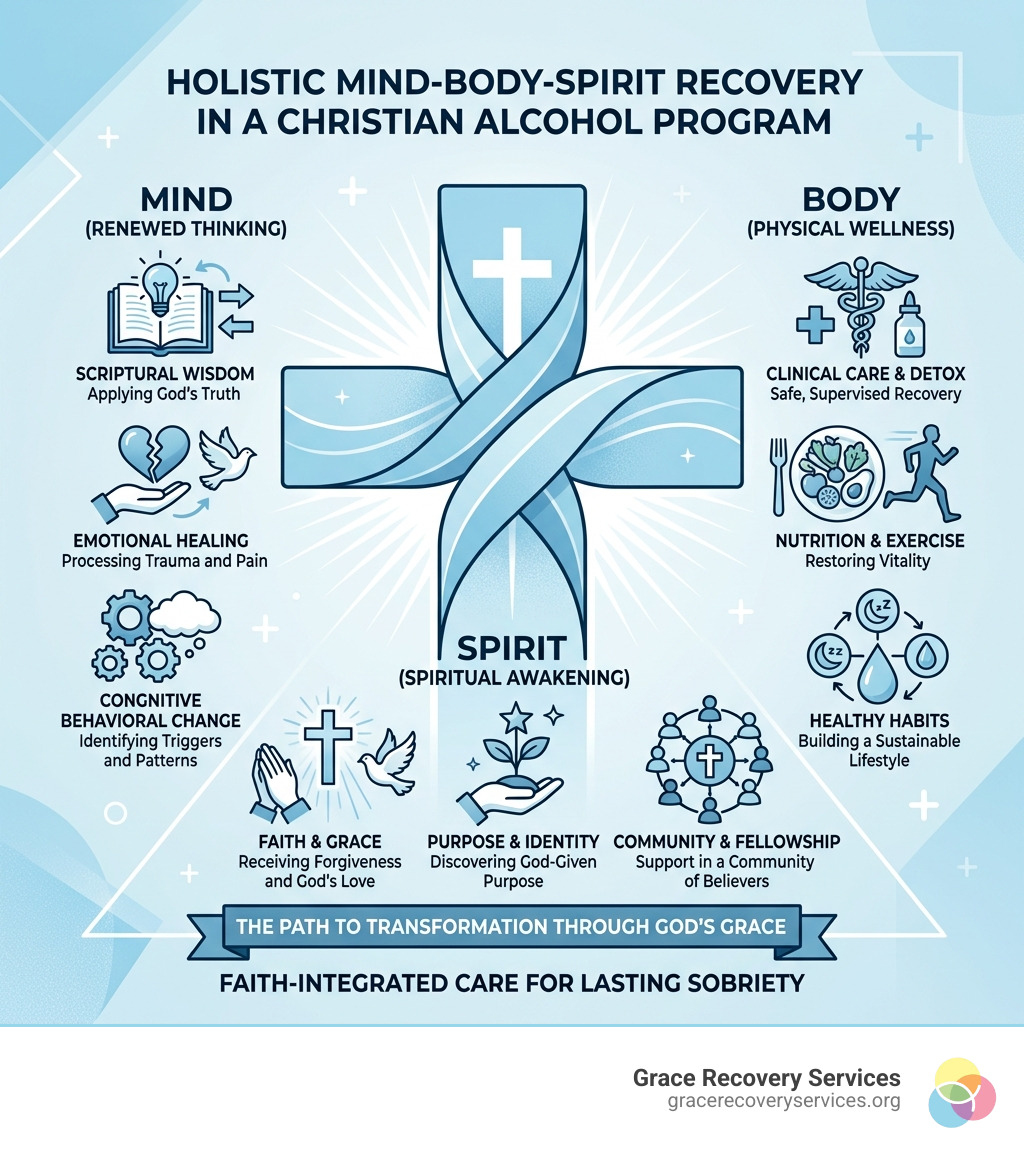
Alcohol use disorder affects millions of people — and for many, healing feels impossible without addressing the whole person: mind, body, and spirit.
That’s exactly what a Christian alcohol recovery program is designed to do.
These programs go beyond managing symptoms. They combine clinical treatment with biblical principles, offering something secular programs often miss — a framework of grace, purpose, and spiritual renewal that can anchor lasting change.
For people of faith, knowing that recovery doesn’t require you to leave your beliefs at the door makes an enormous difference. Research consistently shows that spirituality is a meaningful factor in long-term sobriety. One review found that over 84% of scientific studies identify faith as a positive contributor to addiction recovery outcomes.
And yet — finding the right program, understanding what sets Christian recovery apart, and knowing what to look for can feel overwhelming, especially when you’re already carrying so much.
This guide is here to help.
We’ll walk you through how these programs work, what to expect, and how faith-integrated care can meet you exactly where you are.
I’m Stephen A. Luther, MSEd, MEd, LPC, Executive Director and Founder of Grace Recovery Services in Western Pennsylvania, and I’ve spent over two decades helping individuals and families find healing through trauma-informed, faith-integrated addiction treatment — including Christian alcohol recovery programs that honor both clinical best practices and biblical principles of grace. As we explore this topic together, my hope is that you’ll find not just information, but genuine encouragement for the road ahead.
Defining the Christian Alcohol Recovery Program
When we talk about a Christian alcohol recovery program, we are describing a specialized approach to substance use disorder that views the individual through the lens of God’s grace. While traditional secular programs focus primarily on the physiological and psychological aspects of addiction, a faith-based model recognizes that we are spiritual beings.
The core difference lies in the ultimate goal. In many secular settings, the goal is “sobriety”—the absence of the substance. In a Christian setting, we aim for transformation. The focus is on helping an individual allow God’s grace to lead them toward a life of freedom. It is about moving from a state of “managing” an addiction to experiencing true redemption and a new identity.
At Grace Recovery Services, we believe that how faith helps with addiction is by providing a foundation of hope that never fails. Recovery is not just about “quitting”; it’s about renewing the mind and spirit so that the desire for the substance is replaced by a desire for a purposeful, God-honoring life.

Core Spiritual Principles in a Christian Alcohol Recovery Program
The “secret sauce” of a Christian alcohol recovery program is the integration of timeless biblical wisdom into the daily work of healing. These principles provide a roadmap for those who feel lost in the woods of addiction.
- Identity in Christ: Addiction often strips a person of their dignity and self-worth. We teach that you are not an “addict” first; you are a child of God. This shift in perspective is vital for long-term change.
- Forgiveness and Grace: Shame and guilt are the primary fuels for relapse. Christian programs emphasize that through Christ, forgiveness is available. This allows clients to stop punishing themselves and start healing.
- Submission to a Higher Power: While secular 12-step programs refer to a “Higher Power” of your understanding, we explicitly identify this power as Jesus Christ. We look to Higher Power Higher Purpose biblical principles for addiction to guide the surrender process.
- The Power of Scripture: Using a Bible verse for sobriety isn’t just about memorization; it’s about internalizing truths that counter the lies addiction tells us.
The Role of Trauma-Informed Therapy in a Christian Alcohol Recovery Program
One aspect we prioritize in Western Pennsylvania is the marriage of faith and trauma-informed care. Many people struggling with alcohol use are actually self-medicating for deep-seated emotional wounds or past traumas.
A truly effective Christian alcohol recovery program creates a space of emotional safety. We understand that “renewing the mind” involves healing the brain’s response to past pain. By using Christian integrated addiction treatment, we address the relational wounds that often sit at the root of substance use.
When you renew your mind with these powerful Bible verses, you aren’t just doing a religious exercise; you are participating in a spiritual and psychological rewiring that fosters resilience and peace.
Evidence-Based Care Meets biblical Wisdom
There is a common misconception that you have to choose between “science” and “faith.” In the best Christian alcohol recovery program models, these two forces work in harmony. This is often referred to as clinical excellence grounded in a biblical worldview.
One of the most effective tools we use is Christian-Integrated Cognitive Behavioral Therapy. This approach takes the proven methods of CBT-identifying and changing negative thought patterns-and weaves in spiritual resources. For example, instead of just using secular affirmations, a client might use scripture to challenge the “stinking thinking” that leads to a craving. For readers who want a broader overview of the clinical model behind CBT, the American Psychological Association explains cognitive behavioral therapy.
In Pennsylvania, many individuals seek a hybrid model that honors both science and scripture. At Grace Recovery Services, our Western PA Christian addiction counseling is led by licensed professionals who are also deeply committed to their faith. We believe that God created the mind, so using the best psychological tools available is actually a way of honoring His creation.
Whether you are looking for faith-based rehab in Pittsburgh or support in Westmoreland County, the goal remains the same: provide the highest level of clinical care while never losing sight of the transformative power of the Holy Spirit.

Levels of Outpatient Care in Western Pennsylvania
Recovery isn’t “one size fits all.” Depending on where you are in your journey, you may need different levels of support. Because we focus on outpatient care in the Pittsburgh and North Huntingdon areas, we offer flexibility that allows you to maintain your family and work commitments while receiving intensive treatment.
- Partial Hospitalization Program (PHP): This is the most intensive level of outpatient care. It typically involves several hours of treatment per day, multiple days a week. It’s designed for those who need a high level of structure but can safely return home in the evenings.
- Intensive Outpatient Program (IOP): Our Christian intensive outpatient treatment is a step down from PHP. It focuses on relapse prevention, coping skills, and deepening your spiritual walk. It’s an excellent option for those transitioning from a more intensive program or those whose addiction is caught in the earlier stages.
- General Outpatient Program: This involves weekly or bi-weekly sessions. It’s perfect for long-term maintenance and ongoing faith-based outpatient addiction treatment.
By offering these various outpatient program levels, we ensure that clients in the Penn Hills and Irwin areas have access to the specific intensity of care they need at any given time.
Finding Community and Fellowship in Recovery
You were never meant to carry the weight of addiction alone. One of the most powerful components of a Christian alcohol recovery program is the community. In secular circles, they call it “peer support,” but in the church, we call it “fellowship.”
Across the country, thousands of faith-based support groups meet weekly to provide a safe haven for healing. Interestingly, while many think of these groups only for drugs or alcohol, many clients attend for other “hurts, hang-ups, and habits” like anxiety or codependency. This shared journey creates a bond that is difficult to find elsewhere.
In our local area, Christian addiction recovery in Pittsburgh thrives when people connect with a local church body. Fellowship provides:
- Accountability: Having brothers and sisters in Christ who can ask the hard questions.
- Shared Experience: Realizing that others have walked this path and found victory.
- Service: Part of the healing process is eventually helping others, which provides a sense of purpose.
Our Christian recovery services emphasize that the “lone wolf” rarely survives in recovery. We need the pack—the body of Christ—to thrive.
Frequently Asked Questions about Faith-Based Recovery
Does insurance cover Christian alcohol recovery programs?
Yes! Many people worry that because a program is “Christian,” insurance won’t cover it. However, under the Affordable Care Act (ACA), addiction and mental health treatment are considered essential health benefits.
Most major insurance providers cover treatment in the Pittsburgh and North Huntingdon areas, provided the facility is licensed and accredited. At Grace Recovery Services, we work with most major insurance plans to ensure our clients can access the care they need without an undue financial burden. We always recommend a quick coverage verification call to understand your specific benefits.
Is a Christian program suitable for all denominations?
Absolutely. Most Christian alcohol recovery program options are nondenominational. The focus is on the core tenets of the Christian faith—the authority of the Bible, the grace of God, and the redemptive work of Jesus—rather than specific denominational rituals.
Whether you are Catholic, Baptist, Presbyterian, or simply exploring your faith, you are welcome. We focus on the best Bible verses for recovering addicts and alcoholics that speak to the universal human experience of struggle and hope.
What is the difference between secular and Christian recovery?
The primary difference is the source of power. Secular programs rely heavily on human will, psychological techniques, and a generic “higher power.” A Christian rehab in Pittsburgh relies on the power of the Holy Spirit for internal renewal.
Secular programs are great at changing behavior, but Christian programs aim to change the heart. We believe that when the heart is healed and the spirit is renewed, the behavior changes as a natural byproduct of a new life in Christ.
Conclusion
Recovery is a journey, not a destination. If you or a loved one is struggling with alcohol or opioids in Western Pennsylvania, please know that there is a path forward that honors your faith and provides the clinical support you need.
From our offices in Pittsburgh (Penn Hills area) and North Huntingdon, the team at Grace Recovery Services is dedicated to providing trauma-informed, holistic restoration. We don’t just want to see you “sober”; we want to see you restored to your family, your community, and your God-given purpose.
The chains of addiction are heavy, but they are not unbreakable. Through a combination of evidence-based therapy and the unchanging grace of God, freedom is possible.
If you’re ready to take that first step, we are here to walk with you. Start your journey to freedom today and see what happens when faith meets recovery.
This article was researched with AI and heavily edited by Stephen Luther for accuracy and relevance.
Stephen Luther is the Executive Director and Founder of Grace Christian Counseling, Grace Recovery Services, WPA Counseling, NuWell Online Counseling and Coaching, and NuWell Health. He holds a Master’s degree in Education from the University of Georgia and a Master’s degree in Marriage and Family Therapy from Duquesne University. He is a licensed professional counselor in Pennsylvania.
Since 1997, Steve has been helping children, adolescents, and adults overcome a wide range of emotional and relational challenges. He specializes in working with hurting families, including those with foster, adopted, or traumatized children. Steve uses Attachment-Based Therapy, Splankna Healing, and Therapeutic Parent Coaching to support healing and restoration.
This guide is for educational and spiritual encouragement and is not a substitute for personalized professional counseling. If you are in crisis, please reach out for immediate help.