
“Dry drunk” is an informal phrase used in some recovery communities for a person who has stopped drinking but still has emotional, relational, or behavioral problems from life before recovery. It is not a diagnosis or a defined syndrome. Because the phrase can stigmatize, use it to understand the question, not to label a person. Describe what is actually happening, and seek an assessment when distress, cravings, mental health symptoms, or relationship problems continue.
Someone can stop drinking and still feel angry, numb, restless, isolated, or stuck in the same relationship patterns. People who notice that gap sometimes ask what a dry drunk is. The phrase tries to describe a person who no longer drinks but continues to struggle emotionally or behaviorally. The better response is to respect the work it takes to stop drinking, name the specific concern, and ask what support would help recovery grow.
Abstinence can protect a person’s life, health, relationships, and future. Active recovery builds on that foundation through coping skills, honest relationships, mental health care, meaningful routines, and, when the person wants it, faith. Those parts of recovery do not unfold on one timetable. Struggle after quitting is not proof of failure, and it is not a reason to dismiss the progress someone has made.
Is a dry drunk a clinical diagnosis?
No. Clinical language is more precise. The National Institute on Alcohol Abuse and Alcoholism describes alcohol use disorder as a problematic pattern of alcohol use that leads to clinically significant impairment or distress.[1] The dry drunk phrase does not appear as a separate diagnosis. An international substance-use glossary also flags the expression as stigmatizing and recommends person-centered wording, such as describing someone in recovery who is having emotional or behavioral challenges.[2] That is a useful warning: a familiar phrase can still cause harm when it becomes a verdict about someone’s character.
Why the dry drunk label can get in the way
Labels flatten a complicated situation. If a family member says, “You are acting like a dry drunk,” the person may hear that their abstinence does not count or that every difficult emotion is evidence of addiction. The conversation can turn into an argument about identity instead of a discussion about sleep, anger, cravings, loneliness, grief, or support.
Word choice matters for practical reasons. NIAAA notes that the more stigma a person with alcohol use disorder perceives, the less likely they are to seek treatment, and it recommends person-first terms.[3] In daily life, that can sound like, “You seem more isolated this month, and I am concerned,” rather than, “You are one of those people.”
Some people in recovery use the phrase about themselves and find it meaningful. Their preference deserves respect. The problem is using it as a diagnosis, an insult, or a shortcut for a person you are frustrated with. A spouse, friend, pastor, sponsor, or counselor can talk about observable changes without claiming to know the cause.
Abstinence and active recovery are related, but not identical
Stopping alcohol use can take courage, medical support, treatment, community, prayer, repeated effort, or some combination of these. It is never a small accomplishment. Still, the absence of alcohol does not automatically repair every part of life that alcohol affected. Trust may need time. Stress can still overwhelm old coping habits. Depression, anxiety, grief, trauma, or sleep problems may still need attention.
NIAAA describes recovery as a process of pursuing both remission from alcohol use disorder and an end to heavy drinking. It adds that recovery is often marked by stronger social support and spirituality and by improvements in physical and mental health, quality of life, and well-being.[4] SAMHSA similarly defines recovery as a process of change through which people improve their health and wellness, live self-directed lives, and strive to reach their full potential.[5]
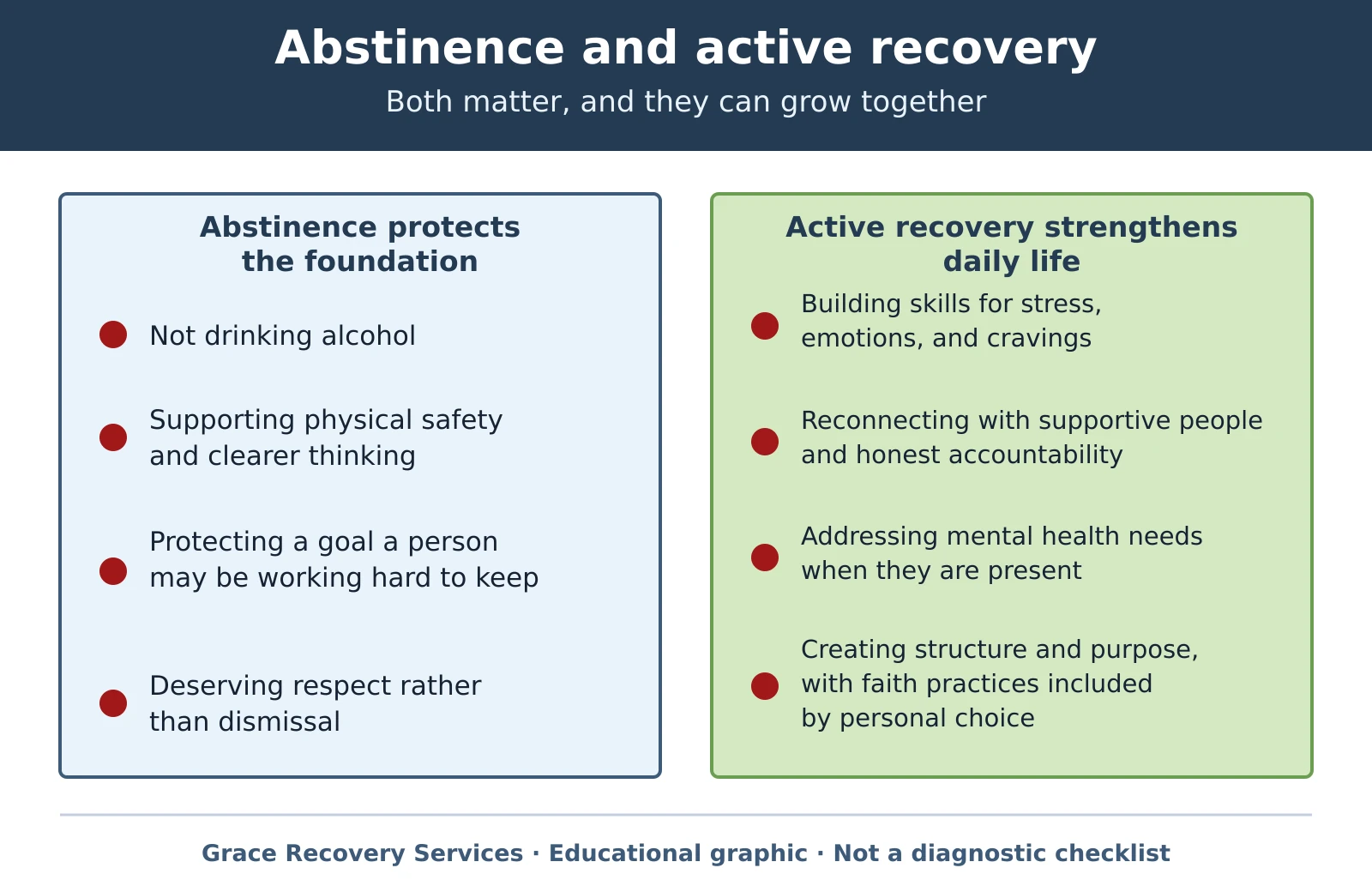
| Abstinence protects the foundation | Active recovery strengthens daily life |
|---|---|
| Not drinking alcohol | Building skills for stress, emotions, and cravings |
| Supporting physical safety and clearer thinking | Reconnecting with supportive people and honest accountability |
| Protecting a goal a person may be working hard to keep | Addressing mental health needs when they are present |
| Deserving respect rather than dismissal | Creating structure and purpose, with faith practices included by personal choice |
What the dry drunk phrase may be trying to describe
There is no diagnostic checklist for “dry drunk syndrome.” The experiences below are not proof that someone has a syndrome, and they do not all come from alcohol use. They are examples of concerns that may deserve a direct, compassionate conversation.
Difficult emotions feel hard to manage
A person may feel irritable, anxious, low, ashamed, resentful, or emotionally numb. They may react quickly and regret it later. Alcohol may once have been a fast, harmful way to escape or change a feeling. After quitting, the feeling remains and the old response is gone. Learning to name emotions, tolerate discomfort, ask for help, and choose a different response takes practice.
These emotions do not point to one cause. Early physical adjustment, poor sleep, conflict, grief, a mental health condition, medication effects, or ordinary stress may be involved. An assessment can sort through possibilities that a label cannot.
Old coping and relationship patterns continue
Secrecy, blame, avoidance, controlling behavior, impulsive choices, or difficulty apologizing may continue after alcohol is gone. Families may stay tense because trust has been hurt. The person in recovery may feel watched, while loved ones may feel they must stay alert. Repair usually takes specific changes, clear boundaries, and time. Abstinence supports that work, but it does not finish it overnight.
Recovery support becomes less consistent
A person may stop attending appointments or groups, avoid honest conversations, or pull away from people who support recovery. That does not prove a return to drinking is coming. It does mean the person has fewer places to talk openly about cravings, stress, or discouragement. Reconnecting early can reduce isolation and make problems easier to address.
Life feels empty without alcohol
Quitting changes more than what is in a glass. It may change friendships, weekends, celebrations, and the way a person ends the workday. If nothing meaningful replaces those routines, boredom and loss can grow. Recovery support can help a person build a life with rest, responsibility, connection, service, enjoyment, and purpose instead of asking willpower to carry everything.
Mental health needs remain untreated
NIAAA reports that the mental health conditions that most often occur with alcohol use disorder include depressive disorders, anxiety disorders, trauma- and stress-related disorders, other substance use disorders, and sleep disorders.[6] Symptoms can overlap, and timing matters. A qualified clinician can consider when symptoms began, how they changed with alcohol use, and what persists during abstinence. When both addiction and mental health concerns are present, both deserve attention, and co-occurring treatment is designed for that.
Trauma may be part of some people’s stories, but it is not the explanation for every addiction or every difficult season after quitting. Trauma-informed care protects choice and does not force a person to disclose or process painful experiences before they are ready.
Why a dry drunk label can miss other causes of distress
The phrase can hide medical and mental health questions that need a real assessment. Sleep disruption, anxiety, low mood, agitation, concentration problems, and cravings can occur for different reasons. Some may relate to alcohol withdrawal or longer-term adjustment. Others may reflect depression, anxiety, grief, chronic stress, relationship conflict, another substance, or a medical condition. One person’s experience cannot establish another person’s cause.
NIAAA describes recovery as a dynamic, individualized process, and notes that treatment plans can include medications, behavioral health care, and mutual support groups.[7] So the useful question is not, “Does this person fit the label?” It is, “What is happening, how serious is it, and what kind of support fits?”
What to do instead of using the dry drunk label
You do not need to decide whether the phrase fits. Start with the part you can observe and the support you can reach.
- 1Name one specific concern. Try “I have noticed you stopped going to appointments and seem alone most evenings,” rather than a claim about the person’s identity. If you are the person in recovery, you might say, “I am not drinking, but my anger and isolation are getting worse.”
- 2Reconnect with people who support honesty. A counselor, peer group, sponsor, recovery mentor, trusted pastor, or supportive friend can help a person speak up before a hard week becomes a private crisis. Different people benefit from different communities.
- 3Ask for a professional assessment. An assessment can look at alcohol use, withdrawal risk, cravings, mental health, physical health, safety, relationships, and the amount of structure needed. It can also identify when outpatient care is not enough.
- 4Rebuild a repeatable day. Regular sleep, meals, movement, appointments, meaningful activity, and contact with supportive people reduce long stretches of isolation. For practical ideas, see our guide to building a sober routine after treatment.
- 5Use faith as support, not pressure. Prayer, Scripture, church community, and Christian discussion may help when the person wants them. Spiritual practices should not be used to dismiss symptoms, force forgiveness, or replace clinical care.
How outpatient treatment can support ongoing recovery
Outpatient treatment can provide structure while a person lives at home and, when appropriate, stays connected to work, school, and family responsibilities. Treatment may help a person understand patterns, practice coping and communication skills, address substance use, and work on co-occurring mental health concerns. How often and how intensively someone attends should match their clinical needs.
GRS is Christ-centered and trauma-informed. Christian faith shapes how we understand hope, grace, and restoration. Clients are welcome regardless of belief, and each person chooses whether prayer, Scripture, or other spiritual practices are part of care.
For loved ones: talk about what you see
Loved ones often carry relief and fear at the same time. You may be grateful that the drinking stopped and still feel hurt by conflict, distance, or broken trust. Both can be true. Supporting recovery does not require ignoring harmful behavior, and setting a boundary does not erase compassion.
Keep the conversation concrete. Choose a calm time, use one or two recent examples, and say what you need without diagnosing. Our guide to supporting someone in recovery has more ideas. You might say:
- “I am glad you are not drinking. I also want us to get help with how often our conversations turn into shouting.”
- “You have seemed very low and alone for several weeks. Would you be willing to talk with a counselor or doctor?”
- “I will not stay in a conversation where I am being threatened. I am willing to talk when we can do so safely.”
- “I care about you. I cannot be your only source of support.”
Do not argue about the label or demand a confession. You can invite help, protect children, keep boundaries, and get support for yourself. If there is violence, a threat of harm, severe intoxication, overdose, or another emergency, use emergency and crisis resources rather than trying to manage the situation alone.
A Christian view of growth without shame
“Therefore, there is now no condemnation for those who are in Christ Jesus.” Romans 8:1 (NIV)
That promise does not remove consequences or the need for treatment. It makes room for honest repentance and help without treating shame as the engine of change.Faith can support daily recovery through prayer, Scripture, service, worship, and relationships with people who understand addiction. It can also help a person recover a sense of identity and purpose. At GRS, these practices follow the client’s choice, and people who do not want spiritual practices are still welcome.
Frequently asked questions
What is a dry drunk, and is it a medical diagnosis?
No. “Dry drunk” is an informal recovery-community phrase, not a medical or mental health diagnosis. A clinician can assess specific concerns such as cravings, anxiety, depression, sleep problems, relationship strain, or alcohol use disorder without using the label.
Can someone stop drinking and still struggle emotionally?
Yes. Not drinking is a meaningful achievement, but it does not make grief, stress, trauma, depression, anxiety, or relationship problems disappear. Those concerns can have several causes, so a professional assessment is more useful than a label.
Does irritability after quitting alcohol mean a return to drinking is coming?
Not necessarily. Irritability by itself does not mean a return to drinking is coming. It may be related to stress, sleep, mood, withdrawal, relationship conflict, or another concern. Persistent distress, cravings, isolation, or loss of support are reasons to talk with a qualified professional.
How can outpatient treatment help when a person is no longer drinking?
Outpatient treatment can help a person understand patterns, build coping and relationship skills, address co-occurring mental health concerns, and strengthen daily recovery supports while living at home. A professional assessment should determine whether outpatient, intensive outpatient, detox, residential, or another level of care is appropriate.
Sources
- 1Alcohol Use Disorder: From Risk to Diagnosis to Recovery. National Institute on Alcohol Abuse and Alcoholism.
- 2ISSUP Glossary entry. International Society of Substance Use Professionals.
- 3Stigma: Overcoming a Pervasive Barrier to Optimal Care. National Institute on Alcohol Abuse and Alcoholism.
- 4Recovery Research Definitions. National Institute on Alcohol Abuse and Alcoholism.
- 5About Recovery. Substance Abuse and Mental Health Services Administration.
- 6Mental Health Issues: Alcohol Use Disorder and Common Co-occurring Conditions. National Institute on Alcohol Abuse and Alcoholism.
- 7Support Recovery: It’s a Marathon, Not a Sprint. National Institute on Alcohol Abuse and Alcoholism.
- 8FDA Requiring Boxed Warning Updated to Improve Safe Use of Benzodiazepine Drug Class. U.S. Food and Drug Administration (September 2020).
- 9National Helpline for Mental Health, Drug, Alcohol Issues. Substance Abuse and Mental Health Services Administration.
- 10Get Help. 988 Suicide & Crisis Lifeline.