
Why Celebrate Recovery Bible Verses Matter in Your Healing Journey
Celebrate Recovery Bible verses are the scriptural foundation of a Christ-centered 12-step program designed to help people find freedom from life’s hurts, habits, and hang-ups. Here are 7 encouraging picks to know:
- Psalm 118:24 – Celebrating each new day as a gift from God
- Matthew 11:28-30 – Jesus inviting the weary to find rest in Him
- Romans 5:3-5 – Suffering producing endurance, character, and hope
- 1 Corinthians 10:13 – God providing a way out of every temptation
- James 5:15-16 – Confession and prayer leading to healing
- 2 Corinthians 1:3-4 – God comforting us so we can comfort others
- Philippians 4:6-7 – Trading anxiety for God’s peace through prayer
Recovery is rarely a straight line. Whether you or someone you love is wrestling with addiction, painful memories, or patterns that feel impossible to break, the journey toward healing can feel overwhelming — even lonely.
That’s exactly where Scripture steps in.
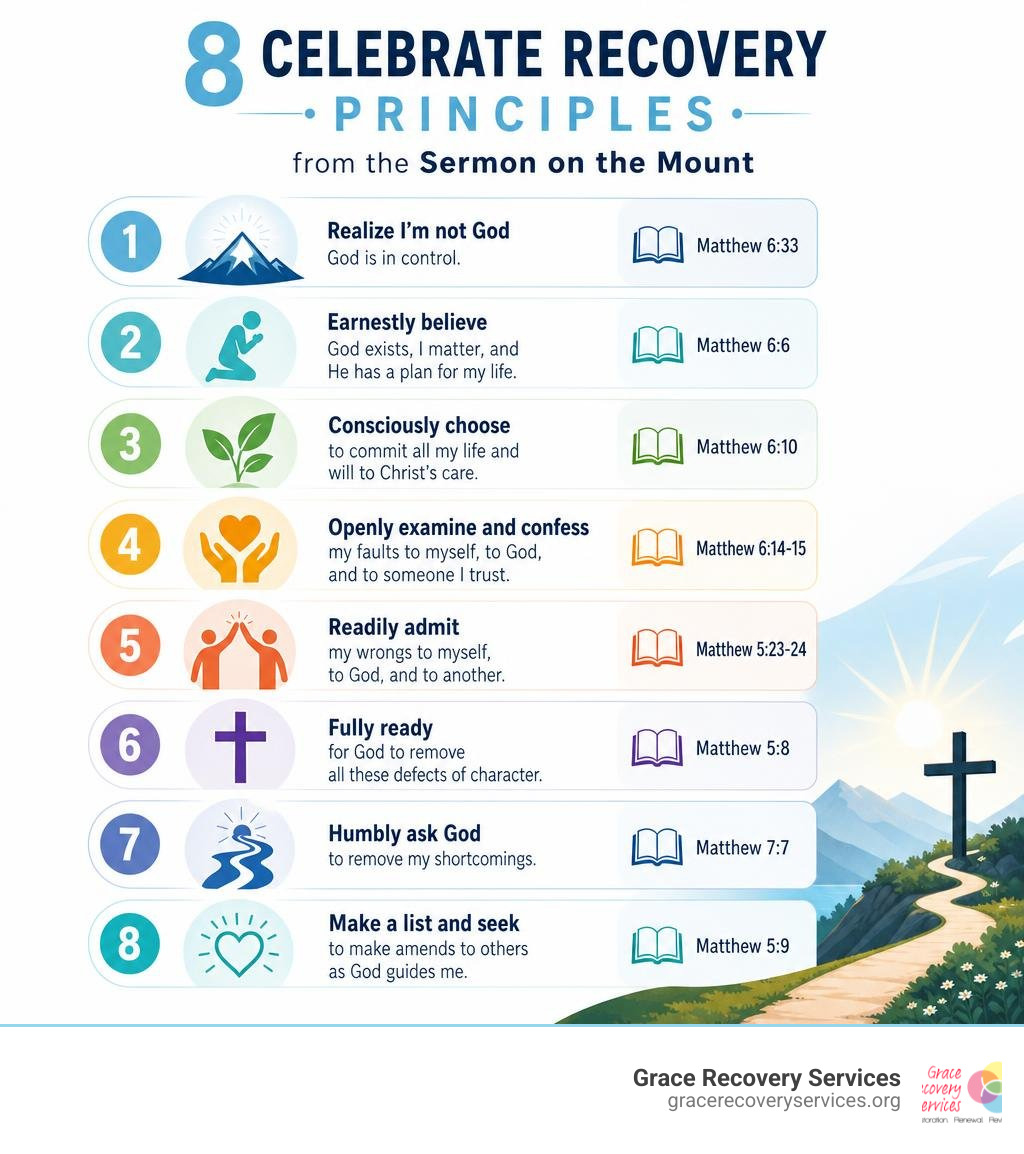
Celebrate Recovery is a faith-based program used in thousands of churches worldwide, pairing the familiar 12-step model with specific Bible verses for each principle. It’s built on eight recovery principles drawn from Jesus’ Sermon on the Mount — and over the years, millions of people have found real hope through its pages.
At Grace Recovery Services in Western Pennsylvania, we see this firsthand. When people engage with biblical truth alongside evidence-based, trauma-informed care, something powerful happens. The Word of God doesn’t just offer comfort — it begins to replace the lies that addiction plants deep inside a person’s sense of worth and identity.
We’ll walk through the most encouraging Celebrate Recovery Bible verses, how they connect to each step of the recovery process, and how you can start drawing on them today.
Must-know celebrate recovery Bible verses terms:
- Bible verses about freedom from addiction
- Bible verses for recovering addicts
- Bible verses to help with addiction
What is Celebrate Recovery and How Does It Use Scripture?

Celebrate Recovery (CR) was founded in 1991 by John Baker at Saddleback Church. What began as a small, passionate group has grown into a global movement operating in thousands of churches. But what makes Celebrate Recovery so distinct from traditional recovery models?
The core difference is its explicit, non-negotiable focus on Jesus Christ as the ultimate “Higher Power.” While secular programs encourage clients to define a higher power of their own understanding, Celebrate Recovery points directly to the Creator of the universe. Baker’s vision was to create a safe space where individuals could address their “hurts, hang-ups, and habits” through a thoroughly biblical lens.
In Celebrate Recovery, these three categories cover a broad spectrum of human suffering:
- Hurts: Relational wounds, childhood trauma, abuse, or grief.
- Hang-ups: Negative mental patterns, anger, anxiety, codependency, or control issues.
- Habits: Compulsive behaviors, substance use disorders, eating disorders, or sexual addiction.
Rather than isolating substance use as a standalone issue, Celebrate Recovery treats it as part of the broader human struggle with sin and brokenness. By anchoring the 12 steps in Scripture, the program reminds us that we cannot heal ourselves in isolation. We need a Savior, and we need a supportive, non-judgmental community.
Some critics from conservative theological circles have questioned the program’s methodology. In critiques like Is Celebrate Recovery biblical?, authors warn against conflating suffering with sin or treating Jesus merely as a “tool” for self-improvement.
At Grace Recovery Services, we believe that when combined with professional Christian counseling and evidence-based mental health practices, these biblical principles provide a beautiful framework for lasting change. We don’t view Jesus as a quick fix; we view Him as the Lord who walks with our clients through every stage of their healing journey. To explore the global ministry further, you can visit the official Celebrate Recovery: Home website.
The 12 Steps and Their Celebrate Recovery Bible Verses
Celebrate Recovery masterfully pairs each of the traditional 12 steps with a specific passage of Scripture. This alignment ensures that every milestone in the recovery journey is deeply rooted in biblical truth, moving clients from self-reliance to radical dependence on God.
Here is how the 12 steps are paired with their corresponding celebrate recovery Bible verses:
- Step 1: Powerlessness – “We admitted we were powerless over our addictions and compulsive behaviors, that our lives had become unmanageable.”
- Scripture: Romans 7:18 – “For I know that good itself does not dwell in me, that is, in my sinful nature. For I have the desire to do what is good, but I cannot carry it out.”
- Step 2: Higher Power – “We came to believe that a power greater than ourselves could restore us to sanity.”
- Scripture: Philippians 2:13 – “For it is God who works in you to will and to act in order to fulfill his good purpose.”
- Step 3: Surrender – “We made a decision to turn our lives and our wills over to the care of God.”
- Scripture: Romans 12:1 – “Therefore, I urge you, brothers and sisters, in view of God’s mercy, to offer your bodies as a living sacrifice, holy and pleasing to God—this is your true and proper worship.”
- Step 4: Moral Inventory – “We made a searching and fearless moral inventory of ourselves.”
- Scripture: Lamentations 3:40 – “Let us examine our ways and test them, and let us return to the Lord.”
- Step 5: Confession – “We admitted to God, to ourselves, and to another human being the exact nature of our wrongs.”
- Scripture: James 5:16 – “Therefore confess your sins to each other and pray for each other so that you may be healed.”
- Step 6: Readiness – “We were entirely ready to have God remove all these defects of character.”
- Scripture: James 4:10 – “Humble yourselves before the Lord, and he will lift you up.”
- Step 7: Humility – “We humbly asked Him to remove all our shortcomings.”
- Scripture: 1 John 1:9 – “If we confess our sins, he is faithful and just and will forgive us our sins and purify us from all unrighteousness.”
- Step 8: Amends List – “We made a list of all persons we had harmed and became willing to make amends to them all.”
- Scripture: Luke 6:31 – “Do to others as you would have them do to you.”
- Step 9: Direct Amends – “We made direct amends to such people whenever possible, except when to do so would injure them or others.”
- Scripture: Matthew 5:23-24 – “Therefore, if you are offering your gift at the altar and there remember that your brother or sister has something against you, leave your gift there in front of the altar. First go and be reconciled to them; then come and offer your gift.”
- Step 10: Continued Inventory – “We continued to take personal inventory and when we were wrong, promptly admitted it.”
- Scripture: 1 Corinthians 10:12 – “So, if you think you are standing firm, be careful that you don’t fall!”
- Step 11: Prayer – “We sought through prayer and meditation to improve our conscious contact with God, praying only for knowledge of His will for us and power to carry that out.”
- Scripture: Colossians 3:16 – “Let the message of Christ dwell among you richly…”
- Step 12: Carrying the Message – “Having had a spiritual experience as the result of these steps, we tried to carry this message to others and to practice these principles in all our affairs.”
- Scripture: Galatians 6:1 – “Brothers and sisters, if someone is caught in a sin, you who are live by the Spirit should restore that person gently.”
To understand how these steps compare structurally to secular 12-step programs, look at the table below:
| Traditional AA 12 Steps | Celebrate Recovery 12 Steps | Key biblical Focus / Verse |
|---|---|---|
| Admitting powerlessness over alcohol. | Admitting powerlessness over hurts, habits, and hang-ups. | Romans 7:18 (Acknowledging the broken human will) |
| Believing in a Higher Power of our own understanding. | Believing in Jesus Christ as our personal Savior and Higher Power. | Philippians 2:13 (God working within us to heal) |
| Turning our will over to God as we understood Him. | Deciding to turn our lives and wills over to the care of Christ. | Romans 12:1 (Our bodies as a living sacrifice) |
| Making a searching and fearless moral inventory. | Making a searching and fearless moral inventory. | Lamentations 3:40 (Testing our ways to return to God) |
| Confessing our wrongs to God, ourselves, and another. | Confessing our wrongs to God, ourselves, and a trusted person. | James 5:16 (Mutual confession leading to healing) |
For those looking to dive deeper into this integration, we highly recommend utilizing specialized study tools. You can explore the Life Recovery Bible – The Bible for People in 12-Step Recovery, which has helped over 5 million people find freedom. Additionally, The Life Recovery Devotional offers thirty scriptural meditations for each step of the journey, helping you focus your thoughts and prayers.
7 Encouraging Bible Verses for Overcoming Hurts, Habits, and Hang-ups

When the weight of recovery feels heavy, having quick access to encouraging scriptures can make all the difference. These seven carefully selected verses are pillars of hope for anyone striving to live a life of sobriety and spiritual freedom.
1. Psalm 118:24
“This is the day the Lord has made; let us rejoice and be glad in it.” In active addiction, days often blend together in a cycle of shame, anxiety, and survival. This verse serves as a beautiful reset button. It reminds us that every single morning we wake up sober is a gift from God. We don’t have to carry the weight of yesterday’s failures or tomorrow’s worries; we only have to navigate “today” with God’s grace. You can read various translations of this comforting passage directly on Psalm 118:24 – Bible Gateway.
2. Matthew 11:28-30
“Come to me, all you who are weary and burdened, and I will give you rest. Take my yoke upon you and learn from me, for I am gentle and humble in heart, and you will find rest for your souls.” Recovery is hard work. If you are feeling exhausted by the constant battle against cravings or emotional pain, Jesus offers a sanctuary. He doesn’t demand perfection before you come to Him; He simply asks you to bring your heavy burdens and trade them for His gentle peace.
3. Romans 5:3-5
“Not only so, but we also glory in our sufferings, because we know that suffering produces perseverance; perseverance, character; and character, hope.” It can be incredibly difficult to find meaning in our past pain. However, this scripture reminds us that our struggles are not wasted. Under the care of a loving God, the trials we face during recovery build spiritual endurance and transform our character. To read more about how God uses our challenges to build resilience, check out our guide on Bible Verses That Provide Strength in Recovery.
4. 1 Corinthians 10:13
“No temptation has overtaken you except what is common to mankind. And God is faithful; he will not let you be tempted beyond what you can bear. But when you are tempted, he will also provide a way out so that you can endure it.” Temptation is an inevitable part of the recovery process, but it does not have to lead to a relapse. This verse is an ironclad promise: you are never completely trapped. God always provides an exit strategy—whether that is picking up the phone to call a sponsor, removing yourself from a triggering environment, or pausing to pray.
5. James 5:15-16
“And the prayer offered in faith will make the sick person well; the Lord will raise them up. If they have sinned, they will be forgiven. Therefore confess your sins to each other and pray for each other so that you may be healed.” Isolation is the fuel of addiction. This passage highlights the absolute necessity of community, confession, and prayer. When we drag our secrets out of the darkness and share them with trusted believers, the power of shame is broken, and genuine healing begins. For more insights on choosing the right scriptures for this process, read our article on The Best Bible Verses for Recovering Addicts and Alcoholics.
6. 2 Corinthians 1:3-4
“Praise be to the God and Father of our Lord Jesus Christ, the Father of compassion and the God of all comfort, who comforts us in all our troubles, so that we can comfort those in any trouble with the comfort we ourselves receive from God.” Your story has a purpose. The pain you have overcome will one day become a beacon of hope for someone else who is still trapped in the darkness. This verse is the heart of Step 12—carrying the message of hope and restoration to others.
7. Philippians 4:6-7
“Do not be anxious about anything, but in every situation, by prayer and petition, with thanksgiving, present your requests to God. And the peace of God, which transcends all understanding, will guard your hearts and your minds in Christ Jesus.” Anxiety is a major trigger for compulsive behaviors. When your mind begins to spin out of control, this scripture offers a practical alternative: turn your worries into prayers. The result is a supernatural peace that guards your emotional safety. To discover more passages that help ground your mind, explore our resource on Scriptures to Help with Addiction and Reclaim Your Life.
Deepening Your Faith with Celebrate Recovery Bible Verses
To truly experience the transformative power of these scriptures, we must move beyond simply reading them—we must study them. Deepening your faith involves understanding the context in which these verses were written. For example, the eight recovery principles of Celebrate Recovery are based directly on the Beatitudes from Jesus’ Sermon on the Mount (Matthew 5).
When you study the Beatitudes, you realize that Jesus was laying out a roadmap for spiritual poverty, mourning, humility, and restoration. He was speaking directly to the brokenhearted.
If you want to integrate these lessons into your daily life, the NIV, Celebrate Recovery Study Bible (35th Anniversary Edition), Paperback, Comfort Print is an invaluable resource. This study Bible includes:
- Over 110 lessons unpacking recovery principles.
- 30 days of recovery-focused devotional readings.
- Over 50 full-page character studies of biblical figures who struggled with their own hurts and habits.
By studying how biblical figures navigated their failures and found God’s grace, you will realize that you are not alone in your struggles. For more encouragement on breaking free from destructive cycles, read our post on Breaking Free with These Powerful Recovery Scriptures.
Finding Strength Daily Through Celebrate Recovery Bible Verses
Consistency is key in recovery. Finding daily strength requires establishing spiritual habits that keep your mind anchored in truth. Two highly effective practices are daily devotionals and Bible journaling.
Bible journaling is a creative, hands-on spiritual aid that has gained significant popularity. Instead of just reading, you interact with the text by highlighting, writing down reflections, or even drawing in the margins of a wide-margin Bible.
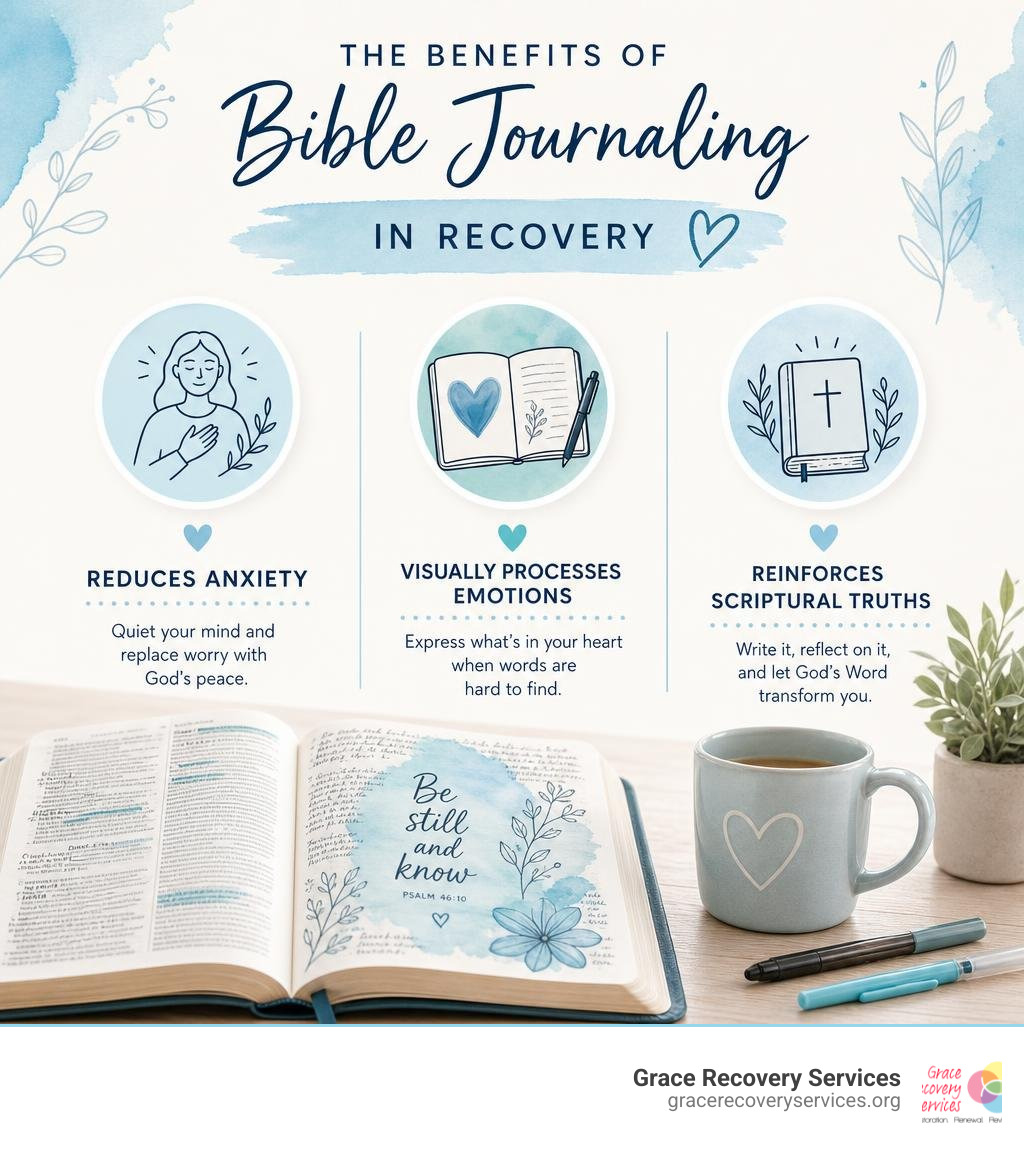
According to a fascinating Scientific research on Bible journaling as a spiritual aid in addiction recovery, this practice helps individuals visually and tactilely process their emotions. The study showed that combining visual art with scripture reading allowed clients (especially women in recovery) to express complex feelings of trauma, grief, and hope that they couldn’t always put into words. It acts as a powerful tool for cognitive behavioral restructuring—literally replacing negative, anxious thoughts with God’s promises.
When you pair journaling with daily character studies, you begin to see God’s track record of faithfulness. If God could restore King David after his moral failures, or heal the woman who spent years suffering in isolation, He can certainly restore you. To remind yourself of God’s tender care during your hardest days, take a moment to read God Is Close to the Brokenhearted and These Verses Prove It.
Frequently Asked Questions About Faith-Based Recovery
What is the difference between Celebrate Recovery and traditional 12-step programs like AA?
While both models utilize a 12-step structure to promote healing, the primary difference lies in their spiritual foundation. Traditional programs like Alcoholics Anonymous (AA) are spiritually cooperative, allowing clients to choose their own definition of a “Higher Power.” Celebrate Recovery is explicitly Christ-centered, naming Jesus Christ as the one true Savior. Furthermore, while AA focuses primarily on alcohol sobriety, Celebrate Recovery addresses a much broader range of “hurts, hang-ups, and habits,” including codependency, trauma, anger, and eating disorders.
Do I need to be a Christian to attend Celebrate Recovery?
Absolutely not. Celebrate Recovery is open to anyone, regardless of their religious background or current beliefs. It is designed to be a safe, non-judgmental environment where you can seek healing at your own pace. While the curriculum is built entirely on Christian scripture and biblical principles, the only requirement for attendance is a desire to find freedom from the things that are holding you back.
How can I find a Celebrate Recovery group near me?
Because Celebrate Recovery is a global movement, meetings are hosted in thousands of local churches. The easiest way to find a group in your area is to use the official church locator tool on the Celebrate Recovery: Home website. If you live in Western Pennsylvania, you can also reach out to us at Grace Recovery Services, and we will gladly help connect you with local, faith-based support systems in your community.
Conclusion
Recovery is a deeply personal, spiritual, and emotional journey. While celebrate recovery Bible verses provide a life-giving framework, walking this path often requires professional, clinical guidance to help you navigate deep-seated wounds and trauma.
At Grace Recovery Services, we provide a compassionate, outpatient-only environment where faith and clinical excellence meet. Led by Stephen A. Luther, MSEd, MEd, LPC (Licensed Professional Counselor & Executive Director), our team is dedicated to offering trauma-informed, evidence-based care across Western Pennsylvania, with convenient offices in Pittsburgh (Penn Hills area) and North Huntingdon (serving Irwin and Westmoreland County).
We guide our clients through our signature Counseling Blueprint, a four-stage healing journey designed to foster deep, lasting transformation:
- Take Off the Mask: We build genuine rapport, trust, and safety, allowing you to drop the exhaustion of pretending everything is okay.
- Heal the Wounds: Together, we gently explore and process the underlying emotional, relational, and traumatic hurts that fuel addictive behaviors.
- Remove the Toxins: We help you identify and dismantle unhelpful beliefs, shame-based narratives, and lingering lies about your worth.
- Replace with Truth: We install empowering, accurate perspectives about yourself, others, and God, anchoring you in sustainable sobriety and peace.
Whether you need an Intensive Outpatient Program (IOP), faith-integrated Christian counseling, or holistic support for your mind, body, and spirit, you do not have to do this alone. There is no shame in asking for help—only dignity, hope, and the promise of a renewed life.
If you are ready to take your next step toward healing, we invite you to Contact Grace Recovery Services for Christian Addiction Recovery in Pittsburgh today. Let us walk beside you as you reclaim your story.
This article was researched with AI and heavily edited by Stephen Luther for accuracy and relevance.
Stephen Luther is the Executive Director and Founder of Grace Christian Counseling, Grace Recovery Services, WPA Counseling, NuWell Online Counseling and Coaching, and NuWell Health. He holds a Master’s degree in Education from the University of Georgia and a Master’s degree in Marriage and Family Therapy from Duquesne University. He is a licensed professional counselor in Pennsylvania.
Since 1997, Steve has been helping children, adolescents, and adults overcome a wide range of emotional and relational challenges. He specializes in working with hurting families, including those with foster, adopted, or traumatized children. Steve uses Attachment-Based Therapy, Splankna Healing, and Therapeutic Parent Coaching to support healing and restoration.
This guide is for educational and spiritual encouragement and is not a substitute for personalized professional counseling. If you are in crisis, please reach out for immediate help.