
What Scripture can and cannot do in recovery
The Bible does not use the modern clinical term substance use disorder, and it should not be forced into the role of a diagnostic manual. It does speak honestly about suffering, temptation, shame, community, wisdom, perseverance, and freedom from what masters us. Those themes can help a person name what is happening and remember that a struggle does not erase dignity or place someone beyond God’s care.
Scripture is most useful here when it leads toward truth and help. It should never be used to tell someone that a craving proves weak faith, that prayer makes medical care unnecessary, or that relapse means God has abandoned them. It should not pressure anyone to disclose trauma, reconcile with an unsafe person, or remain in danger. Christian hope can sit beside clinical assessment, evidence-based treatment, medication when appropriate, peer support, family support, and emergency care.[2]
The ten passages below are not formulas. Choose one that fits the need in front of you, read it in its full context, and pair reflection with a safe action.
10 Bible verses to help with addiction recovery
1. Psalm 34:18: God is near to the brokenhearted
Psalm 34 does not deny distress. It names a God who draws near when a person feels crushed. That can matter when shame says you should hide until you have fixed yourself.
2. Matthew 11:28-30: Bring weariness to Christ
Jesus invites people who are weary and burdened to come to him for rest. Rest is not the same as avoidance, and this passage does not promise that cravings or consequences disappear instantly. It offers a different posture: you do not have to carry recovery through frantic self-reliance.
3. Hebrews 4:15-16: Approach grace without hiding
Hebrews describes Christ as compassionate toward human weakness and invites people to seek mercy and timely help. In recovery, that invitation can counter the belief that a setback makes help unavailable. Grace does not erase accountability. It makes an honest return possible.
4. Romans 8:1: Condemnation is not the path forward
“No condemnation” is not permission to minimize harm. It is a reminder that shame and a person’s identity are not the same thing. You can acknowledge consequences, make amends when appropriate and safe, and change a plan without reducing yourself to your worst day.
5. 1 Corinthians 10:13: Look for a way through temptation
This passage is often read during cravings. Read carefully, it should not be turned into a promise that every urge will feel manageable alone. A “way out” may include the help God has already placed around you.
6. Romans 12:2: Renewal involves new patterns
Paul’s language about the renewal of the mind points toward ongoing change, not a one-time slogan. A Christian may connect that theme with learning to notice thoughts, triggers, routines, and relationships that shape behavior. Scripture reflection can support that work, but it is not interchangeable with cognitive behavioral therapy or another clinical method.
7. Galatians 5:1: Freedom includes wise boundaries
Christian freedom is not a demand to pretend that risk has vanished. Recovery often needs structure: boundaries around people and places, honest accountability, treatment attendance, medication as prescribed, and routines that protect health. A boundary is not a failure of grace.
8. 2 Corinthians 12:9: Weakness does not cancel worth
Paul’s words about grace in weakness make room for humility without humiliation. Needing treatment, medication, withdrawal management, or more support is not proof of spiritual failure. A person can trust God and still need skilled care.
9. James 5:16: Honest community should be safe
James connects confession, prayer, and community. This does not authorize coerced disclosure or make every group a safe place for every detail. Choose trustworthy people, respect confidentiality, and use clinical or safeguarding support when the situation involves trauma, abuse, violence, or immediate risk.
10. 2 Corinthians 5:17: Recovery is bigger than a label
The promise of new life in Christ can loosen the grip of labels that reduce a person to a diagnosis or history. Change may still be gradual and uneven. A new identity does not require denying consequences or pretending the past never happened.
A verse-supported recovery pause
When a passage helps you slow down, use that moment to move toward safety and support:
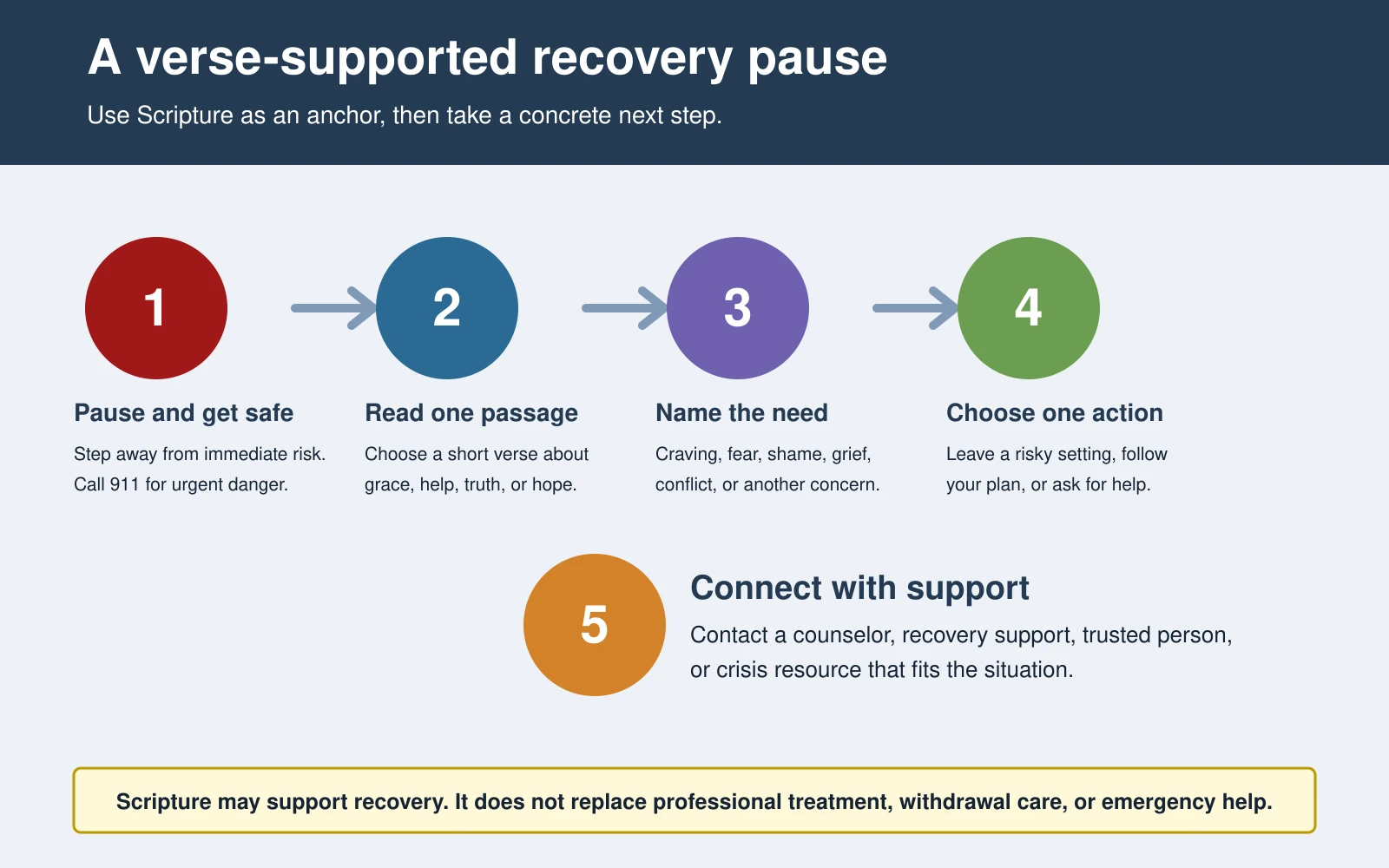
- 1Pause and get safe. Step away from immediate risk. Call 911 for urgent danger.
- 2Read one passage. Choose a short verse about grace, help, truth, or hope.
- 3Name the need. Is this a craving, fear, shame, grief, conflict, a withdrawal concern, or another need?
- 4Choose one practical action. Leave a risky setting, follow your recovery plan, or ask for help.
- 5Connect with support. Contact a counselor, recovery support, trusted person, medical professional, or crisis resource that fits the situation.
Faith and professional addiction treatment can work together
SAMHSA describes recovery as personal and supported by many pathways, which may include clinical treatment, medications, faith-based approaches, peer support, family support, and self-care.[1] That framework leaves room for Christian practice without treating one pathway as a universal formula. A person’s care should match current needs, preferences, risks, and level of support.
Professional assessment still matters because outpatient treatment is not appropriate for every person or every stage of care. If you are weighing options, our guide Is outpatient addiction treatment right for me? walks through what an assessment considers. For a deeper look at the theology behind this kind of hope, see why biblical hope remains the foundation for renewal.
If a return to use happens
A return to use can carry immediate safety risks, especially after a period of reduced tolerance. Respond to the situation in front of you. Call 911 for a suspected overdose, trouble breathing, loss of consciousness, a seizure, or another urgent danger. Once immediate safety is addressed, tell the treatment or recovery team what happened so the plan and level of care can be reassessed.
A return to use is not evidence that prayer was pointless or that a person is beyond grace. It also should not be minimized. Romans 8:1 can challenge condemnation while accountability asks honest questions:
- What changed?
- What support was missing?
- Does the current plan still fit?
- What needs to happen today?
Questions to ask a Christian addiction treatment program
- How do you assess the appropriate level of care and respond when outpatient treatment is not enough?
- Which services are currently available, and who provides the clinical care?
- How are prayer, Scripture, and spiritual discussion offered? Can a client decline or change how they participate?
- How do you address co-occurring mental health concerns and trauma without assuming trauma causes every addiction or rushing trauma processing?
- How do you handle confidentiality, family involvement, safety concerns, and referrals for services you do not provide?
- How will the plan be reviewed if symptoms, risks, supports, or goals change?
How Grace Recovery Services may fit
Reaching out begins a conversation about available options and whether another level or type of care should be considered. It does not guarantee admission, treatment fit, a start date, or a clinical result. Grace Christian Counseling may be a possible path for complementary or continued counseling when appropriate, but it is a separate service, and coordination or placement should never be assumed.
Frequently asked questions
Can Bible verses cure addiction?
No. Scripture may support hope, meaning, honest reflection, and connection, but it is not a cure or a substitute for professional care. Substance use disorders can involve medical, psychological, relational, social, and spiritual needs. Appropriate support may include assessment, treatment, medication, peer or family support, faith practices, and emergency care when needed.
What Bible verse is best for cravings?
There is no single verse that works like a clinical intervention. Many Christians return to 1 Corinthians 10:13 because it encourages them to look for a way through temptation. Pair the passage with a concrete action from your recovery plan, such as leaving a risky setting or contacting support. Seek urgent help when safety is at risk.
What are good Bible verses for sobriety?
Passages many Christians use in sobriety include Psalm 34:18, Matthew 11:28-30, Romans 8:1, 1 Corinthians 10:13, Galatians 5:1, and 2 Corinthians 12:9. They speak to God’s nearness, rest, freedom from condemnation, a way through temptation, wise boundaries, and grace in weakness. Read each in context and pair it with your recovery plan.
Does relapse mean I failed spiritually?
No. A return to use should be taken seriously, but it does not erase a person’s dignity or place them beyond grace. Address immediate safety, tell the treatment or recovery team, and review whether the current plan and level of care still fit. Do not use shame as a treatment strategy.
Do I have to be a Christian to contact GRS?
No. Christian faith is central to GRS’s identity, and people are welcome regardless of belief. Prayer, Scripture, and other spiritual practices are optional and guided by client choice. The care team can explain current services and how faith integration is handled before you decide on a next step.
Sources
- 1About Recovery. Substance Abuse and Mental Health Services Administration.
- 2Principles of Drug Addiction Treatment: A Research-Based Guide (Third Edition). National Institute on Drug Abuse.
- 3Mental Health and Substance Use Helplines. Substance Abuse and Mental Health Services Administration.
- 4What to Expect When You Contact 988. 988 Suicide & Crisis Lifeline.