
Why Addiction Recovery biblical Hope Supports Whole-Person Healing
Addiction recovery biblical hope means bringing faith, compassionate community, and professional care together. For someone experiencing substance use disorder, recovery can begin with one honest step: tell a trusted person, seek a clinical assessment, and build daily support through counseling, prayer, Scripture, and accountability.
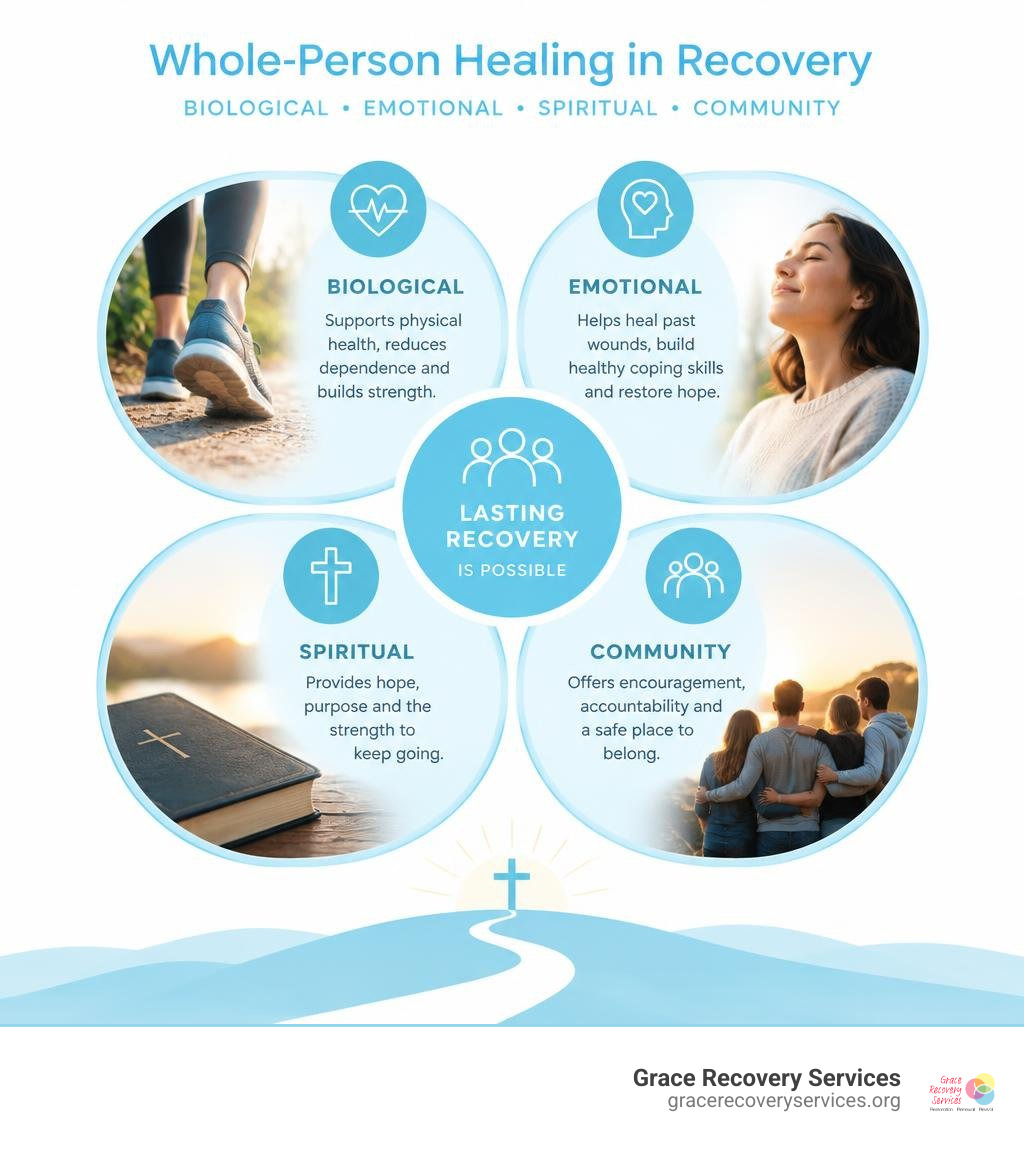
At Grace Recovery Services, we believe addiction affects the mind, body, and spirit. Physical dependence and trauma may need clinical care. Emotional pain needs safe, trauma-informed support. And the spiritual struggle needs the lasting hope of the gospel: no person is beyond grace, forgiveness, or meaningful change.
The need is urgent. In 2022, more than 107,000 people in the United States died from drug overdoses. Yet addiction does not have to be the final word. A biblical hope does not deny cravings, relapse risk, or the need for treatment. It gives clients a reason to persevere and a community that can walk with them without shame.
Our faith-based outpatient services in the Pittsburgh and Western Pennsylvania area integrate Christian counseling, evidence-based treatment, intensive outpatient programs, partial hospitalization programs, and aftercare support. If you or someone you love needs help, contact Grace Recovery Services for a personalized assessment.
Terms related to addiction recovery biblical hope:
5 Core Foundations of Addiction Recovery biblical Hope
Navigating recovery requires a framework that honors the whole person. When substance use takes hold, it impacts neurological pathways, emotional well-being, interpersonal relationships, and spiritual vitality. Purely medical frameworks describe addiction as a chronic brain disease, while purely moralistic viewpoints reduce it to personal failure. A biblical theology offers a richer, more compassionate view: it accounts for our fallen human condition (total depravity affecting body and mind) while presenting a profound pathway toward redemption and progressive sanctification.
| Dimension | Purely Medical Model | Moralistic / Legalistic Approach | Holistic biblical Recovery |
|---|---|---|---|
| Primary Root | Neurochemical disorder and genetics | Willful disobedience and moral weakness | Brokenness, spiritual idolatry, emotional pain, and neurobiology |
| View of the Person | Patient with a chronic brain disease | Offender needing behavioral correction | Bearer of God’s image needing healing, grace, and redemption |
| Source of Power | Medications and behavioral strategies | Personal willpower and strict discipline | The Holy Spirit working through clinical wisdom, community, and truth |
| Ultimate Goal | Symptom remission and sobriety | Rule-following and outward conformity | Whole-person renewal: mind, body, and spiritual restoration |
To walk in lasting recovery, we encourage clients to practice core spiritual disciplines alongside their clinical work:
- Daily Prayer & Meditation: Centering the soul on God’s character and surrendering daily anxieties.
- Scripture Integration: Replacing self-critical lies with biblical truth regarding identity and worth.
- Fellowship & Confession: Stepping into covenantal relationships where vulnerability is met with grace.
- Mindful Rest & Sabbath: Practicing restorative physical care to calm an overstimulated nervous system.
1. Recognizing Misplaced Worship and Idolatry
At its spiritual core, compulsive substance use often represents a search for comfort, relief, or identity apart from the Creator. Romans 1:25 speaks of exchanging the truth of God for a lie, serving created things rather than the Creator. In our Western Pennsylvania counseling offices, we frequently see how substances become a functional refuge—a self-prescribed medication for unaddressed trauma, loneliness, or relational hurt. Exploring biblical perspectives on substance abuse helps clarify that recognizing misplaced worship is not about assigning blame, but about uncovering what the heart is truly crying out for.
When a substance becomes an idol, it makes promises it cannot keep. It offers fleeting euphoria or temporary numbness, but inevitably demands more control over a person’s thoughts, finances, and relationships. In our counseling practice, we utilize our foundational Counseling Blueprint to walk clients through this dynamic:

- Take Off the Mask: Creating a safe, non-judgmental environment where clients can share their real struggles without fear of rejection.
- Heal the Wounds: Exploring the underlying relational hurts, trauma, and unresolved losses that fuel the desire to escape.
- Remove the Toxins: Uncovering false beliefs—such as “I am unlovable” or “I need this substance to survive”—and dismantling destructive coping habits.
- Replace with Truth: Installing empowering, accurate biblical perspectives about self-worth, community connection, and God’s unconditional love.
2. Embracing Regeneration and Identity in Christ
Shame is one of the heaviest barriers to recovery. Research shows that higher levels of shame directly correlate with slower decreases in substance use over time. While secular models often encourage individuals to view themselves primarily through the lens of a chronic disorder, Scripture offers a radically different declaration: “Therefore, if anyone is in Christ, he is a new creation. The old has passed away; behold, the new has come” (2 Corinthians 5:17).
Through spiritual regeneration, God provides a completely new identity. We are not defined by our worst days, our relapses, or our diagnoses. As discussed in Christianity and Drug Addiction — Faith, Grace, and Recovery, the gospel operates on an indicative-imperative pattern. Scripture first tells us who we are in Christ (the indicative: loved, forgiven, redeemed, made clean) before inviting us into how we ought to live (the imperative: walk in freedom, love others, practice self-control). When someone in recovery realizes they are already accepted by God, the drive to self-medicate out of worthlessness begins to lose its grip.
3. Relying on the Holy Spirit in Addiction Recovery biblical Hope
Overcoming chemical dependence cannot be sustained through white-knuckled willpower alone. The human will is easily depleted by stress, biological cravings, and emotional exhaustion. Galatians 5:16 reminds us to “walk by the Spirit, and you will not gratify the desires of the flesh.”
The Holy Spirit serves as our Comforter, Advocate, and internal source of strength throughout progressive sanctification—the gradual, lifelong process of emotional, mental, and behavioral growth. In outpatient treatment, we teach clients practical ways to cooperate with the Holy Spirit:
- Pausing During Cravings: Taking three slow breaths, inviting the Spirit into the moment of biological distress.
- Cognitive Renewal: Using scriptures to renew your mind to interrupt looping thoughts of panic or craving.
- Cultivating the Fruit of the Spirit: Allowing love, peace, and self-control to replace impulsivity through daily spiritual habits.
4. Covenantal Community and Mutual Accountability
Isolation is where addiction thrives; healing happens in connected relationships. James 5:16 instructs believers to “confess your sins to one another and pray for one another, that you may be healed.” Genuine recovery requires safe environments where an individual can admit powerlessness, embrace humility, and experience grace.

This mirrors the spiritual wisdom articulated in Step Three | Thy Will be Done – by Sarah LaSpisa, where true surrender moves beyond self-reliance into radical trust in God. When clients participate in peer groups, intensive outpatient cohorts, or local church ministries in Allegheny or Westmoreland County, they discover they are not alone. Mutual accountability provides both a shield against relapse and a springboard for relational restoration.
5. Integrating Clinical Support with Addiction Recovery biblical Hope
A truly biblical worldview respects both special revelation (Scripture) and common grace (medical science and clinical psychology). God has graciously provided therapists, physicians, and evidence-based methodologies to help heal the physical brain and process psychological trauma.
Engaging in Christ-centered addiction counseling ensures that clinical modalities—such as Cognitive Behavioral Therapy (CBT), Dialectical Behavior Therapy (DBT) skills, and trauma-informed somatic care—are harmonized with biblical truth. Furthermore, medical interventions such as Medication-Assisted Treatment (MAT) can stabilize neurochemistry, reduce intense cravings, and prevent fatal overdoses. Embracing clinical wisdom is not a lack of faith; it is good stewardship of the medical tools God has made available to preserve human life.
Navigating Relapse and Shame Through Gospel Grace

Relapse can evoke intense feelings of despair, leading individuals to believe that their progress is wiped out. However, the gospel of Jesus Christ meets our brokenness with boundless mercy. In Luke 15, Jesus shares the parable of the prodigal son. When the younger son hit the lowest point of his life, he rehearsed a speech of servitude, assuming his relationship as a son was destroyed. Yet, while he was still a long way off, his father ran to him, embraced him, and restored his dignity immediately.
For those navigating recovery, this parable illustrates God’s posture:
- God does not greet our setbacks with condemnation; He runs to meet us with open arms.
- Our standing as sons and daughters of God is anchored in Christ’s finished work, not our uninterrupted perfection.
- Recovery is often a non-linear path of progressive learning, humility, and deeper reliance on grace.
Turning to scriptures for the brokenhearted reminds us that the Lord is near to those crushed in spirit. Even when setbacks occur, resources like Hope in Christ: Spiritual Support for Addiction point us back to the eternal promise that God will complete the good work He began in us (Philippians 1:6).
Building a Gospel-Centered Relapse Prevention Plan
A proactive relapse prevention plan blends practical safety measures with spiritual safeguards:
- Identify Internal and External Triggers: Recognize specific environments, emotional states (HALT: Hungry, Angry, Lonely, Tired), or interpersonal conflicts that elevate cravings.
- Anchor in Scripture: Memorize and meditate on scripture for strength during recovery to anchor your thoughts when cravings arise.
- Establish an Emergency Support Chain: List three trusted individuals (such as an outpatient counselor, sponsor, or pastor) to call immediately when distress strikes.
- Utilize Crisis Lifelines: Keep numbers for national crisis lines (like 988 or SAMHSA’s National Helpline) accessible at all times for urgent assistance.
Practical Steps for Pastors, Families, and Local Churches
Churches and family members across Western Pennsylvania have a unique opportunity to serve as communities of refuge. Rather than responding with shame, local congregations can implement essential biblical recovery steps to walk alongside hurting families:
- Promote Trauma-Informed Awareness: Understand how past trauma shapes behavioral patterns and emotional dysregulation.
- Cultivate Safe Small Groups: Create spaces where open discussions about mental health and addiction are met with empathy rather than gossip.
- Practice Loving, Boundaried Care: Support a loved one’s recovery journey while maintaining healthy relational boundaries that prevent enabling.
- Partner with Outpatient Professionals: Collaborate with licensed Christian counselors and outpatient treatment programs to ensure comprehensive, specialized care.
Frequently Asked Questions About biblical Addiction Recovery
Is addiction considered a sin or a medical disease in Scripture?
Scripture presents a holistic view of humanity. While the initial behaviors and search for relief can involve spiritual idolatry and personal choices, chronic substance use profoundly alters brain structure, neurological reward pathways, and bodily dependence. At Grace Recovery Services, we view addiction as a complex condition involving mind, body, and spirit. It requires both spiritual grace and professional, trauma-informed clinical care.
Can medication-assisted treatment (MAT) be used in faith-based recovery?
Yes. Medications such as buprenorphine or naltrexone serve as evidence-based medical tools to stabilize neurochemistry, reduce cravings, and prevent fatal overdoses. Just as a person with diabetes utilizes insulin to manage blood sugar while praying for health, an individual in recovery can utilize prescribed medications alongside Christian counseling and spiritual disciplines to rebuild their life.
How does biblical hope support families dealing with an addicted loved one?
A biblical hope anchors families in God’s sovereignty and unchanging love. It encourages families to pray faithfully, release the illusion of control, and establish healthy, loving boundaries. Exploring healing scriptures for returning to faith helps family members process their own relational grief, finding comfort in the knowledge that no person is beyond the reach of God’s redemptive grace.
Conclusion: Embracing Complete Healing and Renewal
True, lasting recovery is not merely about stopping a behavior; it is about restoring the whole person—mind, body, and spirit. Through biblical hope, we discover that our past does not dictate our future, our shame is swallowed up in grace, and our daily struggles can be met with the transforming power of the Holy Spirit and compassionate community.
At Grace Recovery Services, we are dedicated to walking alongside individuals and families throughout the greater Pittsburgh, Penn Hills, North Huntingdon, and Westmoreland County areas. Our faith-based outpatient programs—including Christian counseling, intensive outpatient programs (IOP), partial hospitalization programs (PHP), and comprehensive aftercare—are designed to offer trauma-informed, clinically sound, and Christ-centered care.
If you or someone you care about is ready to take the next step toward lasting freedom, we invite you to explore compassionate faith-based outpatient programs or contact our team today for a confidential, personalized assessment. Hope is real, healing is possible, and you do not have to walk this road alone.
This article was researched with AI and heavily edited by Stephen Luther for accuracy and relevance.
Stephen Luther is the Executive Director and Founder of Grace Christian Counseling, Grace Recovery Services, WPA Counseling, NuWell Online Counseling and Coaching, and NuWell Health. He holds a Master’s degree in Education from the University of Georgia and a Master’s degree in Marriage and Family Therapy from Duquesne University. He is a licensed professional counselor in Pennsylvania.
Since 1997, Steve has been helping children, adolescents, and adults overcome a wide range of emotional and relational challenges. He specializes in working with hurting families, including those with foster, adopted, or traumatized children. Steve uses Attachment-Based Therapy, Splankna Healing, and Therapeutic Parent Coaching to support healing and restoration.
This guide is for educational and spiritual encouragement and is not a substitute for personalized professional counseling. If you are in crisis, please reach out for immediate help.