
Cross addiction is an informal term for one harmful pattern taking over the job of another. After someone cuts back or stops one substance, a different substance or behavior can start supplying the same relief, escape, or reward. It is not a diagnosis, and it does not happen to everyone in recovery. Clinicians look at control, consequences, safety, and the full mental health picture rather than a label or a single habit.
Stopping a harmful substance can bring real relief. It can also leave a gap where the substance once supplied escape, energy, comfort, or routine. When a new substance or behavior starts filling that same gap, people often call it cross addiction. The question to ask is what changed, what the new pattern is doing, and whether it is causing harm.
A new interest is not automatically a problem. Recovery often includes new routines, friendships, exercise, work, hobbies, and spiritual practices. Concern grows when the replacement becomes hard to control, crowds out daily life, continues despite consequences, or brings back the secrecy and distress that came with the earlier substance use.
Research on this pattern is still limited, but one large U.S. study offers some reassurance. Adults whose substance use disorder went into remission were less likely to develop a new substance use disorder over the next three years than adults who did not reach remission (13.1% compared with 27.2%).[4] So the pattern can happen, but it is not anyone’s fate.
What does cross addiction mean?
People also use phrases such as “substitute addiction” or “addiction transfer.” These terms usually describe a functional replacement: one substance or activity starts providing relief, reward, numbing, excitement, or connection that another pattern once supplied. The new pattern may appear quickly or grow over time.
The phrase gets too broad when it is applied to every strong interest. In the American Psychiatric Association’s diagnostic manual, gambling disorder is the behavioral addiction listed alongside substance use disorders; internet gaming disorder is listed as needing more research.[1] However, many other behaviors people call addictions, such as shopping or exercise, are not formal diagnoses. Even so, that does not mean a disruptive behavior should be ignored. It means a trained professional should assess the actual symptoms and harm instead of treating a popular label as a diagnosis.
Why cross addiction can take hold
In many cases, substance use becomes tied to a job the person needs done in the moment. It may quiet fear, blunt grief, create energy, ease social discomfort, fill empty time, or provide a predictable reward. When the substance stops, the need underneath it may still be there. A different substance or behavior can start serving the same purpose before the person notices the shift.
Several conditions can make that shift easier to miss:
- Stress stays high. Work, family conflict, money pressure, loneliness, or trauma reminders can intensify the urge for fast relief.
- The new pattern looks acceptable. Work, exercise, food, shopping, gaming, or another activity may earn praise at first, even when it becomes rigid or harmful.
- The original trigger is still active. A person may stop the substance before having other ways to respond to shame, anger, boredom, anxiety, or grief.
- Recovery becomes too narrow. Avoiding one substance matters. Long-term recovery also needs health, stable relationships, purpose, community, and support.
- Mental health needs are untreated or changing. Depression, anxiety, trauma symptoms, attention problems, or another concern can affect coping. These should be assessed without assuming a cause.
None of these points proves that a person has a disorder. They explain why an assessment should look at more than the visible behavior. SAMHSA describes recovery as a personal process supported by health, home, purpose, and community.[3] Looking across those areas tells you more than focusing only on abstinence.
Examples of cross addiction, without quick labels
For the second group, consider what the activity is replacing and what it costs in sleep, health, relationships, finances, treatment, or responsibilities. Then describe what you can observe: “I noticed you are drinking most nights now,” or “You missed treatment twice because you stayed at work.” That helps more than telling someone, “You have another addiction.” Specific observations make room for a professional review without shame or a forced conclusion.
Warning signs of addiction transfer
A single sign is not proof. A cluster of changes, rising harm, or a loss of control is a reason to talk with a qualified professional. Watch for:
- More time, money, or emotional energy going to the new substance or activity than intended
- Repeated attempts to cut back that do not last
- Hiding, minimizing, or lying about the pattern
- Using the pattern mainly to numb distress, escape, feel normal, or change mood
- Sleep, physical health, finances, relationships, work, school, or treatment being pushed aside
- Irritability, anxiety, or restlessness when the person cannot engage in the pattern
- Going back to the earlier substance after consequences from the new pattern
Physical dependence, withdrawal, craving, and loss of control can differ by substance. A clinician may need your medical history, current medications, recent substance use, mental health symptoms, withdrawal history, and information about support at home. Do not use a checklist to decide a diagnosis or level of care yourself.
Four questions to review a new pattern
The guide below is for conversation, not screening. Use it to gather concrete information you can share with a treatment provider.
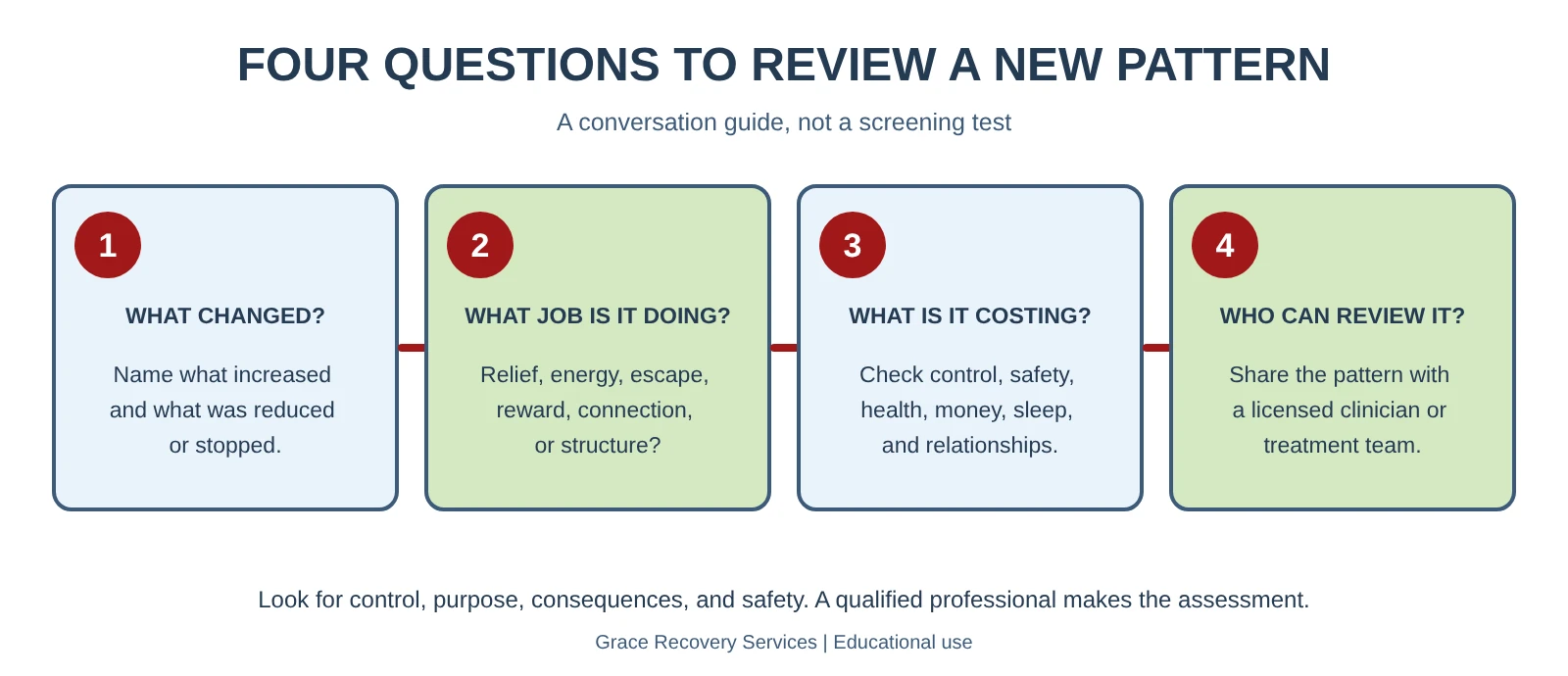
- 1What changed? Name the substance or activity, when it increased, and what was reduced or stopped.
- 2What job is it doing? Notice whether it brings relief, energy, escape, reward, connection, or structure.
- 3What is it costing? Look at control, safety, sleep, health, money, relationships, treatment, and responsibilities.
- 4Who can review it? Share the pattern with a licensed clinician or treatment team and ask for a full assessment.
What to do when you notice a shift
If you suspect cross addiction in yourself or someone you love, these steps can help you respond without panic or blame.
- 1Describe the change plainly. Track the substance or activity, how often, triggers, consequences, and attempts to cut back. Avoid diagnosing yourself or someone else.
- 2Tell the treatment team early. A new pattern is useful clinical information, not a moral failure. Share it before consequences grow.
- 3Look at what it does for you. Ask what feeling, situation, or need tends to come before the behavior and what relief follows. This can guide healthier coping and treatment goals.
- 4Build more than one source of support. Include sleep, meals, movement, relationships, peer support, purposeful activity, clinical care, and faith practices if you want them.
- 5Ask for a new assessment when risk changes. Increased use, withdrawal symptoms, suicidal thoughts, medical problems, unsafe housing, or loss of support may change the level of care you need.
How treatment can address cross addiction
Treatment for cross addiction can look beyond the original substance and ask what keeps the broader pattern going. A professional assessment may review current and past substances, compulsive behaviors, mental health symptoms, trauma history when relevant, medical needs, relationships, daily structure, and safety. The goal is not a dramatic label. It is to identify risks and build care around the person’s actual needs.
Outpatient care does not fit every person or every stage of recovery. GRS does not provide medical detox, withdrawal management, partial hospitalization, residential treatment, medication management, or emergency services. If the main concern is gambling, nicotine, or another behavior, ask the care team whether GRS is the right place for it. They can tell you honestly if another provider would serve you better. Reaching out does not guarantee admission or a particular program.
Faith can support honest reflection without shame
Christian faith shapes Grace Recovery Services, while prayer, Scripture, and other spiritual practices follow each client’s choice. People are welcome regardless of belief. For a client who wants faith included, the goal is honest reflection joined with grace, responsibility, and support, not spiritual pressure.
That prayer can help a person ask what a new pattern is doing for them without reducing recovery to willpower or shame. Clinical care remains clinical care. Faith can add meaning and connection, but it does not replace medical evaluation, withdrawal management, or a level-of-care assessment.
How families can respond
Family members often notice the early signs of cross addiction before anyone has a name for it. Start with one or two recent observations and a direct statement of concern. Choose a time when the person is not intoxicated and the conversation can stay calm.
You might say, “Since you stopped using cocaine, I have noticed that drinking has increased and you missed work twice. I am worried about your safety. Will you talk with a treatment professional about it?” Avoid debating the label. Do not search belongings, threaten, or promise outcomes you cannot control. If there is immediate danger, call emergency services rather than trying to handle it alone.
Families also need support and clear boundaries. Our guide for loved ones can help you prepare for a treatment conversation, respond to emergencies, and protect your own wellbeing.
Safety and crisis help
Call or text 988 for suicidal thoughts, a mental health crisis, or urgent emotional support. The 988 Suicide & Crisis Lifeline is available 24/7.[6]
Call SAMHSA’s National Helpline at 1-800-662-HELP (4357) for free, confidential treatment information and referrals, 24 hours a day.[5]
Grace Recovery Services phone, text, email, contact form, and discovery-call channels are not crisis services and are not monitored around the clock.
Frequently asked questions
Is cross addiction a diagnosis?
No. It is an informal term for a new substance or behavior taking over a similar role after another harmful pattern is reduced or stopped. A licensed professional can assess whether a substance use disorder, gambling disorder, another mental health condition, or a nonclinical habit best explains what is happening.
Does this pattern happen to everyone in recovery?
No. Research does not support the idea that everyone who recovers from one substance use disorder will develop another. The concern is worth discussing when a new substance or behavior becomes hard to control, causes harm, or starts doing the same emotional job as the earlier pattern.
Can a healthy habit become a problem?
A healthy activity is not automatically harmful because someone enjoys it often. Look at control, purpose, and consequences. Exercise, work, food, gaming, or another activity deserves closer review when it becomes rigid, hidden, unsafe, or disruptive to sleep, health, relationships, finances, treatment, or daily responsibilities.
How can Grace Recovery Services help?
Grace Recovery Services offers outpatient and intensive outpatient addiction treatment in North Huntingdon and Penn Hills. A professional assessment can review substance use, mental health concerns, safety, support at home, and the level of care that may be appropriate. GRS does not provide detox, withdrawal management, partial hospitalization, residential treatment, medication management, or emergency services.
In an emergency, call 911. In crisis, call or text 988.
Sources
- 1What Is a Substance Use Disorder?. American Psychiatric Association.
- 2Principles of Drug Addiction Treatment: A Research-Based Guide (Third Edition). National Institute on Drug Abuse.
- 3About Recovery. Substance Abuse and Mental Health Services Administration.
- 4Testing the Drug Substitution Switching-Addictions Hypothesis: A Prospective Study in a Nationally Representative Sample. Blanco C, Okuda M, Wang S, Liu SM, Olfson M. JAMA Psychiatry, 2014 (PubMed Central).
- 5National Helpline for Mental Health, Drug, Alcohol Issues. Substance Abuse and Mental Health Services Administration.
- 6Get Help. 988 Suicide & Crisis Lifeline.
- 7Psalm 139:23 (NIV). Bible Gateway.