
Why Faith-Based Aftercare in Pittsburgh PA Gives Recovery a Lasting Foundation
Faith-based aftercare Pittsburgh PA is a form of continuing care that combines evidence-based recovery support with spiritual guidance — helping people sustain sobriety, rebuild relationships, and find renewed purpose after completing a primary treatment program.
If you or someone you love is looking for faith-integrated aftercare options in the Pittsburgh area, here are some of the core services available:
- Spiritual counseling and Bible-based support groups for ongoing emotional and spiritual healing
- One-on-one mentoring from people with lived recovery experience
- Trauma-informed care addressing the root causes of addiction and co-occurring mental health challenges
- Family reunification support to help repair relational wounds
- Practical reentry assistance including housing guidance and employment counseling
- Outpatient aftercare programs (IOP and PHP) that integrate Christian principles with clinical therapy
- Community partnerships with local churches and nonprofits across Allegheny County
Recovery does not end when a treatment program does. In fact, for many people, the real work begins after.
Western Pennsylvania is facing a serious crisis. Pennsylvania ranks among the top 10 states for opioid use and overdose rates. Allegheny County’s homeless population has grown by 24% since 2022. And roughly 52% of individuals cycling through the Allegheny County Jail return — a painful reminder that without sustained, holistic support, lasting change is incredibly difficult to achieve.
What makes the difference? For many people in Pittsburgh, it is the kind of whole-person care that faith-based aftercare provides — support that goes beyond clinical checklists and meets people where they are spiritually, emotionally, and practically.
At Grace Recovery Services, we believe that true recovery heals the mind, the body, and the spirit. Grounded in Christian principles and delivered with deep compassion, our faith-integrated aftercare programs in Western Pennsylvania are designed to walk alongside clients long after the first step of treatment is taken.
This guide is for anyone in the Pittsburgh area who wants to understand what faith-based aftercare looks like, who it serves, and how to access it.
Understanding Faith-Based Aftercare in Pittsburgh PA
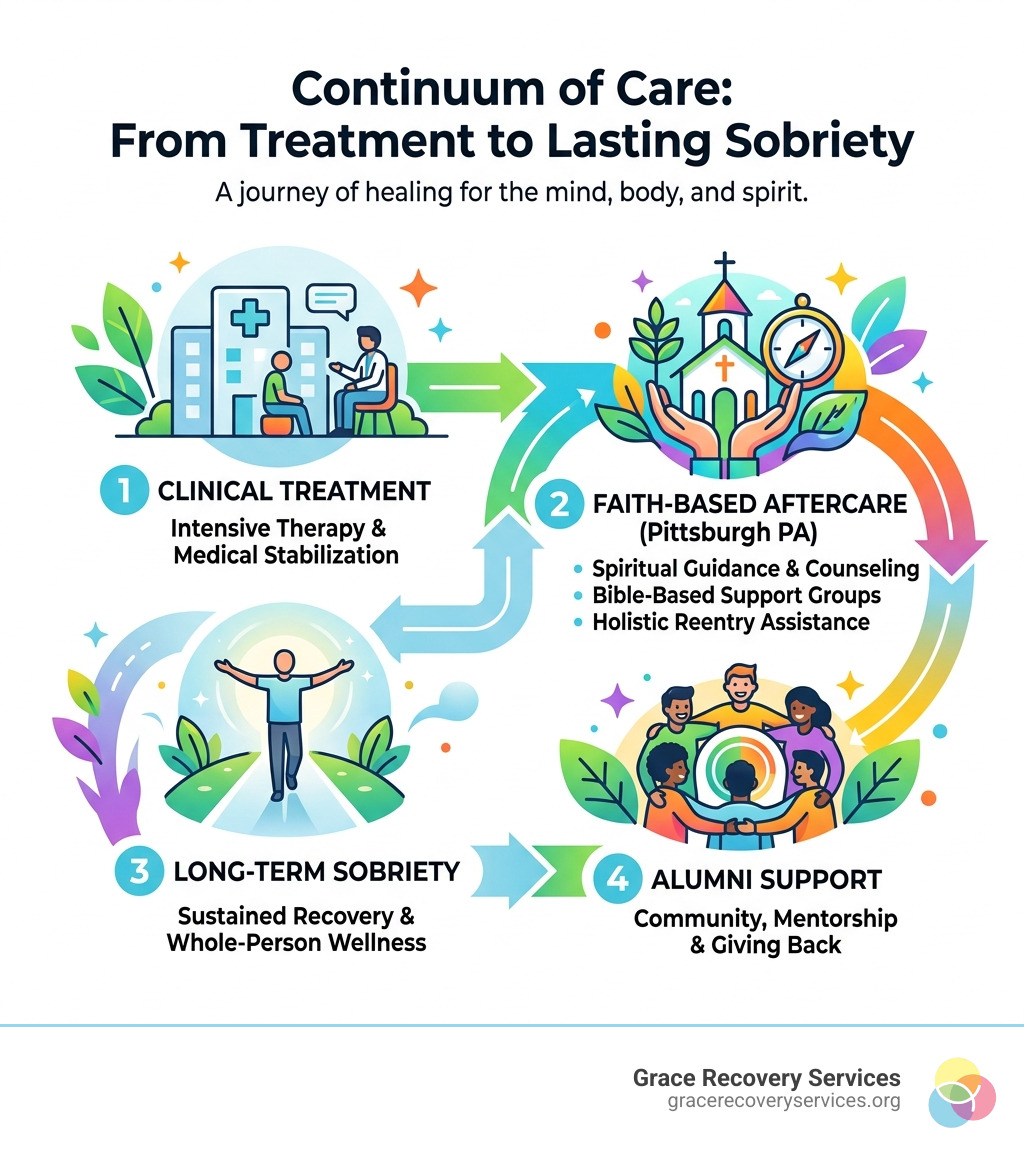
When we talk about faith-based aftercare Pittsburgh PA, we are describing a specialized bridge between intensive treatment and long-term, independent living. Traditional aftercare often focuses solely on clinical relapse prevention—attending meetings and checking in with a counselor. While those are vital, faith-based aftercare adds a layer of spiritual integration that many in Western Pennsylvania find essential for true transformation.
This approach treats addiction not just as a physical or mental health struggle, but as a journey involving the spirit. By combining faith-based rehab in Pittsburgh with evidence-based practices like Cognitive Behavioral Therapy (CBT), we create a “stronger foundation.” It’s like building a house: the clinical tools are the sturdy walls, but the spiritual connection is the bedrock that keeps the structure from shifting when the storms of life hit.
For those seeking more info about faith-based outpatient addiction treatment, it is important to know that clinical credibility is never sacrificed for spiritual growth. Instead, they work in tandem. We address the neurobiology of addiction while simultaneously exploring the grace and redemption found in a relationship with God.
The Role of Community in Faith-Based Aftercare Pittsburgh PA
One of the greatest enemies of recovery is isolation. In the Steel City, community is everything. Faith-based aftercare leverages the power of the local church and peer networks to ensure no one walks alone. Through Christian recovery services, clients are often paired with mentors who have walked the same path.
This isn’t just about accountability; it’s about “discipleship.” It’s having someone to call when cravings are high or when you simply need a reminder of your worth. Church partnerships across Penn Hills and North Huntingdon provide a ready-made family where clients can find acceptance without the weight of shame.
Addressing Spiritual Injury and Trauma
Many of us who have struggled with substance use carry what we call “spiritual injuries.” These are wounds from past trauma, rejection, or the deep-seated belief that we are “broken” beyond repair. Our approach to faith-based trauma recovery is trauma-informed and rooted in biblical hope.
We believe that restoration is possible for everyone. By applying the lens of grace to traumatic experiences, we help clients reframe their stories. You are not defined by what happened to you or the mistakes you’ve made; you are defined by your identity as a child of God. This shift is often the “missing piece” that allows clinical therapy to truly take root.
Why Spiritual Support is Vital for Western Pennsylvania Recovery
The statistics in Allegheny County tell a story of a community in need of deep, lasting healing. With a 52% recidivism rate in our local jails, it is clear that the “revolving door” of incarceration and addiction cannot be stopped by willpower alone. Organizations like the Foundation of HOPE work tirelessly to provide interfaith support to those reentering society, but the need for ongoing aftercare remains high.
Furthermore, the opioid crisis has left no neighborhood untouched, from the city center to the suburbs of Westmoreland County. With 32% of our homeless population facing a diagnosed mental health condition, the need for a holistic approach is more than a preference—it’s a necessity.

Holistic Healing for Mind, Body, and Spirit
To achieve lasting sobriety, we must address every part of the human experience. This means integrating addiction recovery and relapse prevention with:
- Mental Health Support: Addressing co-occurring disorders like anxiety, depression, and PTSD.
- Nutritional Counseling: Restoring the body that has been depleted by substance use.
- Spiritual Counseling: Finding meaning and purpose through prayer, Scripture, and reflection.
When we treat the whole person, we aren’t just stopping the use of a substance; we are reviving a life.
Accessing Faith-Based Aftercare Pittsburgh PA for Families
Addiction is often called a “family disease” because the ripples of pain affect everyone in the home. Faith-based aftercare in the Pittsburgh area places a heavy emphasis on family reunification. We help clients navigate the difficult process of repairing relational wounds and learning healthy parenting skills.
Through Christian rehab Pittsburgh programs, families can participate in support groups that use biblical principles to foster forgiveness and boundaries. Whether you are in Irwin or Penn Hills, these services are designed to bring families back together under a canopy of grace.
Essential Components of a Holistic Aftercare Plan
A successful aftercare plan is like a roadmap for the first year of sobriety. It should be detailed, practical, and spiritually grounded.
| Feature | Traditional Aftercare | Faith-Integrated Aftercare |
|---|---|---|
| Primary Focus | Behavioral change & abstinence | Spiritual renewal & holistic restoration |
| Support System | Support groups (secular) | Church community, mentors, & Bible study |
| Therapeutic Tools | CBT, DBT, Clinical counseling | CBT + Spiritual counseling & Scripture |
| Motivation | Health & legal consequences | Identity in Christ & God-given purpose |
In Allegheny County, the Allegheny County Pre-Release and Aftercare Services offer a starting point for many, providing basic needs and support groups. However, for those seeking a deeper spiritual connection, learning how to stay sober after rehab often involves daily habits of prayer and Scripture reflection.
Mentoring and One-on-One Support
We cannot overstate the value of a mentor. In our outpatient program details, we highlight how lived experience creates a unique bond of trust. A mentor isn’t a boss; they are a guide. They help you set goals—like finding a job or reconnecting with your kids—and celebrate with you when those milestones are reached.
Practical Reentry and Stability
Faith-based aftercare also gets its hands dirty with the practical stuff. We know you can’t focus on spiritual growth if you don’t know where you’re going to sleep or how you’ll eat. This is why intensive outpatient support often includes:
- Housing Assistance: Navigating local resources to find safe, sober living environments.
- Employment Counseling: Helping you build a resume and prepare for interviews despite a complicated past.
- Financial Stewardship: Learning to manage money in a way that honors God and provides for your future.
Overcoming Barriers to Long-Term Restoration
The path to recovery is rarely a straight line. Challenges like social isolation and the stigma of addiction can make someone feel like they don’t belong in a “traditional” church or community setting.

At Grace Recovery Services, we work to reduce that stigma. We remind our clients that their identity is not “addict,” but “redeemed.” This shift in perspective is a powerful tool for faith-based rehab Pittsburgh participants. When you know who you are in Christ, the opinions of the world lose their power to pull you back into old habits.
Specialized Care for Vulnerable Populations
Pittsburgh is home to several specialized faith-based initiatives that address specific types of trauma and loss. These programs are vital for those whose journey includes more than just substance use:
- Trafficking Survivors: Organizations like Her Safe Haven and Garden Home Ministries provide sanctuary and trauma-informed care specifically for women escaping exploitation.
- Divorce Recovery: Programs like DivorceCare help individuals navigate the grief of a broken marriage through a biblical lens.
- Grief Support: Specialized counseling for those who have lost loved ones to the overdose crisis or other tragedies.
- Youth Diversion: Programs aimed at helping teens find a better path before addiction takes a firm hold.
Frequently Asked Questions
Do I need to be religious to participate in faith-based aftercare?
Absolutely not. We believe that God’s grace is available to everyone, regardless of where they are on their spiritual journey. Our programs are non-judgmental and inclusive. We welcome those with doubts, those from different faith backgrounds, and those who are simply curious about how spirituality might help them heal. We meet you where you are, not where someone thinks you “should” be.
How long does a typical aftercare program last?
Recovery is a lifelong journey, but formal aftercare programs often focus on the critical first year of sobriety. Many programs in Pittsburgh, such as those at Light of Life Rescue Mission, utilize a model where clients have bi-weekly contact with a care team for the first 12 months. After that, many transition into “alumni” status, where they stay connected through mentoring and community events.
Is faith-based aftercare affordable in Pittsburgh?
Yes. Many faith-based outpatient programs in Western Pennsylvania are highly accessible. Many insurance providers, including Highmark, UPMC, and Blue Cross Blue Shield, often cover a significant portion of outpatient treatment and aftercare services. Additionally, many local nonprofits operate on donations, ensuring that a lack of funds is never a barrier to receiving the hope and help you deserve.
Finding Your Path to Renewal in Western Pennsylvania
If you are standing at a crossroads, feeling overwhelmed by the road ahead, please know that there is a community in Pittsburgh ready to walk with you. You don’t have to carry the weight of your past alone, and you don’t have to navigate the complexities of early recovery without a map.
At Grace Recovery Services, we are committed to your restoration, renewal, and revival. Whether you are in Penn Hills, North Huntingdon, or anywhere in the greater Pittsburgh area, our team is here to provide the compassionate, faith-centered care you need to build a life of lasting sobriety.
Recovery is possible. Grace is real. And your new story starts today.
Contact our team for a compassionate assessment and take the next step in your journey toward healing.
This article was researched with AI and heavily edited by Stephen Luther for accuracy and relevance.
Stephen Luther is the Executive Director and Founder of Grace Christian Counseling, Grace Recovery Services, WPA Counseling, NuWell Online Counseling and Coaching, and NuWell Health. He holds a Master’s degree in Education from the University of Georgia and a Master’s degree in Marriage and Family Therapy from Duquesne University. He is a licensed professional counselor in Pennsylvania.
Since 1997, Steve has been helping children, adolescents, and adults overcome a wide range of emotional and relational challenges. He specializes in working with hurting families, including those with foster, adopted, or traumatized children. Steve uses Attachment-Based Therapy, Splankna Healing, and Therapeutic Parent Coaching to support healing and restoration.
This guide is for educational and spiritual encouragement and is not a substitute for personalized professional counseling. If you are in crisis, please reach out for immediate help.