
Begin Overcoming Trauma With Scripture, One Safe Step at a Time
Overcoming trauma with Scripture can begin with one small, repeatable practice: choose a gentle verse about God’s presence, read it slowly, breathe, and turn its truth into an honest prayer. For example, Psalm 34:18 reminds hurting people that God is near to the brokenhearted. Use a verse as an anchor during anxious moments, journal what you are feeling, and share the journey with a trusted trauma-informed counselor or supportive faith community.
Scripture does not ask clients to deny pain or rush past it. It offers words for fear, grief, anger, and hope. The Bible makes room for lament, teaches that trauma does not define a person’s identity, and points to Christ’s steady care in suffering.
For people in recovery from substance use disorder, emotional pain and trauma can be closely connected. At Grace Recovery Services in the Pittsburgh area, we believe faith practices can support healing alongside compassionate, evidence-based outpatient care. Progress may come in layers, not all at once.
Overcoming trauma with scripture vocab explained:
- Bible verses about sobriety
- Christian counseling addiction help
- faith integrated recovery Pittsburgh
Understanding the Biblical View of Trauma, Identity, and Suffering

Trauma is not a modern phenomenon unknown to God. Scripture is filled with stories of people who endured violence, betrayal, profound grief, and life-threatening danger. From David fleeing into desert caves to Elijah collapsing from exhaustion under a broom tree, the Bible never minimizes suffering. Understanding The Christian Approach to PTSD: Trauma, the Body, and the God Who Heals reminds us that human distress touches body, mind, and soul simultaneously.
The biblical narrative reveals that God is not distant from our pain. Psalm 34:18 provides an anchor: “The Lord is close to the brokenhearted and saves those who are crushed in spirit.” When someone experiences traumatic events, it can feel as though God is absent or indifferent. Yet, Scripture repeatedly emphasizes His near, tender posture. Exploring healing verses for comfort and recovery helps ground survivors in the truth that suffering does not mean abandonment.
In our clinical outpatient work across Western Pennsylvania, we find that secular frameworks often define trauma primarily by its physiological and neurological symptoms. While neurobiology is vital to understand, a biblical perspective adds deep spiritual meaning: suffering is real, evil is real, but God’s redemptive presence is active within the brokenness.
Reframing Identity in Christ Beyond Past Pain
One of the deepest wounds caused by trauma is the distortion of personal identity. Trauma often tells lies: “You are dirty,” “You are broken beyond repair,” or “You are only a victim.” These painful messages can trap someone in a narrative defined entirely by what happened to them.
Scripture radically disrupts this script. In 2 Corinthians 5:17, Paul writes, “Therefore, if anyone is in Christ, the new creation has come: The old has gone, the new is here!” Your past experiences inform your story, but they do not define your core worth or ultimate destiny. By renewing your mind with powerful scripture, you begin replacing trauma-rooted narratives with gospel truth:
- From condemned to cherished: Romans 8:1 reminds us there is no condemnation for those in Christ Jesus.
- From helpless to secure: Psalm 91:4 speaks of sheltering under His wings.
- From ruined to redeemed: Isaiah 61:3 promises beauty instead of ashes.
In our structured Counseling Blueprint, we guide clients through four foundational stages of restoration:
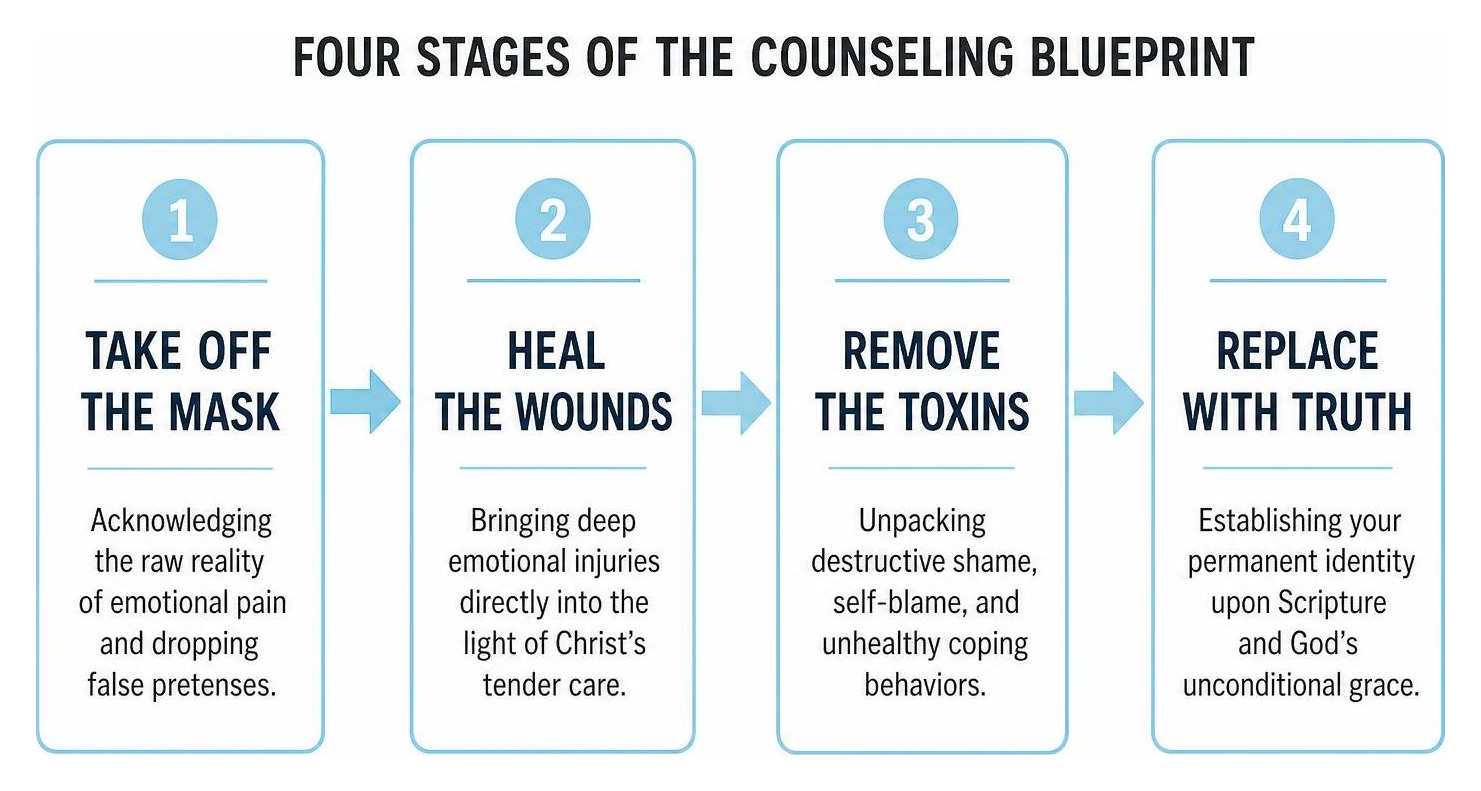
- Take Off the Mask: Acknowledging the raw reality of emotional pain and dropping false pretenses.
- Heal the Wounds: Bringing deep emotional injuries directly into the light of Christ’s tender care.
- Remove the Toxins: Unpacking destructive shame, self-blame, and unhealthy coping behaviors.
- Replace with Truth: Establishing your permanent identity upon Scripture and God’s unconditional grace.
The Sacred Purpose of Biblical Lament in Healing
Many believers believe they must always project cheerful optimism. But suppressing grief or anger is spiritually and emotionally exhausting. God gave us an entire book called Lamentations, and more than a third of the Psalms are songs of raw lament.
Consider Psalm 88, which ends without a tidy resolution, closing simply with the words, “darkness is my closest friend.” Biblical lament is not a lack of faith; it is an act of profound trust. It is taking tears, confusion, and righteous anger directly to God instead of running away from Him. Practicing honest lament allows trauma survivors to:
- Release built-up somatic and emotional pressure safely.
- Validate grief without falling into despair.
- Stand in God’s presence authentically without pretense.
A Step-by-Step Framework for Overcoming Trauma with Scripture

Engaging Scripture during trauma recovery requires intentionality and gentleness. For someone whose nervous system is on high alert, sitting down with huge sections of text can feel overwhelming. Following a practical guide to Bible-based trauma healing provides practical structure, helping you engage God’s Word in bite-sized, stabilizing ways.
Practical Daily Exercises for Overcoming Trauma with Scripture
To move Scripture from an abstract concept into an active refuge, try incorporating these practical steps into your daily rhythm. As highlighted in How to Use Scripture to Feel Safe After Trauma, building safety is the first priority in recovery:
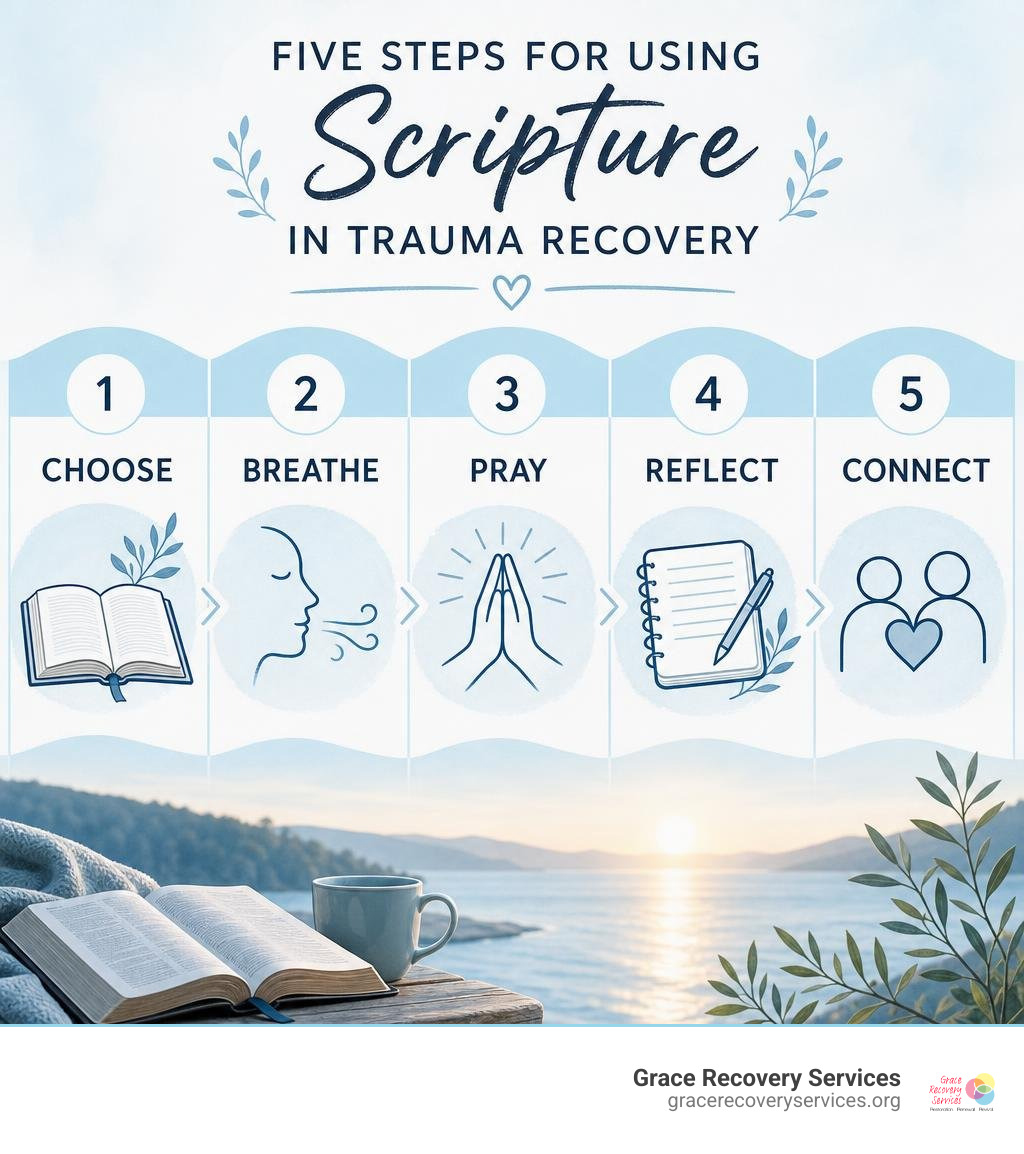
- Select a Single Safety Verse: Rather than reading chapters at once, choose one stabilizing passage, such as Isaiah 41:10 (“Do not fear, for I am with you; do not be dismayed, for I am your God”).
- Create a Trigger-to-Truth Journal: When distressing memories or somatic panic arise, write down the false fear, then write a specific biblical promise directly beside it.
- Pray Scripture Back to God: Turn the words of the verse into a personalized conversation: “Lord, You promised to be near me right now. Help my racing heart believe Your peace.”
- Practice Micro-Dosing the Word: Keep 3×5 index cards in your pocket, purse, or on your phone lock screen for immediate access during moments of distress.
Biblical Meditation, Neurobiology, and Calming the Nervous System
Trauma impacts the autonomic nervous system, often keeping the body locked in a persistent fight, flight, or freeze state. Modern neurobiology confirms that repeated thoughts carve physical neural pathways in the brain.
In Hebrew, the word often translated as “mind” or “imagination” is yêtser (as seen in Isaiah 26:3: “You will keep in perfect peace those whose minds are steadfast, because they trust in you”). When our yêtser constantly replays traumatic imagery, the body responds with genuine panic.
As explored by resources on Healing Trauma-Related Panic through Scripture, slow biblical meditation systematically replaces catastrophic mental imagery with divine truth. When combined with slow diaphragmatic breathing, meditating on Scripture signals safety to the amygdala, helping to reset the central nervous system over time.
Biblical Confession Versus New Age Manifestation
In contemporary wellness culture, the line between Christian meditation and secular “manifestation” can sometimes blur. It is essential to recognize the theological differences:
| Feature | Biblical Declaration / Confession | New Age Manifestation / Affirmations |
|---|---|---|
| Source of Power | God’s sovereign Word and the Holy Spirit | The individual’s mind, universe, or self-will |
| Primary Goal | Aligning one’s heart with God’s truth and will | Attracting personal desires, control, or outcomes |
| Posture | Humble dependence, trust, and surrender | Self-reliant authority and personal control |
| Handling Suffering | Honest lament embraced within God’s care | Avoiding or denying negative thoughts and pain |
| Foundation | The finished work of Jesus Christ | Self-generated positivity and personal power |
Biblical confession does not claim to bend reality by force of will; it invites God’s established truth to transform our inner reality.
Navigating Emotional Triggers, Church Stigma, and Healthy Forgiveness
Engaging Scripture in faith-based trauma recovery requires a nuanced, compassionate setting. Unfortunately, individuals carrying severe wounds occasionally encounter well-meaning believers who unintentionally inflict more harm through simplistic spiritual advice.
Addressing Misconceptions and Harm in Faith Communities
Trauma survivors in church environments are sometimes told clichés like “just pray more,” “have more faith,” or “give it to God and move on.” These platitudes can produce profound spiritual guilt, causing the person to believe their lingering PTSD symptoms stem from personal spiritual failure.
True, Christ-centered fellowship provides a safe space where individuals can weep, heal at their own pace, and receive support without judgment. Spiritual bypassing—using Bible verses to sweep real emotional wounds under the rug—contradicts the gentle, long-suffering character of Jesus.
Approaching Forgiveness Without Bypassing Boundaries
Few topics are more misunderstood in trauma recovery than forgiveness. Rushing a survivor to forgive before they have even felt safe or processed their pain can lead to further emotional injury.
- Forgiveness is not denial: It does not mean pretending the abuse or trauma did not matter.
- Forgiveness is not immediate reconciliation: You can release bitterness to God while maintaining firm, protective physical and emotional boundaries.
- Forgiveness is a process: It often happens in gradual layers rather than a single emotional transaction.
Scripture calls us to forgive as Christ forgave us (Ephesians 4:32), but Jesus also spoke sternly against abusers and wolves, honoring the necessity of safety and wisdom.
Integrating Evidence-Based Clinical Care with Faith Practices
At Grace Recovery Services, we strongly believe that faith and clinical science do not conflict; rather, they work together. God created the human body and brain with intricate biological systems that often need clinical care when damaged by trauma.
Embracing trauma-informed care means combining rich spiritual support with proven psychological modalities.
Integrating Clinical Therapies and Overcoming Trauma with Scripture
Evidence-based therapies provide practical frameworks for processing traumatic memories that are physically stored in the brain’s circuitry. Research demonstrates that pairing these methods with Scripture enhances resilience:
- EMDR (Eye Movement Desensitization and Reprocessing): Helps the brain reprocess stuck traumatic memories. Clients often anchor themselves in a chosen Scripture verse while processing difficult imagery.
- Cognitive Processing Therapy (CPT): Identifies and challenges distorted thoughts (“It was all my fault”), aligning thoughts with objective truth and biblical grace.
- Collaborative Outpatient Care: Engaging in evidence-based trauma treatment alongside Christian counseling allows for comprehensive healing across psychological, physical, and spiritual dimensions.
Somatic Grounding and Outpatient Recovery Support
Because trauma causes hyperarousal in the nervous system, combining somatic grounding techniques with spiritual truths helps bring calm to both body and spirit:
- The 5-4-3-2-1 Grounding Method: Identify five things you see, four you can touch, three you hear, two you smell, and one truth from God’s Word you can cling to.
- Box Breathing with Scripture: Inhale for 4 seconds while focusing on God’s grace; hold for 4 seconds; exhale for 4 seconds releasing tension; hold for 4 seconds remembering His presence.
For individuals seeking structured, intensive recovery without leaving their work or family commitments, our Christian intensive outpatient treatment provides flexible, trauma-informed outpatient counseling tailored to mind, body, and spirit throughout Pittsburgh and Western Pennsylvania.
Frequently Asked Questions About Healing Emotional Trauma Through Scripture
Can Scripture study and prayer replace professional mental health therapy for PTSD?
While Scripture and prayer are essential foundations for spiritual life, PTSD involves physiological and neurobiological injuries that often benefit from specialized clinical treatment. Modalities like EMDR, CPT, and trauma-informed counseling work alongside spiritual disciplines to bring healing to the brain, mind, and spirit together.
How do I handle trauma triggers when certain Bible verses feel distressing?
If a verse was previously weaponized against you in an abusive or legalistic context, give yourself permission to step back from that passage. Focus on neutral, deeply comforting passages, particularly the Psalms, or work with a trauma-informed Christian counselor to navigate those triggers gently and safely.
What is the difference between biblical declaration and positive self-affirmations?
Positive self-affirmations typically rely on personal willpower, self-reliance, and trying to change circumstances through self-belief. Biblical declaration anchors hope entirely in the unchanging character, promises, and authority of Jesus Christ, acknowledging our human limitations while leaning into His strength.
Conclusion
Overcoming trauma is a courageous, layered journey that requires grace, patience, and compassionate support. By walking with God through honest lament, renewing your identity in Christ, and allowing Scripture to calm your nervous system, deep restoration is possible. You do not have to carry the weight of trauma or substance use struggles alone.
If you or a loved one in the Pittsburgh or North Huntingdon area is looking for a safe, compassionate space to heal, explore our comprehensive outpatient services to learn how our dedicated clinical team can walk alongside you toward lasting freedom and peace. Reach out to Grace Recovery Services today for a personalized assessment.
This article was researched with AI and heavily edited by Stephen Luther for accuracy and relevance.
Stephen Luther is the Executive Director and Founder of Grace Christian Counseling, Grace Recovery Services, WPA Counseling, NuWell Online Counseling and Coaching, and NuWell Health. He holds a Master’s degree in Education from the University of Georgia and a Master’s degree in Marriage and Family Therapy from Duquesne University. He is a licensed professional counselor in Pennsylvania.
Since 1997, Steve has been helping children, adolescents, and adults overcome a wide range of emotional and relational challenges. He specializes in working with hurting families, including those with foster, adopted, or traumatized children. Steve uses Attachment-Based Therapy, Splankna Healing, and Therapeutic Parent Coaching to support healing and restoration.
This guide is for educational and spiritual encouragement and is not a substitute for personalized professional counseling. If you are in crisis, please reach out for immediate help.