
Understanding Trauma-Informed Addiction Treatment and Its Core Principles
When an organization embraces trauma-informed addiction treatment, it fundamentally restructures its physical environment, policies, and clinical practices. Rather than viewing substance use in isolation, this model recognizes that addiction is frequently a survival strategy developed in response to emotional, physical, or relational pain.
The Substance Abuse and Mental Health Services Administration (SAMHSA) outlines six fundamental principles that guide effective trauma-informed care:
- Safety: Ensuring both physical and emotional safety for clients and staff alike.
- Trustworthiness and Transparency: Conducting operational and clinical decisions with openness to build lasting trust.
- Peer Support: Leveraging the shared lived experiences of peers to foster mutual hope, safety, and empowerment.
- Collaboration and Mutuality: Flattening traditional power dynamics so clinicians and clients work together as equal partners in recovery.
- Empowerment, Voice, and Choice: Cultivating client autonomy, validating personal strengths, and providing real options in treatment planning.
- Cultural, Historical, and Gender Sensitivity: Moving past baseline cultural competence to offer care that respects each client’s unique background and lived experience.
How Trauma-Informed Addiction Treatment Differs From Trauma-Focused Therapy
It is essential to distinguish between a trauma-informed approach and trauma-focused therapy.
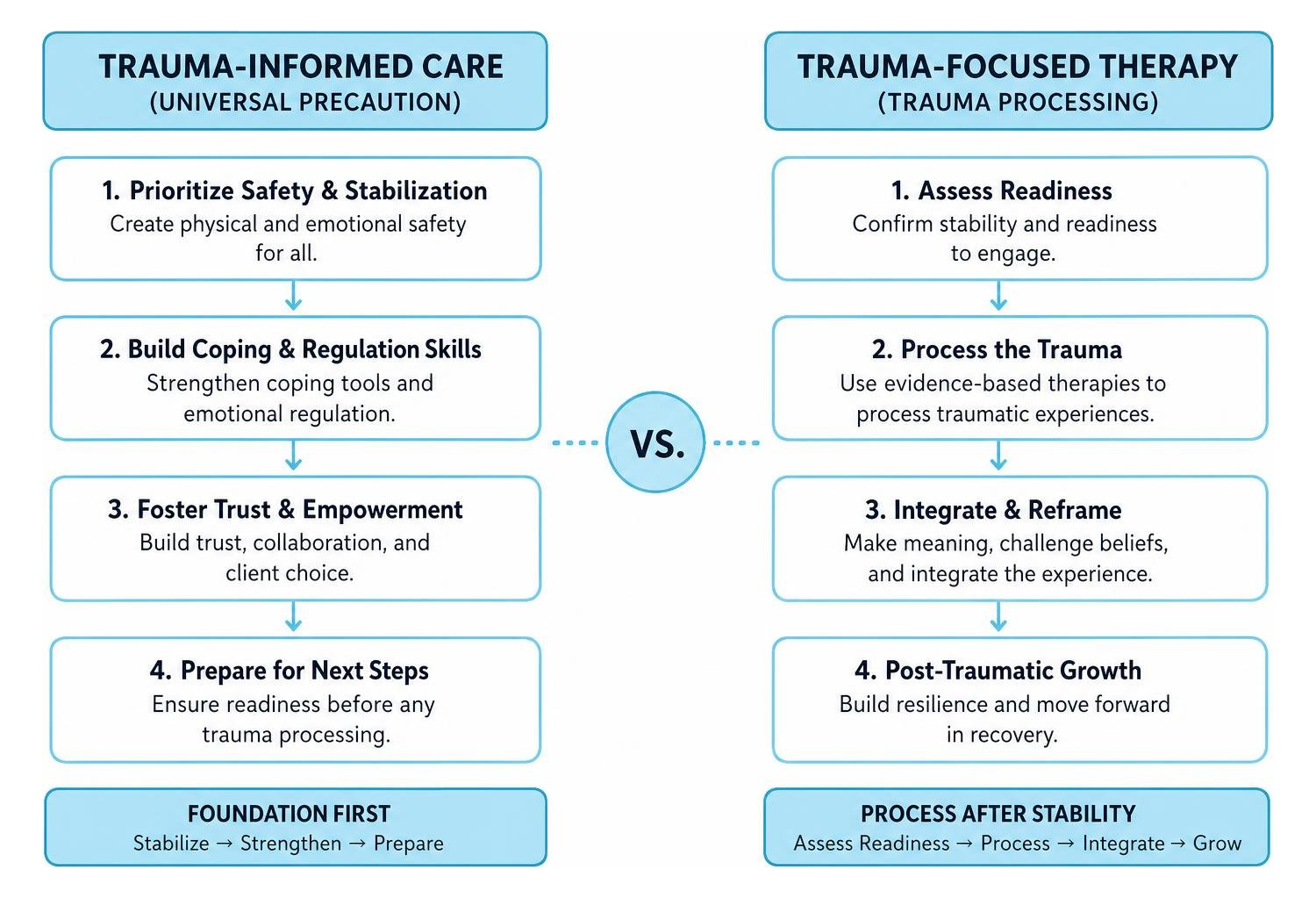
Trauma-focused therapy involves specific, manualized psychotherapies—such as Prolonged Exposure, Cognitive Processing Therapy, or Eye Movement Desensitization and Reprocessing (EMDR)—designed to help a client process a specific traumatic event or treat Post-Traumatic Stress Disorder (PTSD).
In contrast, trauma-informed care acts as a universal precaution. As detailed in expert literature on integrating trauma-informed care into addiction treatment, trauma-informed care does not require clients to disclose or process their detailed trauma narratives immediately. Instead, it creates an environment of total physical and emotional safety.
Forcing direct trauma processing too early in recovery, before a client has developed solid emotional regulation skills, can trigger severe decompensation and relapse. Trauma-informed care prioritizes stabilization, safety, and coping mechanisms first.
SAMHSA’s Four Operational Assumptions for Healing
To operationalize these principles across an outpatient program, organizations rely on SAMHSA’s four key assumptions, often referred to as the “Four Rs”:
- Realization: Realizing the widespread impact of trauma on individuals, families, and communities.
- Recognizing: Recognizing the signs and symptoms of trauma in clients, families, and staff members.
- Responding: Responding by fully integrating knowledge about trauma into every policy, procedure, and clinical practice.
- Resisting Retraumatization: Actively designing clinical processes to avoid triggering or re-traumatizing clients.
Applying these four assumptions ensures that co-occurring treatment addresses both mental health and substance use simultaneously, providing holistic support for long-term health.
Why Trauma-Informed Care is Vital in Substance Use Recovery
The neurobiology of trauma helps explain why standard, high-pressure addiction approaches often fail. Traumatic stress dysregulates the Hypothalamic-Pituitary-Adrenal (HPA) axis, creating chronic sympathetic nervous system arousal. The brain’s threat appraisal system remains locked in a constant “fight, flight, or freeze” state. Addictive substances temporarily calm this biological fire alarm.
The Adverse Childhood Experiences (ACE) study demonstrated a direct link between early childhood adversity and adult substance use disorders. Research indicates that up to 95% of individuals in substance use treatment report a history of trauma. Furthermore, individuals who experienced six or more ACEs faced a 46-fold increased likelihood of developing a substance use disorder in adulthood.

Addressing Retraumatization in Outpatient Clinical Care
Healthcare environments can inadvertently re-traumatize clients through confrontational interactions, overly intrusive intake evaluations, or punitive procedures. Delivering safe care requires rethinking routine interactions, as outlined in clinical guidance on trauma-informed care for women with substance use disorders.
For example, traditional urine drug screens can feel intrusive or shaming. Clinicians can use the GLAPE framework to make routine toxicology trauma-sensitive:
- Giving clear instructions without authoritative commands.
- Listening closely to the client’s fears or concerns.
- Articulating choices whenever possible.
- Permission-asking prior to physical or procedural steps.
- Evaluating the client’s emotional experience after the collection.
Similarly, controlled substance agreements should be transformed from paternalistic contracts into collaborative care plans that clearly outline the provider’s commitments to compassionate care.
Supporting Women and Unique Vulnerable Populations
Women often experience a “telescoping effect,” progressing from initial substance exposure to dependence much faster than men, often driven by violent victimization or interpersonal trauma. Additionally, over the last two decades, overdose mortality among women has increased dramatically, highlighting an urgent need for gender-responsive, trauma-informed interventions.
Transitions between care settings or returning home from correctional supervision represent high-risk windows for fatal overdose due to loss of physical tolerance. Research protocols evaluating trauma-informed interventions to reduce substance use during community transition emphasize three primary pillars of relational care:
- Establishing felt safety in physical and social spaces.
- Building emotional regulation skills to manage intense distress without substances.
- Fostering healthy relational connections through support systems and single-gender recovery cohorts.
Key Elements of Trauma-Informed Addiction Treatment in Outpatient Settings
Shifting from traditional addiction treatment to a trauma-informed model requires changing how we view client behavior and structure care delivery:
| Treatment Dimension | Traditional Approach | Trauma-Informed Approach |
|---|---|---|
| Core Question | “What is wrong with you?” | “What happened to you?” |
| View of Symptoms | Behavior to be managed or eliminated | Survival and coping mechanisms |
| Power Dynamics | Clinician holds authority; demands compliance | Collaborative partnership; emphasizes choice |
| Relapse Response | Punitive; discharge or administrative consequences | Opportunity to review safety plans and triggers |
| Group Modalities | Confrontational style | Skill-building and emotional regulation |
Integrated frameworks like Seeking Safety provide structured group coping skills that treat trauma and substance use concurrently. Studies show that trauma-informed group models significantly improve 3-month treatment retention, reduce PTSD symptoms, and build lasting coping skills. This emphasizes the value of integrated treatment for addiction and mental health.
Leadership, Environment, and Preventing Clinician Burnout
Implementing trauma-informed care organizationally requires active leadership involvement across administrative, environmental, and clinical practices. Simple office adjustments—such as arranging chairs so clients have an unobstructed path to the door, asking permission before closing doors, and eliminating shaming signage—help settle an overactive nervous system. Streamlining initial intake paperwork prevents clients from feeling overwhelmed by intrusive questionnaires on their first day.
Trauma-informed leadership also protects clinicians from secondary traumatic stress and burnout. In high-demand behavioral health settings, prioritizing staff self-efficacy, peer consultation, and ongoing training builds professional quality of life, allowing team members to offer steady, compassionate care.
Integrating Faith, Counseling Blueprints, and Whole-Person Healing
At Grace Recovery Services, we blend evidence-based clinical practices with spiritual restoration. True healing occurs when we care for the whole person—mind, body, and spirit. Combining clinical interventions with faith-based trauma recovery helps clients move past shame and discover their inherent worth.
By integrating the whole person approach to faith-based trauma recovery, we help clients discover hope, grace, and lasting redemption.

The Four-Stage Counseling Blueprint for Lasting Recovery
To help clients navigate recovery safely, we utilize our four-stage Counseling Blueprint:
- Take Off the Mask: We create an environment of safety and rapport, empowering clients to lay down survival masks without fear of judgment.
- Heal the Wounds: We gently identify past relational hurts, emotional injuries, and unresolved trauma driving substance use.
- Remove the Toxins: We identify self-defeating beliefs, negative thought patterns, and lingering lies rooted in trauma.
- Replace with Truth: We equip clients with grounded, empowering truths regarding their identity, purpose, and capability.
Following this structured path helps clients build a solid foundation, which is why your trauma needs a holistic approach to healing. If you are wondering how these steps come together, read our complete step-by-step guide to healing from addiction and trauma.
Frequently Asked Questions About Trauma-Informed Recovery
What is the main difference between trauma-informed care and trauma-focused therapy?
Trauma-informed care operates as a universal precaution for all clients. It focuses on physical safety, transparency, choice, and symptom stabilization without requiring a person to revisit painful trauma details. Trauma-focused therapy consists of specialized therapeutic protocols (such as EMDR or Cognitive Processing Therapy) aimed at processing specific traumatic memories once a client is emotionally stable.
Do I have to detail my past traumatic experiences during addiction treatment intake?
No. In a trauma-informed setting, voluntary disclosure is respected, and forced trauma narratives are avoided. Your intake focus will be on your immediate physical and emotional safety, identifying present-day coping goals, and treating you with dignity from day one.
How does faith integration enhance evidence-based trauma recovery?
Faith integration combines proven clinical models (like cognitive-behavioral skill building and emotional regulation) with spiritual principles of grace, forgiveness, identity restoration, and hope. It provides a deeper sense of purpose and ongoing community support throughout the healing journey.
Finding Hope and Restoration in Western Pennsylvania
Unresolved trauma and substance use do not have to control your life. With trauma-informed, compassionate care, healing is well within reach.
At Grace Recovery Services, our outpatient programs in Western Pennsylvania—including our offices in the Pittsburgh area (Penn Hills) and North Huntingdon—are designed to meet you right where you are. Serving Allegheny County, Westmoreland County, Irwin, and surrounding communities, our team combines evidence-based therapies, clinical excellence, and faith-centered support to help you achieve lasting freedom.
If you or a loved one are ready to take the next step toward recovery, explore our options for trauma-informed care and reach out to us today. Healing, grace, and renewal are waiting.
This article was researched with AI and heavily edited by Stephen Luther for accuracy and relevance.
Stephen Luther is the Executive Director and Founder of Grace Christian Counseling, Grace Recovery Services, WPA Counseling, NuWell Online Counseling and Coaching, and NuWell Health. He holds a Master’s degree in Education from the University of Georgia and a Master’s degree in Marriage and Family Therapy from Duquesne University. He is a licensed professional counselor in Pennsylvania.
Since 1997, Steve has been helping children, adolescents, and adults overcome a wide range of emotional and relational challenges. He specializes in working with hurting families, including those with foster, adopted, or traumatized children. Steve uses Attachment-Based Therapy, Splankna Healing, and Therapeutic Parent Coaching to support healing and restoration.
This guide is for educational and spiritual encouragement and is not a substitute for personalized professional counseling. If you are in crisis, please reach out for immediate help.