
When a Loved One Struggles, the Whole Family Hurts

Addiction recovery for families is the process of healing together — not just supporting the person in recovery, but also addressing the pain, confusion, and exhaustion that family members carry.

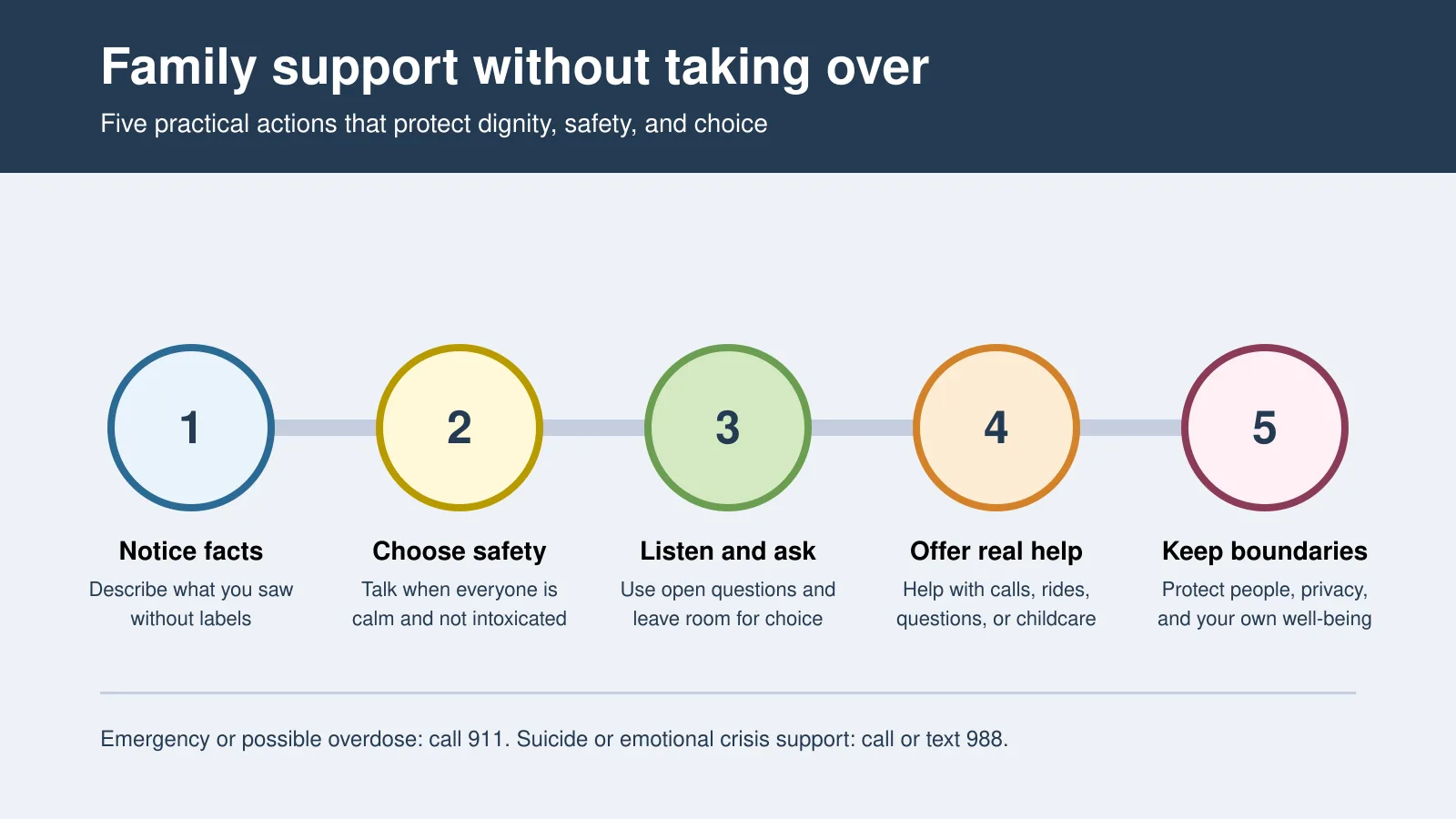
Here is what that process typically involves:

  1. Understand the impact — Recognize how substance use affects the entire family system, not just the individual.
  2. Learn healthy ways to help — Replace enabling patterns with supportive, boundaried behaviors.
  3. Access the right resources — Connect with family therapy, peer support groups, and professional guidance.
  4. Care for yourself too — Tend to your own mental, emotional, and spiritual well-being.
  5. Stay connected through the long haul — Recovery is a journey, not a single event. Ongoing support matters.

The numbers tell a hard truth. At least 25% of people in the United States belong to a family affected by a substance use disorder in a first-degree relative. More than 100 million family members worldwide are affected by a relative’s addiction. And yet, the focus in treatment has historically been placed almost entirely on the individual — leaving families without a clear path forward.

If you are a parent, spouse, sibling, or adult child watching someone you love struggle, you already know the feeling: the fear, the helplessness, the exhaustion of not knowing what to do next.

You are not alone. And this is not your fault.

At Grace Recovery Services in Western Pennsylvania, we believe healing is a whole-family journey. Grounded in faith, trauma-informed care, and evidence-based practice, we walk alongside both clients and their loved ones — because true restoration touches every relationship that addiction has strained.

This guide will give you practical, compassionate, step-by-step direction — from understanding what is happening in your family right now, to finding real support that works.

Infographic: The ripple effect of addiction on family members and steps to recovery infographic

Common addiction recovery for families vocab:

Understanding the Impact of Substance Use on the Family System

To understand how addiction affects a family, we must look at the family as an interconnected system. In any system, when one part moves, every other part is forced to adjust to keep the balance. This desire for balance is what sociologists and clinicians call homeostasis.

When substance use enters a household, the system creates automatic, unspoken rules to survive the chaos. These feedback loops are often designed to minimize conflict or hide the problem from the outside world. Over time, these patterns become deeply ingrained, reinforcing the very behaviors we wish to change. Research shows that up to 90% of individuals with active addiction live at home with a family member or significant other, meaning these daily interactions heavily shape the environment of both active use and potential recovery.

Furthermore, addiction is rarely an isolated event in a single generation. Intergenerational trauma and genetic predispositions often cluster within families, passing down maladaptive coping mechanisms from parents to children. In fact, children who grow up in households with active substance use are two to four times more likely to experience mental health challenges or develop substance use disorders themselves.

Realizing that the entire household is caught in this cycle is the first step toward freedom. True healing cannot happen in isolation; it requires a parallel process of restoration. To explore this dynamic further, read our comprehensive guide on Family Support in Addiction Recovery.

Dysfunctional Family Roles vs. Healthy Dynamics

When a family system is under constant pressure from active addiction, members unconsciously adopt survival roles to maintain homeostasis. While these roles help manage immediate anxiety, they ultimately block long-term healing:

  • The Savior or Hero: Typically the oldest child or a highly responsible partner. They overachieve, excel academically or professionally, and try to make the family look “perfect” to the outside world to compensate for the underlying shame.
  • The Mascot: The family member who uses humor, silliness, or lighthearted distractions to break the tension. While their antics bring temporary relief, they often carry deep internal anxiety.
  • The Lost Child: The quiet survivor who retreats into the background. They avoid making waves, ask for very little, and isolate themselves to stay out of the line of fire.
  • The Scapegoat: The family member who acts out or gets into trouble, drawing the focus away from the addiction. By becoming the “designated problem,” they allow the family to ignore the real elephant in the room.
  • The Enabler or Caregiver: The person who shields the individual from the natural consequences of their choices. Out of deep love and fear, they manage crises, pay debts, make excuses, and inadvertently make it easier for the substance use to continue.

Shifting from these survival roles to healthy dynamics requires immense grace and intentional effort. It means moving from protecting the addiction to practicing loving accountability. In a healthy family system, members learn to express their true feelings, step down from unrealistic responsibilities, and allow their loved ones to experience the natural consequences of their actions.

The Power of Community and Peer Support in Addiction Recovery for Families

One of the heaviest burdens families carry is the profound isolation of stigma. Many families suffer in silence, believing that no one else could possibly understand their shame or fear. This is why connecting with a wider community of peer support is so vital.

Peer support groups offer a safe space where you can share your struggles without fear of judgment. These networks provide practical strategies, emotional validation, and a sense of shared experience that breaks the grip of isolation. Several excellent resources exist specifically for families:

  • Al-Anon and Nar-Anon: Twelve-step fellowships designed for friends and families of individuals struggling with alcohol or drug use. They focus on personal recovery, acceptance, and finding peace regardless of whether the loved one is sober.
  • SMART Recovery Family & Friends: A science-based, secular alternative that teaches practical tools based on Cognitive Behavioral Therapy (CBT) and the CRAFT model.
  • Families In Recovery: A powerful resource network designed to support families in navigating the path to wellness. You can connect with local peer networks through Families In Recovery.

By joining these groups, you discover that your family’s story is shared by millions of others. You learn that while you cannot control your loved one’s choices, you can absolutely reclaim your own peace and joy.

Evidence-Based and Faith-Integrated Approaches to Healing

At Grace Recovery Services, we believe that the most effective treatment combines rigorous, evidence-based clinical practices with spiritually grounded hope. We recognize that families need practical, scientifically proven tools, but they also need the spiritual renewal that restores broken souls.

Integrating clinical therapies like Multidimensional Family Therapy (MDFT) and Behavioral Couples Therapy (BCT) allows us to address the complex web of family relationships. These approaches do not focus solely on the individual; they treat the relationship itself as a primary client. To dive deeper into the clinical framework of these family therapies, you can read the detailed clinical outlines in Chapter 3—Family Counseling Approaches.

Our holistic approach addresses the mind, body, and spirit. Through Christian counseling, we help families process trauma, release deep-seated guilt, and anchor their hope in the redeeming grace of God. To understand how we map out this journey of recovery, explore The Roadmap to Effective Substance Abuse Treatment.

Clinical Family Therapies and the CRAFT Model

When a loved one refuses to seek help, families often feel completely powerless. Traditional, confrontational intervention models (like the Johnson Intervention) can sometimes lead to defensiveness, anger, and further estrangement. Fortunately, there is a highly effective, compassionate alternative: the Community Reinforcement and Family Training (CRAFT) model.

CRAFT is a non-confrontational, motivational approach that teaches family members how to use positive reinforcement to encourage their loved one toward treatment. Instead of arguing or issuing ultimatums, CRAFT helps you:

  1. Understand the triggers and patterns behind your loved one’s substance use.
  2. Provide positive reinforcement when your loved one is sober, making sobriety more rewarding than active use.
  3. Allow natural, negative consequences to occur when they are using, without stepping in to rescue them.
  4. Communicate clearly, briefly, and compassionately using motivational interviewing techniques.
  5. Encourage them to engage with outpatient care when they show readiness.

The results speak for themselves. Clinical studies show that the CRAFT approach is twice as effective as the traditional Johnson Intervention and three times more effective than standard Al-Anon facilitation at engaging treatment-resistant individuals into care. It empowers families to take constructive action while preserving the dignity of their loved one.

The Counseling Blueprint for Families

At Grace Recovery Services, our care is guided by our signature clinical framework: The Counseling Blueprint. This four-stage healing journey is designed to gently move families away from fear and shame and toward deep, lasting restoration:

  • Stage 1: Take Off the Mask — We create a warm, non-judgmental space where family members can drop the expectation of perfection. Here, we build genuine trust and allow you to safely voice your fears, anger, and grief.
  • Stage 2: Heal the Wounds — We explore the emotional and relational hurts that have accumulated over years of active addiction. This trauma-informed stage focuses on mending broken trust and processing generational patterns.
  • Stage 3: Remove the Toxins — We help you identify unhelpful beliefs and lingering lies that keep you stuck, such as “I am responsible for my child’s addiction” or “If I love them enough, I can cure them.”
  • Stage 4: Replace with Truth — We install empowering, biblical, and accurate perspectives about yourself, your boundaries, and your loved one’s journey. We replace shame with grace and equip you with practical tools for the future.

This blueprint ensures that we do not simply patch up the surface-level issues. Instead, we do the deep work necessary to cultivate a healthy, resilient family system.

Practical Steps for Supporting a Loved One While Maintaining Well-Being

Caring for someone struggling with a substance use disorder is incredibly taxing. Without proper strategies, family members frequently experience compassion fatigue — a state of physical, emotional, and spiritual exhaustion that leaves you feeling drained and hollow.

To help your loved one effectively, you must first secure your own foundation. You cannot pour from an empty cup. For immediate, practical ways to walk this path, read our guide on How to Support Someone in Recovery.

How to Start a Compassionate Conversation

Starting a conversation about substance use can feel like walking through a minefield. However, waiting for a crisis is not the answer. You can initiate a dialogue using simple, gentle entry points.

Consider using these practical guidelines to keep the conversation constructive:

  • Pick the Right Moment: Never attempt to have a serious conversation when your loved one is actively under the influence or when emotions are already running high. Choose a quiet, private time when you are both calm.
  • Lead with Love, Not Accusations: Start with simple, disarming phrases like, “Can we talk? I love you, and I’ve noticed some things lately that have me feeling concerned.”
  • Use “I” Statements: Instead of saying, “You are destroying this family,” try saying, “I feel scared when I see you struggling, and I want to support you.”
  • Practice Active Listening: Give them space to talk without immediately jumping in to correct, lecture, or argue. Sometimes, simply being heard is the bridge that allows a person to admit they need help.

For more detailed communication scripts and strategies, explore our resource on How to Help Someone with Substance Abuse.

Setting Healthy Boundaries and Practicing Self-Care

Boundaries are not walls meant to keep your loved one out; they are bridges designed to keep both of you safe. Setting boundaries is an act of profound love. It communicates: “I love you too much to help you destroy yourself, and I love myself too much to let you destroy me.”

Enabling Behaviors (Harmful) Supportive Behaviors (Healthy)
Paying their bills, rent, or legal fees Offering to pay directly for treatment or groceries
Making excuses to employers, friends, or family Letting them face the natural consequences of missed obligations
Lying or covering up their substance use Speaking the truth in love and refusing to hide the issue
Prioritizing their moods and needs above your own safety Practicing regular self-care and maintaining your own schedule

To sustain your well-being, integrate self-care across these five core categories:

  1. Sensory: Creating a calm environment, listening to uplifting music, or spending time in quiet reflection.
  2. Emotional: Journaling, attending individual therapy, or sharing your heart with a trusted friend.
  3. Physical: Prioritizing sleep, eating nourishing meals, and taking walks outdoors.
  4. Spiritual: Praying, studying scripture, and gathering with your faith community.
  5. Social: Spending time with friends who lift you up and have nothing to do with the crisis.

Recovery is a marathon, not a sprint. To build the endurance you need for this path, reflect on the insights in Recovery is a Journey.

Navigating the healthcare system can feel overwhelming, especially when you are already dealing with the emotional weight of a loved one’s crisis. Understanding how behavioral health care is structured can significantly reduce your stress.

When coordinating support, it is helpful to understand the legal guardrails that protect patient privacy. Two key federal regulations govern substance use treatment:

  • HIPAA (1996): Protects the privacy of patient health information, requiring written consent before providers can share treatment details with family members.
  • 42 CFR Part 2: A strict federal law that specifically protects the confidentiality of substance use disorder patient records.

While these laws can sometimes feel like barriers to worried families, they are designed to build trust between the client and their clinical team. For a step-by-step roadmap on how to coordinate care, access school supports, and manage crisis planning, we highly recommend reading Navigating Mental Health and Substance Use Care: An Introductory Guide for Families.

Debunking Misconceptions About Addiction Recovery for Families

To heal, we must first clear away the myths that breed shame and keep families stuck in destructive patterns:

  • The Myth of Codependency: For decades, well-meaning people have used the label “codependent” to describe family members. However, this term is not a clinical diagnosis and can sometimes pathologize natural human kindness and compassion. You are not sick for loving someone who is hurting; you simply need tools to love them safely.
  • The “Tough Love” Myth: The belief that you must completely shut out your loved one or let them hit a dangerous “rock bottom” before they can heal is outdated and dangerous. In the era of highly potent synthetic drugs, waiting for a “rock bottom” can carry a tragic cost. Compassionate, boundaried engagement is far more effective.
  • The Misconception of Harm Reduction: Some believe that harm reduction practices (like carrying naloxone/Narcan) enable addiction. In reality, harm reduction is about keeping your loved one alive long enough to find recovery. It is a vital safety net, not an endorsement of use.

By replacing these myths with evidence-based truths, we reduce stigma and build a safer runway for lasting change.

Coordinating Care and Accessing Local Western PA Resources

If you live in Western Pennsylvania, you do not have to navigate this system alone. Our region has robust, compassionate networks designed to support families through every step of the recovery process.

At Grace Recovery Services, we provide outpatient care tailored to the unique needs of our local communities. With offices in the Pittsburgh (Penn Hills area) and North Huntingdon, we offer a range of flexible services, including:

  • Intensive Outpatient Programs (IOP): Structured clinical care that allows clients to receive deep, trauma-informed therapy while continuing to live at home and work.
  • Christian Counseling: Spiritually integrated therapy that helps individuals and families heal relational wounds through biblical principles.
  • Relapse Prevention Programs: Practical planning and support to help clients maintain their hard-won sobriety.

By utilizing local outpatient resources, your family can heal in tandem, practicing new communication skills and boundary-setting in real-time. To learn more about how we help clients build a resilient life, read about Addiction Recovery and Relapse Prevention.

Frequently Asked Questions About Addiction Recovery for Families

FAQ 1: Am I enabling my loved one if I let them live at home?

Living at home does not automatically equal enabling. It depends entirely on the structure, rules, and boundaries of the household. If you are paying their bills, covering up their mistakes, and allowing them to use substances in your home without consequences, that is enabling.

However, if their presence in your home is tied to clear expectations — such as participating in an outpatient program, doing chores, submitting to drug screenings, and actively working on their recovery — you are providing a supportive, structured environment.

FAQ 2: What is the difference between family therapy and an intervention?

An intervention is a single, highly structured event designed with one primary goal: to convince a loved one to accept professional treatment immediately. It is often guided by a professional interventionist.

Family therapy, on the other hand, is an ongoing, collaborative clinical process. It focuses on healing the entire family system over time, improving communication, resolving old trauma, and building healthy relationship patterns for everyone involved, regardless of where the loved one is in their recovery.

FAQ 3: How can I help if my loved one refuses to admit they have a problem?

When a loved one is in denial, shifting your focus from trying to “fix” them to changing your own responses is the most powerful move you can make.

  • Stop rescuing them from the natural consequences of their substance use.
  • Establish clear boundaries regarding what you will and will not tolerate.
  • Implement CRAFT model strategies to reward positive, sober behaviors.
  • Focus on your own healing by joining family support groups and seeking professional counseling.

Often, when the family system stops adapting to the addiction, the individual is forced to face the reality of their situation and seek help.

Conclusion

Active addiction in a household can feel like a devastating storm, but it does not get the final say. Your family’s story does not have to end in heartbreak. There is a path to restoration, renewal, and lasting peace.

At Grace Recovery Services, we are deeply committed to walking this journey with you. Through our trauma-informed care, evidence-based outpatient programs, and faith-integrated Christian counseling in Western Pennsylvania, we help families heal from the inside out. We believe that no wound is too deep for grace, and no relationship is beyond the reach of redemption.

If you are ready to take the first step toward healing for yourself and your loved one, we are here to listen. We invite you to learn more about how we integrate faith into our clinical care by reading How Faith Helps with Addiction.

Reach out to us today. Let us help your family step out of the shadows of shame and into the light of lasting recovery.

This article was researched with AI and heavily edited by Stephen Luther for accuracy and relevance.

Stephen Luther is the Executive Director and Founder of Grace Christian Counseling, Grace Recovery Services, WPA Counseling, NuWell Online Counseling and Coaching, and NuWell Health. He holds a Master’s degree in Education from the University of Georgia and a Master’s degree in Marriage and Family Therapy from Duquesne University. He is a licensed professional counselor in Pennsylvania.

Since 1997, Steve has been helping children, adolescents, and adults overcome a wide range of emotional and relational challenges. He specializes in working with hurting families, including those with foster, adopted, or traumatized children. Steve uses Attachment-Based Therapy, Splankna Healing, and Therapeutic Parent Coaching to support healing and restoration.

This guide is for educational and spiritual encouragement and is not a substitute for personalized professional counseling. If you are in crisis, please reach out for immediate help.