Why Biblical Sobriety Encouragement Verses Matter in Recovery
Biblical sobriety encouragement verses offer something that willpower alone cannot — a source of strength, hope, and purpose that reaches beyond the moment of craving or doubt.
Recovery is hard. Whether you are taking your first steps toward sobriety or working to protect years of healing, there are days when the weight of it all feels unbearable. Many people in recovery — and their families — have found that turning to scripture in those moments provides a kind of grounding that nothing else quite replaces.
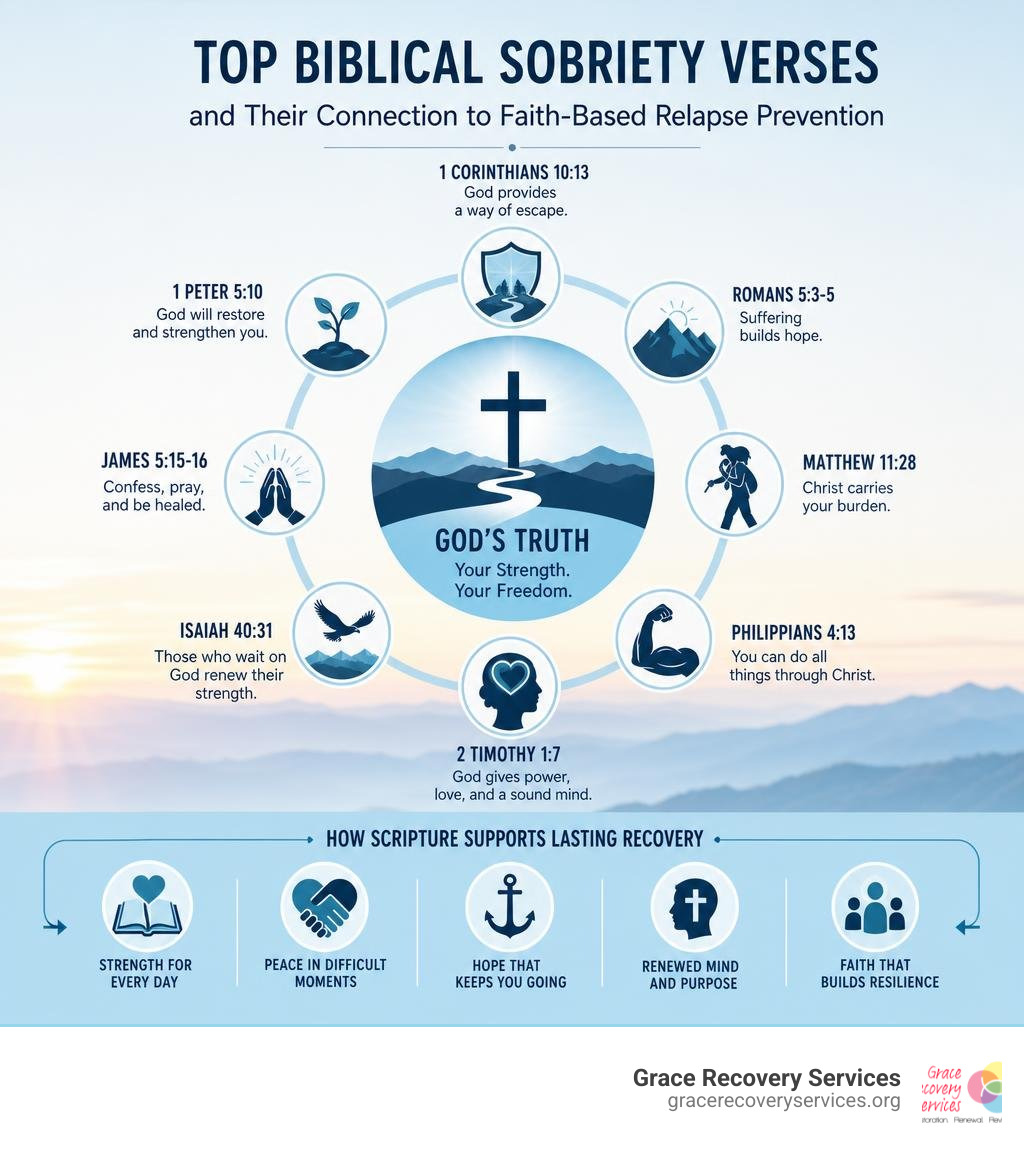
Here are some of the most widely used biblical sobriety encouragement verses to know:
| Verse | Theme | Key Promise |
|---|---|---|
| 1 Corinthians 10:13 | Resisting temptation | God provides a way of escape |
| Romans 5:3-5 | Perseverance through suffering | Suffering builds hope |
| Matthew 11:28 | Rest and relief | Christ carries your burden |
| Philippians 4:13 | Strength | You can do all things through Christ |
| 1 Peter 5:10 | Restoration | God will restore and strengthen you |
| James 5:15-16 | Prayer and healing | Confess, pray, and be healed |
| Isaiah 40:31 | Renewal | Those who wait on God renew their strength |
| 2 Timothy 1:7 | Self-discipline | God gives power, love, and a sound mind |
Research backs what many in faith-based recovery already know from lived experience. Studies suggest that individuals who incorporate spiritual practices — like scripture reading and prayer — into recovery are significantly less likely to relapse in the first year.
At Grace Recovery Services in Western Pennsylvania, we see this reality play out every day. Our faith-integrated, trauma-informed approach treats the whole person — not just the addiction. Biblical truth is one of the most powerful tools we help our clients learn to carry with them.
You are not alone in this journey. The Bible is full of promises written for people in exactly your situation — weary, hopeful, and pressing forward.
Biblical sobriety encouragement verses vocab to learn:
The Power of Biblical Sobriety Encouragement Verses in Recovery
When we talk about recovering from a substance use disorder, we are talking about a journey that is physical, emotional, and deeply spiritual. Addiction has a way of isolating us, weakening our closest relationships, and making us feel completely cut off from God. Many of our clients in Western Pennsylvania share that before they began their outpatient program with us, they felt a profound sense of spiritual emptiness.
This is where the transformative power of spiritual practices comes into play. According to research from the National Institute on Drug Abuse (NIDA), spirituality and religiosity are positively correlated with significantly reduced relapse rates and improved treatment outcomes. Furthermore, a study published in the Journal of Religion and Health found that faith practices are indispensable when it comes to preventing and recovering from substance abuse. In fact, faith-based recovery programs show a 60% to 80% higher rate of long-term sobriety compared to strictly secular programs.
Why do biblical sobriety encouragement verses work so well? As we explore in our guide on 10 Undeniable Reasons Why Sober Bible Verses Work, scripture acts as a living promise. It gives you concrete, practical tools to fight back when a sudden craving hits or when anxiety starts to whisper that you aren’t strong enough.
Rather than trying to white-knuckle your way through early recovery, reading scripture allows you to anchor your mind to an unchanging truth. It helps you shift from a mindset of shame to one of grace. In her insightful article, Faith & Sobriety: What The Bible Says About Drinking Alcohol, Dr. Olapeju Simoyan highlights that while the Bible contains warnings against the destructive nature of alcohol, it also points us toward holistic healing. True recovery requires a comprehensive approach that addresses the brain, the emotions, and the spirit together.
Key Scripture Passages for Strength and Self-Control

When you are fighting a battle against addiction, having a clear mind is your greatest asset. The Bible frequently speaks about being “sober-minded” or “watchful.” This isn’t just about abstaining from substances; it is about cultivating mental clarity, self-discipline, and emotional balance.
Different Bible translations present these concepts in unique ways, helping us see various facets of what God’s Word offers. Let’s look at how translations shape our understanding of key verses found in The Ultimate List of Recovery Bible Verses and Sober Strength Bible Verses: 7 Encouraging Picks:
| Scripture | Translation | Phrasing | Recovery Application |
|---|---|---|---|
| 1 Peter 5:8 | ESV | “Be sober-minded; be watchful.” | Stay alert to triggers and old patterns. |
| NLT | “Stay alert! Watch out for your great enemy…” | Actively protect your peace and boundaries. | |
| 2 Timothy 1:7 | KJV | “…of power, and of love, and of a sound mind.” | Overcoming the fear and chaos of early recovery. |
| NIV | “…of power, of love and of self-discipline.” | Rebuilding healthy habits and daily routines. |
Finding Comfort in Biblical Sobriety Encouragement Verses for Temptation
Temptation is an inevitable part of the recovery journey. Cravings will come, and old triggers — such as specific people, places, or stressful situations — will test your resolve. During these moments of crisis, meditating on targeted scripture can act as an immediate shield.
- 1 Corinthians 10:13: “No temptation has overtaken you that is not common to man. God is faithful, and he will not let you be tempted beyond your ability, but with the temptation he will also provide the way of escape, that you may be able to endure it.”
This is one of the most reassuring promises in scripture. It reminds us that our struggles are not unique to us, and more importantly, that God always provides an exit route. In our outpatient groups in Pittsburgh and North Huntingdon, we help clients identify what that “way of escape” looks like in real life — whether it’s calling a sponsor, driving away from a risky environment, or stepping into a quiet room to pray. - Proverbs 20:1: “Wine is a mocker, strong drink a brawler, and whoever is led astray by it is not wise.” (Read the full context at Proverbs 20:1 – Bible Gateway or explore the broader passage on wisdom in Prov. 20.1-22.16 ESV – Wine is a mocker, strong drink a – Bible Gateway).
This verse paints a vivid picture of how substances trick us. Alcohol promises relaxation or escape, but it delivers chaos and conflict. Keeping this warning close can help you see through the illusion of “just one drink.” - Ephesians 5:18: “And do not get drunk with wine, for that is debauchery, but be filled with the Spirit.” (See multiple translations at Eph_5:18 – Bible Gateway and Ephesians 5:18 ESVUK – Bible Gateway).
This passage contrasts the temporary, destructive escape of intoxication with the lasting, life-giving peace of being filled with the Holy Spirit. It invites us to swap a harmful coping mechanism for a spiritual connection that actually heals. - Proverbs 31:6: “Let beer be for those who are perishing, wine for those who are in anguish…” (Read more at Proverbs 31:6 – Let beer be for those who are perishing, wine for … \| Bible Study Tools).
Historically, this passage warned rulers to keep their minds sharp and drug-free, illustrating that substances can dull our judgment when we need it most. Keeping your mind sharp is essential for long-term growth, as detailed in our guide 25 Be Sober-Minded Scripture Passages to Keep You Sharp.
Restoring Hope with Biblical Sobriety Encouragement Verses for Healing
In early recovery, it is easy to feel weighed down by guilt, shame, and the wreckage of past mistakes. But God’s story is always one of restoration. He does not waste our pain; instead, He uses it to build something beautiful.
- Romans 5:3-5: “Not only that, but we rejoice in our sufferings, knowing that suffering produces endurance, and endurance produces character, and character produces hope, and hope does not put us to shame…”
Your struggle with addiction has undoubtedly caused suffering, but through Christ, that suffering can be transformed. It produces the very endurance and character you need to maintain long-term sobriety. - 1 Peter 5:10: “And after you have suffered a little while, the God of all grace, who has called you to his eternal glory in Christ, will himself restore, confirm, strengthen, and establish you.”
This is a beautiful promise for anyone who feels broken. God’s ultimate plan for you is not ongoing struggle, but complete restoration and stability. You can find more comforting promises like this in our collection of Bible Verses Overcoming Addiction: 10 Encouraging Scriptures. - Matthew 11:28: “Come to me, all who labor and are heavy laden, and I will give you rest.”
When you are tired of carrying the heavy burden of addiction, Jesus invites you to hand it over. Recovery doesn’t mean you have to be strong all the time; it means learning to lean on His strength when yours runs out.
Overcoming Isolation Through Community and Prayer
Addiction thrives in the dark. It convinces us that we are completely alone, that no one understands our pain, and that we must hide our struggles. But biblical recovery is built on the foundation of community and open confession.
- James 5:16: “Therefore, confess your sins to one another and pray for one another, that you may be healed. The prayer of a righteous person has great power as it is working.”
Healing happens when we step out of isolation and into safe, faith-filled relationships. Confessing our struggles to trusted people breaks the power of shame. At Grace Recovery Services, our outpatient groups provide exactly this kind of safe space where you can share your heart without fear of judgment. - Ecclesiastes 4:9-10: “Two are better than one, because they have a good reward for their toil. For if they fall, one will lift up his fellow. But woe to him who is alone when he falls and has not another to lift him up.”
Sobriety is not a solo journey. Having a supportive community in Western Pennsylvania — whether through our intensive outpatient programs (IOP) or local church recovery groups — ensures that when you have a weak moment, there is someone there to lift you up. For practical advice on building this foundation, check out our guide on Bible Verses for Addicts: 7 Simple Steps to Encouragement.
Practical Ways to Apply Scripture to Your Recovery Journey
Knowing these verses is a wonderful starting point, but the real power comes when you begin to apply them to your daily life. At Grace Recovery Services, we utilize a unique, four-stage healing journey called the Counseling Blueprint. This clinical and spiritual framework helps our clients integrate biblical truths directly into their recovery process.
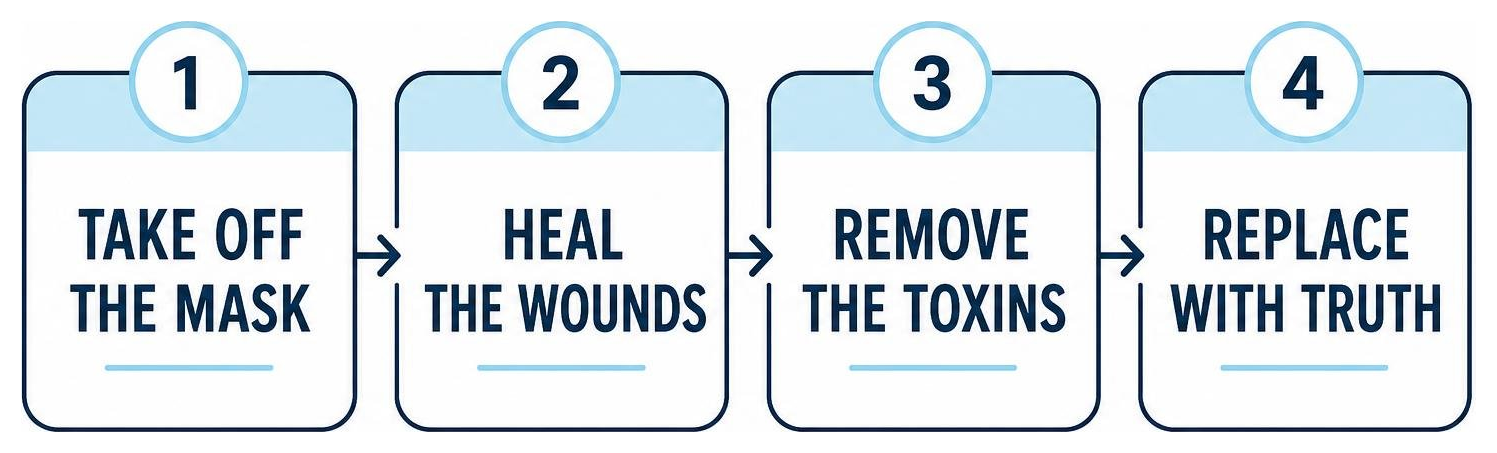
Here is how you can use scripture at each stage of your healing journey:
- Take Off the Mask (Building Trust and Authenticity):
In this first stage, we stop pretending that everything is fine. We acknowledge our struggles honestly before God and others. You can use verses like Psalm 139 or Matthew 11:28 to remind yourself that God already knows your heart and loves you exactly as you are. You don’t have to wear a mask of perfection here. - Heal the Wounds (Addressing Trauma and Relational Hurts):
Our care is deeply trauma-informed. We look beneath the surface of the addiction to heal the underlying pain. During this stage, lean on verses like Psalm 34:18 (“The Lord is near to the brokenhearted…”) to find comfort as you process past wounds in Christian counseling. - Remove the Toxins (Identifying Lies and Unhelpful Beliefs):
Addiction fills our minds with toxic lies: “You’ll always be an addict,” “You aren’t worth saving,” or “You can’t handle life sober.” We must actively identify and remove these thoughts. Use 2 Corinthians 10:5 (“We destroy arguments… and take every thought captive to obey Christ”) to challenge these destructive mental patterns. - Replace with Truth (Installing Empowering Perspectives):
Once the toxic lies are removed, we must fill that space with biblical truth. This is where you actively memorize and speak biblical sobriety encouragement verses over your life. Replace the lie of worthlessness with the truth of Romans 8:1 (“There is therefore now no condemnation for those who are in Christ Jesus”).
To help you stay focused on this daily renewal, we recommend keeping a scripture journal. Write down one verse each morning, meditate on its meaning, and write a simple prayer asking God to help you live out that truth throughout the day. For daily inspiration, read our guide on 10 Sober-Minded Bible Verses to Guide You Today.
Frequently Asked Questions About Biblical Sobriety
How does the Bible define being sober-minded?
In the Bible, being sober-minded goes far beyond simply not drinking alcohol or using drugs. It refers to a state of mental clarity, self-control, and spiritual alertness. In 1 Peter 5:8, we are told to be sober-minded and watchful because our spiritual adversary seeks to derail us. A sober mind is stable, grounded in truth, and able to make wise decisions rather than being driven by fleeting emotions, anxiety, or physical cravings.
Can scripture reading prevent a relapse?
While scripture reading is not a magic cure, it is an incredibly powerful tool for relapse prevention when combined with professional outpatient treatment. Reading and memorizing verses provides spiritual grounding and acts as an emotional anchor during moments of high stress or intense cravings. It replaces negative, toxic thoughts with positive, life-giving truths, helping you resist triggers and maintain your focus on your long-term goals.
How can family members use Bible verses to support a loved one?
Family members can use scripture to offer non-judgmental encouragement, hope, and strength to their loved one in recovery. Instead of using verses to lecture or shame, share passages that highlight God’s grace, love, and power to restore, such as Jeremiah 29:11 or 1 Peter 5:10. Praying these scriptures over your loved one while maintaining healthy, loving boundaries is one of the most supportive actions you can take.
Conclusion
The journey of recovery is a path of profound transformation. While the physical and emotional challenges of overcoming a substance use disorder are real, you do not have to face them using your own limited strength. By leaning on biblical sobriety encouragement verses, you invite the living power of God to restore your mind, heal your heart, and guide your steps.
If you or a loved one is ready to take the next step toward a healthier, sober life, we are here for you. Grace Recovery Services offers compassionate, trauma-informed outpatient treatment that beautifully integrates evidence-based clinical practices with deep Christian values.
Whether you are in Pittsburgh, Penn Hills, North Huntingdon, Irwin, or anywhere across Westmoreland County and Western Pennsylvania, our dedicated team is ready to walk alongside you. We provide Christian counseling, intensive outpatient programs (IOP), and aftercare support designed to bring healing to your mind, body, and spirit.
There is hope, there is grace, and there is a supportive community waiting to welcome you. Reach out to us today to learn more about our programs and start your journey of restoration.
Explore Grace Recovery Services Outpatient Programs
This article was researched with AI and heavily edited by Stephen Luther for accuracy and relevance.
Stephen Luther is the Executive Director and Founder of Grace Christian Counseling, Grace Recovery Services, WPA Counseling, NuWell Online Counseling and Coaching, and NuWell Health. He holds a Master’s degree in Education from the University of Georgia and a Master’s degree in Marriage and Family Therapy from Duquesne University. He is a licensed professional counselor in Pennsylvania.
Since 1997, Steve has been helping children, adolescents, and adults overcome a wide range of emotional and relational challenges. He specializes in working with hurting families, including those with foster, adopted, or traumatized children. Steve uses Attachment-Based Therapy, Splankna Healing, and Therapeutic Parent Coaching to support healing and restoration.
This guide is for educational and spiritual encouragement and is not a substitute for personalized professional counseling. If you are in crisis, please reach out for immediate help.