Understanding Outpatient Addiction Treatment in Pittsburgh
The need for accessible, compassionate recovery care in Pittsburgh has never been greater.
In 2022, Allegheny County recorded over 1,000 drug overdose deaths – part of a statewide toll exceeding 5,200 lives lost that year alone. And yet, roughly 1 in 5 Pennsylvania adults who needed substance use treatment did not receive it.
Those numbers represent real people. Mothers, fathers, siblings, friends. People who deserved more.
The good news? Pittsburgh has a growing network of outpatient recovery resources, and getting help does not have to mean waiting weeks for an appointment, navigating confusing systems alone, or feeling judged for where you are right now.
At Grace Recovery Services, we believe healing is possible for everyone. Our faith-integrated, trauma-informed approach to outpatient addiction recovery in Western Pennsylvania meets people exactly where they are – with grace, not shame.
This guide walks you through the outpatient recovery landscape in Pittsburgh, compares different approaches to care, and helps you find a path that supports your unique journey toward restoration, renewal, and lasting sobriety.
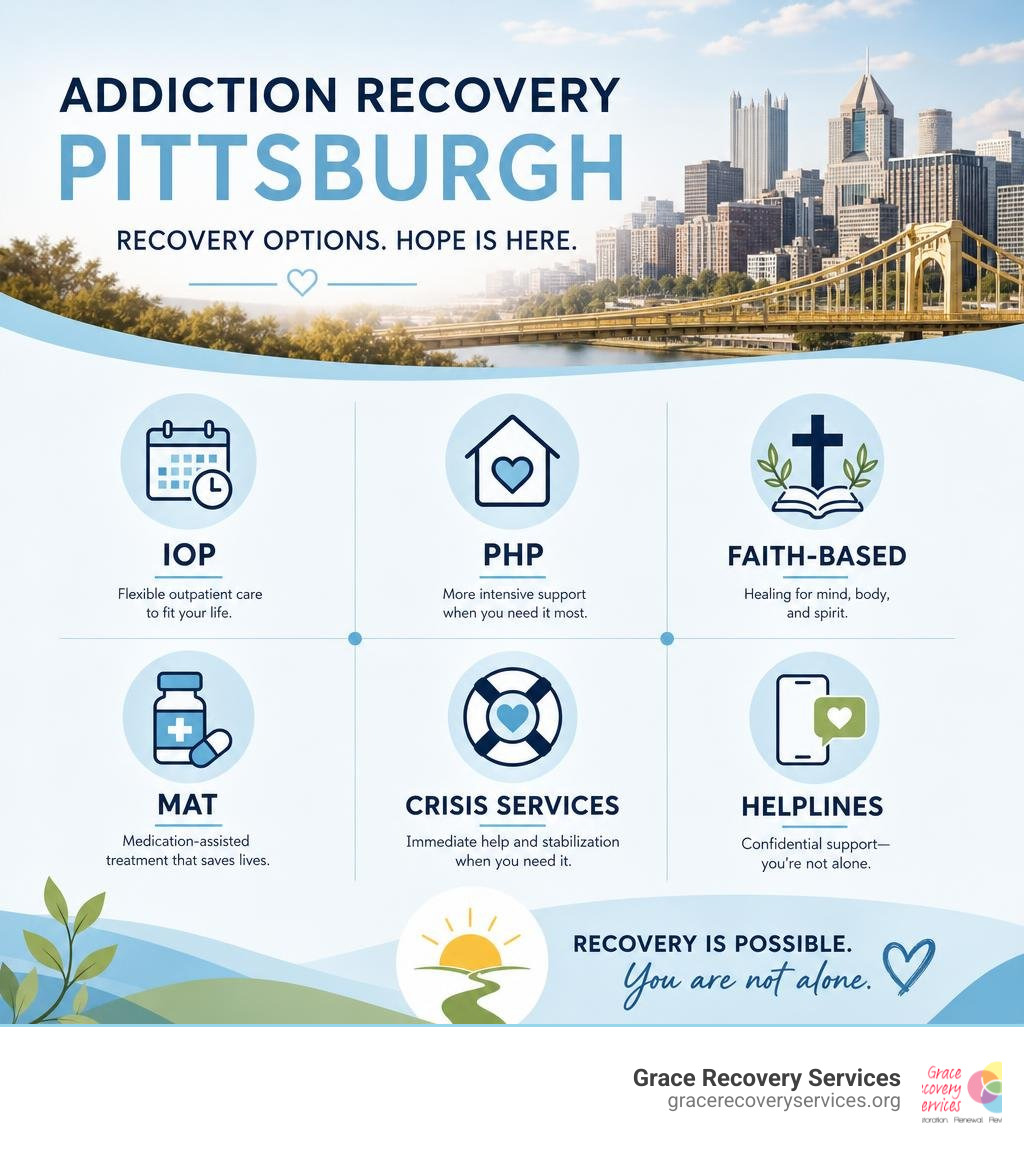
Key terms for addiction recovery pittsburgh:
When exploring options for addiction recovery pittsburgh, one of the first decisions you or your family will face is choosing the right outpatient structure and philosophy of care. For many people, maintaining daily responsibilities like work, school, or family care is vital. Outpatient treatment offers a flexible yet highly structured path that helps clients receive meaningful support while staying connected to their everyday lives.
Traditional Clinical Outpatient vs. Faith-Integrated Recovery
Many outpatient programs in Western Pennsylvania focus primarily on clinical, evidence-based therapies. These tools can be deeply valuable, especially when they are delivered with compassion, consistency, and respect for the whole person.
At Grace Recovery Services, we offer a specialized outpatient approach for clients who want clinical care that also honors their faith. We combine evidence-based treatment with Faith-Based Outpatient Addiction Treatment. This approach does not ask you to choose between science and spirituality. Instead, we offer a space where science meets spirit, blending evidence-based modalities like Cognitive Behavioral Therapy (CBT) with Christian Addiction Recovery Pittsburgh principles.
For clients seeking a deeper spiritual connection, our Pittsburgh Christian Sobriety Programs help rebuild lives on a foundation of biblical truth, grace, and community. We focus on healing the whole person – mind, body, and spirit – so you do not have to leave your faith at the door when you walk into therapy.
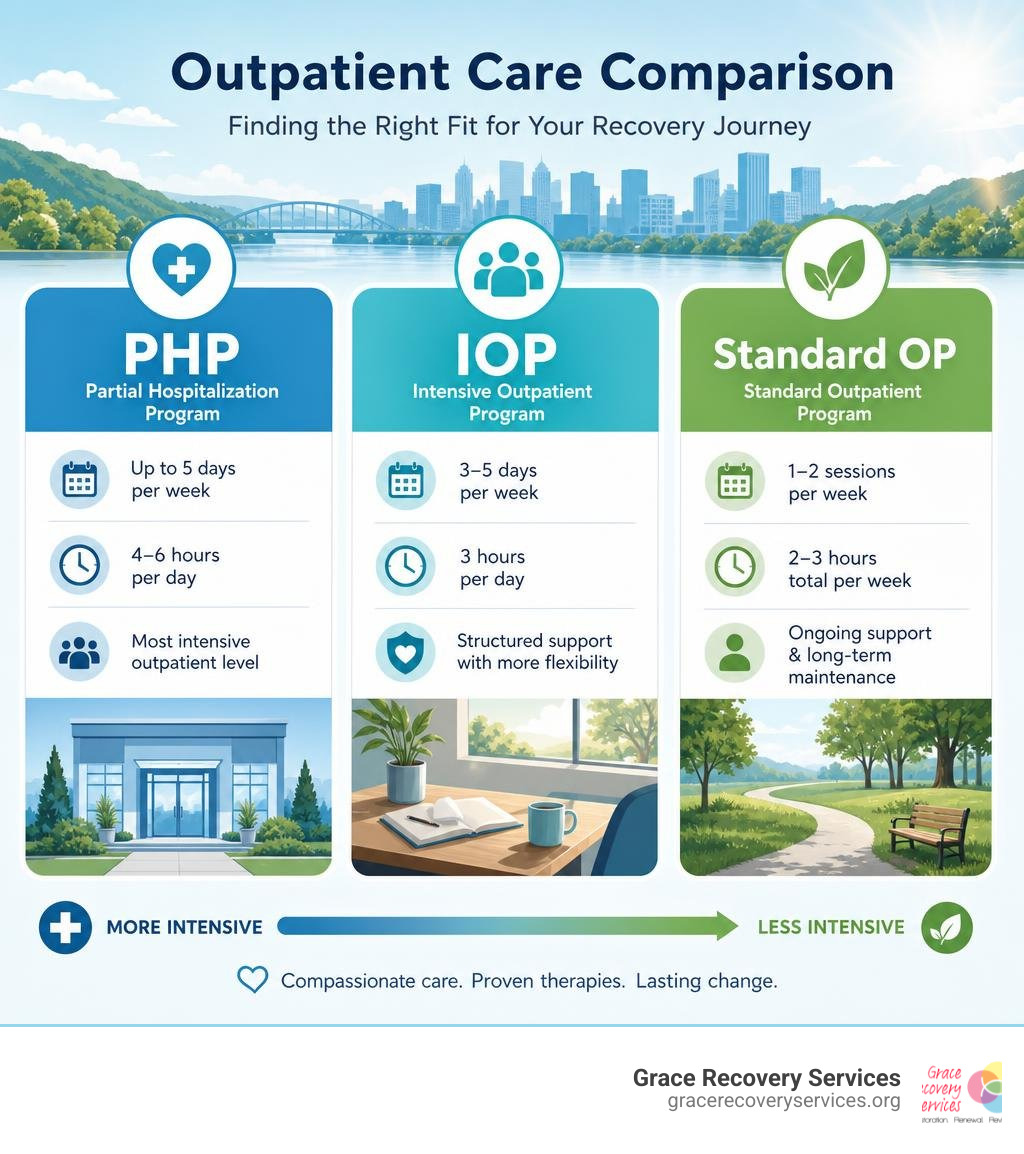
The Levels of Outpatient Care: PHP, IOP, and Standard Outpatient
Outpatient care is not a one-size-fits-all solution. Depending on where you are in your journey, you may need a highly immersive day program or a lighter level of ongoing support to keep you anchored.
- Partial Hospitalization Program (PHP): This is the most intensive outpatient level. Clients typically attend structured clinical programming for 4 to 6 hours a day, up to 5 days a week, while continuing to live at home and remain connected to supportive routines.
- Intensive Outpatient Program (IOP): A step down in intensity, an Intensive Outpatient program offers robust clinical support while freeing up more of your schedule. This level typically requires 3 hours of therapy per day, 3 to 5 days a week. It is often a strong fit for clients balancing employment, school, or family duties. We also offer a specialized Christian Intensive Outpatient Treatment program for those who want to weave faith into this structured level of care.
- Standard Outpatient Program (OP): Our standard Outpatient Program involves 1 to 2 sessions per week, usually 2 to 3 hours total. It serves as an excellent step-down program for ongoing accountability, counseling, relapse prevention, and long-term sobriety maintenance.
Addressing Co-Occurring Mental Health & Trauma
Addiction rarely travels alone. Often, substance use is an attempt to cope with deeper, underlying emotional pain, untreated mental health conditions, or past trauma. To achieve lasting freedom, we must look beneath the surface.
Dual Diagnosis in Pittsburgh Outpatient Care
When a substance use disorder coexists with a mental health condition like depression, anxiety, or bipolar disorder, it is known as a dual diagnosis. Addressing only one side of this coin is a recipe for relapse.
We emphasize Integrated Treatment for Addiction and Mental Health. By utilizing Co-occurring Treatment strategies, our clinical team helps clients manage their psychiatric symptoms alongside their recovery goals. This dual-focused care ensures that as you heal from substance dependence, you are also gaining the clinical tools needed to manage your mental health. Our comprehensive Mental Health and Addiction Services are designed to treat both conditions simultaneously, giving you a cohesive, unified path forward.
Our Trauma-Informed Approach: The Counseling Blueprint
Trauma is often the silent engine driving addictive behaviors. Whether it stems from childhood neglect, a sudden loss, or relational wounds, unresolved trauma must be addressed with extreme care. We provide specialized Trauma-Informed Care that prioritizes your emotional safety and dignity.
Our clinical framework is built around The Counseling Blueprint, a compassionate, four-stage healing journey designed to foster deep, lasting transformation:
- Take Off the Mask: We begin by building genuine rapport and trust. In this safe, judgment-free space, clients can drop their defenses and show up exactly as they are.
- Heal the Wounds: We gently explore the emotional and relational hurts of the past, identifying the root causes of pain rather than just treating the outward symptoms.
- Remove the Toxins: Together, we identify unhelpful beliefs, lingering lies, and shame-based thought patterns that have kept you trapped in cycles of addiction.
- Replace with Truth: We install empowering, accurate, and spiritually grounded perspectives about your self-worth, your relationship with others, and your divine purpose.
For those who wish to combine this clinical pathway with spiritual renewal, we offer Faith-Based Trauma Recovery and The Whole Person Approach to Faith-Based Trauma Recovery. If you are searching for localized support in Western Pennsylvania, you can learn more about Finding the Best Western PA Trauma Rehab for Your Needs to ensure your care team understands both trauma and clinical recovery.
Navigating Insurance & Admissions in Western PA
Taking the first step toward recovery can feel overwhelming, but navigating the logistics of insurance and admissions should not be a barrier to getting the help you deserve.
Common Insurance Plans Accepted
Many individuals worry about how they will cover the costs of outpatient care. The encouraging news is that most major health insurance plans provide comprehensive coverage for substance use disorder treatment and mental health services.
In the Pittsburgh and Western PA regions, commonly accepted insurance networks include:
- Highmark Blue Cross Blue Shield
- UPMC Health Plan
- Aetna
- Cigna
- UnitedHealthcare
- Geisinger
Because every policy is unique, we highly recommend verifying your benefits beforehand. Our team can help you navigate this process confidentially, or you can check out our guide on 8 Practical Ways to Find Outpatient Rehab Near Me for tips on verifying coverage and finding accessible local care.
Same-Day Evaluations & Getting Started
When you are ready to seek help, waiting weeks for an appointment is not an option. Immediate access to clinical assessments is vital to capturing the window of willingness.
Many modern facilities in the Pittsburgh area, including our offices in Penn Hills and North Huntingdon, offer rapid intake processes. We focus on providing streamlined, compassionate admissions to get you connected to care as quickly as possible. During your initial evaluation, a licensed clinician will sit down with you to assess your physical health, mental health history, and recovery goals. This assessment helps us build a personalized treatment plan tailored specifically to your life.
If you are ready to explore your options or schedule an evaluation, you can learn more about our Services, read about our mission on our About Us page, or reach out directly via our Contact page.

Long-Term Recovery & Support Resources
Completing an outpatient program is a monumental achievement, but the journey of recovery continues long after your formal therapy sessions conclude. Building a life of sustainable sobriety requires a strong safety net, ongoing relapse prevention strategies, and active community engagement.
Outpatient Aftercare & Relapse Prevention
True recovery is a daily practice. To transition smoothly back into daily life without relying on substances, having a concrete plan is essential. We work closely with each client to develop a personalized aftercare plan that addresses their unique triggers, social circles, and lifestyle.
To support you on this journey, we have compiled practical resources on Addiction Recovery and Relapse Prevention and actionable steps on How to Stay Sober After Rehab.
Additionally, we recognize that addiction is a family disease. Rebuilding trust and healing relational wounds is a critical part of maintaining long-term sobriety. Families can find guidance on how to navigate this transition through our resources on Family Support in Addiction Recovery and How to Support Someone in Recovery.
Westmoreland and Allegheny County Community Resources
For those living in Western PA, Allegheny County and Westmoreland County offer excellent localized resources to help you or your loved ones find immediate assistance, funding, and peer support networks.
- PA Get Help Now Helpline: Available 24/7/365 at 1-800-662-HELP (4357). This free, confidential helpline connects individuals in Pennsylvania directly to local treatment centers, funding assistance, and support resources.
- Pathway to Care and Recovery: Located at 326 Third Avenue in downtown Pittsburgh, this walk-in crisis center provides 24/7, barrier-free access to clinical screenings, peer support, and resource connections without requiring an appointment or insurance.
- Westmoreland County Drug and Alcohol Commission: If you live in North Huntingdon, Irwin, or other parts of Westmoreland County, the local Single County Authority (SCA) can assist with treatment funding, referrals, and case management. You can find more information through the Drug and Alcohol Resources & Treatment Facilities portal.
- Allegheny County Resources: For those in Penn Hills and the greater Pittsburgh area, the Allegheny County Department of Human Services offers localized support, case management, and funding assistance to help individuals access the care they need.
Finding Hope and Healing in Pittsburgh
No matter how dark the road has seemed, your story is not over. Recovery is not about achieving perfection; it is about taking one step forward in grace, surrounded by a community that believes in your future.
At Grace Recovery Services, we are dedicated to walking beside you through every stage of this journey. By blending evidence-based clinical practices with faith-integrated support, we help you heal the wounds of the past and build a purposeful, sober future.
If you or a loved one is ready to take the first step toward addiction recovery in Pittsburgh, we invite you to explore our faith-based resources. Find strength, comfort, and biblical encouragement by reading our guide on scriptures to help with addiction and reclaim your life.
Reach out to us today. Healing, restoration, and a renewed life are within your reach.
This article was researched with AI and heavily edited by Stephen Luther for accuracy and relevance.
Stephen Luther is the Executive Director and Founder of Grace Christian Counseling, Grace Recovery Services, WPA Counseling, NuWell Online Counseling and Coaching, and NuWell Health. He holds a Master’s degree in Education from the University of Georgia and a Master’s degree in Marriage and Family Therapy from Duquesne University. He is a licensed professional counselor in Pennsylvania.
Since 1997, Steve has been helping children, adolescents, and adults overcome a wide range of emotional and relational challenges. He specializes in working with hurting families, including those with foster, adopted, or traumatized children. Steve uses Attachment-Based Therapy, Splankna Healing, and Therapeutic Parent Coaching to support healing and restoration.
This guide is for educational and spiritual encouragement and is not a substitute for personalized professional counseling. If you are in crisis, please reach out for immediate help.