Finding Outpatient Rehab Near Me: A Compassionate Starting Point
If you’re searching for outpatient rehab near me, here are the most practical ways to find quality local care:
- Use SAMHSA’s FindTreatment.gov — enter your zip code to find verified nearby programs
- Check your county’s drug and alcohol resources — Westmoreland County and Allegheny County both maintain local provider lists
- Verify your insurance — most major plans cover outpatient treatment
- Look for accredited, licensed facilities — confirm credentials before committing
- Consider your specific needs — faith-based, trauma-informed, or dual diagnosis care may be important to you
- Ask about program levels — PHP, IOP, standard outpatient, and virtual telehealth each serve different needs
- Inquire about MAT options — medication-assisted treatment can be part of outpatient care
- Evaluate aftercare support — long-term recovery depends on what happens after primary treatment
Recovery is possible. And it doesn’t have to mean putting your entire life on hold.
For many people in Western Pennsylvania — and across the country — outpatient rehab is the path that makes treatment actually work. It allows you to stay home with your family, keep your job, and maintain your daily responsibilities, all while receiving structured, professional support for addiction and the wounds beneath it.
The hard part is often just knowing where to start looking.
There are dozens of programs out there. Some are a good fit. Many aren’t. And when you’re already exhausted from struggling — or watching someone you love struggle — sorting through all those options can feel overwhelming before you’ve even made a single phone call.
You deserve better than that.
At Grace Recovery Services, we believe that healing involves the whole person — mind, body, and spirit. Our faith-integrated, trauma-informed outpatient programs in the Pittsburgh area are built around that conviction. But wherever your journey leads, this guide will help you find the right care, ask the right questions, and take the next step with confidence.
Understanding Outpatient Rehab Near Me and Its Benefits
When you first begin looking for addiction treatment, the terminology can feel like a foreign language. Understanding the different levels of outpatient care is the first step toward making an informed decision for your recovery.
Outpatient care allows you to remain living in the comfort of your own home. You attend therapy sessions and medical appointments during scheduled times of the day or evening, and then return to your normal environment.
This structure offers immense flexibility. It means you do not have to abandon your career, pause your education, or step away from parenting and family caregiving duties. Instead of isolating recovery from your daily life, you learn to integrate recovery tools directly into your real-world routine from day one.
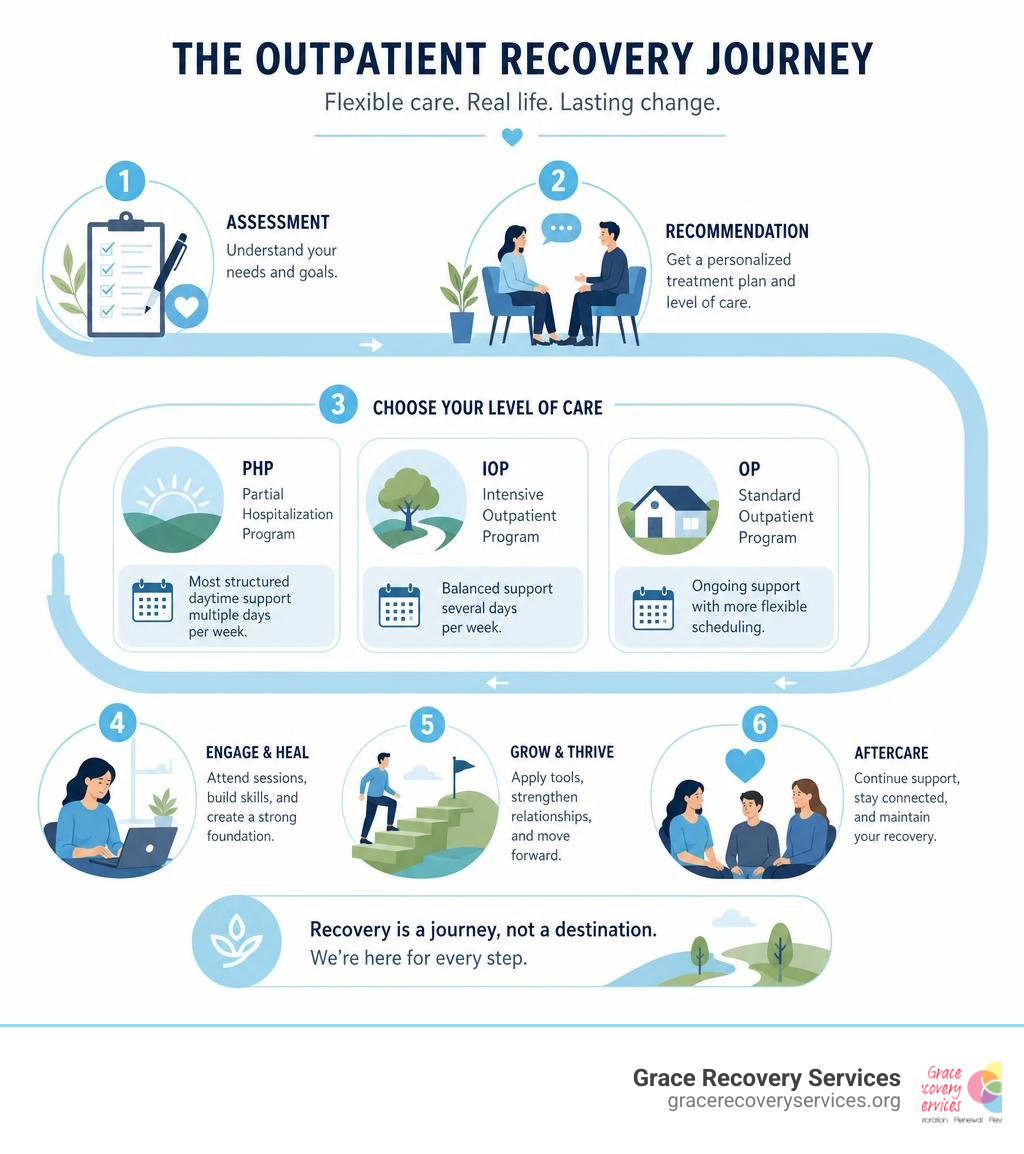
To help you visualize how these options compare, we have broken down the different levels of care below:
| Level of Care | Weekly Hours | Living Arrangement | Best For |
|---|---|---|---|
| Partial Hospitalization (PHP) | 20–30+ hours | Lives at home or sober living | High clinical need; transitioning from detox |
| Intensive Outpatient (IOP) | 9–10+ hours | Lives at home | Balancing work/school with structured therapy |
| Standard Outpatient (OP) | 1–3 hours | Lives at home | Maintenance; long-term relapse prevention |
What is Outpatient Rehab?
At its core, an Outpatient Program is a structured substance use disorder treatment program where clients attend scheduled therapy sessions throughout the week. These sessions are designed to provide high-quality clinical interventions—including individual counseling, group therapy, family support, and medical management—without requiring an overnight stay.
In an outpatient setting, you work closely with a multidisciplinary team of licensed counselors, therapists, and medical professionals. Together, we build a supportive environment where you can explore the root causes of addiction, develop healthy coping mechanisms, and establish a local peer network that keeps you grounded in your sobriety.
Who is a Good Candidate for an Outpatient Rehab Near Me?
Outpatient care is an incredibly effective pathway to recovery, but it is not the right fit for everyone. Because you return home after your sessions, a successful outpatient experience relies on certain clinical and environmental factors.
You or your loved one may be an excellent candidate for a local outpatient program if you meet the following criteria:
- A Stable Home Environment: Your living situation is safe, supportive, and free from active substance use.
- Mild to Moderate Substance Use: You do not require 24/7 medical supervision for severe withdrawal symptoms or acute medical complications.
- High Motivation to Change: You are ready to actively participate in your recovery and show up for scheduled clinical sessions.
- A Strong Support System: You have family, friends, or a faith community in the local area who encourage your healing.
- A Professional Clinical Assessment: A licensed clinician has evaluated your situation and confirmed that outpatient care is safe and clinically appropriate for your specific needs.
Types of Outpatient Programs and What They Require
Not all outpatient programs are the same. They exist on a spectrum of intensity, allowing you to step down to lower levels of care as you grow stronger and more stable in your recovery. Understanding these program levels will help you determine what kind of schedule and commitment to expect.
Partial Hospitalization Programs (PHP)
Often referred to as “day treatment,” a Partial Hospitalization Program (PHP) is the most intensive form of outpatient care. It is designed for individuals who need robust clinical oversight and structured therapy but are stable enough to go home at night.
- Time Commitment: Typically requires 5 days per week, with sessions lasting 5 to 6 hours per day (totaling 20 to 30+ hours weekly).
- What it Includes: Intensive group therapy, daily or weekly individual counseling, psychiatric evaluations, and medication management.
- Who it is For: Clients stepping down from detox, or those experiencing severe symptoms who still have a safe, sober environment to sleep in.
Intensive Outpatient Programs (IOP)
An Intensive Outpatient program offers a step down in intensity while maintaining a strong therapeutic structure. It is highly valued for its flexible scheduling, which often includes evening or morning tracks to accommodate your work or school life.
- Time Commitment: Usually meets 3 to 5 days per week for about 3 hours per session, totaling 9 to 10 hours weekly.
- What it Includes: A strong focus on group therapy, weekly individual counseling, and practical relapse prevention skills.
- Who it is For: Individuals balancing daily responsibilities who still require structured, professional accountability.
To learn more about what is expected of clients in this level of care, explore our detailed breakdown of Making the Grade with IOP Program Requirements.
Standard Outpatient and Virtual Telehealth
Standard Outpatient (OP) and virtual telehealth represent the most flexible, low-intensity levels of care.
- Time Commitment: Usually consists of 1 to 2 sessions per week, totaling 1 to 3 hours of therapy.
- What it Includes: Individual therapy, occasional group sessions, and periodic check-ins.
- Virtual Telehealth: Many providers now offer these sessions via HIPAA-compliant video conferencing, allowing you to connect with your therapist from the privacy of your home or office.
- Who it is For: Individuals who have completed higher levels of treatment and are focused on long-term maintenance, accountability, and continued personal growth.
8 Practical Ways to Find the Right Treatment Center
Finding a quality program that aligns with your values, schedule, and location in Western Pennsylvania doesn’t have to be a guessing game. Here are eight practical, reliable strategies to find the right outpatient rehab near me.
1. Use Verified Government Directories
When starting your search, it is best to begin with verified, unbiased sources. The Substance Abuse and Mental Health Services Administration (SAMHSA) maintains a free, confidential, and anonymous search tool called FindTreatment.gov.
By entering your zip code or city, you can instantly view licensed treatment facilities in your immediate area. The platform allows you to filter your results specifically by outpatient services, payment options, accepted insurance plans, and specialized programs. This ensures you only contact facilities that meet strict state licensing and accreditation standards.
2. Consult Local County Resources
County health departments are excellent resources for localized care. If you live in Westmoreland County, PA, or the surrounding Western Pennsylvania counties, the local government provides dedicated directories and funding options for residents seeking help.
The Westmoreland County Single County Authority (SCA) helps coordinate local treatment services, funding for uninsured individuals, and community-based support networks. You can access these localized services through the Westmoreland County Drug and Alcohol Resources directory to find a provider near you.
3. Check State-Specific Rehab Registries
State-specific registries offer up-to-date information on facility licensing, safety records, and local program availability. In Pennsylvania, registries are updated regularly to reflect active providers and community resources.
If you are looking for verified options in Westmoreland or Allegheny County, checking regional registries can point you toward highly rated programs close to home.
4. Verify Your Insurance Coverage
One of the most common barriers to seeking treatment is worrying about how to pay for it. Fortunately, the vast majority of commercial insurance plans, as well as Medicaid and Medicare, provide coverage for outpatient substance use disorder treatment.
Before committing to a program, reach out to the facility’s admissions team for a confidential insurance verification. Most quality centers will work directly with your provider to determine your out-of-pocket costs, copays, and deductible requirements. This ensures there are no financial surprises, allowing you to focus entirely on your healing.
5. Look for Faith-Based and Christian Programs
For many individuals, true healing requires connecting with a higher power and integrating spiritual principles into the clinical recovery process. If your faith is a cornerstone of your life, look for programs that offer specialized Christian counseling.
Faith-based outpatient programs combine evidence-based therapeutic practices with biblical principles of hope, redemption, and grace. Rather than relying solely on human effort, these programs invite the healing power of Christ into the restoration process.
At Grace Recovery Services, we offer dedicated tracks such as Christian Intensive Outpatient Treatment and Faith-Based Outpatient Addiction Treatment to help you rebuild your life on a foundation of faith.
6. Seek Trauma-Informed and Holistic Care
Addiction is rarely just about the substance itself; it is almost always connected to deeper emotional wounds, relational hurts, or past trauma. If a program only focuses on stopping the drug or alcohol use without addressing these underlying factors, the risk of relapse remains high.
Look for a provider that utilizes a trauma-informed, holistic approach to heal the mind, body, and spirit. At Grace Recovery Services, we guide our clients through our proprietary Counseling Blueprint, a compassionate four-stage healing journey:
- Take Off the Mask: We build genuine rapport, safety, and trust, allowing you to drop the exhaustion of pretending everything is okay.
- Heal the Wounds: We gently explore the deep emotional and relational hurts that led to substance use in the first place.
- Remove the Toxins: Together, we identify and dismantle the unhelpful beliefs, lingering lies, and shame-based mindsets that keep you stuck.
- Replace with Truth: We install empowering, biblically grounded, and accurate perspectives about who you are, your worth, and your future.

7. Ask About Medication-Assisted Treatment (MAT) Options
For individuals recovering from opioid or alcohol use disorders, Medication-Assisted Treatment (MAT) can be a lifesaving component of an outpatient program. MAT combines behavioral therapy with FDA-approved medications like Suboxone or Vivitrol to help manage intense cravings and alleviate physical withdrawal symptoms.
When searching for a program, ask if they offer MAT coordination under close medical supervision. When used as part of a comprehensive, trauma-informed counseling plan, MAT helps stabilize the brain’s chemistry, allowing you to fully engage in the psychological and spiritual aspects of your therapy.
8. Evaluate Aftercare and Long-Term Support
Recovery is not a destination; it is a lifelong journey. Research shows that extending your engagement with treatment significantly improves your chances of sustained sobriety. Specifically:
- Spending at least 90 days in treatment can vastly improve your chances of long-term recovery.
- Extending care through structured 6- or 12-month rehab programs and ongoing aftercare further increases recovery success.
When evaluating local outpatient centers, ask about their continuum of care. Do they offer transition plans, support groups, or alumni networks? To learn more about maintaining your progress after primary treatment, read our guides on How to Stay Sober After Rehab and Faith-Based Aftercare in Pittsburgh for Lasting Sobriety.
What to Expect: Therapies, Dual Diagnosis, and the Intake Process
Taking the first step to enter treatment can feel intimidating simply because of the unknown. Knowing what to expect during the initial stages can help calm your anxiety and prepare you for the healing journey ahead.
The Intake and Assessment Process
Your first day at an outpatient center will begin with a comprehensive clinical intake and assessment. This is not an interrogation; it is a safe, confidential conversation designed to help us understand your unique story, physical health, and recovery goals.
During this process, a licensed clinician will evaluate:
- Your history of substance use and any previous treatment experiences.
- Your physical health, mental health, and emotional well-being.
- Your current living situation and local support systems.
Using this information, we co-create a personalized treatment plan tailored specifically to your needs. To understand how this clinical foundation shapes your recovery, you can explore The Roadmap to Effective Substance Abuse Treatment.
Addressing Co-Occurring Mental Health Disorders
It is incredibly common for substance use disorders to co-occur alongside mental health conditions like depression, anxiety, PTSD, or bipolar disorder. This is known as a dual diagnosis.
If a program only treats the addiction while ignoring the underlying mental health condition, the untreated anxiety or depression will often trigger a relapse. Quality outpatient programs offer integrated dual diagnosis care, treating both conditions simultaneously. To learn more about how we address these interconnected struggles, read about our approach to Integrated Treatment for Addiction and Mental Health.
How Do I Choose the Best Outpatient Rehab Near Me?
As you make your final decision, look for a program that combines clinical excellence with deep personal compassion. In Western Pennsylvania, the opioid crisis has touched almost every family, making the need for highly qualified, empathetic local care more urgent than ever.
When choosing a provider, look for these marks of quality:
- Evidence-Based Modalities: The program should utilize proven clinical therapies like Cognitive Behavioral Therapy (CBT) and Dialectical Behavior Therapy (DBT).
- Licensed & Credentialed Staff: Ensure the clinical team consists of Licensed Professional Counselors (LPCs), certified addiction specialists, and experienced clinical supervisors.
- Flexible Scheduling: The facility should offer morning, afternoon, or evening sessions to fit your life.
- A Culture of Grace: Choose a center where you are treated with dignity, respect, and unconditional love—never with shame or judgment.
Frequently Asked Questions About Outpatient Treatment
Can I work or attend school while in outpatient rehab?
Yes, absolutely. One of the greatest benefits of outpatient treatment is its flexibility. Programs like our Intensive Outpatient Program (IOP) are specifically structured to accommodate working professionals, students, and parents. With flexible morning or evening sessions, you can receive high-quality clinical care without having to pause your career, education, or family responsibilities.
How long does outpatient rehab usually last?
The duration of outpatient treatment varies depending on your individual progress and clinical needs. A typical IOP program may last anywhere from 6 to 12 weeks, while PHP programs usually run for 2 to 4 weeks before stepping down to a lower level of care. However, because spending at least 90 days in a structured treatment environment is a key indicator of long-term recovery success, we often recommend continuing with standard outpatient therapy or faith-based aftercare for several months.
Does insurance cover the cost of outpatient treatment?
Yes. Most major commercial health insurance plans cover outpatient substance use disorder treatment and co-occurring mental health care. Because outpatient treatment does not require overnight stays, it is often highly cost-effective, and many insurance plans will cover up to 100% of the cost. We highly recommend contacting our admissions team for a free, confidential insurance verification to understand your specific benefits.
Conclusion
Finding the right outpatient rehab near me is the first, courageous step toward a restored and renewed life. You do not have to walk this path alone, and you do not have to carry the heavy burden of shame.
At Grace Recovery Services, we are dedicated to helping individuals in Western Pennsylvania find lasting freedom from addiction. With convenient offices in Pittsburgh (Penn Hills area) and North Huntingdon, we offer a safe, compassionate, and faith-integrated space where you can heal.
Through our trauma-informed care and our unique Counseling Blueprint—guiding you to Take Off the Mask, Heal the Wounds, Remove the Toxins, and Replace with Truth—we treat you as a whole person, restoring your mind, body, and spirit.
No matter how dark the road has seemed, a new dawn is waiting for you.

If you or a loved one is ready to take the next step toward healing, we are here to walk with you. Reach out to us today to speak with a caring professional, verify your insurance, and Begin Your Healing Journey Today.
This article was researched with AI and heavily edited by Stephen Luther for accuracy and relevance.
Stephen Luther is the Executive Director and Founder of Grace Christian Counseling, Grace Recovery Services, WPA Counseling, NuWell Online Counseling and Coaching, and NuWell Health. He holds a Master’s degree in Education from the University of Georgia and a Master’s degree in Marriage and Family Therapy from Duquesne University. He is a licensed professional counselor in Pennsylvania.
Since 1997, Steve has been helping children, adolescents, and adults overcome a wide range of emotional and relational challenges. He specializes in working with hurting families, including those with foster, adopted, or traumatized children. Steve uses Attachment-Based Therapy, Splankna Healing, and Therapeutic Parent Coaching to support healing and restoration.
This guide is for educational and spiritual encouragement and is not a substitute for personalized professional counseling. If you are in crisis, please reach out for immediate help.