
Why Sober Strength Bible Verses Matter in Recovery
Finding the right sober strength Bible verses can be a lifeline when addiction feels overwhelming. For many people walking the road of recovery, Scripture offers something that willpower alone cannot — a deep, steady source of hope, identity, and courage that holds even on the hardest days.
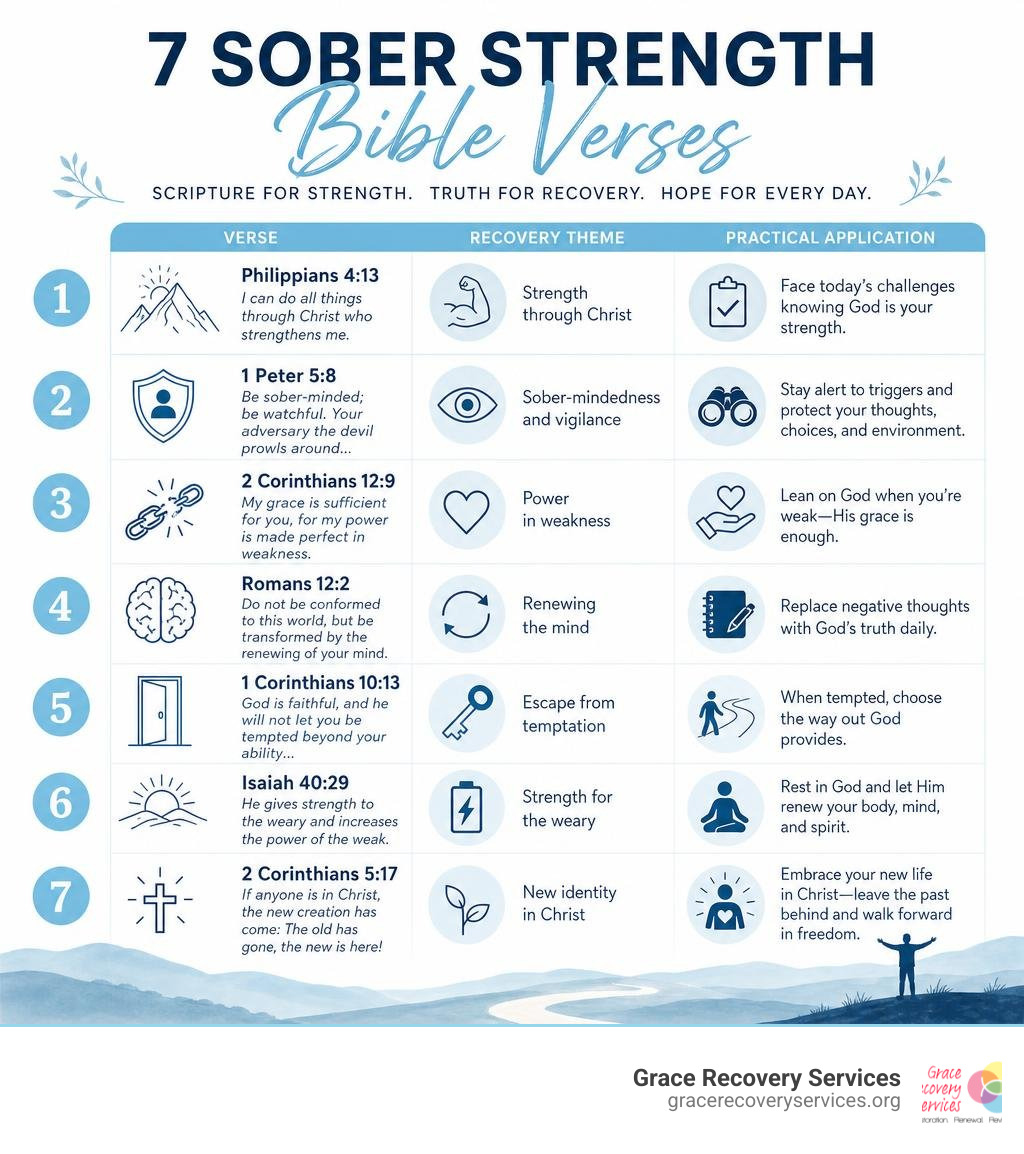
Here are 7 key sober strength Bible verses to anchor your recovery:
| # | Verse | Core Theme |
|---|---|---|
| 1 | Philippians 4:13 | Strength through Christ |
| 2 | 1 Peter 5:8 | Sober-mindedness and vigilance |
| 3 | 2 Corinthians 12:9 | Power in weakness |
| 4 | Romans 12:2 | Renewing the mind |
| 5 | 1 Corinthians 10:13 | Escape from temptation |
| 6 | Isaiah 40:29 | Strength for the weary |
| 7 | 2 Corinthians 5:17 | New identity in Christ |
Recovery is hard. More than 20 million people in the U.S. are living with a substance use disorder, yet only a small fraction ever seek help. And for those who do take that courageous step, the journey doesn’t end at detox — it continues day by day, choice by choice.
Faith doesn’t make that journey easy. But it can make it possible.
Research from the National Center for Biotechnology Information confirms what many in recovery already know firsthand: spiritual practices and religious participation play a meaningful role in long-term sobriety. At Grace Recovery Services in Western Pennsylvania, we see this truth lived out every day — clients who integrate faith into their healing process find an anchor that evidence-based tools alone can’t fully provide.
This article walks through seven powerful scriptures, explains what each one means for someone in recovery, and shows you how to put them to work in your daily life.
Easy sober strength Bible verses glossary:
The Role of Faith and Spiritual Strength in Recovery
When we talk about recovery, we are talking about a journey that affects the whole person — body, mind, and spirit. Addiction does not just impact physical health or chemical pathways in the brain. It is a deeply isolating experience that often fractures our sense of purpose, damages our relationships, and leaves us feeling spiritually disconnected.
This is why a purely physical or clinical approach, while vital, sometimes feels like it is missing a piece of the puzzle. Incorporating spiritual vigilance and faith practices into your daily life can act as a shield against the mental health struggles, anxiety, and depression that frequently trigger a return to substance use.
According to research published by the National Center for Biotechnology Information, individuals who actively participate in faith-based recovery support systems or include spiritual practices in their daily routines show significantly higher rates of long-term sobriety and program completion. Faith gives us a reason to keep going when our own strength runs dry. It shifts the burden of recovery from our limited willpower to God’s unlimited grace.
For those looking to deepen their spiritual foundation, taking time to study 10 Bible Quotes to Support Your Christian Sobriety can help you build a personalized spiritual defense system. Scriptural truths act as anchors, keeping you steady when emotional storms or physical cravings threaten to pull you under.
7 Sober Strength Bible Verses for Your Recovery Journey

To help you build a solid foundation, we have compiled seven essential scriptures that speak directly to the challenges of recovery. These verses address the core struggles of sobriety: finding strength when you feel weak, maintaining vigilance against triggers, renewing your mind, and rebuilding your identity.
To explore more scriptures on this topic, you can also read our guide on 10 Bible Verses About Being Sober to Help You Stay Strong. Let’s take a closer look at these seven powerful passages.
1. Philippians 4:13 – Finding Christ-Centered Sober Strength Bible Verses
“I can do all things through Christ which strengtheneth me.” — Philippians 4:13 KJV
This is perhaps one of the most famous verses in the entire Bible, but its true power lies in its context. The Apostle Paul wrote these words while sitting in a dark, cold prison cell. He was not talking about achieving worldly success or personal ambition; he was talking about finding contentment and peace in the midst of extreme hardship, hunger, and limitation.
For someone in recovery, this verse is a reminder that you do not have to rely on your own strength to stay sober. When a craving hits, or when the weight of past mistakes feels too heavy to bear, you can lean into a strength that is external to you.
This scripture is a declaration of Christ-sourced sufficiency. By shifting your focus from “I must do this perfectly” to “Christ will give me the strength to get through this hour,” you find a sustainable path forward. If you are looking for a primary scripture to memorize and repeat during difficult moments, this is an excellent Bible Verse for Sobriety to keep close to your heart.
2. 1 Peter 5:8 – Vigilance and Sober Strength Bible Verses in Action
“Be sober, be vigilant; because your adversary the devil, as a roaring lion, walketh about, seeking whom he may devour.” — 1 Peter 5:8
In recovery, being “sober-minded” means much more than simply abstaining from alcohol or drugs. It means having clear judgment, being fully present, and remaining highly aware of your surroundings and your internal state.
This verse frames recovery as a battle that requires constant vigilance. The “roaring lion” represents any negative influence, toxic environment, or internal trigger that seeks to pull you back into the cycle of addiction.
To put this verse into practice, you must identify your personal triggers. Ask yourself:
- Who are the people, what are the places, and what are the emotional states (such as hunger, anger, loneliness, or tiredness) that make me vulnerable?
- What is my exit strategy when I find myself in a triggering situation?
Remaining vigilant is not about living in fear; it is about being spiritually and mentally prepared. For a deeper dive into how to maintain this level of mental clarity, explore our resource on 25 Be Sober-Minded Scripture Passages to Keep You Sharp.
3. 2 Corinthians 12:9 – Power Perfected in Weakness
“And he said unto me, My grace is sufficient for thee: for my strength is made perfect in weakness…” — 2 Cor 12:9
One of the biggest hurdles in early recovery is the feeling of shame. We often believe that we must be strong, perfect, and completely put together to deserve healing or love. But God’s economy is entirely different. He does not ask us to hide our weaknesses; He asks us to surrender them.
When we admit that we are powerless over our addiction on our own, we open the door for divine grace to work within us. Our weakness becomes the exact space where God’s power is put on display.
At Grace Recovery Services, we utilize a specialized four-stage healing journey called the Counseling Blueprint. The very first stage of this blueprint is to Take Off the Mask. This means dropping the false front of perfection, admitting where we are struggling, and allowing ourselves to be seen in our weakness. When you stop pretending to have it all together, you can finally receive the grace and support you need. For more encouragement on finding power in your moments of vulnerability, read about Bible Verses That Provide Strength in Recovery.
4. Romans 12:2 – Renewing the Mind and Transforming Thoughts
“And be not conformed to this world: but be ye transformed by the renewing of your mind, that ye may prove what is that good, and acceptable, and perfect, will of God.” — Romans 12:2
Addiction carves deep, repetitive pathways in the brain. Over time, our thoughts default to lies: “I can’t cope without a drink,” “I will always be a failure,” or “No one really cares about me.”
Remarkably, modern science and ancient scripture agree on how to fix this. The concept of neuroplasticity shows that the brain can physically rewire itself when we consistently practice new ways of thinking. In clinical therapy, this is the foundation of Cognitive Behavioral Therapy (CBT).
Scripture calls this “the renewing of your mind.” In our Counseling Blueprint, this aligns perfectly with the stages of Removing the Toxins (identifying unhelpful beliefs and lingering lies) and Replacing with Truth (installing empowering, accurate perspectives about yourself and God).
By replacing destructive thought patterns with the truth of God’s Word, you literally transform your mind and build new, healthy mental habits. To begin this transformation, check out our guide on how to Renew Your Mind with These Powerful Bible Verses.
5. 1 Corinthians 10:13 – A Way of Escape from Temptation
“There hath no temptation taken you but such as is common to man: but God is faithful, who will not suffer you to be tempted above that ye are able; but will with the temptation also make a way to escape, that ye may be able to bear it.” — 1 Corinthians 10:13
When cravings or temptations strike, they can feel completely overwhelming, like a wave that is guaranteed to sweep you away. This verse offers two incredibly comforting promises:
- You are not alone: Your struggles are common to humanity. Others have walked this path and survived.
- There is always an exit: God will never allow you to face a temptation without also providing a “way of escape.”
In practical relapse prevention, the “way of escape” might be picking up the phone to call an accountability partner, stepping out of a social gathering that has become uncomfortable, or pausing to pray and recite Scripture. The key is to look for the exit immediately rather than lingering in the presence of the temptation. If you are looking for more spiritual tools to help you identify these escapes, read our article on Scriptures to Help with Addiction and Reclaim Your Life.
6. Isaiah 40:29 – Strength to the Weary
“He giveth power to the faint; and to them that have no might he increaseth strength.” — Isaiah 40:29
Recovery is a marathon, not a sprint. It is completely normal to experience moments of deep exhaustion — physical, mental, and spiritual. There will be days when you simply feel tired of fighting, tired of processing trauma, and tired of explaining your journey to others.
Isaiah reminds us that God does not expect us to run on empty. When you feel “faint” and have “no might,” He promises to increase your strength.
This is where the second stage of our Counseling Blueprint comes in: Heal the Wounds. True healing requires us to look at the underlying emotional and relational hurts that drove us to substance use in the first place. This process can be tiring, but as we process these wounds under the care of compassionate counselors, God gently restores our energy and gives us the stamina to keep moving forward. You can find additional comfort for weary days by exploring our compilation of Breaking Free with These Powerful Recovery Scriptures.
7. 2 Corinthians 5:17 – A New Identity in Christ
“Therefore if any man be in Christ, he is a new creature: old things are passed away; behold, all things are become new.” — 2 Corinthians 5:17
Active addiction often strips away our sense of identity, leaving us feeling defined entirely by our worst choices, our labels, or our past mistakes. You might view yourself as “an addict,” “a disappointment,” or “beyond saving.”
This verse offers a radical, beautiful truth: in Christ, your past is no longer your identity. You are not just a “recovering” version of your old self; you are a completely new creation. The old habits, the old guilt, and the old labels have passed away.
Rebuilding your identity is a crucial step in sustainable recovery. When you begin to see yourself through God’s eyes — as loved, forgiven, chosen, and purposeful — the urge to return to self-destructive behaviors begins to lose its grip. To learn more about how to embrace this new identity, check out The Best Bible Verses for Recovering Addicts and Alcoholics.
Practical Steps to Apply Sobriety Scriptures Daily

Knowing scripture in your head is a great start, but the real power of these sober strength Bible verses comes when you integrate them into your daily recovery routine. Here are a few practical ways to do that:
- Morning Meditation: Start your day by picking one verse. Read it slowly, write it down, and ask God to help you apply it to whatever challenges you might face during the day.
- Create a Thought-Replacement Journal: When you notice a negative or toxic thought popping into your head (e.g., “I can’t handle this stress without a drink”), write it down in one column. In the opposite column, write down a scripture that replaces that lie with truth (e.g., “I can do all things through Christ who gives me strength”).
- Keep Verses Visible: Put sticky notes with your favorite verses on your bathroom mirror, your refrigerator, or your car dashboard. Keeping these truths in your line of sight helps keep your mind focused on recovery.
To help you see how these spiritual practices line up with proven clinical recovery tools, we have put together this comparison table:
| Daily Spiritual Practice | How It Maps to Clinical Recovery Tools |
|---|---|
| Morning Scripture Meditation | Relapse Prevention Planning & Mindful Grounding |
| Thought-Replacement Journaling | Cognitive Behavioral Therapy (CBT) Thought Records |
| Daily Prayer & Surrender | Reducing Stress, Managing Anxiety, & Enhancing Self-Control |
| Scripture-Based Identity Affirmations | Trauma-Informed Self-Soothing & Self-Worth Building |
If you want to learn how to study the Bible in a way that directly supports your sobriety, take a look at our guide on How to Stay Sharp with a Sober Mind Bible Study.
The Power of Community and Accountability in Sobriety
Addiction thrives in isolation. When we keep our struggles, our fears, and our temptations secret, they grow larger and more intimidating. The Bible consistently teaches that we were never meant to walk through life — or recovery — alone.
Ecclesiastes 4:9-10 reminds us:
“Two are better than one… For if they fall, the one will lift up his fellow: but woe to him that is lonely when he falleth; for he hath not another to help him up.”
Surrounding yourself with a supportive, faith-based community is one of the most effective ways to maintain your sobriety. This might look like:
- Attending a local Christian support group or Celebrate Recovery meeting.
- Sharing your weekly struggles and victories with a trusted accountability partner or mentor.
- Participating in faith-based counseling where you can speak openly without fear of judgment.
Having people who can pray with you, check in on you, and remind you of God’s promises when you are feeling weak provides an invaluable safety net. To learn more about building these healthy, supportive connections, check out 10 Sober-Minded Bible Verses to Guide You Today.
Frequently Asked Questions about Sobriety Scriptures
How does being sober-minded help prevent relapse?
Being sober-minded means maintaining clear judgment and spiritual vigilance. When you are sober-minded, you can recognize emotional triggers and cravings early, allowing you to use your coping strategies before a relapse occurs. It helps you stay sharp, notice the “roaring lion” of temptation, and immediately seek the “way of escape” God provides. For a deeper look at why this works, read 10 Undeniable Reasons Why Sober Bible Verses Work.
Can Bible verses replace professional addiction treatment?
While Scripture is an incredibly powerful spiritual tool, it is designed to work alongside professional clinical care, not replace it. Addiction is a complex medical and psychological condition that often involves deep-seated trauma. A holistic approach combines evidence-based therapies (like CBT and trauma-informed counseling) with faith-based support. If you are looking for this kind of integrated care, explore Bible Verses Overcoming Addiction: 10 Encouraging Scriptures.
How do I start a daily scripture routine in early recovery?
Keep it simple. You don’t need to read chapters at a time. Start with just one verse a day, using a morning devotional or a recovery scripture app. Spend five minutes reflecting on that verse, pray for the strength to live it out, and write it in a journal. For more practical ideas, check out Kick the Habit with These Uplifting Bible Verses for Addiction.
Conclusion
The journey of recovery is a profound act of courage, but you do not have to walk it in your own strength. By anchoring your life in sober strength Bible verses, you can find a steady, unshakeable source of hope, healing, and identity that carries you through even the most difficult days.
At Grace Recovery Services, we provide compassionate, Christian trauma-informed outpatient addiction treatment in Western PA. Our outpatient programs are designed to meet you exactly where you are, combining evidence-based clinical therapies with deep spiritual support.
Through our specialized Counseling Blueprint, we walk with you through a transformative four-stage healing journey:
- Take Off the Mask: Building genuine trust, safety, and rapport.
- Heal the Wounds: Exploring and processing the emotional and relational hurts behind the addiction.
- Remove the Toxins: Identifying and dismantling unhelpful beliefs and lingering lies.
- Replace with Truth: Installing empowering, biblical, and accurate perspectives about yourself, others, and the world.
Whether you are looking for intensive outpatient programs (IOP) or Christian counseling, our team is here to support you. We serve families across Western Pennsylvania with convenient outpatient offices in Pittsburgh (Penn Hills area) and North Huntingdon.
You do not have to fight this battle alone. Reach out to us today to learn more about how we can support your journey toward lasting restoration and peace. For more details on how we can help, visit our services page.
This article was researched with AI and heavily edited by Stephen Luther for accuracy and relevance.
Stephen Luther is the Executive Director and Founder of Grace Christian Counseling, Grace Recovery Services, WPA Counseling, NuWell Online Counseling and Coaching, and NuWell Health. He holds a Master’s degree in Education from the University of Georgia and a Master’s degree in Marriage and Family Therapy from Duquesne University. He is a licensed professional counselor in Pennsylvania.
Since 1997, Steve has been helping children, adolescents, and adults overcome a wide range of emotional and relational challenges. He specializes in working with hurting families, including those with foster, adopted, or traumatized children. Steve uses Attachment-Based Therapy, Splankna Healing, and Therapeutic Parent Coaching to support healing and restoration.
This guide is for educational and spiritual encouragement and is not a substitute for personalized professional counseling. If you are in crisis, please reach out for immediate help.