Finding Faith-Based Recovery Close to Home in Western Pennsylvania

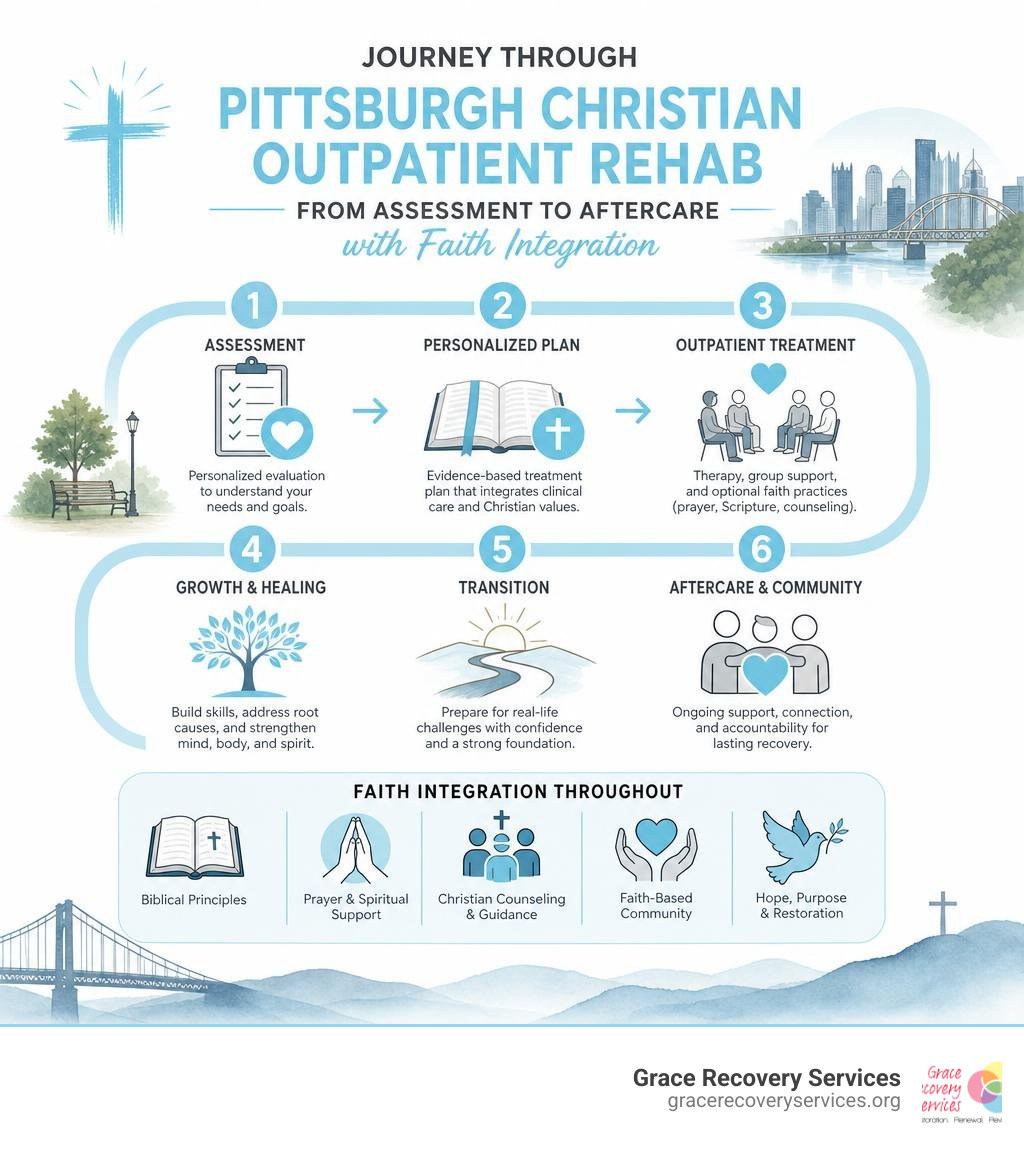
Pittsburgh Christian outpatient rehab is available — and closer than many people realize. If you or someone you love is looking for addiction treatment that weaves together clinical care and Christian faith, here is a quick overview of what to expect locally:
Quick-glance guide to Pittsburgh Christian outpatient rehab options:
- What it is: Structured addiction treatment combining evidence-based therapies with optional faith practices (prayer, Scripture reflection, pastoral counseling)
- Who it serves: Adults in Pittsburgh, Allegheny County, Westmoreland County, and surrounding Western PA communities
- Levels of care available: Standard Outpatient (OP) and Intensive Outpatient (IOP)
- How faith is integrated: Through biblical principles, Christian counseling, and spiritually grounded group support — always alongside clinical treatment
- Insurance: Most major plans accepted, including Medicaid, Highmark, and UPMC
- Do I need to be Christian to attend? Not necessarily — many programs make faith integration optional
The need for accessible, compassionate care in this region is real. In Allegheny County, roughly 1 in 10 clients reports needing substance use treatment — yet only about 20% actually receive it. That gap is painful, and it has a human cost.
For people of faith, that gap can feel even wider. Secular programs, while valuable, may not speak to the spiritual dimension of healing — the guilt, the shame, the sense of being separated from God and community. A faith-grounded outpatient program offers something different: a place where clinical expertise and Christian hope work together.
At Grace Recovery Services, we believe recovery is not just about stopping substance use. It is about restoration — of relationships, of purpose, and of identity. Our programs in the Pittsburgh area are built around exactly that vision.
Pittsburgh Christian outpatient rehab vocab to learn:
Understanding Pittsburgh Christian Outpatient Rehab
When searching for the right recovery path, understanding the distinct nature of a Pittsburgh Christian outpatient rehab can help clarify your options. Traditional secular outpatient programs do an excellent job of delivering clinical care, utilizing evidence-based modalities like Cognitive Behavioral Therapy (CBT) or Dialectical Behavior Therapy (DBT). However, they often leave out the spiritual component of a person’s life.
For many individuals in Western Pennsylvania, faith is not merely a weekend activity; it is the very foundation of how they view themselves and the world.
Choosing Faith-Based Outpatient Addiction Treatment means opting for a holistic healing experience that treats the mind, body, and spirit as interconnected parts of a whole. In a Christian program, we do not ignore the science of addiction. Instead, we view science and faith as complementary forces. God has provided clinical tools, psychological insights, and medical advancements to help us heal, and we use those tools alongside spiritual disciplines.

By attending a Christian Rehab Pittsburgh program, clients find a community of like-minded peers and licensed professionals who speak the same spiritual language. Research consistently highlights the immense value of this approach. Studies show that individuals who participate in faith-based recovery programs have a 30-50% higher long-term sobriety rate compared to those who participate in secular programs alone. Furthermore, Christian-based rehab programs that integrate spiritual counseling with evidence-based therapies report up to a 40% better retention rate among participants with strong religious beliefs.
This dramatic difference in retention and success is largely due to the deep sense of meaning, purpose, and community that faith provides. When you feel connected to a loving God and a supportive church family, the isolation of addiction begins to melt away.
Core Pillars of a Pittsburgh Christian Outpatient Rehab Program
A high-quality Christian outpatient program stands on several essential pillars that ensure both spiritual depth and clinical safety. These pillars work together to create a balanced, effective environment for lasting change:
- Scripture Reflection: Utilizing the Bible as a source of wisdom, comfort, and practical guidance. We look at scripture not to induce guilt, but to reveal God’s deep love, mercy, and desire for our restoration.
- Prayer and Fellowship: Incorporating prayer into sessions and group meetings, allowing clients to lift up their struggles and celebrate their victories in a supportive community.
- Pastoral and Christian Counseling: Providing access to clinical therapists who are also trained in biblical counseling, helping to bridge the gap between psychological healing and spiritual growth.
- Evidence-Based Clinical Therapies: Utilizing professional, licensed techniques such as trauma-informed care and relational therapy to address the root causes of substance use.
By combining these elements, our Christian Recovery Services ensure that you do not have to choose between professional mental health care and your deeply held Christian values.
Types of Faith-Based Outpatient Programs in Western Pennsylvania
Outpatient care is highly flexible, making it an excellent option for individuals who need professional support but cannot leave their daily responsibilities, such as work, school, or parenting. In Western Pennsylvania, we offer different levels of outpatient care to match where you are on your recovery journey.
| Program Feature | Standard Outpatient Program (OP) | Intensive Outpatient Program (IOP) |
|---|---|---|
| Hours per Week | 1 to 3 hours | 9 to 15 hours |
| Weekly Sessions | 1 to 2 days per week | 3 to 5 days per week (Morning or Evening) |
| Focus | Maintenance, ongoing therapy, and long-term relapse prevention | Intensive therapy, skill-building, and stabilizing early recovery |
| Ideal For | Stepping down from higher care or managing mild substance use | Transitioning from detox or needing structured support while living at home |
| Faith Integration | Individual Christian counseling and weekly support groups | Daily scripture reflection, Christian group therapy, and pastoral care |
Determining whether you need a standard Outpatient Program or an Intensive Outpatient program depends on your clinical assessment, the stability of your home environment, and your personal daily schedule.
Both levels of care allow you to live at home, sleep in your own bed, and remain connected to your local church and family. This real-world setting is highly beneficial because it allows you to practice the recovery skills you learn in therapy in real-time, facing everyday stressors with the immediate support of your clinical and spiritual team.
In Pennsylvania, accessing these services has become significantly easier in recent years. Since 2015, Pennsylvania’s Medicaid expansion has increased access to outpatient substance abuse treatment by over 25%. This expansion has benefited both traditional and faith-based programs, ensuring that financial limitations do not stand in the way of life-saving care.
In addition to Medicaid, many major commercial insurance plans — such as Highmark, Blue Cross Blue Shield, and UPMC — are widely accepted by outpatient providers.
As clients progress through these programs, aftercare planning becomes a crucial focus. Long-term sobriety is maintained through a strong continuum of care. Our local programs place a heavy emphasis on connecting clients with Western PA church recovery ministries, Christian peer support groups, and ongoing individual counseling to ensure they never walk alone, even after their formal program concludes. This robust network of Faith-Based Recovery Pittsburgh resources helps turn early sobriety into a lifelong walk of faith.
Choosing the Right Pittsburgh Christian Outpatient Rehab for Your Needs
Finding a program that fits your life means looking at both geographic convenience and clinical specialization. If you live in Allegheny County or Westmoreland County, finding a local center reduces the stress of long commutes, making it much easier to stay committed to your session schedule.
For those located in the eastern suburbs of Pittsburgh, exploring How Christian IOP Programs in Penn Hills Can Help You Recover is a great starting point. Having local offices in Penn Hills and North Huntingdon (Irwin area) allows us to serve these tight-knit communities directly.
When choosing a program, always look for licensed clinicians, a compassionate and non-judgmental atmosphere, convenient access from your community, and a clear framework for how faith is woven into the clinical treatment.
Integrating Clinical Excellence with Spiritual Depth
One of the most common misconceptions about faith-based recovery is that it relies solely on prayer and Bible study while ignoring modern clinical science. At Grace Recovery Services, we firmly reject this division. We believe that true healing happens when we combine clinical excellence with deep spiritual truth.
Many individuals struggling with substance use are also dealing with deep-seated emotional pain, childhood trauma, or co-occurring mental health conditions like depression, anxiety, and PTSD. This is known as a dual diagnosis. If a program only addresses the physical act of using a substance without healing the underlying trauma, relapse is highly likely. In fact, untreated trauma is one of the strongest drivers of continued substance use.
To address this, we utilize a trauma-informed care model that integrates evidence-based therapeutic modalities with Christian truth. Our Christian Integrated Addiction Treatment and Christian Intensive Outpatient Treatment programs utilize highly effective clinical tools, including:
- Cognitive Behavioral Therapy (CBT): Helping clients identify unhelpful, negative thought patterns and replace them with healthy, constructive behaviors.
- Dialectical Behavior Therapy (DBT) Skills: Teaching mindfulness, distress tolerance, emotion regulation, and interpersonal effectiveness to help clients navigate difficult emotions without turning to substances.
- Seeking Safety: A specialized, present-focused counseling model designed specifically to help people attain safety from both trauma (PTSD) and substance abuse simultaneously.
By weaving clinical modalities together with biblical wisdom, we help clients understand that their psychological struggles are not a sign of spiritual failure, but rather areas of deep wounding that God wants to heal.
The Counseling Blueprint Approach to Healing
To guide our clients through this integrated process, we use a structured, four-stage healing framework known as the Counseling Blueprint. This clinical and spiritual journey is designed to move clients from a place of isolation and pain to a life of freedom and truth:
- Take Off the Mask: In this initial stage, we focus on building genuine rapport, safety, and trust. Clients are encouraged to step away from the shame and pretense that often accompany addiction, allowing them to be completely honest about their struggles in a non-judgmental space.
- Heal the Wounds: Here, we gently explore the emotional, relational, and historical hurts that have fueled the addiction. Utilizing trauma-informed care, we address the root pain rather than just treating the surface-level symptoms.
- Remove the Toxins: In this stage, we work to identify unhelpful beliefs, lingering lies, and toxic thought patterns that the client has internalized over time (such as “I am unlovable,” “I will always be a failure,” or “God has abandoned me”).
- Replace with Truth: Finally, we install empowering, accurate, and biblical perspectives about self, others, and the world. We ground the client’s identity in the truth of God’s grace, love, and redemption, equipping them with the practical and spiritual tools needed for long-term, sustainable recovery.
Frequently Asked Questions About Faith-Based Recovery
Do I have to be a Christian to attend a faith-based outpatient program?
Absolutely not. At Grace Recovery Services, our doors and our hearts are open to everyone, regardless of where they are on their spiritual journey. We practice deep inclusivity and provide a warm, non-judgmental environment.
While our program is founded on Christian principles, the integration of faith is entirely optional. Our evidence-based clinical therapies are highly effective on their own, and we never force our beliefs on anyone. We are here to support you, meet you where you are, and walk alongside you with grace and dignity.
How does outpatient rehab address co-occurring mental health issues like trauma?
We treat co-occurring mental health conditions and substance use disorders simultaneously through an integrated dual-diagnosis approach. Because trauma and mental health struggles are so closely linked to addiction, trying to treat one without the other is rarely successful.
Through our Christian Addiction Recovery Pittsburgh programs, we use specialized trauma-informed therapies like Seeking Safety alongside Christian counseling. This helps clients process their trauma, manage symptoms of anxiety or depression, and develop healthy coping mechanisms, all while building a firm spiritual foundation of hope.
Does health insurance cover Christian outpatient treatment in Pennsylvania?
Yes, in most cases, health insurance does cover faith-based outpatient treatment. Under the Affordable Care Act (ACA), substance use and mental health services are classified as essential health benefits, meaning insurance providers must offer coverage for these programs.
We work with a wide variety of major insurance plans, including Highmark, UPMC, and other commercial carriers, as well as Pennsylvania Medicaid. We also offer affordable private pay options and sliding-scale fees for those who may have limited coverage, ensuring that financial barriers do not prevent you from getting the help you deserve.
Conclusion
If you or a loved one is struggling with addiction, please know that you do not have to carry this heavy burden alone. There is no shame in asking for help; in fact, seeking support is a courageous step toward grace, healing, and a restored life.
At Grace Recovery Services, we are dedicated to providing the highest quality of trauma-informed, clinically excellent, and deeply compassionate faith-based care in Western Pennsylvania. Whether you are located in Penn Hills, North Huntingdon, Irwin, or the greater Pittsburgh area, our team is ready to welcome you with open arms and walk with you through every stage of our Counseling Blueprint.
Let this be the day you step out of the shadows of addiction and into the light of God’s redemptive love. To learn more about our programs, verify your insurance, or schedule a confidential, obligation-free assessment, we encourage you to take the first step today.
This article was researched with AI and heavily edited by Stephen Luther for accuracy and relevance.
Stephen Luther is the Executive Director and Founder of Grace Christian Counseling, Grace Recovery Services, WPA Counseling, NuWell Online Counseling and Coaching, and NuWell Health. He holds a Master’s degree in Education from the University of Georgia and a Master’s degree in Marriage and Family Therapy from Duquesne University. He is a licensed professional counselor in Pennsylvania.
Since 1997, Steve has been helping children, adolescents, and adults overcome a wide range of emotional and relational challenges. He specializes in working with hurting families, including those with foster, adopted, or traumatized children. Steve uses Attachment-Based Therapy, Splankna Healing, and Therapeutic Parent Coaching to support healing and restoration.
This guide is for educational and spiritual encouragement and is not a substitute for personalized professional counseling. If you are in crisis, please reach out for immediate help.