How Family Healing Faith Programs Help Families Start Again
Family healing faith programs help people rebuild trust, improve communication, set healthy boundaries, and find support through Christian prayer and recovery-focused care. Start by choosing a program that is trauma-informed, welcomes each person without shame, and can connect clients to licensed mental health or substance use treatment when needed.
These programs often help families facing:
- Substance use and its effect on children, partners, and caregivers
- Divorce, separation, estrangement, grief, or incarceration
- Long-standing hurt, conflict, secrecy, or broken trust
- Patterns of guilt, fear, resentment, or unhealthy caretaking
At Grace Recovery Services in Western Pennsylvania, faith-integrated recovery can make room for both spiritual formation and practical change. Prayer, Scripture, honest listening, repentance, forgiveness, and clear boundaries can support healing. They do not require pretending harm did not happen, rushing reconciliation, or waiting for every relative to participate.
One person can begin by seeking support, changing harmful patterns, and praying for wisdom. When safety, peace, or readiness is missing, it can also be faithful to step back, keep appropriate boundaries, and trust God with what cannot be controlled.
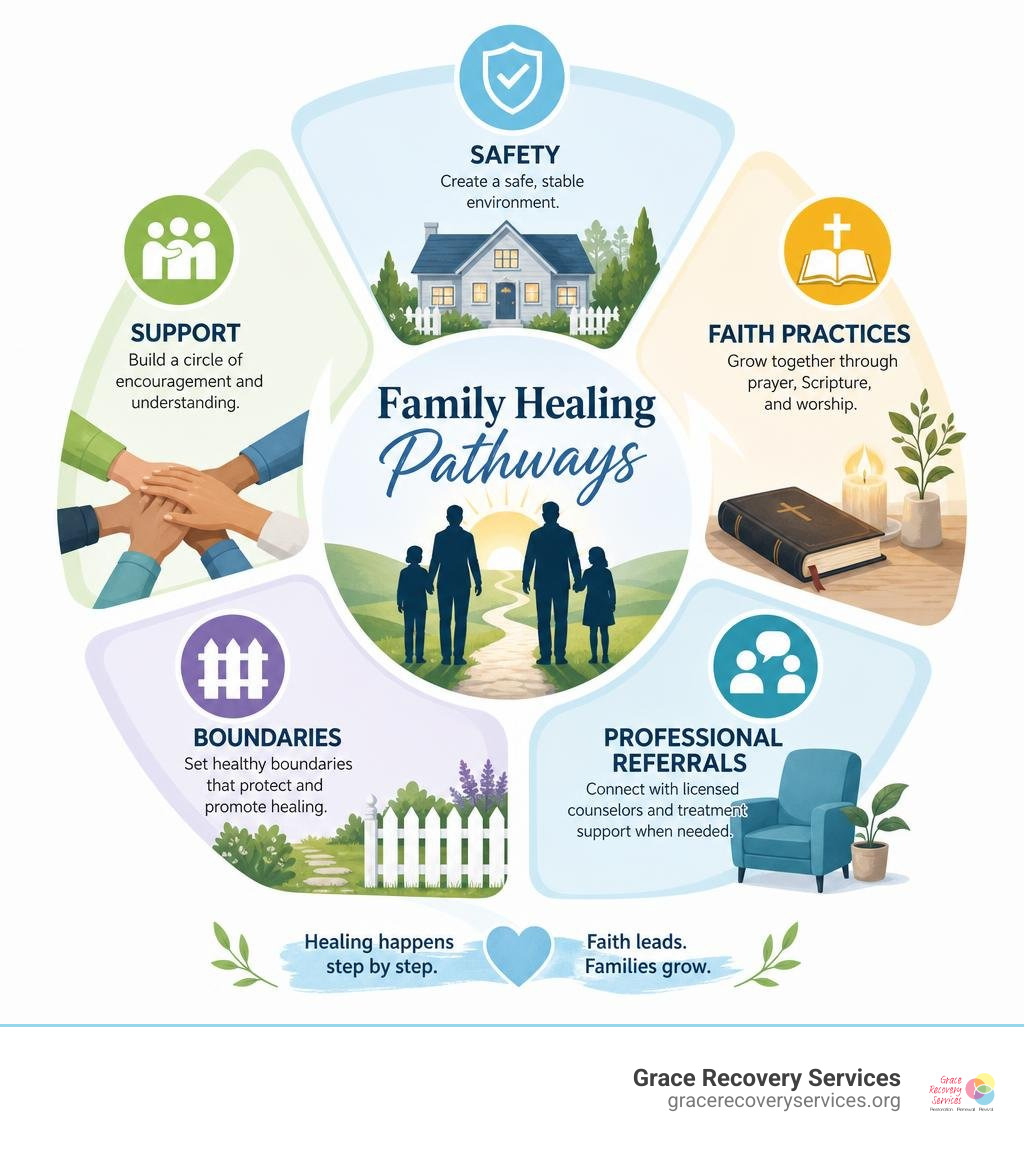
Simple guide to family healing faith programs terms:
Core Dimensions of Family Healing Faith Programs

Family wounds rarely happen in a vacuum, and they do not resolve through surface-level optimism. True spiritual restoration addresses the root issues that cause division, resentment, and generational pain. When we examine what makes faith-centered restoration effective, we see a careful balance of spiritual disciplines, emotional honesty, and practical relationship skills.
Our clinical and spiritual experience in Western Pennsylvania shows that families find breakthrough when they pair heartfelt prayer with clinical insight. Through faith-based trauma recovery, clients learn that spiritual growth requires facing reality rather than ignoring pain. Our four-stage Counseling Blueprint guides this transformation:
- Take Off the Mask: Dropping denial, pretense, and false harmony to speak the truth in love.
- Heal the Wounds: Bringing unresolved grief, childhood trauma, and past hurts into the open.
- Remove the Toxins: Breaking codependency, secrecy, unhealthy caretaking, and resentment.
- Replace with Truth: Establishing healthy communication, biblical identities, and enduring trust.
Scriptural Tools: Repentance, Forgiveness, and Healthy Boundaries
Scripture provides direct tools for restoring broken households, but these tools must be handled with care. Misapplying spiritual concepts can sometimes cause further harm if boundaries are neglected.
- Repentance: Genuine biblical repentance goes beyond saying “I’m sorry.” It involves an intentional turning away from destructive behaviors and making amends.
- Relational Forgiveness: Forgiveness is a spiritual release of resentment and a surrender of the desire for payback. It is a gift given to God and oneself, distinct from instant reconciliation.
- Healthy Boundaries: Setting clear limits is not un-Christian; it is essential stewardship of your emotional and spiritual safety. Boundaries create the secure space where love can mature.
- Active Listening: James 1:19 reminds us to be quick to listen and slow to speak. Listening validates underlying pain without immediately defending oneself.
- Intercessory Prayer: Consistently bringing loved ones before the Lord softens hardened hearts and invites divine wisdom into complex relational dynamics.
Following a step-by-step guide to family addiction recovery helps loved ones apply these scriptural principles methodically rather than reacting emotionally during high-stress moments.
Distinguishing the True Cross from Spiritual Bondage
A frequent challenge in faith communities is confusing the “necessary suffering” of Christian discipleship with the “unnecessary suffering” born of toxic patterns, untreated addiction, or spiritual bondage.
The Cross represents sacrifices made for righteousness, love, and spiritual obedience. In contrast, staying in an emotionally unsafe environment or enabling destructive behaviors is not carrying a biblical cross. Spiritual oppression and generational cycles thrive in secrecy, chronic guilt, and manipulation.
Structured prayer frameworks and specialized ministries, such as the Healing of Families Ministry, emphasize identifying spiritual access points like unforgiveness, occult involvement, or generational patterns. Breaking these cycles frees family members to pursue lasting emotional and spiritual freedom.
Addressing Systemic Family Trauma and Crisis
Family crises often touch every generation. When one member experiences profound distress, the entire household adapts—often developing unhealthy coping mechanisms to manage the pressure.

Trauma-informed care recognizes that destructive behaviors are often rooted in deep, unresolved pain. By providing intentional family support in addiction recovery, faith-based programs help restore healthy communication while addressing the trauma beneath the surface.
Healing Substance Use and Systemic Codependency
Substance use disorders alter family dynamics dramatically. Family members frequently take on survival roles—such as the enabler, the hero, the scapegoat, or the lost child—to maintain a sense of balance amidst chaos.
Understanding the ultimate guide to family roles in addiction is a crucial step in breaking free from codependency. In the United States, 1 in 4 children lives in a home impacted by substance use. These children often carry invisible emotional scars that persist into adulthood if left unaddressed.
Organizations like the National Association for Children of Addiction (NACoA) and their Faith Leaders Institute (developed over 25 years in partnership with SAMHSA) equip leaders with tools like the Celebrating Families! curriculum. When professional care is needed, our outpatient center provides structured faith-based outpatient addiction treatment in Western Pennsylvania, supporting both the individual and their loved ones.
Overcoming Incarceration, Separation, and Divorce
When a family experiences the incarceration of a parent or the pain of marital dissolution, the resulting grief and stigma can feel overwhelming.
Programs like the Family Faith Restoration Program in Chicago offer structured, Scripture-based curricula to help families navigate parental incarceration, work through grief, and re-establish trust.
Similarly, adult children of divorce frequently wrestle with hidden attachment wounds, fear of intimacy, and chronic anxiety. Retreats and peer-led ministries such as the Life-Giving Wounds Online Retreat provide tailored spiritual support. These programs frame personal healing through a redemptive lens, empowering individuals to move past abandonment and build stable, faith-filled relationships.
Modalities and Formats in Family Healing Faith Programs

Modern family healing initiatives utilize a range of formats to meet diverse emotional and spiritual needs. These range from educational seminars to intensive clinical outpatient care.
| Program Modality | Primary Focus | Best Suited For | Format Options |
|---|---|---|---|
| Spiritual Coaching & Cohorts | Healing attachment wounds with God; personal spiritual growth | Individuals wrestling with identity, shame, and relationship with God | 12-week online cohorts, small-group video calls, prayer journaling |
| Generational Prayer Seminars | Dismantling spiritual strongholds and generational patterns | Families experiencing chronic relational rifts or spiritual oppression | Weekend seminars, parish workshops, structured prayer guides |
| Peer-Led Retreats | Processing specific family trauma (divorce, loss, estrangement) | Adults carrying childhood family wounds seeking community | Multi-day virtual retreats, local chapter meetings, silent reflections |
| University Certificate Studies | Equipping parents and leaders in family spirituality | Parents, ministry workers, and pastoral counselors | Semester-based classes, monthly hybrid workshops, ministry practicums |
| Clinical Outpatient Therapy | Treating substance use and co-occurring mental health trauma | Clients and families needing licensed therapeutic intervention | Intensive outpatient programs (IOP), individual therapy, family sessions |
Essential Modalities in Family Healing Faith Programs
Specialized coaching models, like the KNOWN Catholic Coaching Program, integrate evidence-based psychology with traditional spirituality to address foundational attachment wounds with God the Father. When individuals experience the unconditional love of God, their capacity to engage healthily with human family members expands.
Applying a whole-person approach to faith-based trauma recovery ensures that biological, psychological, social, and spiritual needs are addressed simultaneously.
Practical Pathways in Family Healing Faith Programs
For ongoing formation, academic programs like the Loyola Marymount University Family Spirituality Certificate reframe parenting as a sacred calling, combining silent retreats with theological reflection to strengthen domestic life.
When addiction or serious mental health challenges are present, enrolling in professional faith-based addiction counseling provides the clinical accountability needed to navigate complex family dynamics safely.
Navigating Family Healing When Relatives Resist
A common heartbreak in family restoration occurs when one person desires reconciliation, but other family members remain unwilling or unable to participate.
Healing is still possible even if you are the only person actively engaging the process. You can cultivate emotional health and spiritual maturity regardless of another person’s willingness to change.
Standing in the Gap Through Solo Engagement
In Christian tradition, “standing in the gap” (Ezekiel 22:30) means interceding faithfully for others. Even when relatives are resistant, an individual can effect positive change within the family system:
- Interrupting Reactivity: Ceasing participation in predictable family arguments shifts the dynamic and invites new ways of relating.
- Practicing Emotional Detachment with Love: Caring deeply for a family member without taking responsibility for their choices or emotional state.
- Maintaining Personal Integrity: Focusing on your own spiritual growth and emotional health rather than attempting to manage or fix others.
- Consistent, Relational Prayer: Lifting your family to God privately while honoring their free will and emotional autonomy.
By discovering finding peace through Western PA Christian counseling, individuals learn to live in God’s grace rather than carrying the weight of changing other people.
Discerning When to Contend and When to Surrender
How do you know when to keep actively contending for a relationship and when to step back? Discernment requires paying close attention to spiritual peace, personal safety, and divine timing.
- Indicators to Keep Contending: There is mutual willingness to communicate, humility on both sides, respect for boundaries, and a shared desire for resolution.
- Indicators to Step Back and Surrender: Chronic manipulation, ongoing dishonesty, physical or emotional unsafety, active substance use without help-seeking, or persistent boundary violations.
Stepping back is not giving up hope; it is surrendering control to God. When your efforts produce exhaustion rather than peace, releasing the situation into God’s hands is often the most faithful step forward.
Frequently Asked Questions About Family Healing
Can one family member bring spiritual breakthrough if others refuse to participate?
Yes. While a person cannot make spiritual or behavioral choices on behalf of another adult, one individual can profoundly influence the family system. By establishing healthy boundaries, refusing to participate in dysfunctional patterns, and praying faithfully, one person can break generational cycles and invite God’s peace into the home.
How do faith-based programs integrate clinical therapy with spiritual practices?
Faith-based programs integrate evidence-based therapies—such as Cognitive Behavioral Therapy (CBT) and trauma-informed care—with Christian spiritual formation. This approach pairs clinical tools for processing trauma and emotional dysregulation with spiritual practices like prayer, Scripture study, and community support, caring for the mind, body, and spirit together.
How can local churches support families in crisis without replacing professional treatment?
Churches serve as essential support networks by creating welcoming, shame-free environments, offering pastoral counseling, and hosting peer recovery groups. When complex trauma, severe clinical depression, or substance use disorders arise, church leaders can partner with licensed clinical providers, offering ongoing spiritual and community support alongside professional treatment.
Conclusion
Family restoration is a journey that requires time, emotional safety, and practical steps. Whether your family is navigating the challenges of substance use, working through long-standing relational rifts, or seeking to break generational patterns of pain, there is a clear path forward through faith, healthy boundaries, and evidence-based care.
At Grace Recovery Services, we walk alongside individuals and families throughout Western Pennsylvania, including our locations in Penn Hills and North Huntingdon. Our outpatient programs integrate Christian faith with clinical excellence to foster long-term recovery and emotional restoration.
If you or a loved one is ready to take the next step toward healing, we invite you to explore our outpatient recovery and Christian counseling services to learn how our personalized programs can support your family’s path forward.
This article was researched with AI and heavily edited by Stephen Luther for accuracy and relevance.
Stephen Luther is the Executive Director and Founder of Grace Christian Counseling, Grace Recovery Services, WPA Counseling, NuWell Online Counseling and Coaching, and NuWell Health. He holds a Master’s degree in Education from the University of Georgia and a Master’s degree in Marriage and Family Therapy from Duquesne University. He is a licensed professional counselor in Pennsylvania.
Since 1997, Steve has been helping children, adolescents, and adults overcome a wide range of emotional and relational challenges. He specializes in working with hurting families, including those with foster, adopted, or traumatized children. Steve uses Attachment-Based Therapy, Splankna Healing, and Therapeutic Parent Coaching to support healing and restoration.
This guide is for educational and spiritual encouragement and is not a substitute for personalized professional counseling. If you are in crisis, please reach out for immediate help.