
Understanding Evidence-Based Faith Treatment for Substance Use
Evidence-based faith treatment integrates scientifically validated clinical therapies—such as Cognitive Behavioral Therapy (CBT) and Twelve-Step Facilitation—with spiritual practices and Christian values to treat substance use disorder holistically. Modern clinical science shows that bridging psychological care and spiritual grounding provides comprehensive support for lasting healing. When clinicians utilize evidence-based tools alongside a client’s personal values, treatment engagement deepens and emotional, physical, and existential pain are addressed together.
At Grace Recovery Services, we approach care through a whole-person lens. We recognize that substance use disorder alters physical wellness, cognitive patterns, social relationships, and spiritual peace. Addressing these areas together creates true clinical synergy.
The Clinical Framework of Evidence Based Faith Treatment
Evidence-based clinical practice relies on randomized controlled trials (RCTs) and rigorous meta-analyses to measure what truly works. The landmark evaluation of religious and spirituality-based therapy compared to standard treatment in mental health care revealed that spiritually integrated interventions produce moderate, statistically significant improvements across psychiatric symptoms (Hedges’ g = 0.44) and overall psychological and behavioral functioning (g = 0.62).
Even more encouraging, the therapeutic gains of faith-integrated treatment continue to grow over time. At 6-month follow-ups, the symptom reduction effect size expanded to g = 0.72. Meeting people at the intersection of their values and clinical science provides lasting tools for sobriety.
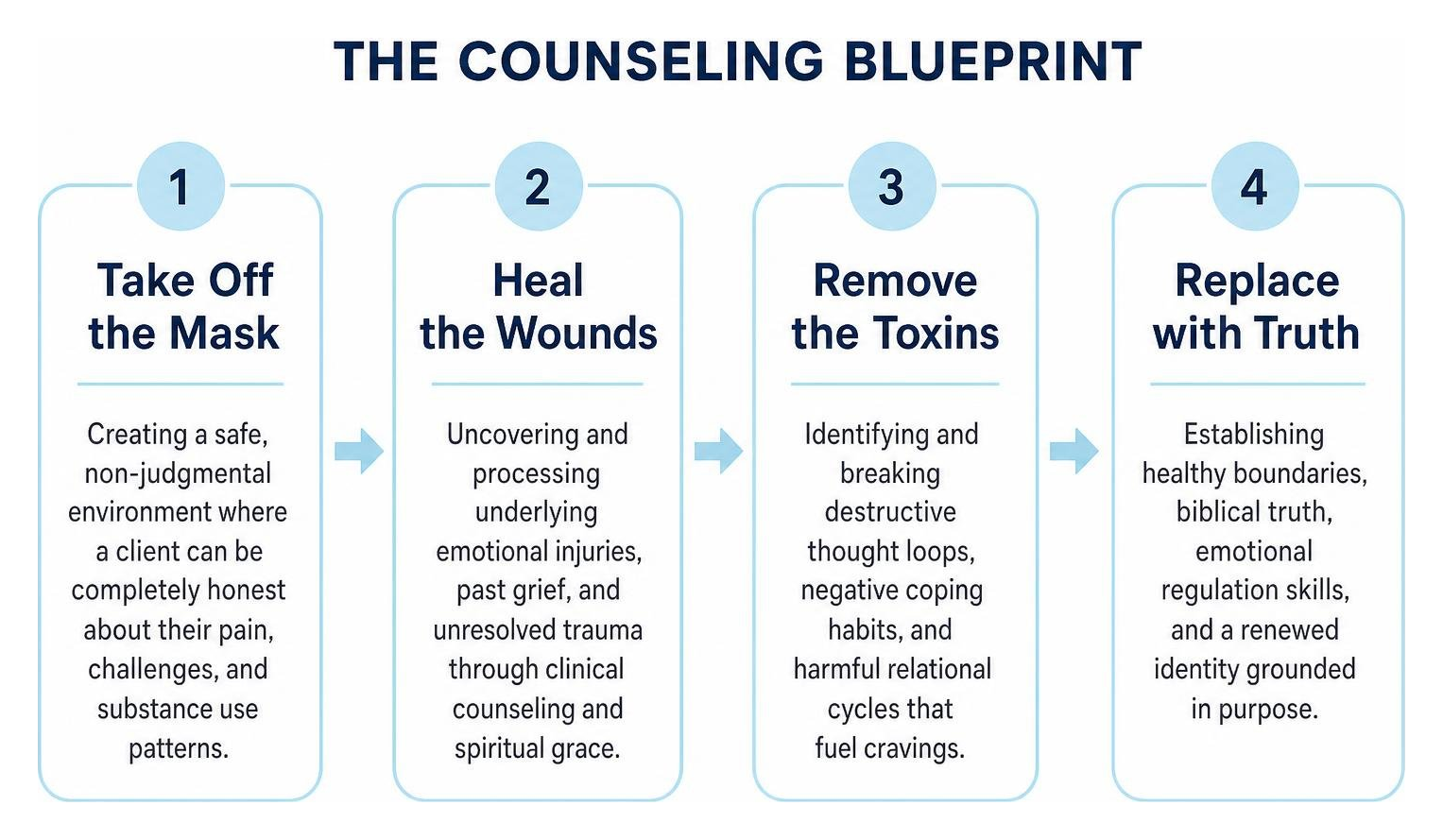
To structure this care effectively, we guide clients through our Counseling Blueprint, which consists of four progressive healing stages:
- Take Off the Mask: Creating a safe, non-judgmental environment where a client can be completely honest about their pain, challenges, and substance use patterns without fear of condemnation.
- Heal the Wounds: Uncovering and processing underlying emotional injuries, past grief, and unresolved trauma through clinical counseling and spiritual grace.
- Remove the Toxins: Identifying and breaking destructive thought loops, negative coping habits, and harmful relational cycles that fuel cravings.
- Replace with Truth: Establishing healthy boundaries, biblical truth, emotional regulation skills, and a renewed identity grounded in purpose.
Integrating Clinical Science with Spiritual Renewal
True clinical integration never forces religious dogma onto a client. Instead, it weaves a person’s chosen faith into established clinical protocols. The Substance Abuse and Mental Health Services Administration (SAMHSA) identifies emotional, physical, social, and spiritual well-being as foundational pillars of recovery.
By practicing faith integrated recovery in Pittsburgh where science meets spirit, we offer outpatient treatment that respects medical interventions, psychiatric therapies, and personal spiritual walks. Faith does not replace evidence-based therapy; it enriches every step of the therapeutic process.
Core Mechanisms of Faith-Integrated Addiction Recovery
Why do faith-based and spiritual interventions produce strong recovery outcomes? Researchers have spent decades analyzing the specific mechanisms of change within mutual-help groups, Twelve-Step Facilitation (TSF), and pastoral counseling. The evidence reveals that recovery is driven by a combination of social network restructuring, behavioral activation, and profound internal spiritual transformation.
Social Support, 12-Step Facilitation, and Spiritual Awakening
Twelve-Step Facilitation is one of the most thoroughly researched approaches in addiction medicine. When compared against active controls like conventional Cognitive Behavioral Therapy (CBT) and Motivational Enhancement Therapy (MET), Twelve-Step Facilitation slightly outperforms other established modalities (Cohen’s d = 0.176).
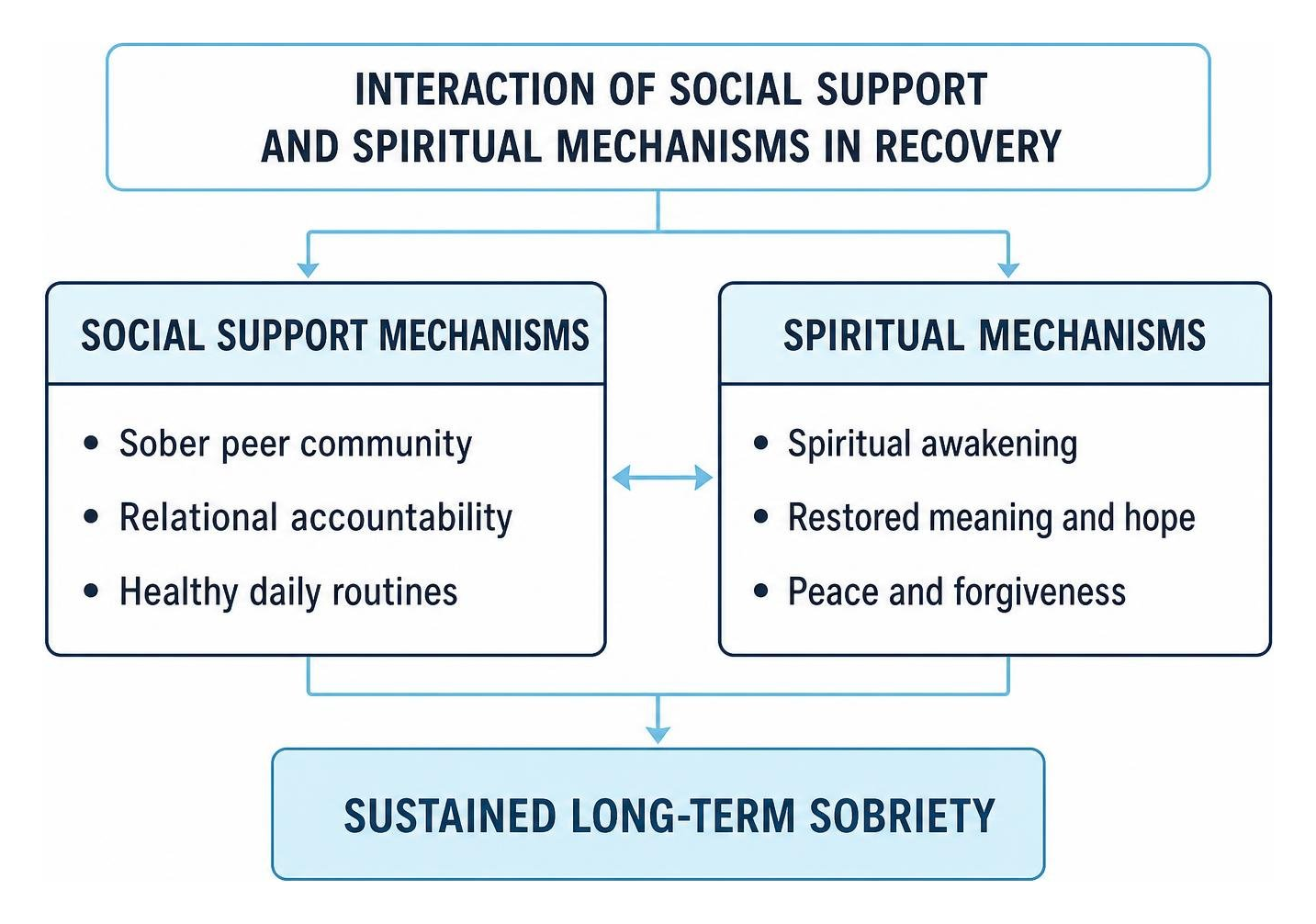
A primary driver of this success is the construction of positive social networks. Addiction thrives in isolation. When an individual connects with a mutual-help group, they gain a sober peer community, relational accountability, and healthy daily routines.
At the same time, internal spiritual changes play a vital role. In quantitative addiction studies:
- Up to 82% of clients who experienced a spiritual awakening during treatment remained completely abstinent at a 1-year follow-up, compared to 55% of non-awakened clients.
- An overwhelming 84% of scientific studies confirm that faith serves as a positive, protective factor in addiction prevention and recovery.
- Approximately 73% of addiction treatment programs across the United States include a spirituality-based element, recognizing its ability to restore meaning and hope.
Understanding how faith helps with addiction allows clinicians to harness these spiritual awakenings to help clients build long-term recovery capital.
Positive vs. Negative Religious Coping in Relapse Prevention
How a person relates to God during adversity dramatically impacts their mental health and recovery trajectory. Clinical psychology distinguishes between two primary styles of spiritual coping: Positive Religious Coping (PRC) and Negative Religious Coping (NRC).
Positive religious coping involves viewing God as a loving, merciful source of strength, leaning on spiritual community, and using prayer to find comfort during distress. Conversely, negative religious coping is characterized by spiritual distress—feeling abandoned by God, viewing illness as divine retribution, or experiencing intense religious guilt.
Research indicates that negative religious coping exacerbates anxiety, intensifies withdrawal distress, and elevates relapse vulnerability. In our clinical sessions, we actively screen for spiritual distress and help clients transition toward positive, grace-filled coping strategies, supporting them with a beginners guide to faith-based relapse prevention.
| Coping Dimension | Positive Religious Coping (PRC) | Negative Religious Coping (NRC) | Clinical Impact on Recovery |
|---|---|---|---|
| View of Higher Power | Loving, forgiving, supportive partner in healing | Punitive, distant, judgmental, or condemning | PRC reduces cravings; NRC increases internal anxiety and shame |
| Spiritual Practices | Centering prayer, gratitude, uplifting Scripture | Compulsive bargaining, fearful pleading, isolation | PRC fosters emotional regulation; NRC heightens distress |
| Response to Triggers | Leaning on grace and community support | Hiding in shame and believing oneself unworthy | PRC strengthens relapse prevention; NRC elevates relapse risk |
| Relational Dynamics | Openness, fellowship, authentic connection | Fear of judgment from church and peers | PRC builds recovery capital; NRC creates painful isolation |
Clinical Modalities: Religion-Adapted CBT and Trauma Care
One of the most effective approaches in modern outpatient addiction treatment is Religion-Adapted Cognitive Behavioral Therapy. R-CBT takes the gold-standard tools of cognitive restructuring and behavioral activation and integrates them directly with a client’s Christian values and biblical teachings.
Cognitive Restructuring Through Scripture and Metanoia
Traditional CBT focuses on identifying and reframing automatic negative thoughts and cognitive distortions (such as catastrophizing, all-or-nothing thinking, and excessive “should” statements). For a Christian client, this process aligns naturally with Scripture.
In the New Testament, the Greek word for repentance is metanoia, which literally translates to “a transformation of the mind.” This concept is mirrored in Romans 12:2: “Do not conform to the pattern of this world, but be transformed by the renewing of your mind.”
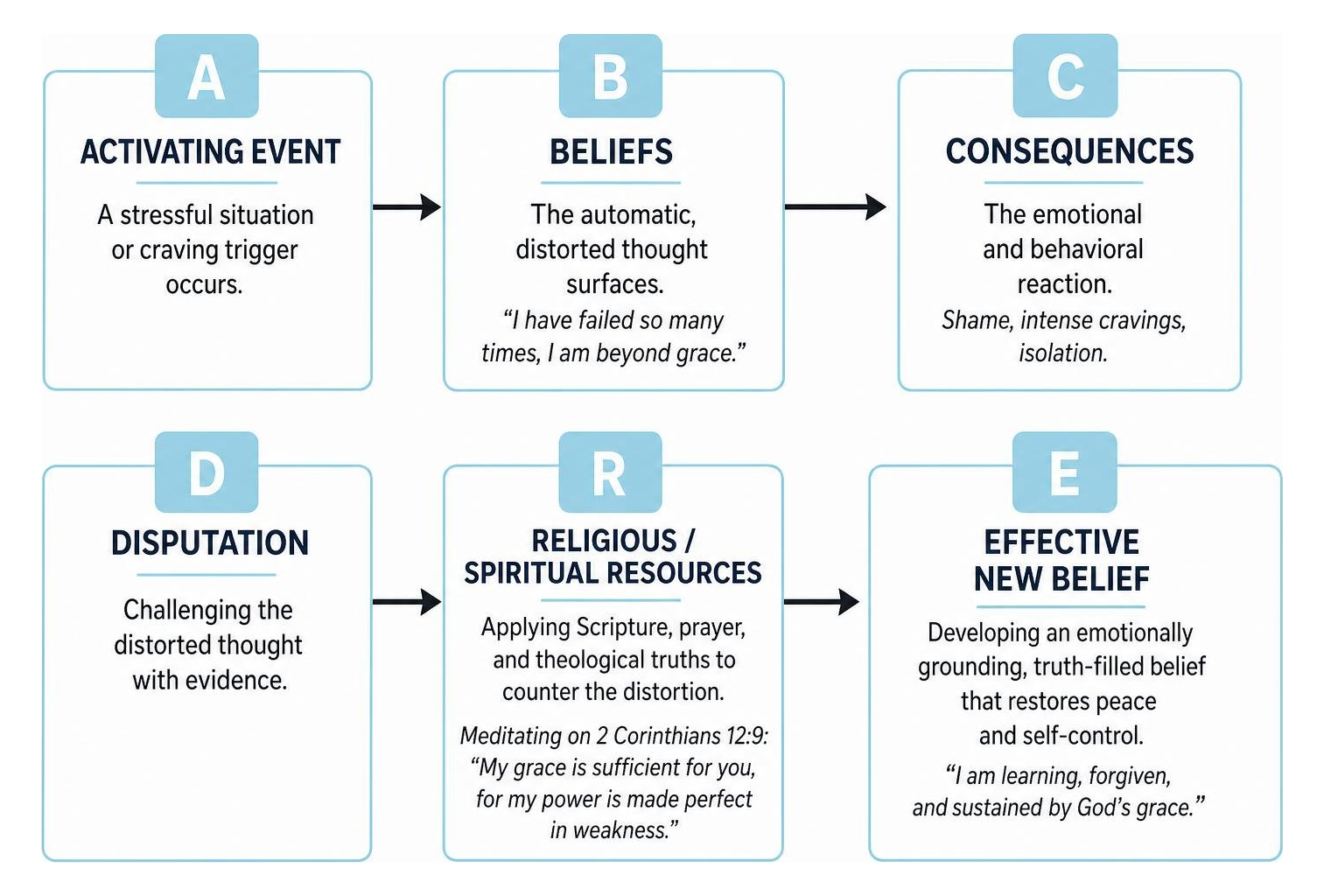
Clinical protocols such as the Religiously Integrated Cognitive Behavioral Therapy manual expand the standard ABCDE model into the ABCDE-R model:
- A (Activating Event): A stressful situation or craving trigger occurs.
- B (Beliefs): The automatic, distorted thought surfaces (e.g., “I have failed so many times, I am beyond grace”).
- C (Consequences): The emotional and behavioral reaction (e.g., shame, intense cravings, isolation).
- D (Disputation): Challenging the distorted thought with evidence.
- R (Religious/Spiritual Resources): Applying Scripture, prayer, and theological truths to counter the distortion (e.g., meditating on 2 Corinthians 12:9: “My grace is sufficient for you, for my power is made perfect in weakness”).
- E (Effective New Belief): Developing an emotionally grounding, truth-filled belief that restores peace and self-control.
Implementing Evidence Based Faith Treatment in Outpatient Care
Addiction recovery requires addressing the physical and emotional scars left by past pain. Substance use disorder frequently co-occurs with complex trauma, requiring trauma-informed counseling that stabilizes the nervous system while fostering spiritual safety.
Through structured faith-based outpatient addiction treatment, clients receive clinical care while living at home and maintaining work or family commitments. Our clinical team provides specialized faith-based trauma recovery across our locations in Western Pennsylvania, including our offices in Penn Hills and North Huntingdon.
By combining clinical psychotherapy, nervous system regulation, and spiritual direction, outpatient care offers flexible schedules that allow individuals to put recovery skills into practice immediately in everyday life.
The Economic and Preventative Value of Faith Support Systems
Beyond individual healing, faith communities serve as essential social safety nets that actively prevent substance abuse and ease the burden on public healthcare systems.
A comprehensive systematic review and meta-analysis of religious and spiritual interventions published in Psychological Medicine confirmed significant, measurable reductions in anxiety and distress through spiritual care. When faith is cultivated early in life, it provides powerful preventative protection:
- Teens who consider religious beliefs unimportant are nearly 3 times more likely to smoke, 5 times more likely to binge drink, and nearly 8 times more likely to use marijuana compared to peers who value faith.
- Individuals who attend religious services weekly throughout childhood and adolescence are 33% less likely to use illegal substances.
- In a review of 278 quantitative studies on alcohol use, 86% confirmed that faith significantly reduced the risk of alcohol use disorders.
- Out of 185 studies on drug misuse, 84% established that spiritual involvement serves as a direct deterrent against chemical dependence.
From an economic perspective, faith-based volunteer support groups and congregation-based recovery programs contribute up to $316.6 billion in annual savings to the United States economy at no taxpayer expense. An estimated 129,680 faith congregations across the nation host free recovery support groups, providing essential recovery capital to communities.
Cultivating faith-forward freedom from opioids and alcohol strengthens family bonds, supports long-term recovery networks, and builds healthier communities across Westmoreland County and the greater Pittsburgh area.
Frequently Asked Questions About Evidence-Based Faith Treatment
Is faith-based addiction treatment supported by clinical scientific research?
Yes. Meta-analyses of randomized controlled clinical trials confirm that faith-integrated therapies and Twelve-Step Facilitation produce statistically significant reductions in substance use and psychological distress. These approaches perform equally to or slightly outperform standard active controls like conventional CBT, especially among individuals who place personal value on their faith.
How does Christian cognitive behavioral therapy differ from secular CBT?
Christian CBT includes all the proven clinical mechanisms of traditional CBT—such as identifying cognitive distortions, behavioral activation, and mood tracking—while framing these tools within a Christian worldview. Therapists use Scripture, grace-centered theology, and prayer to help clients reframe negative thought patterns, drawing on the biblical principle of renewing the mind (metanoia).
Can individuals with religious doubts or trauma benefit from faith-integrated care?
Absolutely. High-quality faith treatment is entirely non-judgmental and meets clients wherever they are. If an individual carries religious trauma or spiritual doubts, our clinicians provide a trauma-informed environment to explore that pain safely. Clients are never pressured to adopt specific beliefs; care is tailored around their unique goals and personal pace.
Conclusion
Overcoming substance use disorder requires caring for the whole person: mind, body, and spirit. By uniting clinical psychology with the enduring power of faith, evidence-based Christian treatment offers a path toward deep, lasting transformation.
At Grace Recovery Services, our outpatient programs in Penn Hills and North Huntingdon walk alongside individuals and families across Western Pennsylvania. Whether you are taking the very first step toward healing or seeking structured support to maintain long-term sobriety, our team provides compassionate, trauma-informed outpatient care grounded in clinical excellence and Christian grace.
If you or a loved one is navigating substance use disorder, reach out to our team to schedule a confidential, personalized assessment. Healing and restoration are always within reach.
Explore our compassionate outpatient recovery services today.
This article was researched with AI and heavily edited by Stephen Luther for accuracy and relevance.
Stephen Luther is the Executive Director and Founder of Grace Christian Counseling, Grace Recovery Services, WPA Counseling, NuWell Online Counseling and Coaching, and NuWell Health. He holds a Master’s degree in Education from the University of Georgia and a Master’s degree in Marriage and Family Therapy from Duquesne University. He is a licensed professional counselor in Pennsylvania.
Since 1997, Steve has been helping children, adolescents, and adults overcome a wide range of emotional and relational challenges. He specializes in working with hurting families, including those with foster, adopted, or traumatized children. Steve uses Attachment-Based Therapy, Splankna Healing, and Therapeutic Parent Coaching to support healing and restoration.
This guide is for educational and spiritual encouragement and is not a substitute for personalized professional counseling. If you are in crisis, please reach out for immediate help.