
Why Holistic Christian Addiction Help Is Changing Recovery Outcomes
Holistic Christian addiction help combines evidence-based clinical treatment with spiritual healing — addressing not just the physical side of substance use, but the emotional wounds, broken relationships, and deep spiritual emptiness that so often lie beneath it.
If you or someone you love is struggling with addiction in the Pittsburgh or Western Pennsylvania area, here is a quick overview of what this approach involves:
- What it is: Faith-integrated outpatient treatment that heals mind, body, and spirit together
- Who it’s for: Adults with substance use disorders, including those with co-occurring mental health conditions like anxiety, depression, or trauma
- How it works: biblical principles, Christian counseling, and evidence-based therapies like CBT work together in one care plan
- What makes it different: Spiritual accountability and grace-based community support improve long-term sobriety outcomes
- Where to start: A confidential assessment helps match you with the right level of care — IOP, PHP, or outpatient services
The research is clear. Studies show that 82% of people who experienced a spiritual awakening during recovery were still sober one year later, compared to just 55% of those without a spiritual component. That is not a small gap — it reflects how powerfully the spirit shapes the path to lasting freedom.
At Grace Recovery Services, we believe addiction is never just a physical problem. It carries wounds — shame, grief, fractured identity, and relational hurt. True recovery means tending to all of it.
“Recovery is more than symptom management — it is whole-person transformation.”
That is exactly what holistic Christian care is designed to do. And for many people across Western Pennsylvania, it is finally the approach that works.
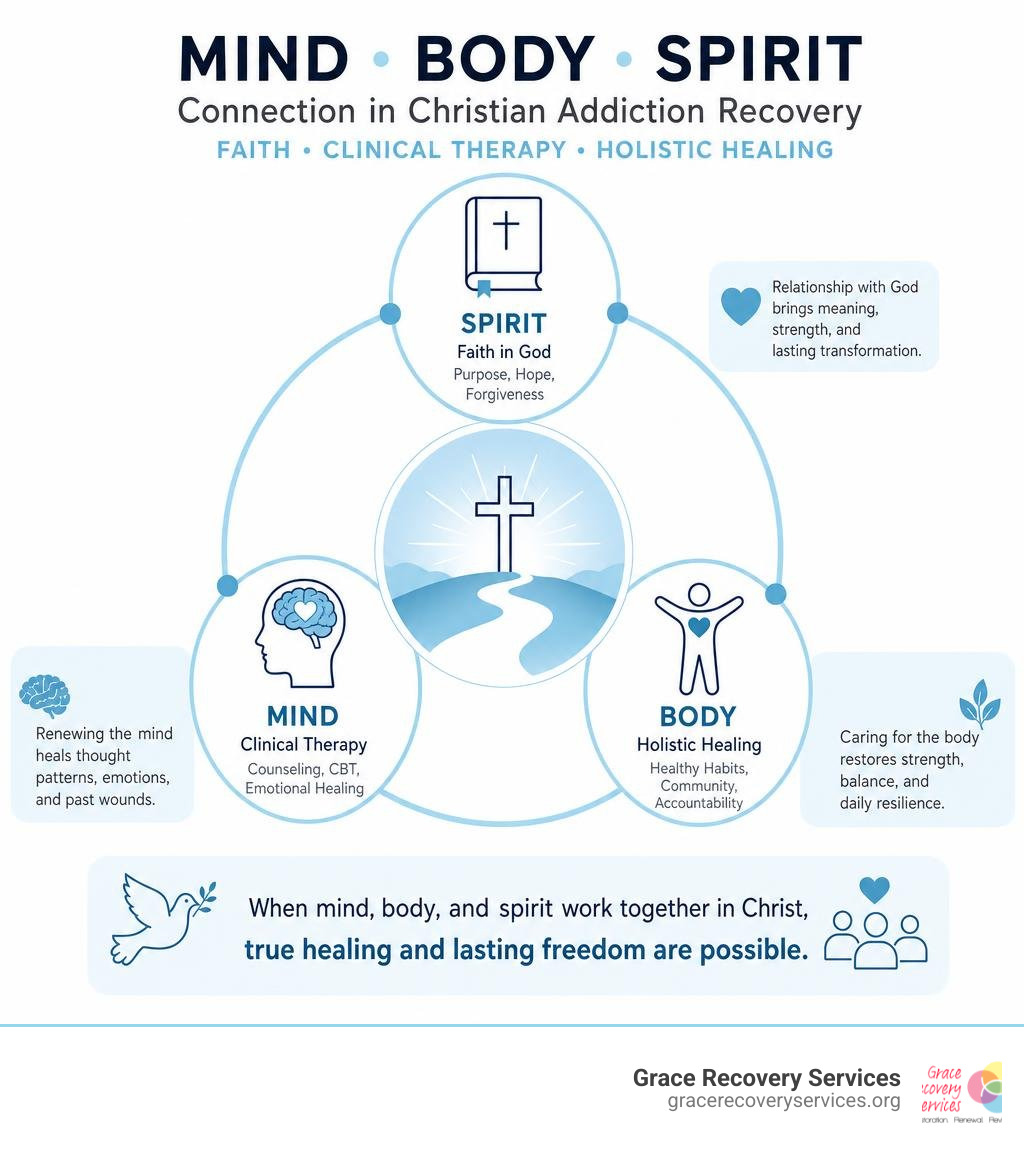
Simple guide to holistic Christian addiction help:
What is Holistic Christian Addiction Help?
At its core, holistic Christian addiction help is an approach to recovery that views substance use through a comprehensive lens. It recognizes that a person is not merely a collection of physical symptoms or chemical dependencies. Instead, we are complex, beautiful creations made of mind, body, and spirit. When one part of us suffers, the other parts feel the pain.
Traditional secular programs often focus primarily on physical stabilization and cognitive behavioral adjustments. While these clinical elements are incredibly important, they can sometimes leave a spiritual void. Holistic Christian recovery steps into that gap. By combining professional clinical excellence with the healing power of the Gospel, this approach offers a path to Christian Integrated Addiction Treatment that restores the whole person.

In a holistic faith-based setting, we do not ask you to leave your faith at the door—nor do we force a rigid set of rules upon you. Instead, we offer grace-based care. We meet you exactly where you are, offering a compassionate, non-judgmental environment where you can explore the underlying pain of addiction while building a solid spiritual foundation for the future.
Bridging Science and Scripture in Outpatient Care
For a long time, there was an unfortunate divide in the recovery world: you could either choose “clinical science” or “spiritual faith.” We believe that division is entirely unnecessary. In fact, true healing happens when we let science and scripture work hand-in-hand.
Modern neuroscience has shown us how addiction alters brain chemistry, hijacks the prefrontal cortex, and traps the nervous system in a state of chronic survival. At the same time, biblical truth teaches us about our inherent worth, the power of renewal, and the promise of redemption.
By integrating evidence-based therapies—such as Cognitive Behavioral Therapy (CBT) and trauma-informed care—with Christian counseling, we create a powerful synergy. We call this Faith Integrated Recovery in Pittsburgh Where Science Meets Spirit. Clients learn how to physically manage cravings and regulate their nervous systems, while simultaneously grounding their identity in Christ rather than their struggles.
How Spiritual Awakening Drives Long-Term Sobriety
Is spiritual healing just a comforting idea, or does it actually lead to better clinical outcomes? The data gathered over the years points to a resounding yes. Spiritual development is one of the most reliable predictors of long-term sobriety.
Consider these powerful statistics from national recovery research:
- 82% of clients who experienced a spiritual awakening during addiction recovery were still sober one year later, compared to 55% of those without a spiritual component.
- Developing religiosity or active faith during treatment raises the odds of remaining abstinent by about 39.1% six months after completing a program.
- Nearly 90% of peer-reviewed studies found that active spiritual or religious involvement directly reduced alcohol abuse, while 84% reported significantly lower drug misuse among believers.
To see how these elements compare in practice, look at the differences in recovery dynamics below:
| Recovery Aspect | Traditional Secular Outpatient Care | Holistic Christian Outpatient Care |
|---|---|---|
| Primary Focus | Symptom reduction and behavioral modification | Whole-person restoration (mind, body, and spirit) |
| Source of Strength | Self-reliance, clinical tools, or a generic higher power | Personal relationship with Jesus Christ and clinical tools |
| View of Identity | Often focused on managing a chronic disease label | Grounded in grace, forgiveness, and biblical identity |
| Community Support | Peer support groups | Faith-based fellowship, accountability, and local church integration |
| Addressing Trauma | Clinical trauma therapies | Trauma-informed clinical care paired with spiritual healing and prayer |
These outcomes show that when we invite God into the clinical therapy room, we are not just talking about theology—we are actively strengthening a person’s resilience against relapse.
The Counseling Blueprint: A Four-Stage Journey to Wholeness
At Grace Recovery Services, we walk alongside our clients using a highly specialized, compassionate framework known as the Counseling Blueprint. Created by our Executive Director, Stephen A. Luther, MSEd, MEd, LPC, this blueprint is a structured, four-stage outpatient counseling journey designed to help clients recover from addiction and heal from deep-seated emotional pain.

Instead of just treating the surface-level behaviors of substance use, the Counseling Blueprint dives deep into the relational wounds, trauma, and unhelpful beliefs that keep people trapped in cycles of self-medication. It is The Whole Person Approach to Faith-Based Trauma Recovery that brings lasting change.
Stage 1 and 2: Taking Off the Mask and Healing the Wounds
The journey begins with Stage 1: Take Off the Mask. When struggling with addiction, many people wear a mask of perfection, anger, or indifference to protect themselves from judgment. In this first stage, our counselors focus on building genuine rapport and absolute trust. We create a safe, non-judgmental space where clients feel secure enough to lay down their defenses and speak their honest truth.
Once the mask is off, we transition into Stage 2: Heal the Wounds. We know that substance use is very often an attempt to soothe unhealed trauma, grief, or relational pain. Through compassionate, Faith-Based Trauma Recovery, we help clients look gently at these emotional hurts. By processing these memories with clinical expertise and spiritual grace, we begin the deep work of emotional healing.
Stage 3 and 4: Removing Toxins and Replacing with Truth
After addressing the wounds, we move to Stage 3: Remove the Toxins. In this phase of our Western PA Christian Addiction Counseling, we help clients identify the “spiritual and cognitive toxins” they have been carrying. These are the unhelpful beliefs, lingering lies, and negative self-talk that sound like: “I am a failure,” “I will never change,” or “God has abandoned me.”
Finally, we arrive at Stage 4: Replace with Truth. We do not leave the client with an empty space where those toxic beliefs used to live. Instead, we work diligently to install empowering, accurate, and biblical perspectives about who they are, how God sees them, and what they are capable of achieving. This stage solidifies a client’s identity in Christ, giving them a firm, unshakeable foundation for long-term sobriety.
Core Components of a Faith-Integrated Outpatient Program
A high-quality, holistic faith-integrated program does not rely on prayer alone—nor does it rely solely on clinical worksheets. It brings the best of both worlds together into a structured outpatient continuum of care.
Our outpatient services in Western Pennsylvania, including our offices in Penn Hills (Pittsburgh area) and North Huntingdon, feature several core components designed to fit into your daily life:
- Clinical Therapy: Individual, group, and family therapy sessions led by licensed professionals who understand both clinical psychology and faith integration.
- Intensive Outpatient Programs (IOP): Structured programming that meets several times a week, allowing clients to receive intensive support while continuing to live at home, work, and care for their families.
- Partial Hospitalization Programs (PHP): A higher level of outpatient care providing comprehensive daily therapeutic support for those who need structured stabilization without an overnight stay.
- Christian Counseling: Dedicated counseling sessions that focus directly on spiritual growth, biblical wisdom, and rebuilding a personal relationship with God.
- Holistic Wellness Practices: Integrating physical health, nutritional awareness, and stress-reduction techniques to help the physical body recover from the toll of substance use.
This comprehensive structure ensures that clients in our Christian Intensive Outpatient Treatment receive the rigorous clinical care they need while remaining fully immersed in their local support systems.
Addressing Co-occurring Mental Health and Trauma
It is incredibly common for substance use disorders to walk hand-in-hand with mental health challenges. Whether it is chronic anxiety, deep depression, or post-traumatic stress disorder (PTSD), treating the addiction without treating the mental health issue is like trying to fix a leaky roof by only mopping the floor.
In our Faith-Based Outpatient Addiction Treatment, we specialize in dual-diagnosis care. We recognize that anxiety and depression are often the very “wounds” our clients are trying to self-medicate. Our licensed therapists use clinical techniques like Cognitive Behavioral Therapy (CBT) and trauma-informed care to help clients manage mental health symptoms, while our pastoral support helps them process the spiritual questions and existential pain that often accompany these struggles.
Why Holistic Christian Addiction Help Benefits Non-Believers
We are frequently asked: “Do I have to be a Christian to attend your program?” The answer is an absolute and welcoming no.
While our program is firmly rooted in Christian principles and biblical truth, we meet every client exactly where they are on their spiritual journey. If you are a non-believer, agnostic, or come from a different religious background, you can still find life-changing value in our Holistic Drug Rehabilitation.
Our approach benefits everyone because Christian values—such as radical grace, forgiveness, self-honesty, accountability, and community service—are universal keys to human flourishing. We never force our beliefs on anyone. Instead, we offer an inclusive, supportive space where you can focus on healing your mind, restoring your physical health, and discovering a sense of purpose and meaning that keeps you moving forward.
Fostering Community, Accountability, and Relapse Prevention
One of the greatest hazards in recovery is isolation. Addiction thrives in the dark, silent corners of our lives. That is why building a strong, loving community is a vital pillar of our Christian Recovery Services.
In a faith-based recovery community, accountability is not about shame, judgment, or finger-pointing. It is about love. It is about having brothers and sisters in recovery who walk beside you, celebrate your victories, and gently hold you to your commitments when you feel weak. This healthy, spiritual accountability fosters humility and reminds us that we do not have to carry our burdens alone.
The Role of Local Congregations and Support Networks
A major benefit of outpatient recovery in Western Pennsylvania is the ability to connect directly with local communities. By choosing outpatient care, you can build a local support network in real-time while remaining connected to your daily life.
We actively encourage our clients to connect with local churches and faith-based support networks in the Pittsburgh and Westmoreland County areas. In fact, faith communities play a massive role in the nationwide recovery landscape.
According to research, congregations that back recovery initiatives contribute an estimated $316 billion in savings to the U.S. economy by providing volunteer support, meeting spaces, sober social events, and community-based safety nets. By integrating into Faith-Based Recovery Pittsburgh, our clients step into a ready-made, drug-free social network that supports their new way of life.
Practical Spiritual Disciplines for Relapse Prevention
Relapse prevention is about more than just knowing what triggers to avoid; it is about building daily habits that keep your mind and spirit at peace.
Here are several practical, daily spiritual disciplines that our clients use to maintain emotional balance and spiritual strength:
- Centering Prayer: Taking 10 to 15 minutes each morning to sit quietly in God’s presence, surrendering anxieties and asking for guidance.
- Scripture Reflection: Reading encouraging biblical passages to remind yourself of your true identity and God’s promises.
- Daily Gratitude Journaling: Writing down three things you are thankful for each day, shifting your focus from what is lacking to how you are blessed.
- Fellowship Check-Ins: Reaching out to a sponsor, counselor, or recovery peer daily to share your struggles and stay in the light.
- Serving Others: Finding small, practical ways to help someone else, which naturally reduces self-centered thinking and builds healthy relational connections.
Navigating the Path to Recovery for Families
When a person struggles with addiction, the entire family system feels the impact. Parents, spouses, and children often carry their own heavy burdens of worry, anger, confusion, and grief. Because of this, we believe that family healing is a non-negotiable part of the recovery process.
If your goal is to find compassionate, localized outpatient care that allows your loved one to heal while remaining present in your daily family life, staying local is often the most supportive choice. Local care can make it easier for families to participate in counseling, maintain healthy routines, and build a recovery support system close to home.
What to Look for in a Quality Outpatient Program
When evaluating local options for your family, it is important to look for programs that maintain high clinical and professional standards.
Here are a few key elements to look for, which we discuss in detail in our Faith-Based Counseling Near Me Local Experts Guide:
- Licensed Professionals: Ensure the program’s counselors are state-licensed clinical professionals (such as LPCs, LCSWs, or LMFTs) who possess specialized training in addiction and trauma.
- Dual-Diagnosis Capability: Choose a program that can treat co-occurring mental health issues like depression and anxiety alongside substance use.
- Family Therapy Integration: Look for programs that offer dedicated family counseling to help restore trust, heal relational wounds, and establish healthy boundaries.
- Insurance Compatibility: A quality program should work with major commercial insurance providers to help make care accessible for your family.
Choosing the Right Holistic Christian Addiction Help for Your Family
If you live in Western Pennsylvania—including Pittsburgh, Penn Hills, North Huntingdon, Irwin, or Westmoreland County—finding local, accessible care is the first step toward rebuilding your life.
By choosing our local outpatient services at our Christian Rehab Pittsburgh locations, you get clinical excellence right in your backyard. Your loved one can attend intensive clinical and spiritual therapy sessions during the day or evening, and return home to put those recovery skills into practice immediately within their natural environment.
Frequently Asked Questions About Faith-Based Recovery
Do I have to be a Christian to attend a faith-based outpatient program?
Absolutely not. Our outpatient programs are open to anyone seeking help, regardless of their religious beliefs or background. While our clinical staff operates from a Christian worldview, we respect your personal journey and meet you exactly where you are with grace, compassion, and support.
How does a holistic program address mental health issues like depression or anxiety?
We use a dual-diagnosis approach, which means we treat substance use and mental health conditions simultaneously. Our licensed counselors utilize evidence-based techniques like Cognitive Behavioral Therapy (CBT) and trauma-informed care to help you manage anxiety and depression, while integrating spiritual support to help you find peace, hope, and purpose.
What is the difference between outpatient Christian rehab and traditional secular programs?
Traditional secular programs focus primarily on behavioral changes and clinical coping mechanisms. While we utilize those exact same high-quality clinical tools, we also integrate biblical principles, Christian counseling, and spiritual accountability. We focus on healing the spirit and restoring your identity, which research shows significantly improves long-term sobriety outcomes.
Conclusion
Addiction is a heavy burden, but you do not have to carry it alone. At Grace Recovery Services, we are dedicated to helping individuals and families across Western Pennsylvania experience true, lasting restoration of mind, body, and spirit.
Through our compassionate, trauma-informed outpatient care, our unique Counseling Blueprint, and our dedicated Christian counseling, we provide a safe harbor where you can take off the mask, heal your wounds, and step into a bright, sober future.
Whether you are looking for care in Pittsburgh, Penn Hills, North Huntingdon, or the surrounding Westmoreland County area, our team is ready to welcome you with open arms and professional expertise.
If you are ready to take the first step toward healing, we invite you to reach out to us today. Explore our outpatient recovery services and discover how we can support you on your journey to wholeness.
This article was researched with AI and heavily edited by Stephen Luther for accuracy and relevance.
Stephen Luther is the Executive Director and Founder of Grace Christian Counseling, Grace Recovery Services, WPA Counseling, NuWell Online Counseling and Coaching, and NuWell Health. He holds a Master’s degree in Education from the University of Georgia and a Master’s degree in Marriage and Family Therapy from Duquesne University. He is a licensed professional counselor in Pennsylvania.
Since 1997, Steve has been helping children, adolescents, and adults overcome a wide range of emotional and relational challenges. He specializes in working with hurting families, including those with foster, adopted, or traumatized children. Steve uses Attachment-Based Therapy, Splankna Healing, and Therapeutic Parent Coaching to support healing and restoration.
This guide is for educational and spiritual encouragement and is not a substitute for personalized professional counseling. If you are in crisis, please reach out for immediate help.