
What Is an Intensive Outpatient Program Faith Model?
An intensive outpatient program (IOP) is an ambulatory level of behavioral health care designed to provide comprehensive, structured treatment without disrupting daily home life. According to the American Society of Addiction Medicine (ASAM), an IOP represents Level 2.1 care. It serves as an essential bridge for someone in recovery who needs more clinical accountability than traditional weekly therapy can provide, while still maintaining work, family, or academic responsibilities.
In a faith-centered framework, this clinical structure is intentionally paired with spiritual encouragement. Rather than viewing addiction purely as a biological or behavioral issue, a faith-based model honors the mind, body, and spirit connection.
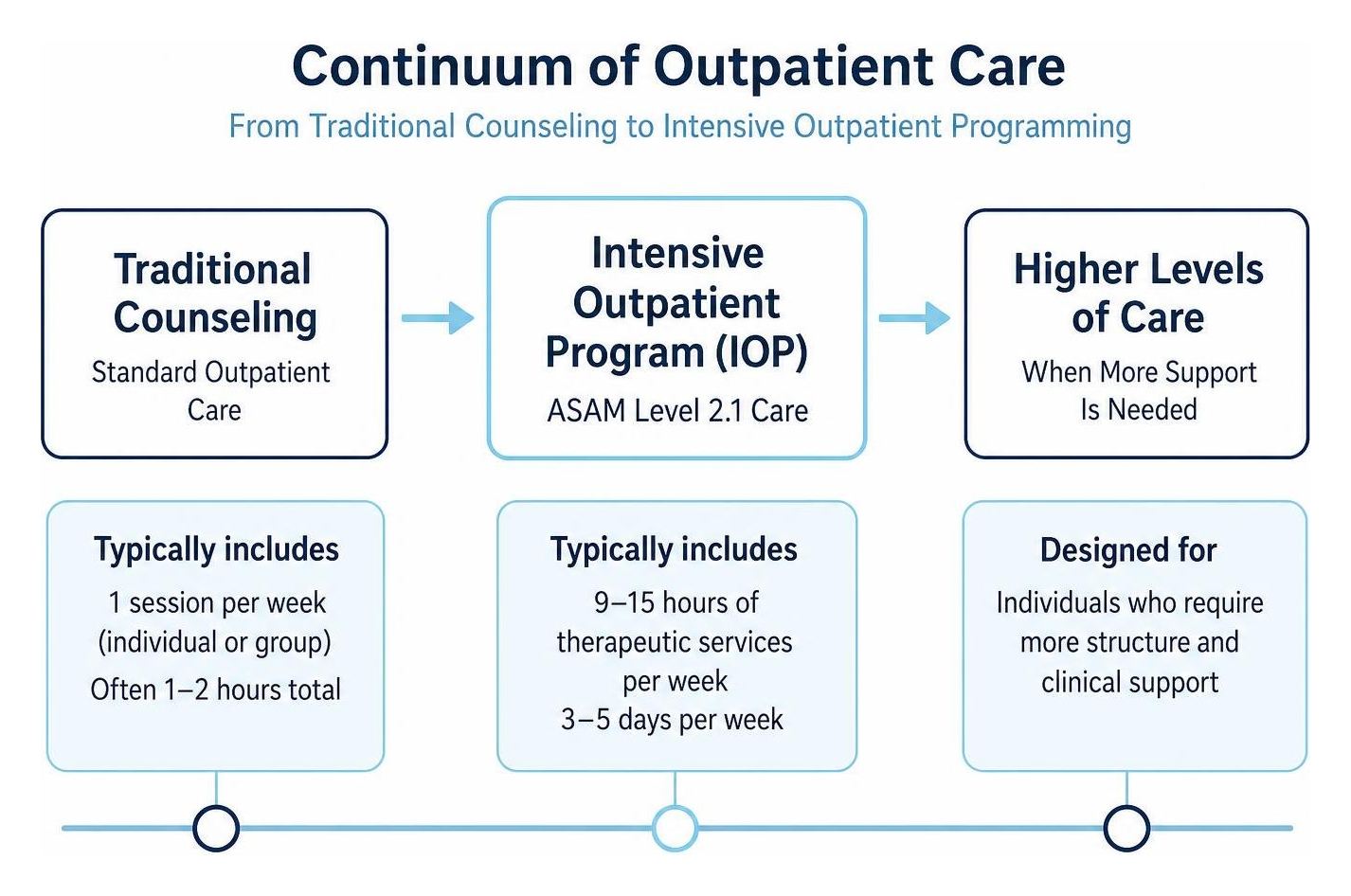
Clients typically engage in 9 to 15 hours of scheduled therapeutic services per week, spread across three to five days. To explore how this structure works in detail, you can read our in-depth guide to what is an intensive outpatient program. Treatment plans are highly personalized, ensuring that both clinical milestones and personal spiritual goals are nurtured throughout the healing journey.
How IOP Differs from Standard Outpatient Counseling
While standard outpatient counseling usually consists of one individual or group session per week (often one to two hours total), an intensive outpatient schedule delivers significantly more therapeutic depth.
| Feature | Standard Outpatient Therapy | Intensive Outpatient Program (IOP) |
|---|---|---|
| Weekly Time Commitment | 1 to 3 hours per week | 9 to 15 hours per week |
| Session Frequency | 1 or 2 days weekly | 3 to 5 days weekly |
| Clinical Structure | Periodic maintenance & check-ins | Multi-day skill building & group therapy |
| Peer Fellowship | Limited interaction with peers | Strong, consistent community cohort |
| Level of Accountability | Self-directed between sessions | High clinical and relational accountability |
Clients who need foundational stabilization, active relapse prevention training, or deep trauma processing benefit from the concentrated rhythm of an IOP. For a broader look at outpatient care tiers, review our detailed guide to outpatient programs.
Why Choose an Intensive Outpatient Program Faith Pathway?
Choosing an intensive outpatient program faith pathway allows clients to heal in an environment where their spiritual values are respected and actively integrated into therapy. Walking through substance use recovery can stir profound questions about guilt, identity, purpose, and forgiveness.
Through Christian intensive outpatient treatment, clients discover that they do not have to leave their faith at the clinic door. Surrounded by clinicians and peers who share an understanding of grace, individuals build lasting recovery habits anchored in biblical principles and genuine fellowship.
Core Clinical and Spiritual Components of Faith-Based Care
Effective outpatient care must be clinically sound and spiritually uplifting. At Grace Recovery Services, our outpatient care incorporates evidence-based clinical modalities led by licensed mental health and addiction professionals, while honoring each client’s spiritual background.
To see how these elements combine across various programs, check out A Comprehensive Guide to Finding Faith-Based IOP Options.
Our clinical approach is guided by our unique Counseling Blueprint, which moves through four transformative stages:
- Take Off the Mask: Creating a safe, judgment-free space to honestly acknowledge struggles, break denial, and embrace vulnerability.
- Heal the Wounds: Addressing underlying emotional pain, adverse experiences, and trauma using clinical, trauma-informed therapies.
- Remove the Toxins: Identifying and dismantling destructive behavioral cycles, toxic thought patterns, and negative relational dynamics.
- Replace with Truth: Establishing healthy coping mechanisms, emotional resilience, and a grounded identity rooted in truth and grace.
Core Clinical Therapies in an Intensive Outpatient Program Faith Setting
Our clinical sessions utilize proven therapeutic interventions adapted to meet each person’s needs:
- Cognitive Behavioral Therapy (CBT): Helps clients identify unhelpful core beliefs and reframe distorted thoughts into balanced, constructive actions. Scientific research on evidence-based cognitive therapy affirms its effectiveness in long-term addiction recovery.
- Dialectical Behavior Therapy (DBT) Skills: Teaches emotional regulation, distress tolerance, and mindfulness techniques for managing cravings and stress.
- Motivational Interviewing (MI): Strengthens internal motivation and commitment toward positive life change.
- Relapse Prevention Education: Equips clients with practical strategies to manage triggers, navigate social pressure, and build a healthy lifestyle.
Integrating biblical Principles, Prayer, and Chaplaincy
Spiritual care in an IOP is always voluntary, compassionate, and tailored to the client’s comfort level. When requested, licensed counselors and chaplains integrate:
- Scripture Reflection: Exploring themes of redemption, peace, and spiritual resilience.
- Pastoral and Chaplain Support: Providing dedicated spiritual guidance, prayer, and relational care.
- Restoring Identity: Helping individuals rediscover their worth and purpose free from the shame often associated with substance use disorder.
Treating Dual Diagnosis and Co-Occurring Mental Health
Many individuals experiencing substance use disorders also face co-occurring mental health challenges, such as major depression, generalized anxiety, or post-traumatic stress disorder (PTSD). Addressing one without the other leaves recovery incomplete.
Through comprehensive dual diagnosis care in our faith-based outpatient addiction treatment, our multidisciplinary team coordinates psychiatric evaluations, clinical counseling, and non-judgmental medication-assisted treatment (MAT) coordination when appropriate, treating the whole person with dignity.
Program Formats and Daily Flexibility: In-Person and Virtual Options
Recovery should fit into your life, not pull you away from your positive commitments. To learn more about attendance structures, see our guide on making the grade with IOP program requirements.
In-Person Group Dynamics and Fellowship
For clients living in Western Pennsylvania, our regional centers—including our locations serving Penn Hills, Pittsburgh, and North Huntingdon (Westmoreland County)—provide a safe, warm environment for face-to-face healing.
Gathering in person allows clients to build deep community, practice interpersonal skills, and share encouragement with peers on the same journey. If you are exploring regional programs, discover Pittsburgh Christian outpatient rehab local options to consider that align with your lifestyle.
Virtual IOP for Work-Life Balance
For individuals balancing demanding careers, caregiving duties, or transportation limitations, virtual IOP (VIOP) delivers the same rigorous clinical curriculum via secure, HIPAA-compliant telehealth technology.
Clients can attend scheduled group therapy, individual counseling, and spiritual care sessions from the comfort and privacy of home. Learn how remote options work by exploring faith-based care on the go with Christian outpatient therapy.
Navigating Admissions, Insurance Coverage, and Family Involvement
Taking the first step toward recovery can feel overwhelming, but the admissions process is straightforward, confidential, and supportive. If you are beginning your search, review these 8 practical ways to find outpatient rehab near me for helpful guidance.
The Step-by-Step Admissions Process
- Confidential Initial Call: A compassionate conversation to learn about your situation, answer questions, and schedule a screening.
- Clinical & Spiritual Assessment: A licensed clinician evaluates your medical history, substance use patterns, mental health needs, and preferences for faith integration.
- Personalized Care Plan: We design an outpatient schedule (morning or evening tracks) tailored to your daily life.
- Orientation & First Session: You are welcomed into your group cohort and introduced to your primary counselor. For newcomers, check out the best IOP programs near me for beginners.
Insurance Verification and Cost Factors
Most major commercial health insurance policies and Medicaid plans provide coverage for outpatient substance use and mental health treatment. During your initial intake call, our admissions specialists verify your insurance benefits directly with your provider, explaining coverage details and any applicable co-pays clearly before treatment begins. We believe life-saving care should be accessible and transparent.
Engaging Family Support and Relational Restoration
Addiction impacts entire family systems. When clients provide consent, family members can participate in outpatient family counseling sessions. These guided conversations focus on:
- Establishing healthy, loving boundaries.
- Rebuilding broken trust through consistent action.
- Improving constructive communication.
- Understanding the neurobiology of addiction and the spiritual journey of healing.
Building Lasting Sobriety: Aftercare and Spiritual Community

Graduation from an intensive outpatient program marks a milestone, not the end of growth. Lasting sobriety is sustained through intentional aftercare planning that connects clients to long-term support systems.
Our clinicians work with each client to create a comprehensive discharge plan, which may include stepping down into standard weekly outpatient therapy, joining alumni support networks, and integrating into local faith communities or faith-centered 12-step groups. Having a strong circle of spiritual fellowship ensures that whenever life becomes challenging, you are never walking the road alone.
Frequently Asked Questions About Faith-Based IOP
How many hours per week does a faith-based IOP require?
Most intensive outpatient programs require between 9 and 15 hours of structured therapy each week. These hours are typically divided across three to five days in three-hour blocks, with both morning and evening schedules available to accommodate personal routines.
Can I attend a faith IOP while working or going to school?
Yes. Because IOP is an outpatient level of care, sessions are structured specifically to allow clients to maintain their employment, attend classes, and care for their families while receiving intensive treatment.
Do I need to belong to a specific church or denomination to enroll?
No. Faith-based outpatient programs welcome individuals from all Christian denominations, backgrounds, and varying stages of personal faith. Spiritual elements like prayer and Scripture study are tailored with grace to support wherever you are on your personal journey.
Conclusion
Recovery is a journey of restoration—one that honors your mind, body, and spirit. Through a faith-based intensive outpatient program, you receive the highest standard of evidence-based clinical therapy while rediscovering your identity, purpose, and spiritual strength.
If you or someone you care about is ready to take the next step toward sustainable healing in Western Pennsylvania, we are here to walk with you. Explore an inspirational Bible verse for sobriety to find daily encouragement, or reach out to our caring admissions team at Grace Recovery Services today for a confidential, personalized assessment.
This article was researched with AI and heavily edited by Stephen Luther for accuracy and relevance.
Stephen Luther is the Executive Director and Founder of Grace Christian Counseling, Grace Recovery Services, WPA Counseling, NuWell Online Counseling and Coaching, and NuWell Health. He holds a Master’s degree in Education from the University of Georgia and a Master’s degree in Marriage and Family Therapy from Duquesne University. He is a licensed professional counselor in Pennsylvania.
Since 1997, Steve has been helping children, adolescents, and adults overcome a wide range of emotional and relational challenges. He specializes in working with hurting families, including those with foster, adopted, or traumatized children. Steve uses Attachment-Based Therapy, Splankna Healing, and Therapeutic Parent Coaching to support healing and restoration.
This guide is for educational and spiritual encouragement and is not a substitute for personalized professional counseling. If you are in crisis, please reach out for immediate help.