
What Is Trauma-Informed Care and Why Does It Matter?
Trauma-informed care is an overarching framework that fundamentally transforms how organizations and clinicians view human suffering. Rather than seeing symptoms as isolated deficits, this model recognizes that trauma—defined by the Substance Abuse and Mental Health Services Administration (SAMHSA) as an event, series of events, or set of circumstances experienced by an individual as physically or emotionally harmful or life-threatening—has lasting adverse effects on functioning and mental, physical, social, emotional, or spiritual well-being (NBK207195).
To help organizations operationalize this understanding, SAMHSA’s Concept of Trauma and Guidance for a Trauma-Informed Approach outlines the foundational “Four R’s”:
- Realize the widespread impact of trauma and understand potential paths for recovery.
- Recognize the signs and symptoms of trauma in clients, families, staff, and others involved with the system.
- Respond by fully integrating knowledge about trauma into policies, procedures, and clinical practices.
- Resist re-traumatization by actively eliminating coercive, disempowering, or invalidating practices (NBK604200).
Trauma affects the nervous system deeply. When a person faces overwhelming stress or chronic adversity—such as adverse childhood experiences (ACEs)—the autonomic nervous system adapts to survive. Hypervigilance, emotional numbness, rapid mood shifts, and substance use often develop as survival mechanisms rather than intentional defiance.
When treatment environments ignore these neurobiological realities, they risk compounding distress. Understanding the distinction between traditional deficit-based paradigms and a trauma-informed relational health model helps clarify this vital shift:
| Dimension | Traditional Healthcare Paradigm | Trauma-Informed Paradigm |
|---|---|---|
| Primary Question | “What is wrong with you?” | “What happened to you?” & “What is strong within you?” |
| View of Symptoms | Pathology, non-compliance, or behavioral deficits | Adaptive coping strategies developed to survive trauma |
| Power Dynamic | Hierarchy where the provider dictates directives | Collaborative partnership with mutual voice and choice |
| Safety Focus | Clinical compliance and risk containment | Physical, psychological, and relational safety |
| Environment | Rigid, procedural, and institutional | Transparent, predictable, and welcoming |
| Approach to Relapse | Failure of will or treatment resistance | Opportunity to examine emotional triggers and safety needs |
Shifting the Paradigm: From “What’s Wrong” to “What Happened”
When healthcare spaces label someone as “resistant,” “manipulative,” or “non-compliant,” they fail to see the protective armor that person had to construct. Shifting the conversation to “What happened to you?” allows us to view trauma responses as understandable adaptations to abnormal events (NBK207195).
We further extend this question to ask, “What is strong with you?” True restoration recognizes the innate dignity, resilience, and god-given strengths within every individual. This non-judgmental inquiry creates the safety necessary to explore holistic trauma healing, tending to the delicate interplay between mind, body, and spirit.
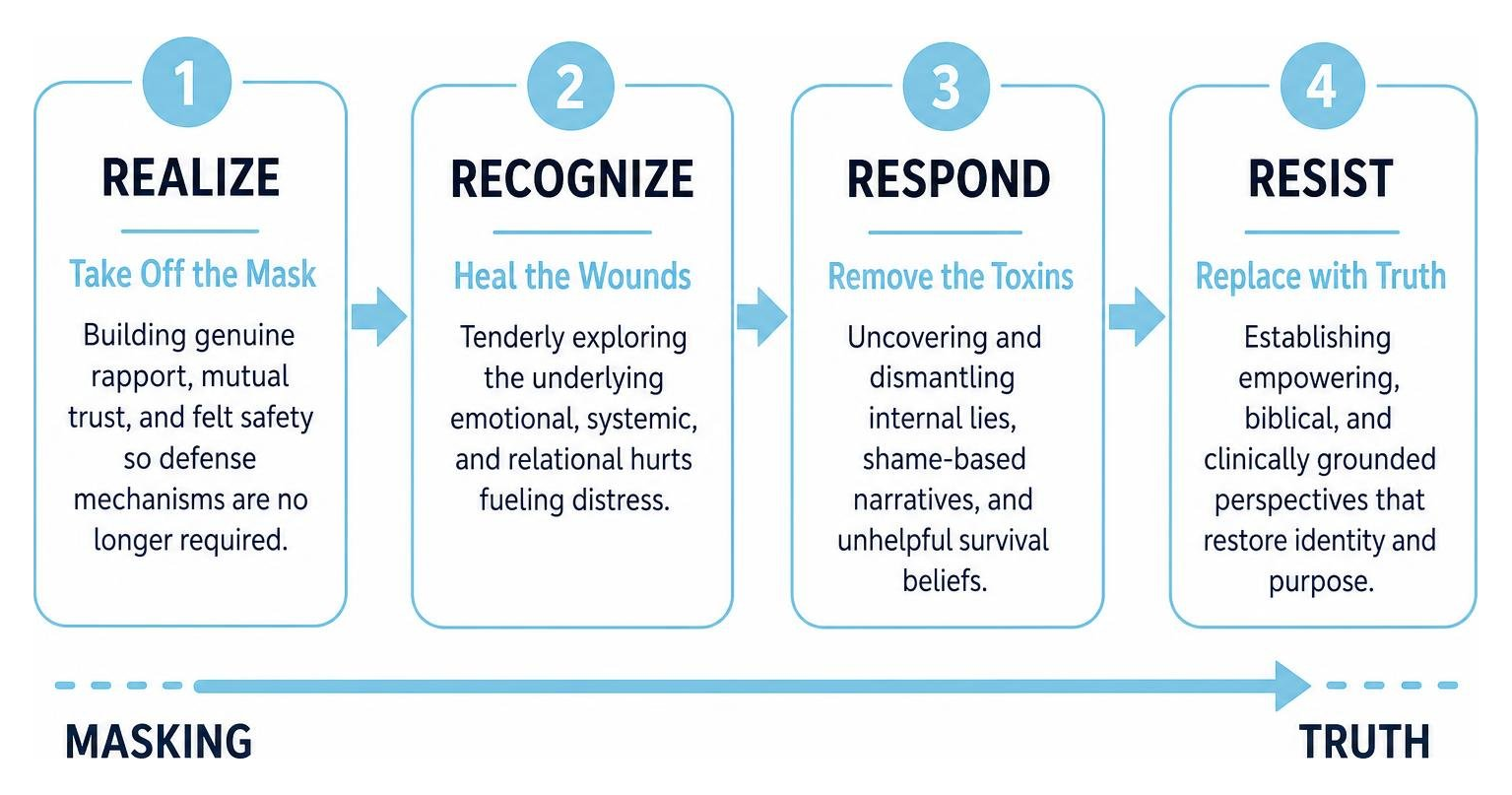
In our outpatient programs, we navigate this transition through our four-stage Counseling Blueprint:
- Take Off the Mask: Building genuine rapport, mutual trust, and felt safety so defense mechanisms are no longer required.
- Heal the Wounds: Tenderly exploring the underlying emotional, systemic, and relational hurts fueling distress.
- Remove the Toxins: Uncovering and dismantling internal lies, shame-based narratives, and unhelpful survival beliefs.
- Replace with Truth: Establishing empowering, biblical, and clinically grounded perspectives that restore identity and purpose.
The Six Core Principles of Trauma-Informed Care
According to SAMHSA guidelines and clinical summaries from the StatPearls overview of Trauma-Informed Therapy, trauma-informed care rests upon six essential pillars (NBK604200):
- 1. Safety: Ensuring physical, emotional, and relational safety throughout the entire care environment, from the waiting room to the counseling office.
- 2. Trustworthiness and Transparency: Conducting operations and treatment decisions with clarity, consistency, and open communication to build and sustain trust.
- 3. Peer Support: Leveraging shared lived experiences to foster hope, build community, reduce isolation, and demonstrate that sustained recovery is achievable.
- 4. Collaboration and Mutuality: Leveling power imbalances between staff and clients, recognizing that healing happens in genuine partnership.
- 5. Empowerment, Voice, and Choice: Cultivating client autonomy, validating personal strengths, and ensuring individuals are active decision-makers in their care plans.
- 6. Cultural, Historical, and Gender Responsiveness: Actively moving past cultural stereotypes and biases, offering gender-responsive services, and acknowledging historical and systemic trauma (NBK614499).
Addressing Cultural, Historical, and Systemic Trauma
Trauma does not occur in a vacuum. A complete sociocultural perspective recognizes that intergenerational wounds, racial bias, economic disenfranchisement, and systemic oppression shape how communities experience pain and perceive healthcare institutions (NBK207195). Historical trauma can make reaching out for help feel dangerous.
True cultural humility requires organizations to evaluate policies continuously, listen deeply to marginalized voices, and respect diverse communal practices. For many individuals across Western Pennsylvania and Westmoreland County, integrating spiritual heritage is an essential part of collective resilience. Incorporating faith-based trauma recovery pathways allows individuals to draw upon spiritual foundations, finding grace over shame, renewal, and enduring community support.
The Organizational Shift: Preventing Harm and Re-Traumatization
Becoming trauma-informed is not simply a technique applied by a therapist behind closed doors; it is an organizational-wide commitment (NBK614499). Healthcare systems can unintentionally mimic abusive dynamics when environments are authoritarian, cold, or unpredictable. A truly trauma-informed agency views every administrative workflow, waiting room layout, and front-desk interaction through a lens of psychological safety.
Furthermore, an organization cannot care for its clients if it neglects its staff. Secondary traumatic stress, vicarious traumatization, and workforce burnout are substantial risks in behavioral health (NBK207195). Sustainable trauma-informed cultures prioritize workforce wellness through supportive clinical supervision, realistic caseload boundaries, and spaces where team members can process professional grief without fear of judgment.
Identifying Subtle Triggers and Systemic Re-Traumatization
Re-traumatization occurs when procedures, institutional interactions, or staff attitudes mirror the dynamics of past abuse—such as powerlessness, loss of privacy, coercion, or arbitrary control. Applying trauma-informed principles as a “universal precaution” means assuming every individual walking through our doors may have a trauma history, treating all with profound care.
Common institutional practices that can trigger distress include:
- Cold, intrusive intake questionnaires completed without explanation or relational rapport.
- Staff standing over seated clients, creating subtle physical intimidation.
- Abrupt changes to schedules, treatment plans, or clinicians without transparent communication.
- Dismissing pain or emotional expressions as “attention-seeking.”
By maintaining transparent clinical boundaries, providing clear explanations before asking sensitive questions, and exploring trauma-informed addiction treatment options, providers ensure clients retain their agency and dignity at every stage of the healing journey.
Eliminating Seclusion and Restraint in Care Settings
Historically, psychiatric and behavioral health settings relied on coercive measures like seclusion, manual restraints, and chemical restraints to manage behavioral crises. Modern trauma research shows these practices are counter-therapeutic, cause severe psychological harm, and frequently re-traumatize individuals who have survived physical restraint or abuse.
Data highlighted by national safety reviews reveals that staff injury rates in facilities utilizing seclusion and restraint exceed those seen in high-risk manual labor industries. Furthermore, people subjected to these coercive measures remain in care longer and experience higher rates of readmission.
A trauma-informed culture replaces coercion with proactive de-escalation, comfort rooms, personalized safety plans, and non-restrictive emotional regulation strategies. When safety and emotional containment replace physical force, both clients and healthcare providers flourish in an environment of mutual respect.
Practical Strategies for Behavioral Health Settings

Transitioning from abstract theory to daily practice requires practical, structured workflows (NBK614499). Guidance from TIP 57 Trauma-Informed Care in Behavioral Health Services emphasizes patient-centered pacing and collaborative goal-setting (NBK207195). When clients are allowed to set the pace of their vulnerability, their nervous systems learn that they are finally in control of their own narrative.
Implementing Trauma-Informed Care Through Universal Screening
Screening for trauma must be handled with utmost sensitivity. It should never feel like an interrogation or an invasive checklist. Instead, universal screening is a gentle gateway to understanding what resources, supports, and pacing a client requires.
Best practices for screening include:
- Clarifying the Purpose: Explaining why trauma questions are asked and emphasizing that clients have full permission to skip any question.
- Utilizing Validated Tools: Employing brief, evidence-based instruments such as the Primary Care PTSD Screen (PC-PTSD) or the SPAN screen. Clinicians can consult our guide to trauma-informed assessment tools for structured administration protocols.
- Cross-Cultural Sensitivity: Recognizing that expressions of distress vary across cultural backgrounds, requiring open-ended exploration rather than rigid diagnostic assumptions (NBK207195).
- Immediate Grounding Support: Ensuring that any disclosure of painful memories is followed by emotional containment, grounding exercises, and safety validation.
A Multi-Year Roadmap for Systemic Culture Change
Transforming an organization into a trauma-informed system is an intentional process. Experts establish that it typically takes a minimum of three to five years to embed trauma-informed values into all facets of organizational policy, hiring, supervision, and physical architecture.
Key milestones across this implementation roadmap include:
- Executive Buy-In & Oversight: Establishing a dedicated trauma-informed steering committee composed of leadership, clinicians, non-clinical staff, and individuals with lived recovery experience (NBK614499).
- Comprehensive Staff Training: Educating all personnel—including receptionists, intake specialists, billing coordinators, and counselors—on trauma awareness, de-escalation, and secondary traumatic stress (NBK207195).
- Environmental Audits: Re-evaluating waiting areas, lighting, signage, and intake rooms to maximize comfort, privacy, and safety.
- Continuous Feedback Loops: Regularly collecting anonymous feedback from clients and staff to assess safety, adjust policies, and eliminate emerging practices that cause stress or disengagement.
Frequently Asked Questions About Trauma Recovery
How does trauma-informed care differ from trauma-specific treatment?
Trauma-informed care refers to the overall environment, philosophy, and organizational culture that prioritizes safety, trust, and the avoidance of re-traumatization across all interactions (NBK614499). In contrast, trauma-specific treatments are targeted clinical modalities—such as Trauma-Focused Cognitive Behavioral Therapy (TF-CBT) or Eye Movement Desensitization and Reprocessing (EMDR)—utilized by licensed therapists to process specific traumatic memories (NBK604200). An organization must first be trauma-informed for trauma-specific therapies to be safe and effective.
Can trauma-informed principles be applied outside of mental health clinics?
Yes. Trauma-informed care serves as a universal relational framework applicable across primary medical care, dental practices, educational systems, human resources, child welfare, and community ministries (NBK604200). Any environment that values clear communication, bodily autonomy, transparent expectations, and mutual respect benefits from adopting these six core principles.
What role does peer support play in trauma-informed environments?
Peer support specialists—individuals with lived experience in trauma recovery or substance use recovery—provide an irreplaceable bridge of empathy, trust, and validation. They demonstrate that long-term recovery, renewal, and emotional wholeness are genuinely attainable, reducing the isolation, stigma, and self-blame that so often accompany unaddressed trauma.
Conclusion
Healing from deep emotional hurts and co-occurring substance use is not a matter of willpower or rigid compliance; it is a journey of restoration, renewal, and revival. When care is delivered through a foundation of safety, transparent trust, and non-judgmental compassion, individuals are empowered to remove the mask, heal underlying wounds, and embrace their true identity.
At Grace Recovery Services, we walk alongside individuals and families throughout Pittsburgh, Penn Hills, North Huntingdon, and the greater Western Pennsylvania region. Through our outpatient programs—including intensive outpatient care (IOP), partial hospitalization (PHP), aftercare support, and Christian counseling—we provide an integrated approach that honors the whole person: mind, body, and spirit.
If you or a loved one are ready to take the next step in a safe, compassionate environment, we invite you to reach out today for a confidential assessment. Discover the healing power of personalized, trauma-informed care designed to walk with you every step of the way.
This article was researched with AI and heavily edited by Stephen Luther for accuracy and relevance.
Stephen Luther is the Executive Director and Founder of Grace Christian Counseling, Grace Recovery Services, WPA Counseling, NuWell Online Counseling and Coaching, and NuWell Health. He holds a Master’s degree in Education from the University of Georgia and a Master’s degree in Marriage and Family Therapy from Duquesne University. He is a licensed professional counselor in Pennsylvania.
Since 1997, Steve has been helping children, adolescents, and adults overcome a wide range of emotional and relational challenges. He specializes in working with hurting families, including those with foster, adopted, or traumatized children. Steve uses Attachment-Based Therapy, Splankna Healing, and Therapeutic Parent Coaching to support healing and restoration.
This guide is for educational and spiritual encouragement and is not a substitute for personalized professional counseling. If you are in crisis, please reach out for immediate help.