
When Faith Meets Recovery: Your Guide to Christian Help for Addiction
If you or someone you love is searching for Christian help for addiction, here is a quick overview of what that looks like in practice:
Quick Answer: What Christian Help for Addiction Includes
- Faith-integrated counseling — addressing spiritual, emotional, and relational roots of addiction alongside clinical care
- biblical principles — using Scripture, prayer, and community to build lasting hope and identity in Christ
- Evidence-based treatment — outpatient therapy, trauma-informed care, and structured programs grounded in clinical best practices
- Support networks — Celebrate Recovery groups, church communities, and accountability partnerships
- Family involvement — guidance for loved ones on healthy boundaries and compassionate support
- Aftercare — ongoing spiritual and clinical support to sustain long-term recovery
Addiction doesn’t discriminate. It reaches across every background, income level, and faith tradition — including deeply committed Christians who love God and still find themselves trapped.
If that describes you or someone in your family, you are not alone. And you are not beyond hope.
There is a phrase worth sitting with: the opposite of addiction is connection. Not willpower. Not shame. Connection — to God, to community, and to your own deeper story.
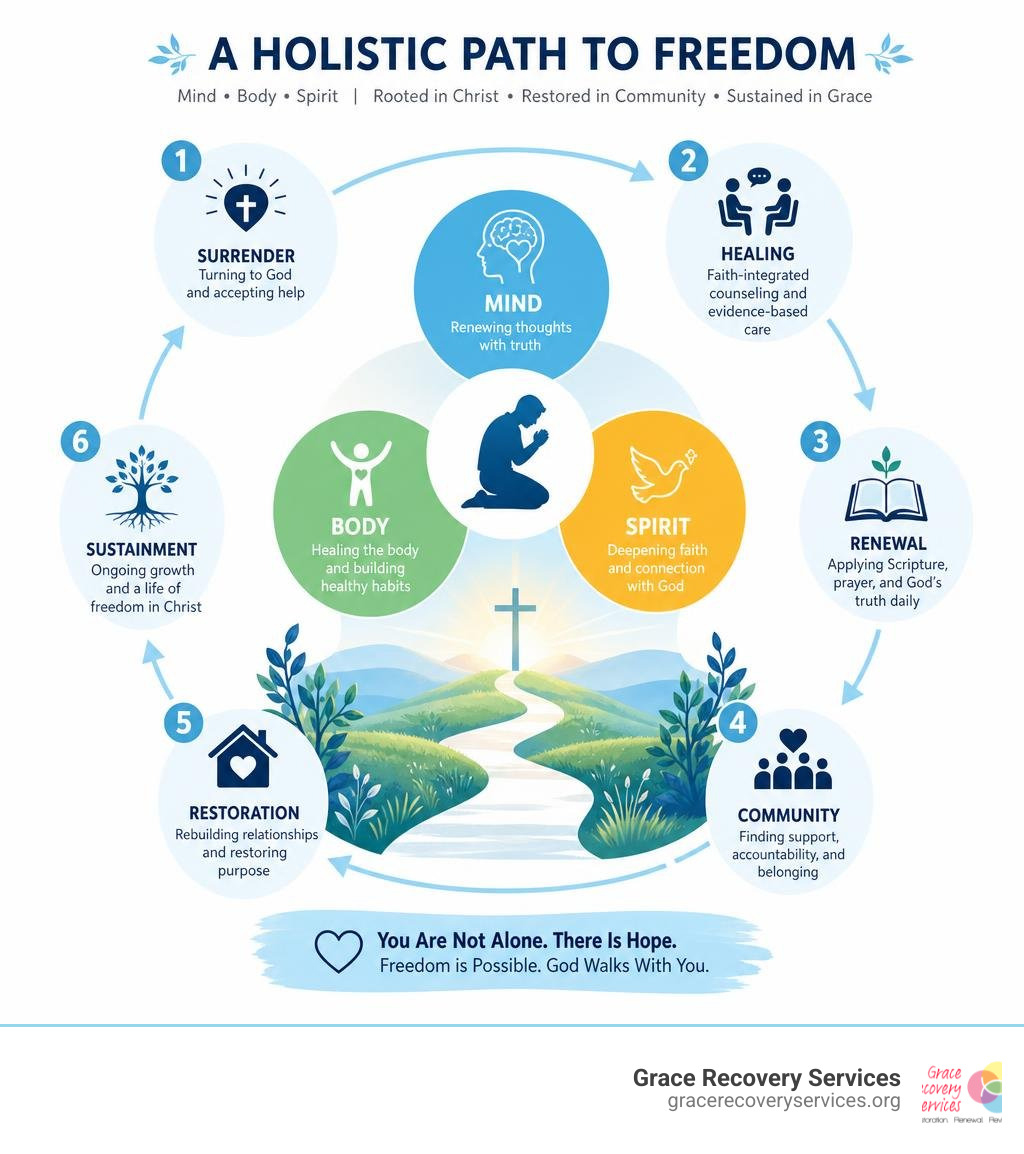
Christian help for addiction brings something unique to recovery. It doesn’t just ask what you’re struggling with. It asks why — and it looks at the whole person: mind, body, and spirit. At Grace Recovery Services in Western Pennsylvania, that is exactly the kind of healing we walk alongside our clients through every day.
This guide will show you what faith-based addiction recovery looks like, how it works, and how to take your next step — whether you’re in Pittsburgh, the surrounding Western PA area, or simply searching for answers right now.
Understanding Addiction Through a biblical Lens
To understand how Christian help for addiction works, we must first look at how the Bible views this struggle. In many traditional circles, addiction has been treated purely as a moral failure or a lack of willpower. However, a deeper, biblically sound approach reveals that addiction is a complex battle involving physical, psychological, and spiritual dimensions.
Scripture teaches that we are whole beings—created with interconnected bodies, minds, and spirits. When we struggle with a substance use disorder, every part of our design is impacted. According to How should a Christian view addiction? | GotQuestions.org, addiction can be understood as a form of spiritual bondage or slavery. It is a state where a substance or behavior begins to take the place of God in our lives, serving as a false comfort or a coping mechanism for deep emotional pain.
This dynamic is closely tied to the biblical concept of idolatry. Idolatry isn’t just bowing down to statues; it is turning to anything other than God to find our ultimate security, worth, comfort, or escape. When someone experiences trauma, childhood wounds, or broken relationships, they may turn to substances to numb the ache. Over time, this coping mechanism becomes a taskmaster, trapping the individual in a cycle of physical dependency and spiritual isolation.
Through spiritual warfare, the enemy uses shame, guilt, and isolation to keep us locked in darkness. But God’s Word offers a completely different narrative—one of light, hope, and absolute freedom. By meditating on The Best Bible Verses for Recovering Addicts and Alcoholics, we discover that God does not abandon us in our brokenness. Instead, He promises to be close to the brokenhearted and to provide the strength we need to overcome.
The Relationship Between Sin, Grace, and Addiction
How do we balance the concepts of sin and sickness in recovery? From a biblical counseling perspective, the behaviors associated with addiction—such as lying, isolation, and self-destruction—can be sinful, but the addiction itself is a complex physical and spiritual captivity.
True healing begins when we step out of the shadow of shame and into the light of grace. In a Christian outpatient environment, we emphasize:
- Repentance without Shame: Repentance is not about beating ourselves up; it is a beautiful, grace-filled turning toward the Father. It is admitting that our self-reliance has failed and that we need help.
- Forgiveness: Receiving God’s forgiveness allows us to forgive ourselves and begin repairing the relational wounds caused by our struggle.
- Identity in Christ: We are not defined by our addiction. We are defined by who God says we are: chosen, redeemed, and deeply loved.
- Spiritual Transformation: Real change comes from the inside out. As we surrender our struggles to God, the Holy Spirit begins a work of progressive sanctification, renewing our minds and healing our bodies.
By understanding these Higher Power Higher Purpose: biblical Principles for Addiction, clients learn to view their recovery not as a punishment, but as an invitation to a deeper, more vibrant relationship with Jesus Christ.
Key Components of a Christian Help for Addiction Program
A truly effective faith-based recovery program does not force a choice between spiritual devotion and clinical excellence. Instead, it seamlessly integrates the two. At Grace Recovery Services, we believe that God frequently uses professional clinical therapy, evidence-based practices, and medical science as instruments of His healing grace.
For those seeking help in Western Pennsylvania, our outpatient care model allows clients to receive high-quality treatment while remaining active in their families, careers, and local church communities.

Unique elements of faith-integrated outpatient care include:
- Professional Christian Counseling: Therapy led by licensed professionals who share your faith and understand how to weave biblical truth with psychological clinical methods.
- Trauma-Informed Care: Recognizing that trauma and emotional pain are often at the root of substance use, we address these wounds with extreme gentleness and clinical expertise.
- Spiritual Guidance: Access to prayer, biblical meditation, and spiritual mentorship to help rebuild your relationship with God.
- Clinical Therapy: Utilizing evidence-based modalities like Cognitive Behavioral Therapy (CBT) and Dialectical Behavior Therapy (DBT) to build healthy coping mechanisms.
By choosing a program that values both clinical and spiritual integrity, such as Christian Integrated Addiction Treatment, you receive a holistic plan tailored to your unique journey.
Integrating the 12-Step Model with Christian Help for Addiction
The 12-step model has transformed millions of lives worldwide. While many secular programs refer to a “higher power of your understanding,” the Christian model explicitly recognizes Jesus Christ as the one true Higher Power.
Christ-centered 12-step frameworks, such as Celebrate Recovery, align perfectly with biblical principles. Each step is rooted in the teachings of Scripture—from admitting our powerlessness (Step 1) to surrendering our lives to Christ (Step 3) and conducting a fearless moral inventory (Step 4).
This integration provides a powerful structure for daily accountability and spiritual growth. It reminds us that we cannot heal ourselves; we must rely on God’s strength and the support of a loving community. To explore this deeper, read about How Faith Helps with Addiction.
Comparing Secular and Christian Help for Addiction
While secular outpatient recovery models offer valuable clinical tools, they often miss the spiritual core that drives lasting transformation. Below is a comparison highlighting how a faith-based approach builds upon and deepens traditional recovery methods:
| Feature | Secular Outpatient Recovery | Christian Outpatient Recovery (Grace Recovery) |
|---|---|---|
| Primary Focus | Behavior modification and psychological coping skills. | Holistic healing of mind, body, spirit, and soul. |
| Source of Strength | Self-reliance, willpower, and peer support. | Complete reliance on Jesus Christ and the Holy Spirit. |
| View of Identity | Often identifies as a “recovering addict” long-term. | Identity is rooted in Christ as a new creation (2 Cor. 5:17). |
| Root Cause Resolution | Addresses psychological triggers and trauma. | Addresses psychological trauma, shame, and spiritual emptiness. |
| Community Base | General peer support groups. | Faith-based fellowship, local churches, and Christian mentorship. |
Practical Steps to Healing: The Counseling Blueprint
At Grace Recovery Services, we walk clients through a structured, highly compassionate therapeutic journey known as our Counseling Blueprint. This four-stage model ensures that we don’t just treat the surface-level symptoms of substance use, but instead facilitate deep, lasting emotional and spiritual healing.

This blueprint forms the foundation of our Christian Rehab Pittsburgh programs, ensuring every client feels seen, valued, and safe.
Stage 1 and 2: Take Off the Mask and Heal the Wounds
The first step in any genuine recovery journey is honesty. In Stage 1: Take Off the Mask, we focus on building a deep, non-judgmental rapport. Many individuals struggling with addiction carry a heavy burden of shame, pretending everything is fine while suffering in silence. We provide a safe space where you can drop the act, be completely honest about your struggles, and build trust with your clinical team.
Once the mask is off, we transition to Stage 2: Heal the Wounds. Addiction is rarely just about the chemical substance; it is almost always an attempt to self-medicate deep emotional or relational pain. In this stage, we utilize trauma-informed clinical care to explore past hurts, childhood wounds, and broken relationships. By bringing these painful memories into the light of Christ’s love, true emotional healing can begin. This deep work is a core component of our Christian Intensive Outpatient Treatment program.
Stage 3 and 4: Remove the Toxins and Replace with Truth
Healing requires clearing out the negative spiritual and psychological patterns that keep us stuck. In Stage 3: Remove the Toxins, we help clients identify the unhelpful beliefs, lingering lies, and toxic thought patterns that fuel their addiction. These “toxins” often sound like: “I am unlovable,” “I will always be a failure,” or “God has abandoned me.”
Finally, in Stage 4: Replace with Truth, we install empowering, accurate perspectives about yourself, others, and the world. We replace the lies of the enemy with the absolute truth of Scripture and clinical wisdom. You learn to see yourself through God’s eyes—as a person of immense worth, purpose, and capability. This restorative process is highly emphasized in our Faith-Based Outpatient Addiction Treatment options, providing you with a solid foundation for long-term sobriety.
How Families and Churches Can Support the Recovery Journey
Recovery does not happen in a vacuum. For an individual to thrive in long-term sobriety, they need a supportive ecosystem. Families and local churches play an indispensable role in providing the grace, accountability, and community necessary for lasting change.
For families, supporting a loved one through addiction requires a delicate balance of compassion and firm boundaries. It is easy to fall into the trap of codependency or enabling, but true Christian love means setting healthy boundaries that encourage the individual to seek professional help.
Churches can support this journey by shifting from a culture of judgment to one of restoration. When a local church openly discusses mental health and addiction, it reduces stigma and makes it safe for struggling individuals to step forward.
To help local families and churches build these supportive networks, we highly recommend utilizing local resources, professional counseling networks like Christian Counseling Associates, and structured aftercare plans. You can learn more about building this circle of support through our guide on Christian Aftercare Programs in Pittsburgh: How Faith-Based Options Can Help You to Heal.
Frequently Asked Questions About Faith-Based Recovery
What is the difference between Christian outpatient programs and secular ones?
Christian outpatient programs integrate biblical truth, prayer, and spiritual transformation with evidence-based clinical therapies. While secular programs focus primarily on behavioral coping strategies and self-reliance, Christian programs emphasize complete reliance on Jesus Christ, healing spiritual emptiness, and discovering your identity in Him. Our Faith-Based Rehab Pittsburgh services provide this complete, holistic care model.
How can a local church support someone in recovery without causing shame?
Churches can support recovery by educating their congregations, preaching messages of grace, and establishing support groups like Celebrate Recovery. By treating addiction as a complex physical and spiritual struggle rather than a simple moral failing, churches create a safe, non-judgmental environment. To learn more about how we partner with local ministries, check out our resources on Christian Addiction Recovery Pittsburgh.
What Christian books and resources are recommended for families?
We highly recommend classic spiritual works that deepen your understanding of grace and identity, such as Mere Christianity by C.S. Lewis, More Than a Carpenter by Josh McDowell, and Addictions: A Banquet in the Grave by Edward T. Welch. Additionally, participate in local Celebrate Recovery groups and utilize the free family guides provided by faith-based counseling organizations.
Conclusion
If you or a loved one is struggling, please know that your story is not over. The shame, isolation, and pain of addiction do not have the final say. Through the power of God’s grace, professional clinical support, and a compassionate community, true restoration is entirely possible.
At Grace Recovery Services, we are dedicated to providing the highest quality of trauma-informed, outpatient Christian help for addiction in Western Pennsylvania. With convenient offices in Pittsburgh (Penn Hills area) and North Huntingdon (serving Westmoreland County and Irwin, PA), our professional team is ready to walk with you every single step of the way.
Do not wait another day to step into the freedom Christ has for you. Begin your healing journey today and let us help you rewrite your future.
This article was researched with AI and heavily edited by Stephen Luther for accuracy and relevance.
Stephen Luther is the Executive Director and Founder of Grace Christian Counseling, Grace Recovery Services, WPA Counseling, NuWell Online Counseling and Coaching, and NuWell Health. He holds a Master’s degree in Education from the University of Georgia and a Master’s degree in Marriage and Family Therapy from Duquesne University. He is a licensed professional counselor in Pennsylvania.
Since 1997, Steve has been helping children, adolescents, and adults overcome a wide range of emotional and relational challenges. He specializes in working with hurting families, including those with foster, adopted, or traumatized children. Steve uses Attachment-Based Therapy, Splankna Healing, and Therapeutic Parent Coaching to support healing and restoration.
This guide is for educational and spiritual encouragement and is not a substitute for personalized professional counseling. If you are in crisis, please reach out for immediate help.
This article was researched with AI and heavily edited by Stephen Luther for accuracy and relevance.
Stephen Luther is the Executive Director and Founder of Grace Christian Counseling, Grace Recovery Services, WPA Counseling, NuWell Online Counseling and Coaching, and NuWell Health. He holds a Master’s degree in Education from the University of Georgia and a Master’s degree in Marriage and Family Therapy from Duquesne University. He is a licensed professional counselor in Pennsylvania.
Since 1997, Steve has been helping children, adolescents, and adults overcome a wide range of emotional and relational challenges. He specializes in working with hurting families, including those with foster, adopted, or traumatized children. Steve uses Attachment-Based Therapy, Splankna Healing, and Therapeutic Parent Coaching to support healing and restoration.
This guide is for educational and spiritual encouragement and is not a substitute for personalized professional counseling. If you are in crisis, please reach out for immediate help.