
The signs of cocaine use are not always obvious, and no single behavior proves that a person is using cocaine. Families may notice a pattern of unusual energy, little sleep, irritability, anxiety, secrecy, money problems, or physical changes such as enlarged pupils, sweating, eating less, or frequent nose irritation. Some changes have other medical or mental health causes. Focus on repeated patterns, immediate safety, and a respectful conversation. A professional assessment can clarify what kind of help fits.
Cocaine warning signs at a glance
- Look for a cluster of changes rather than one isolated sign.
- Physical effects can include enlarged pupils, sweating, tremors, a fast heart rate, and nose problems in people who snort it.[1][2]
- Behavioral changes can include unusual energy, rapid speech, agitation, anxiety, suspiciousness, secrecy, and a sharp change in sleep.
- Repeated borrowing, unexplained spending, missing money, or neglected bills may add to concern, but none of these proves cocaine use.
- Call 911 for a possible overdose, seizure, trouble breathing, loss of awareness, severe overheating, chest pain, or another medical emergency.
- When there is no immediate danger, speak privately while the person is sober and offer help arranging an assessment.
Signs of cocaine use often appear as a pattern
Cocaine is a stimulant. Its effects can begin quickly and often fade within a few minutes to an hour, depending on how a person uses it.[2] A person may seem unusually alert, energetic, confident, or talkative and later appear exhausted, withdrawn, or low. That contrast can stand out to people who know the person’s usual rhythm.
However, the same observation can have many explanations. Anxiety, sleep loss, a medical condition, prescription medication, another substance, or a stressful event can change someone’s appearance and behavior. A list of warning signs cannot diagnose cocaine use or cocaine use disorder. Instead, it can help you decide whether to ask a direct question, seek medical care, or request a professional assessment.
Physical cocaine warning signs
Possible physical signs include:
- Enlarged pupils or unusual sensitivity to light
- Sweating, feeling overheated, or flushed skin
- Restlessness, shaking, or small tremors
- A fast heartbeat, lightheadedness, nausea, or vomiting[1]
- Eating less than usual, or weight loss over time
- Trouble sleeping followed by pronounced fatigue
- Frequent sniffing, nosebleeds, loss of smell, or nasal irritation in people who snort cocaine
- Cough, breathing problems, or other lung symptoms in people who smoke cocaine[2]
Some physical effects require emergency care, especially when they are intense or appear suddenly. Do not wait for certainty if the person has a seizure, cannot breathe normally, loses awareness, has chest pain, becomes dangerously hot, or seems severely confused.
Behavioral signs of cocaine use
Cocaine can affect mood, judgment, and behavior. Family members may notice periods of:
- Unusually high energy or rapid, rambling speech
- Irritability, agitation, anxiety, or panic
- Suspiciousness, paranoia, or unusual distrust
- Impulsive decisions or risk-taking that is out of character
- Leaving suddenly, returning at odd hours, or taking unexplained breaks
- Greater secrecy about plans, contacts, phone use, or whereabouts
- Declining follow-through at work, school, home, or in relationships
- Pulling away after an intense period of activity
These changes deserve attention when they repeat, become more intense, or occur alongside physical or financial signs. Still, they are observations, not a diagnosis. Describe what you have seen without attaching a label to the person.
Money and household patterns
Cocaine use can involve frequent spending because its effects may fade quickly. A family may see repeated requests for money, unexplained cash withdrawals, overdue bills, sold belongings, or valuable items that have gone missing. Work attendance or performance may also change.
Money problems have many causes, and searching for proof can turn a worried conversation into a confrontation. Keep a clear record of facts that affect you, such as an unpaid shared bill or money missing from a joint account. Protect your own finances and safety. Then speak about the concrete pattern you have observed.
Route-specific clues have limits
The way a person uses cocaine can affect what you see. For example, snorting can cause nosebleeds, loss of smell, nasal damage, or trouble swallowing. Smoking can cause cough and lung problems. Injection can leave puncture marks and raises the risk of infections such as HIV and hepatitis C.[2] These clues are not a reliable way to identify a substance, and their absence does not rule out use.
Because the signs of cocaine use vary by route, amount, frequency, other substances, and health, avoid trying to reconstruct exactly what happened from appearance alone. If a person will share what they used and how they used it, pass that information to emergency responders or the assessing clinician. Accurate information can guide medical decisions; it is not a reason to delay calling for help.
What cocaine warning signs do and do not prove
The signs of cocaine use can overlap with other stimulant use, medication effects, mania, anxiety, trauma responses, sleep deprivation, thyroid problems, and other health concerns. Even a drug test has limits, and a qualified professional should interpret it in the right context.
Avoid diagnosing, threatening, or demanding a confession. Those responses often increase shame and defensiveness. You can be direct without claiming to know more than you do:
- “I have noticed that you have barely slept, you seem very anxious, and money has gone missing twice this month. I am worried about your health. Can we talk about what has been happening?”
That statement names observable facts, expresses concern, and leaves room for an honest answer. If the person denies using cocaine, you can still address the behavior that affects safety, shared finances, children, housing, or work.
For a broader view of substance-related changes, read GRS’s guide to warning signs across different substances.
When cocaine warning signs mean an emergency
Cocaine can cause a life-threatening reaction. It can affect heart rhythm, blood pressure, body temperature, breathing, and the brain.[1] In addition, illegal drugs, including cocaine, may contain fentanyl or other substances the person does not know about, which makes the reaction less predictable.[3]
Call 911 or go to the nearest emergency department now for a possible overdose, seizure, chest pain, trouble breathing, blue or gray lips or skin, loss of awareness, a very fast or irregular heartbeat, severe agitation or confusion, signs of stroke, or dangerously high body temperature. If a person is unresponsive or not breathing normally and naloxone is available, give it according to its instructions while emergency help is on the way. Naloxone will not reverse cocaine effects, but it can help if an opioid such as fentanyl is also involved.
Do not leave the person alone. Do not try to make the person “sleep it off,” drive them yourself when an ambulance is needed, or assume a symptom will pass because the cocaine effects have seemed brief before.
- For an immediate medical emergency, possible overdose, or immediate danger, call 911.
- For suicide-related or emotional crisis support in the United States, call or text 988.[5]
- For treatment information and referral, call SAMHSA’s National Helpline at 1-800-662-HELP (4357).[6]
- Grace Recovery Services contact channels are not crisis services and are not monitored around the clock.
A four-part response to possible cocaine use
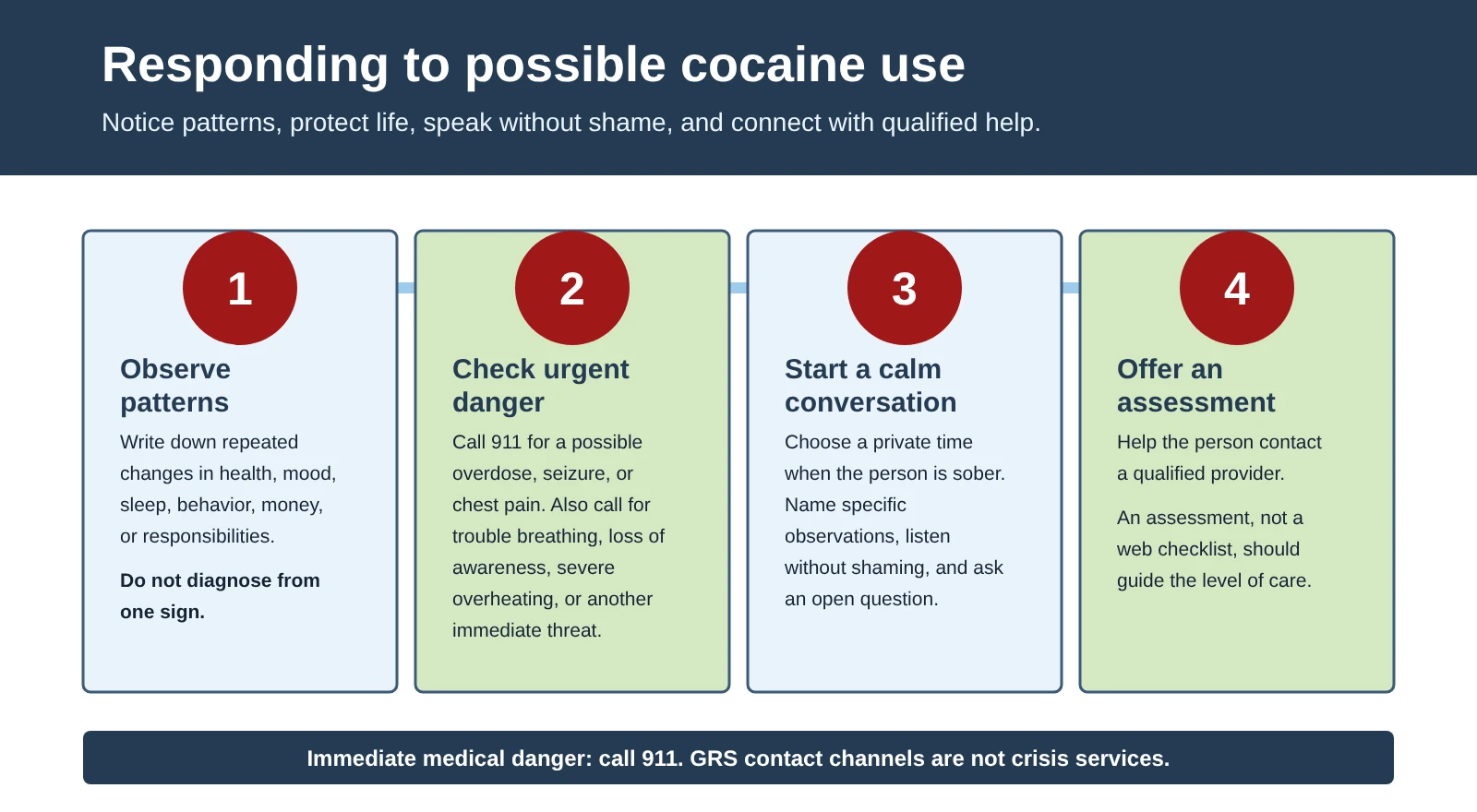
- 1Observe patterns. Write down repeated changes in health, mood, sleep, behavior, money, or responsibilities. Do not diagnose from one sign.
- 2Check urgent danger. Call 911 for a possible overdose, seizure, chest pain, trouble breathing, loss of awareness, severe overheating, or another immediate threat.
- 3Start a calm conversation. Choose a private time when the person is sober. Name specific observations, listen without shaming, and ask an open question.
- 4Offer an assessment. Help the person contact a qualified provider. An assessment, not a web checklist, should guide the level of care.
How to talk with a loved one about cocaine
Choose a private time when neither of you is rushed and the person does not appear intoxicated. If you are concerned about violence or your own safety, do not confront the person alone. Make a safety plan and seek professional guidance.
Start with two or three concrete observations. Avoid a long inventory of every past mistake. SAMHSA encourages families to listen without judgment, speak with kindness, and remember that it may take many conversations before someone gets help.[4] Open questions also give the person room to answer honestly.
You might say:
- “I care about you, and I have noticed that you have not slept much and seem frightened and on edge. What has the last week been like for you?”
- “We have missed two rent payments, and I am worried about the cash withdrawals. Can we look at what is happening?”
- “I am not asking you to settle everything tonight. Would you talk with a treatment professional about what you have been experiencing?”
Listen to the answer. Reflect back what you heard before offering a solution. If the person is willing, help make a call, arrange transportation, or sit nearby while they complete a contact form. GRS’s article on helping a loved one with addiction gives more guidance on boundaries, support, and family safety.
Compassion does not require you to cover up dangerous behavior, provide money, lie to an employer, or allow substance use in your home. A boundary should state what you will do: “I will not give cash, but I will help you call a treatment provider.” If children, driving, weapons, threats, or violence are involved, make immediate safety the priority.
When a professional assessment can help
An assessment is appropriate when you suspect cocaine use and the pattern is affecting health, sleep, money, relationships, work, school, or safety. It is also reasonable to seek an assessment after a single frightening event. You do not need to wait for an arrest, job loss, or overdose.
Bring the signs of cocaine use that you have actually observed, along with dates when possible. Separate facts from assumptions. A short, accurate account is more useful than a label and gives the clinician room to ask about other explanations.
A qualified provider may ask about cocaine and other substance use, recent intoxication, withdrawal, medical conditions, medications, mental health symptoms, prior treatment, living situation, and available support. The answers help determine whether outpatient care, intensive outpatient care, residential treatment, hospital care, withdrawal management, or another service fits best.
If stopping substance use raises withdrawal or medical concerns, read the GRS overview of when a higher level of support may be needed. Cocaine withdrawal is usually different from alcohol or benzodiazepine withdrawal, but severe depression, suicidal thoughts, or other urgent mental health symptoms still require immediate help.
What treatment can address
Treatment for stimulant use problems may address triggers, cravings, thoughts and behaviors connected to use, sleep, relationships, daily structure, and a plan for continued support. When anxiety, depression, or trauma symptoms are also present, care for addiction and mental health together can address both. No article can predict which approach will help a specific person, and no ethical program should promise an outcome.
Grace Christian Counseling is a separate organization. If you are interested in counseling there, ask about it directly rather than assuming the two services coordinate care.
Frequently asked questions
Can you tell if someone uses cocaine by looking at them?
No. Enlarged pupils, sweating, appetite changes, agitation, little sleep, nose problems, and rapid speech can occur with cocaine use, but they can also have other causes. Look for repeated patterns, describe what you observe, and seek a professional assessment instead of trying to diagnose the person.
How long do cocaine effects last?
The timing varies by the amount, route of use, other substances, and the person’s health. MedlinePlus notes that effects may last from minutes to about an hour, while sleep, mood, and health changes can last longer. Do not use a timing estimate to decide that someone is safe after possible intoxication.
When should I call 911 for possible cocaine use?
Call 911 for a possible overdose, seizure, chest pain, trouble breathing, blue or gray lips or skin, loss of awareness, severe overheating, signs of stroke, a very fast or irregular heartbeat, or another immediate threat. Do not wait for proof of what substance was used.
Can outpatient treatment help with cocaine use?
It may help some people, but outpatient care does not fit everyone. A professional assessment should consider current use, medical and mental health needs, safety, other substances, living situation, and support. GRS offers outpatient and intensive outpatient care, not detox, partial hospitalization, residential treatment, medication management, or emergency services.
Sources
- 1Cocaine intoxication. MedlinePlus, U.S. National Library of Medicine. Reviewed January 8, 2025.
- 2Cocaine. MedlinePlus, U.S. National Library of Medicine.
- 3Polysubstance Use Facts. Centers for Disease Control and Prevention. Reviewed April 2, 2024.
- 4How to Talk to Someone About Help. Substance Abuse and Mental Health Services Administration.
- 5Get Help. 988 Suicide & Crisis Lifeline.
- 6National Helpline for Mental Health, Drug, Alcohol Issues. Substance Abuse and Mental Health Services Administration.