
The Spiritual and Psychological Science of Overcoming Addiction through Faith
To understand why overcoming addiction through faith is so deeply transformative, we have to look at both the brain and the spirit. Science shows us that substance use disorders hijack the brain’s natural reward systems. When a person uses drugs, alcohol, or engages in compulsive behaviors, their brain is flooded with dopamine—the neurotransmitter responsible for pleasure, motivation, and learning. Over time, the brain becomes desensitized, demanding more of the substance just to feel normal. This creates an intense physical and psychological cycle that willpower alone cannot break.
Yet, spiritual transformation acts as a powerful cognitive and neurological disruptor. A groundbreaking one-year longitudinal study on Surrender to God assessed during addiction treatment shed light on the exact mechanics of this healing. The study distinguished between two levels of faith:
- Explicit Surrender: This is the conscious, verbalized commitment to God. While incredibly helpful in early recovery—predicting lower relapse rates for the first critical month—it is often a deliberate coping strategy.
- Implicit Surrender: This is an automatic, subconscious faith deeply integrated into a person’s core identity. The study found that implicit surrender to God predicted a nearly three times lower risk of relapse over a full year.
This deep-seated reliance on a higher power fosters what psychologists call “humble detachment.” Instead of desperately fighting cravings with limited human willpower, a person learns to hand the heavy emotional burden over to God. This shifts the internal locus of control, quiets the mind, and stops intrusive thoughts before they escalate into physical relapse.
By understanding how faith helps with addiction, we can see that spiritual practices do not simply mask symptoms; they build genuine psychological resilience.
How Different Traditions View Overcoming Addiction through Faith
While theological frameworks differ, various religious and spiritual traditions share a profound understanding of recovery. They all recognize that addiction is more than a physical ailment—it is a condition that requires the healing of the soul.
- Christian Grace: In the Christian tradition, recovery is centered on the unmerited grace of God and the redemptive power of Jesus Christ. Rather than focusing on self-condemnation, Christianity teaches that we are made new. Through confession, prayer, and community, clients are encouraged to lay down their shame and receive unconditional love.
- Islamic Purification (Tazkiyat al-Nafs): Islamic psychology, drawing from classical scholars like Ibn al-Qayyim, views addiction as an imbalance of natural desires (hawā) that have overstepped healthy boundaries. Healing is achieved through tazkiyat al-nafs (purification of the soul), utilizing spiritual disciplines like fasting and prayer to strengthen the intellect and restore spiritual order.
- Latter-day Saint Atonement: This perspective emphasizes the healing and enabling power of the Atonement of Jesus Christ. It views those struggling with addiction not as weak-willed, but as courageous warriors engaged in a difficult battle, relying on divine grace to gradually restore their spiritual strength.
| Spiritual Tradition | Core Concept of Addiction | Pathway to Recovery | Role of Divine Intervention |
|---|---|---|---|
| Christianity | Separation from God; brokenness and sin | Grace, spiritual surrender, and biblical discipleship | Direct restoration of identity and healing of wounds |
| Islam | Unregulated desires (hawā) overtaking the spirit | Purification of the self (tazkiyat al-nafs) and fasting | Spiritual discipline and alignment with divine law |
| Latter-day Saint | Physical and spiritual bondage | Gradual healing through the Atonement and support | Enabling power to change desires and rebuild strength |
Understanding what the Bible says about substance abuse helps us ground our recovery programs in timeless principles of hope, redemption, and unconditional love.
Understanding the Impact of Addiction on Heart, Mind, and Spirit
Addiction is fundamentally isolating. It creates a painful chasm between the individual, their loved ones, and God. When someone is caught in the cycle of substance use, they often experience deep emotional pain, unresolved trauma, and a profound sense of spiritual emptiness.
To cope with this pain, many turn to substances, which act as a temporary escape. In his classic devotional work, we see how Christ is described as the bridge between human brokenness and divine reconciliation, helping us climb out of the deepest pits of despair. You can read more about this spiritual foundation in Christ.
When a person feels trapped, the psychological cycle of addiction is reinforced by shame:
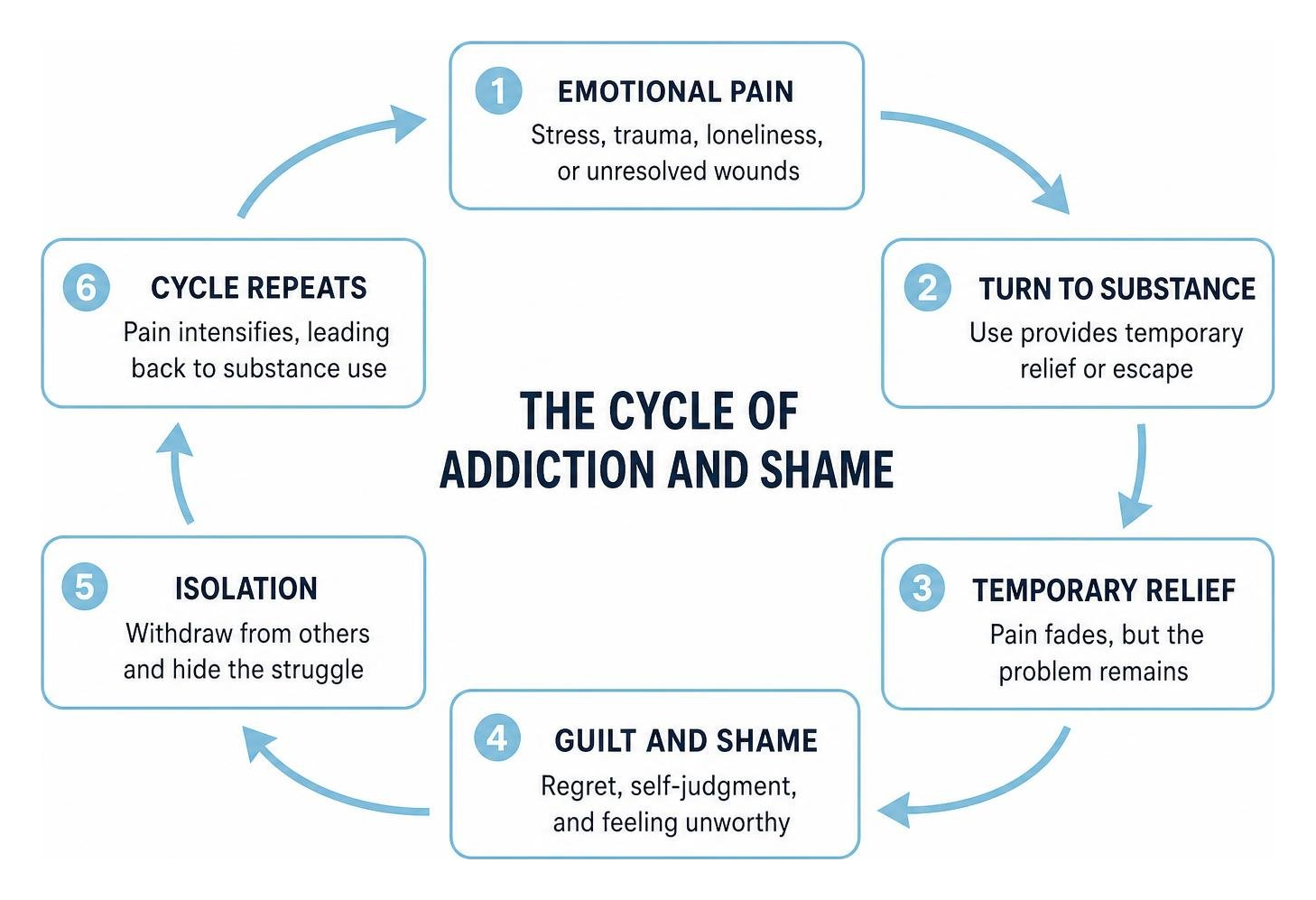
This cycle is particularly dangerous during times of high stress. For instance, in a typical year, alcohol consumption doubles during the holiday season, and alcohol-related deaths have been steadily rising for twenty years. When individuals feel they cannot live up to spiritual or social expectations, they isolate themselves further, believing they are beyond saving.
At Grace Recovery Services, we combat this isolation by offering a warm, non-judgmental community where clients can explore a biblical approach to recovery beginners guide to rebuild their lives from the inside out.
Overcoming Addiction through Faith by Healing Trauma and Relational Wounds
We cannot talk about sustained recovery without addressing the wounds that started the cycle. For many, substance use is an attempt to self-medicate the pain of childhood trauma, neglect, or broken relationships. If we only treat the physical symptoms of withdrawal without healing these underlying emotional wounds, the risk of relapse remains high.
This is where the concept of post-traumatic growth (PTG) becomes vital. Post-traumatic growth is the positive psychological change that can occur after struggling through highly challenging life circumstances. In a faith-based context, PTG does not simply return a person to who they were before the trauma; it deepens their spiritual understanding, reshapes their identity, and helps them build a stronger, more resilient faith.
As Swiss psychiatrist Carl Jung famously observed, individuals who cultivate a genuine spiritual connection tend to experience more sustainable and lasting recoveries. This is because faith fills the internal “hole” that drugs or alcohol previously tried to fill.
A beautiful example of this is documented in The Epoch Times’ story of a drug addict’s faith-inspired recovery, which highlights how moving away from toxic environments and surrendering to God can transform a life from utter hopelessness into a beacon of light for others.
For those searching for a deeper spiritual connection, exploring the soul searchers guide to faith-based recovery can provide the comfort and direction needed to take the first steps toward healing.
A Step-by-Step biblical Framework for Recovery
Active recovery requires practical, daily steps grounded in faith and accountability. A biblical framework for overcoming addiction involves several key elements:
- Admit Powerlessness: True victory begins with surrender. Acknowledging that we cannot conquer addiction through our own limited willpower opens the door for divine grace to work within us.
- Establish Accountability: Healing does not happen in isolation. Having a trusted Christian mentor, counselor, or peer who will speak truth into your life and hold you accountable is essential.
- Avoid Environmental Triggers: Scripture encourages us to flee temptation. This means changing our “people, places, and things” to protect our newly found sobriety.
- Serve Others: Shifting our focus outward is incredibly therapeutic. When our hands are busy serving others, they cannot be turned inward toward self-focus and cravings.
We see this transformative process in action through testimonies like the one featured in Guideposts, where turning to God helped her kick her gambling and drug addictions. By replacing destructive habits with prayer, Bible study, and community service, she was able to find a lasting “sure bet” in her faith.
To learn more about how to apply these steps to your daily life, read our essential guide to biblical recovery steps and discover how to align your recovery with a higher power and higher purpose through biblical principles for addiction.

Integrating Professional Counseling with Spiritual Support
While faith is our foundation, we also recognize that God works through professional clinical practices. A holistic approach to recovery integrates evidence-based outpatient therapies, such as our Intensive Outpatient Programs (IOP), with spiritual discipleship.
At Grace Recovery Services, we utilize a unique, trauma-informed clinical model called the Counseling Blueprint. This four-stage journey is designed to guide clients from brokenness to lasting restoration:
- Take Off the Mask: We focus on building genuine rapport, safety, and trust, allowing clients to drop their defenses and be completely honest about their struggles.
- Heal the Wounds: We explore the deep-seated emotional, relational, and traumatic hurts that drive the need to escape.
- Remove the Toxins: Together, we identify and dismantle unhelpful beliefs, lingering lies, and toxic shame that keep clients stuck in the cycle of addiction.
- Replace with Truth: We install empowering, accurate, and biblically grounded perspectives about self-worth, identity, and the world.
By combining clinical expertise with spiritual care, our faith-based addiction counseling beginners guide offers a comprehensive roadmap for those seeking faith-based recovery in Pittsburgh and the surrounding Western Pennsylvania areas.
How Families Can Support Recovery Without Enabling
When a loved one is struggling with a substance use disorder, the entire family is affected. It is natural for family members to want to help, but well-meaning actions can sometimes cross the line into enabling. Enabling occurs when we shield an individual from the natural consequences of their behavior, which ultimately keeps them trapped in their addiction.
To support a loved one effectively, families must establish healthy boundaries:
- Differentiate between helping and enabling: Helping is doing something for a person that they are genuinely unable to do for themselves. Enabling is doing things for them that they should and can do for themselves (such as paying their debts, bailing them out of legal trouble, or lying to cover for them).
- Address codependency: Family members often become codependent, meaning their own emotional well-being becomes entirely tied to the addict’s behavior. Seeking family counseling is crucial to break this unhealthy cycle.
- Rebuild family trust gradually: Trust is broken quickly but rebuilt slowly. Families must allow the person in recovery the time and space to prove their commitment through consistent, long-term actions.
If you are looking for local support and guidance, we encourage you to read about finding grace and guidance in top faith-based rehabs in Irwin and beyond and explore how families can walk together toward faith-forward freedom from opioids and alcohol.
Frequently Asked Questions about Faith-Based Recovery
Why do some individuals fail to seek or accept spiritual healing?
Often, individuals hesitate to seek spiritual healing because of intense shame and a fear of being judged by faith communities. If they have been taught to view God as a harsh, punitive judge waiting to punish their mistakes, they will naturally hide from Him.
At Grace Recovery Services, we work to restore hope by emphasizing God’s true character as a loving, compassionate Father who offers grace over shame. We meet clients exactly where they are, offering a safe space free of condemnation.
What should I do if I experience a relapse during my recovery journey?
First, understand that recovery is rarely a straight line. A setback or relapse does not mean you have failed, nor does it mean your faith is invalid.
If you experience a relapse:
- Embrace grace over shame: Do not let self-loathing keep you isolated.
- Seek immediate accountability: Confess the slip to God and contact your sponsor, counselor, or accountability partner right away.
- Adjust your relapse plan: Analyze what triggered the relapse and make necessary changes to your environment, routine, or coping strategies to prevent it from happening again.
Can faith-based recovery help with behavioral addictions like social media or gambling?
Absolutely. While substance use disorders are highly visible, behavioral addictions can be just as destructive to the heart and spirit. In 2011, a study found that 59% of participants felt “addicted” to social media, and more recent studies indicate that up to 16% of university students meet the criteria for internet addiction.
Whether the struggle is with slot machines, smartphones, or substances, the root cause is often the same: an attempt to fill an internal void. Faith-based recovery provides the holistic healing and spiritual fulfillment needed to quiet these compulsive behaviors and restore balance to your life.
Conclusion
Overcoming addiction through faith is a journey of restoration, renewal, and revival. It is about reclaiming your identity, healing your deepest wounds, and stepping into the purposeful life God designed for you.
At Grace Recovery Services, led by Licensed Professional Counselor and Executive Director Stephen A. Luther, we are dedicated to walking beside you every step of the way. Our outpatient programs in Western Pennsylvania—with convenient offices in the Pittsburgh (Penn Hills area) and North Huntingdon—combine compassionate, trauma-informed clinical therapy with a solid, faith-based foundation.
You do not have to carry this burden alone. If you or a loved one is ready to take the first step toward lasting healing, we invite you to reach out to us today. Let us help you experience the life-changing power of true surrender and grace.
To learn more or to schedule a personalized assessment, visit our page on how faith helps with addiction and begin your journey to wholeness today.
This article was researched with AI and heavily edited by Stephen Luther for accuracy and relevance.
Stephen Luther is the Executive Director and Founder of Grace Christian Counseling, Grace Recovery Services, WPA Counseling, NuWell Online Counseling and Coaching, and NuWell Health. He holds a Master’s degree in Education from the University of Georgia and a Master’s degree in Marriage and Family Therapy from Duquesne University. He is a licensed professional counselor in Pennsylvania.
Since 1997, Steve has been helping children, adolescents, and adults overcome a wide range of emotional and relational challenges. He specializes in working with hurting families, including those with foster, adopted, or traumatized children. Steve uses Attachment-Based Therapy, Splankna Healing, and Therapeutic Parent Coaching to support healing and restoration.
This guide is for educational and spiritual encouragement and is not a substitute for personalized professional counseling. If you are in crisis, please reach out for immediate help.