Finding the Right Pittsburgh IOP: A Quick Guide for Western PA Families
If you or someone you love is searching for a Pittsburgh IOP, here are some of the primary types of intensive outpatient programs available in Western Pennsylvania:
- Faith-Based and Christian IOP – Grace Recovery Services (Penn Hills & North Huntingdon)
- Adult Mental Health IOP – Clinical hospital-affiliated programs
- Adult Substance Abuse IOP – Specialized addiction recovery centers
- Adolescent IOP – Programs tailored for teens (ages 13-18)
- College Student IOP – University-affiliated support tracks
- Evening/Flexible IOP – Programs designed for working professionals
Getting the right level of care is one of the most important decisions a person in recovery can make. Not too much. Not too little. Just the right amount of structure to heal — while still keeping your job, your family, and your daily life intact.
That’s exactly what an Intensive Outpatient Program (IOP) is designed to do.
In Western Pennsylvania, there are more options than most people realize. Programs range from hospital-affiliated clinical tracks to faith-integrated outpatient care that treats the whole person — mind, body, and spirit. Some are built for working adults. Others are designed specifically for teenagers, college students, or people navigating both mental health challenges and substance use at the same time.
The hard part isn’t finding a program. It’s finding the right one for your specific situation.
This guide walks through five of the best types of IOP programs in the Pittsburgh area — so you or your loved one can take a confident next step toward healing.
What is a Pittsburgh IOP and How Does It Work?
An Intensive Outpatient Program (IOP) is a structured, therapeutic level of care designed to help individuals recover from substance use disorders, mental health conditions, or co-occurring dual diagnoses. An IOP allows you to sleep in your own bed, stay connected with your family, and continue working or attending school in the local community while receiving structured, professional support.
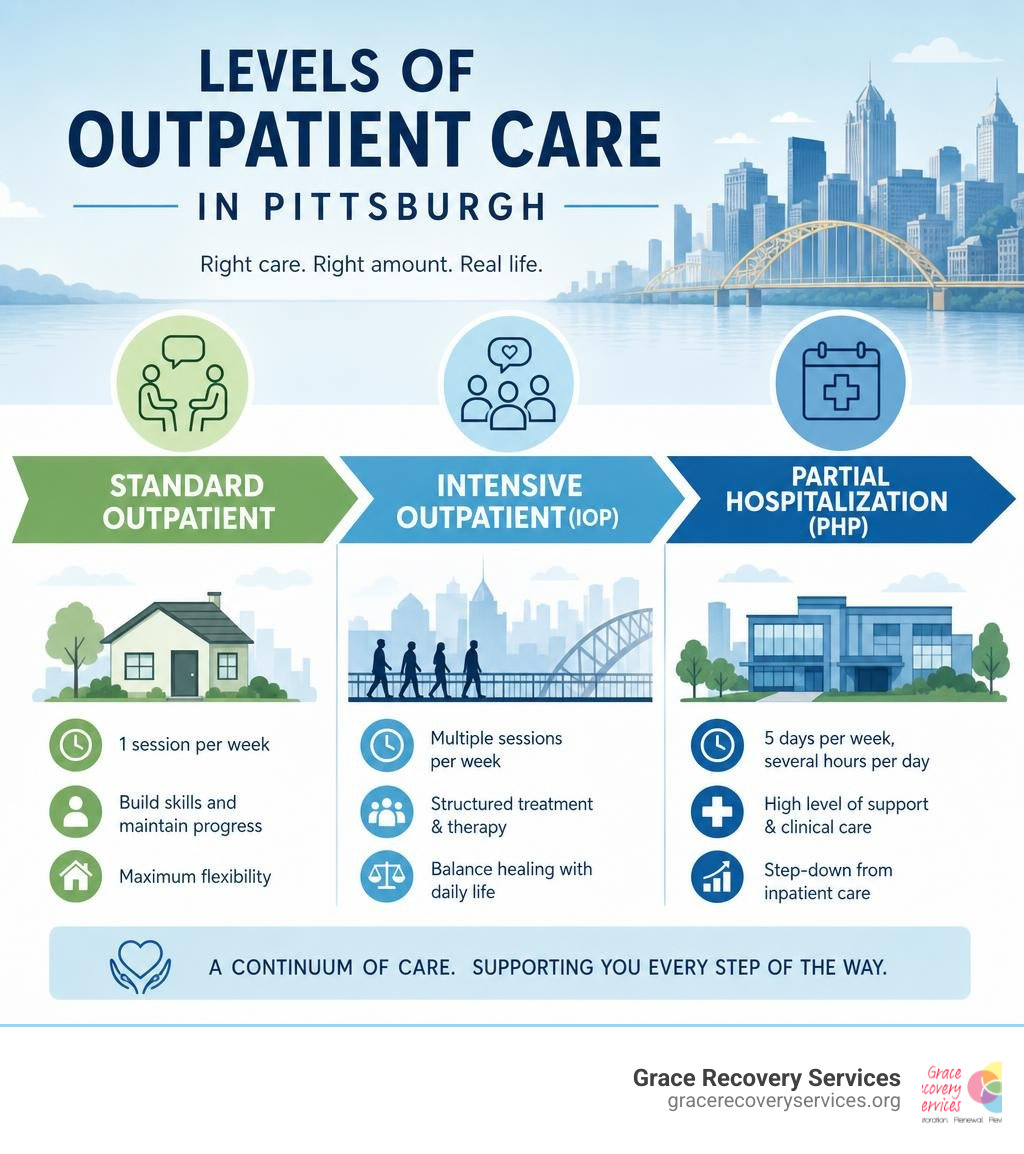
In the continuum of care, a pittsburgh iop serves as a vital middle ground. It is more intensive than standard weekly therapy but offers significantly more flexibility than a Partial Hospitalization Program (PHP).
To help Western PA families understand where they or their loved ones fit in this spectrum, we have broken down the key differences between these outpatient care levels:
| Level of Care | Typical Weekly Schedule | Hours Per Week | Primary Focus | Best For |
|---|---|---|---|---|
| Partial Hospitalization Program (PHP) | 5 days per week | 20 to 30 hours | Intensive clinical stabilization, medical oversight, and daily therapy. | Individuals stepping down from acute care or needing structured daytime support. |
| Intensive Outpatient Program (IOP) | 3 to 5 days per week | 9 to 15 hours | Group therapy, individual counseling, skill-building, and relapse prevention. | Individuals balancing recovery with work, school, or family responsibilities. |
| Standard Outpatient Program (OP) | 1 to 2 days per week | 2 to 5 hours | Maintenance, checking in with a therapist, and ongoing peer support. | Individuals in long-term recovery who have established strong coping skills. |
By utilizing our structured Intensive Outpatient program, clients can practice the coping skills they learn in therapy in real-time within their home environments. This immediate, real-world application is one of the primary reasons IOPs are so effective for long-term sobriety and mental health management.
Finding the Right Balance with a Pittsburgh IOP
We understand that recovery is not a one-size-fits-all process. The beauty of an IOP lies in its ability to balance clinical structure with daily flexibility. Most programs in the Pittsburgh and Westmoreland County areas require a commitment of 9 to 15 treatment hours per week. These hours are typically divided into three-hour sessions spread across three to five days.
For example, a typical schedule might include:
- Morning Sessions: 9:00 AM to 12:00 PM (ideal for parents, night-shift workers, or those with flexible daytime schedules)
- Evening Sessions: 5:30 PM to 8:30 PM (perfect for working professionals or college students)
During these hours, clients participate in a blend of group therapy, individual counseling, and family involvement. Group sessions provide a safe space to share experiences, build accountability, and practice relational skills under the guidance of licensed clinicians. Individual therapy allows for a deeper dive into personal trauma and beliefs, while family sessions help repair trust and communication at home.
If you are looking for a program that integrates these clinical strategies with a spiritual foundation, we also offer specialized Christian Intensive Outpatient Treatment that nurtures the spirit alongside the mind and body.
Who is a Candidate for a Pittsburgh IOP?
Determining the right level of care is a crucial first step. A pittsburgh iop is highly effective, but it is specifically designed for individuals who meet certain clinical and lifestyle criteria.
You or your loved one may be an excellent candidate for an IOP if you:
- Are Transitioning from a Higher Level of Care: Many individuals use an IOP as a “step-down” transition after completing a PHP or other intensive stabilization program, helping them ease back into daily life without losing their clinical safety net.
- Need More Support Than Weekly Therapy Can Provide: If you are attending traditional weekly therapy but find yourself still struggling with cravings, intense anxiety, depression, or emotional instability, an IOP offers the “step-up” support you need.
- Experience Co-Occurring Disorders: Many people struggle with a dual diagnosis — such as a substance use disorder paired with depression, trauma, PTSD, bipolar disorder, or anxiety. An integrated IOP addresses both conditions simultaneously.
- Have a Supportive, Safe Home Environment: Because clients return home each day, it is critical that their living situation is stable, safe, and free from active substance use.
- Are Motivated and Able to Attend Scheduled Sessions: Consistency is key to recovery. Candidates must be willing to commit to their weekly schedule and actively participate in group sessions.
5 Types of the Best IOP Programs in Western Pennsylvania

When exploring options in Allegheny County and Westmoreland County, you will find that different facilities specialize in different clinical methodologies and demographic needs. Finding a program that matches your personal beliefs, lifestyle, and clinical requirements is essential for a successful recovery journey.
Below, we explore the five most common types of high-quality IOP programs available in Western Pennsylvania, highlighting how they serve various needs in our community.
1. Faith-Based and Christian IOP Programs
For many individuals in Western Pennsylvania, faith is the cornerstone of their lives. When facing the storms of addiction or mental health struggles, separating their spiritual beliefs from their clinical treatment can feel like trying to heal with one hand tied behind their back. That is why faith-based and Christian IOP programs are so vital to our local communities in Penn Hills, North Huntingdon, and Irwin, PA.
At Grace Recovery Services, we believe that true restoration, renewal, and revival happen when clinical excellence meets spiritual truth. Our faith-integrated approach does not replace evidence-based therapy; rather, it supercharges it. We combine proven modalities like Cognitive Behavioral Therapy (CBT) and Dialectical Behavior Therapy (DBT) with biblical principles of grace, hope, and redemption.
In our Christian IOP sessions, clients are invited to explore how their relationship with God can serve as a source of strength and identity. Instead of carrying the heavy weight of shame and condemnation, we emphasize God’s unconditional love and the promise of a fresh start. Whether we are discussing emotional regulation, relapse prevention, or relational healing, we ground our conversations in the truth of who God says you are.
Our offices are conveniently located to serve families throughout Western PA, providing a warm, non-judgmental environment where you can take off your mask and heal. If you want to learn more about how this unique approach can support your journey, discover our Penn Hills location and help you build a firm foundation for lasting sobriety.
2. Trauma-Informed Outpatient Care
It is a well-established truth in the clinical community that addiction and mental health challenges rarely exist in a vacuum. More often than not, they are the outward symptoms of deep, unhealed emotional wounds and past trauma. Trauma-informed outpatient care is designed with this reality in mind, shifting the clinical question from “What is wrong with you?” to “What happened to you?”
A trauma-informed IOP prioritizes physical and emotional safety above all else. Clinicians in these programs are specifically trained to recognize the signs of trauma and avoid re-traumatization. They utilize specialized, evidence-based modalities such as:
- Seeking Safety: A present-focused therapy designed to help clients attain safety from both trauma/PTSD and substance use simultaneously.
- Dialectical Behavior Therapy (DBT): Helping clients build distress tolerance and emotional regulation skills to manage intense feelings without turning to substances.
- Acceptance and Commitment Therapy (ACT): Encouraging clients to accept their thoughts and feelings while committing to actions that align with their personal values.
By addressing the root causes of distress, trauma-informed care helps clients heal the deep-seated wounds that drive addictive behaviors or mental health crises. At Grace Recovery Services, we weave trauma-informed principles into every aspect of our care, ensuring that science and spirit work hand-in-hand to bring lasting peace. You can read more about this integrated approach in our guide on Faith Integrated Recovery in Pittsburgh Where Science Meets Spirit.
3. Dual Diagnosis and Co-Occurring Disorder Programs
When an individual struggles with both a substance use disorder and a mental health condition (such as depression, anxiety, PTSD, or bipolar disorder), it is known as a co-occurring disorder or dual diagnosis. Historically, treatment systems forced people to seek help for these issues separately. Today, we know that the most effective way to heal is through integrated, simultaneous treatment.
Dual diagnosis IOP programs in Western Pennsylvania employ multidisciplinary teams — including licensed professional counselors, clinical social workers, and psychiatric medication providers — to treat both conditions under one roof.
Key components of dual diagnosis care include:
- Integrated Assessment: A thorough evaluation that looks at how your mental health symptoms and substance use patterns interact and feed into one another.
- Coordinated Therapy: Group and individual sessions that address both sides of the coin, teaching coping skills for anxiety or depression alongside relapse prevention techniques.
- Medication Management: Regular consultations with psychiatric providers to monitor and adjust medications safely, ensuring they support your recovery without posing a risk for misuse.
By treating the whole clinical picture, dual diagnosis programs help clients break the cycle of self-medicating mental health symptoms with drugs or alcohol, leading to much more stable and sustainable outcomes.
4. Holistic and Mind-Body-Spirit Programs
A growing number of individuals are seeking outpatient programs that look beyond clinical symptoms to address their overall wellness. Holistic and mind-body-spirit IOPs focus on restoring balance to every area of a client’s life, recognizing that physical health, mental clarity, and spiritual vitality are deeply interconnected.
In addition to traditional clinical therapies, holistic programs often incorporate wellness-focused practices such as:
- Nutritional Counseling: Helping clients rebuild their physical health and brain chemistry through balanced, nutrient-rich eating habits.
- Mindfulness and Meditation: Teaching grounding techniques, deep breathing, and prayer to help manage stress, anxiety, and cravings.
- Creative and Expressive Therapies: Utilizing art, music, or journaling to help clients process complex emotions that may be difficult to put into words.
- Physical Wellness Education: Encouraging gentle movement, proper sleep hygiene, and stress-management habits that support long-term recovery.
These programs are particularly beneficial for individuals in Allegheny County who are looking for a comprehensive, restorative experience that helps them rebuild their lives from the inside out.
5. Evening and Flexible Working Professional Programs
One of the biggest barriers to seeking help is the fear of losing a job, falling behind in school, or neglecting family responsibilities. For working adults, single parents, and college students, stepping away from daily life for weeks at a time is simply not an option.
Evening and flexible IOP tracks are specifically designed to bridge this gap. These programs allow clients to maintain their careers, attend classes, or care for their children during the day, and then attend structured clinical therapy in the evening.
An evening IOP typically meets three nights a week (such as Monday, Wednesday, and Thursday) from 5:30 PM to 8:30 PM. This schedule ensures that clients receive the exact same high-quality clinical care, peer support, and licensed therapy as daytime participants, without having to put their lives on hold. By keeping their daily routines, clients can immediately practice their newly learned coping mechanisms in the workplace and at home, building resilience in the very environments where they face their daily stressors.
What to Expect During Your Outpatient Recovery Journey
Taking the first step toward treatment can feel intimidating, but knowing what to expect can help ease your anxiety. Your journey begins with a warm welcome and a comprehensive, confidential assessment. During this initial visit, a licensed clinician will sit down with you to understand your unique story, clinical needs, and personal goals. Together, you will co-create a personalized treatment plan tailored to your life.
At Grace Recovery Services, we guide our clients through a deeply transformative four-stage healing journey we call the Counseling Blueprint. This clinical and spiritual framework is designed to help you move from survival mode to a life of thriving peace:
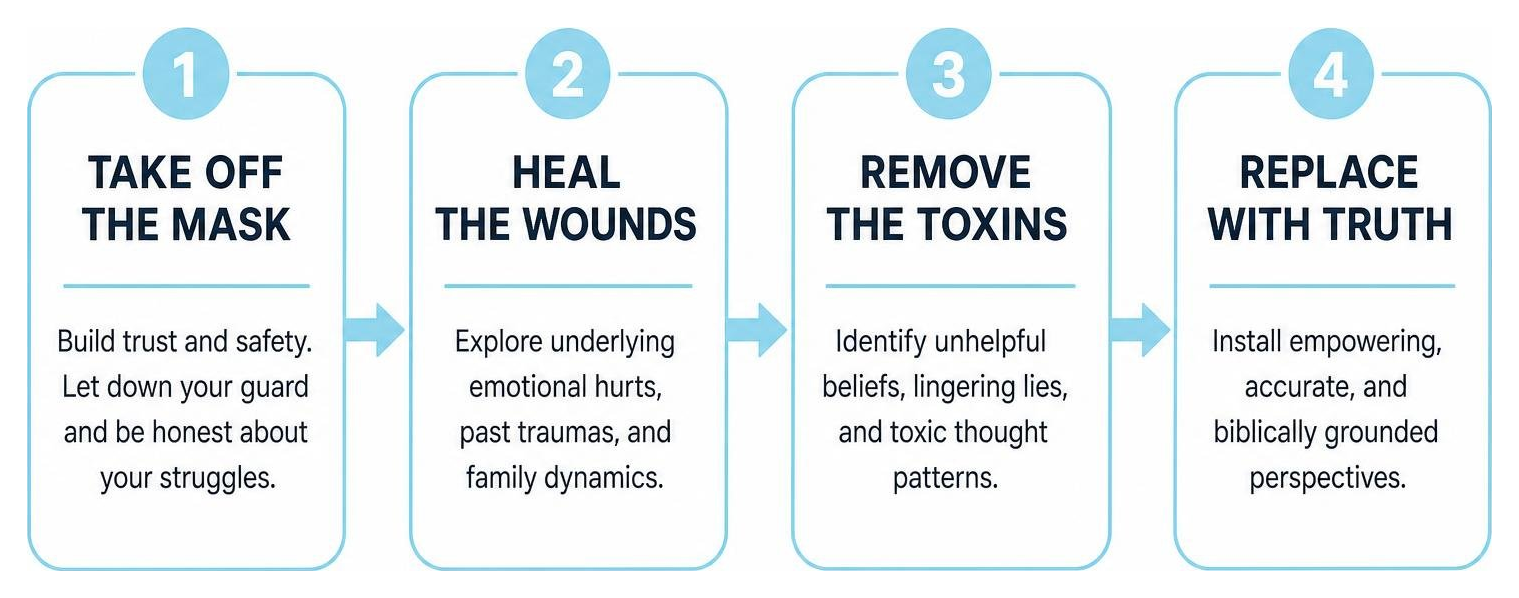
- Take Off the Mask: The journey begins by building genuine rapport and trust. In a safe, non-judgmental environment, you are invited to let down your guard and be honest about your struggles, knowing you will be met with grace rather than shame.
- Heal the Wounds: Next, we gently explore the underlying emotional and relational hurts, past traumas, and family dynamics that may be driving your current challenges.
- Remove the Toxins: Together, we identify unhelpful beliefs, lingering lies, and toxic thought patterns that have kept you stuck in cycles of addiction or anxiety.
- Replace with Truth: Finally, we install empowering, accurate, and biblically grounded perspectives about yourself, others, and the world, equipping you with the tools needed for lasting victory.
Throughout your time in our IOP, your progress will be continuously monitored, and your plan will be adjusted as you grow, ensuring you always receive the exact level of support you need.
Frequently Asked Questions About Outpatient Treatment in Allegheny County
Navigating mental health and addiction treatment can feel overwhelming. To help you make an informed decision, we have answered some of the most frequently asked questions about outpatient care in Western Pennsylvania.
How many hours per week is an IOP?
A standard Intensive Outpatient Program (IOP) requires a time commitment of 9 to 15 hours of treatment per week. This is typically structured as three-hour sessions, three to five days per week. The exact schedule depends on whether you choose a morning, afternoon, or evening track, allowing you to find a balance that fits your daily career or family responsibilities.
Does insurance cover intensive outpatient programs in Pennsylvania?
Yes, most commercial health insurance plans in Pennsylvania cover intensive outpatient programs, and in many cases, they can cover up to 100% of the treatment costs. Because every policy is different, our admissions team at Grace Recovery Services provides a completely free, confidential benefits check to help you understand your coverage and plan financially before you begin.
What is the difference between PHP and IOP?
The primary difference lies in the level of clinical supervision and weekly time commitment. A Partial Hospitalization Program (PHP) is a higher level of care, typically requiring 20 to 30 hours per week (5 days a week, 4 to 6 hours a day). An IOP is more flexible, requiring 9 to 15 hours per week, making it ideal for those transitioning back to work or school.
Finding Hope and Healing Close to Home
No matter how dark the road may seem right now, please know that you do not have to walk it alone. True restoration, renewal, and revival are entirely possible for your life.
At Grace Recovery Services, we are committed to walking beside you every step of the way. We do not just focus on getting you through our program; we focus on preparing you for a lifetime of health and joy. That is why we place a heavy emphasis on comprehensive aftercare planning, helping you transition smoothly to standard outpatient therapy, peer support groups, or faith-based community networks.
If you want to explore how our specialized aftercare support can help you maintain your progress, we invite you to read our guide on Christian Aftercare Programs in Pittsburgh How Faith-Based Options Can Help You to Heal.
We are proud to serve our neighbors throughout Western Pennsylvania, with warm, welcoming offices in the Penn Hills area of Pittsburgh and North Huntingdon. If you or a loved one is ready to take a courageous step toward healing, we are here to listen with open hearts and open arms.
Reach out to us today through our Intensive Outpatient page or contact our compassionate team directly. Let us help you find the grace, guidance, and clinical support you need to reclaim your life.
This article was researched with AI and heavily edited by Stephen Luther for accuracy and relevance.
Stephen Luther is the Executive Director and Founder of Grace Christian Counseling, Grace Recovery Services, WPA Counseling, NuWell Online Counseling and Coaching, and NuWell Health. He holds a Master’s degree in Education from the University of Georgia and a Master’s degree in Marriage and Family Therapy from Duquesne University. He is a licensed professional counselor in Pennsylvania.
Since 1997, Steve has been helping children, adolescents, and adults overcome a wide range of emotional and relational challenges. He specializes in working with hurting families, including those with foster, adopted, or traumatized children. Steve uses Attachment-Based Therapy, Splankna Healing, and Therapeutic Parent Coaching to support healing and restoration.
This guide is for educational and spiritual encouragement and is not a substitute for personalized professional counseling. If you are in crisis, please reach out for immediate help.