Finding Christian Counseling in Pittsburgh: What You Need to Know First
If you’re searching for Christian counseling in Pittsburgh, here are the most important things to know right away:
- What it is: Faith-integrated therapy that combines licensed clinical care with biblical principles — treating mind, body, and spirit together.
- Who it’s for: Individuals, couples, and families dealing with anxiety, depression, addiction, trauma, grief, or relationship struggles.
- Where to find it: Western Pennsylvania has a wide network of licensed Christian counselors, including options in Pittsburgh proper, the North Hills, East Liberty, Cranberry Township, and surrounding Allegheny County communities.
- In-person or online: Many providers offer both in-person sessions and telehealth throughout Pennsylvania.
- How to start: Most practices offer a free initial consultation or discovery call to help you find the right fit.
Life in Western Pennsylvania can be hard. Whether you’re carrying the weight of addiction, wrestling with anxiety, or trying to hold a marriage together, there are moments when everything feels too heavy to carry alone.
For many people in Pittsburgh, healing means more than managing symptoms. It means reconnecting with something deeper — with faith, with purpose, and with a sense of who God created them to be.
That’s exactly where Christian counseling comes in.
Unlike standard therapy, Christian counseling weaves biblical truth into evidence-based clinical care. It doesn’t ask you to choose between your faith and your mental health. It honors both. And in a city with a rich faith community like Pittsburgh, the options for finding this kind of care are more accessible than many people realize. Psychology Today alone lists over 400 Christian therapists in the Pittsburgh metro area.
At Grace Recovery Services, we’ve seen how powerful it can be when someone finally finds a counselor who gets them — clinically skilled, spiritually grounded, and genuinely compassionate. That combination changes lives.
This guide walks you through practical tips for finding the right Christian counselor in Pittsburgh, so you can take that first step with clarity and confidence.
Similar topics to christian counseling pittsburgh:
Understanding Faith-Integrated Therapy vs. Traditional Counseling
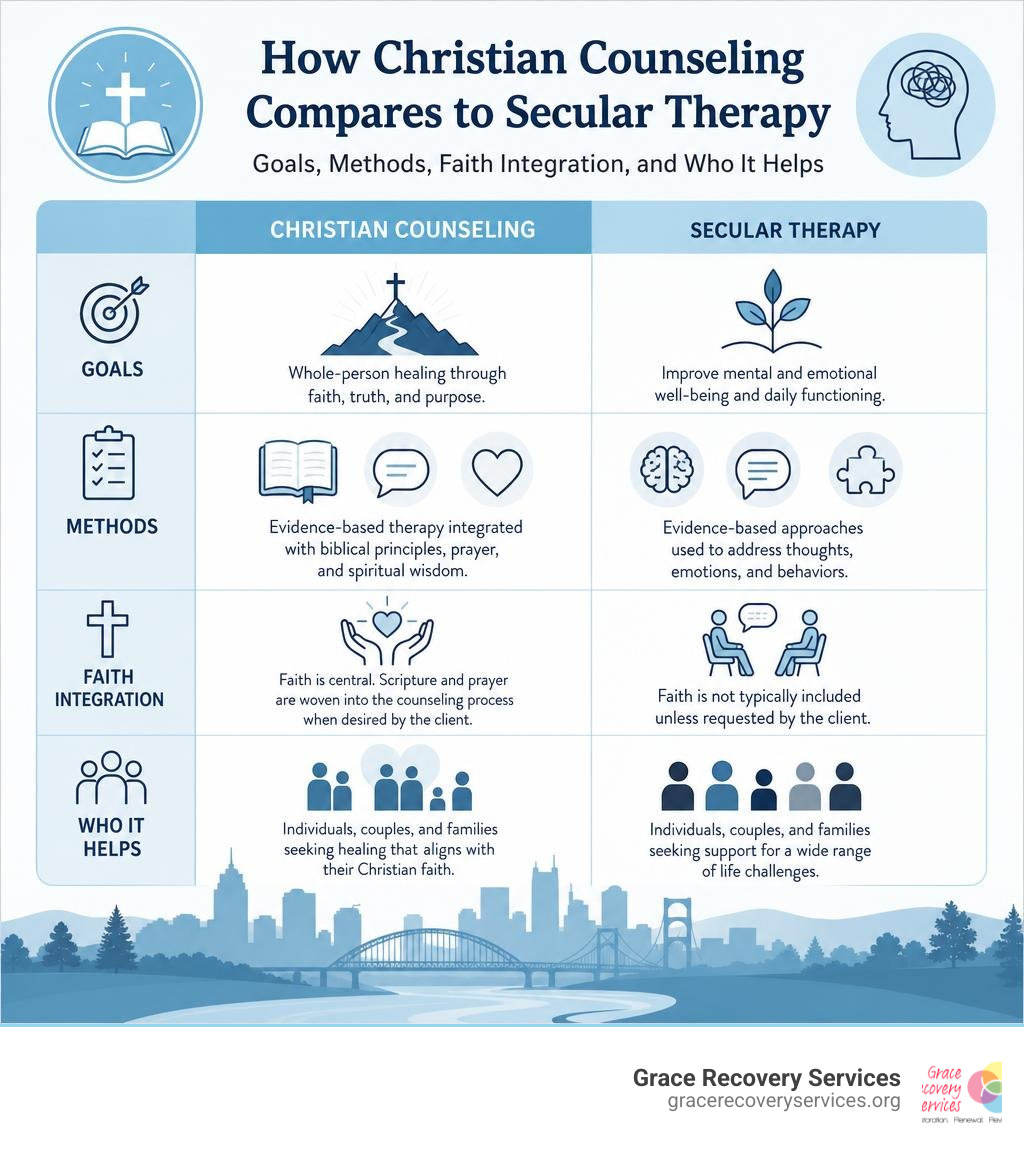
To find the right support, it helps to understand what makes faith-integrated therapy unique. Traditional, secular counseling is highly valuable and relies on evidence-based practices like Cognitive Behavioral Therapy (CBT) to help people change unhelpful thought patterns. However, secular therapy often leaves a person’s spiritual life out of the equation.
For a person of faith, ignoring the spiritual dimension during a mental health crisis can feel like trying to heal a broken bone while ignoring the rest of the body.
Faith-integrated therapy bridges this gap by combining clinical psychology with a solid foundation of biblical principles. It views the human experience holistically. In this model, psychology is not seen as an enemy of faith; rather, it is understood as the study of God’s intricate design for the human mind and relationships.
When you work with a counselor who specializes in christian counseling pittsburgh, you receive the benefit of proven clinical tools while also exploring spiritual connection, prayer, and scriptural truths that speak to your worth and identity in Christ. This integrated approach can be especially powerful for those who want to anchor their healing in hope, grace, and a deeper sense of purpose. If you are eager to learn more about how this integration brings lasting comfort, you can read about Finding Peace Through Western PA Christian Counseling.
7 Tips for Selecting a Christian Therapist in Western PA
Finding a therapist who aligns with both your mental health needs and your faith can feel overwhelming. To make your search easier, we have compiled seven practical tips to help you navigate the process in Western Pennsylvania.
- Verify Licensing and Clinical Credentials: Ensure your counselor is a Licensed Professional Counselor (LPC), Licensed Clinical Social Worker (LCSW), or Licensed Marriage and Family Therapist (LMFT). Proper licensing guarantees they have met the rigorous educational and clinical standards required by the state of Pennsylvania.
- Ask About Their Theological Training: Christian counselors have varying degrees of theological education. Some are ordained ministers with clinical degrees, while others are licensed clinicians who have completed specialized training in biblical integration. Ask how they define their faith-based approach.
- Clarify the Role of Faith in Sessions: Some counselors only bring up scripture or prayer if you specifically request it, while others make it a central component of every session. Be clear about what comfort level you prefer.
- Look for Specialized Experience: If you are dealing with trauma, family conflict, or substance use, make sure the counselor has specific clinical training in those areas. Faith alone is a powerful foundation, but specialized clinical tools are necessary for complex issues.
- Consider the Logistics: Decide whether you prefer in-person sessions in the Pittsburgh area (such as the Penn Hills or North Huntingdon offices) or the flexibility of virtual telehealth sessions.
- Inquire About Therapist Matching: A good counseling practice will take the time to understand your unique personality, struggles, and goals before matching you with a professional on their team.
- Seek Local Recommendations: Ask trusted pastors, ministry leaders, or friends in the Western PA area for recommendations. You can also narrow your search by checking a counselor’s Pennsylvania license status, confirming their specialties, and asking whether they offer faith-integrated care before scheduling.
Finding the Right Fit for Christian Counseling Pittsburgh
When searching for local therapy, finding the right match is about balancing clinical credentials with spiritual alignment. You want a counselor who understands the local culture of Western PA, but more importantly, you need someone who understands your personal goals.
Whether you are looking to rebuild a damaged relationship, navigate a difficult career transition, or overcome a deep-seated personal struggle, your therapist should be someone you feel completely safe with. If you reside in the eastern suburbs of Allegheny County, you may want to explore The 7 Best Penn Hills Christian Counselors Compared to see how different local professionals approach faith-based care.
Look for Trauma-Informed and Evidence-Based Care
Mental health struggles are rarely simple. Often, issues like anxiety, depression, or substance use are deeply intertwined with past traumas and unresolved emotional wounds. That is why it is crucial to find a counselor who practices trauma-informed care.
Trauma-informed Christian counseling ensures that your story is treated with the utmost gentleness and respect, without rushing you to “just get over it” or spiritualizing your pain. Look for practitioners trained in evidence-based trauma therapies, such as Eye Movement Desensitization and Reprocessing (EMDR) or Dialectical Behavior Therapy (DBT).
These clinical tools, when combined with biblical truths about your worth, create a profound environment of emotional safety. To understand how clinical excellence and spiritual care work together to heal deep wounds, read about Your Path to Recovery with Christian Counseling in Penn Hills.
Consider Outpatient and Intensive Outpatient Options
Depending on the severity of what you are walking through, standard weekly outpatient therapy sessions might not provide enough support. If you or a loved one are struggling to manage daily life due to severe mental health challenges or substance use disorders, an Intensive Outpatient Program (IOP) might be the right step.
An IOP offers a higher level of care, meeting multiple times a week for structured group and individual therapy, while still allowing you to live at home, keep your job, and maintain your family dynamics. This flexible scheduling ensures you do not have to put your entire life on hold to heal. For those in Western Pennsylvania navigating these complex needs, exploring Western PA Christian Addiction Counseling can provide a clearer picture of how structured outpatient care fits into a busy lifestyle.
Navigating Christian Counseling Pittsburgh: Your Path to Wholeness
Entering the counseling room is an act of courage. It means putting down the heavy burden of pretending everything is fine and choosing to pursue genuine mental wellness. In Allegheny County and Westmoreland County, we are blessed with a community that understands the reality of spiritual warfare and the necessity of grace.
True healing does not happen in isolation. It happens when we allow clinically trained professionals to walk alongside us, helping us unpack our pain and reclaim the joy God desires for us. If you are specifically looking for faith-based support to overcome substance use or co-occurring mental health issues, you can learn more about local resources by visiting Christian Rehab Pittsburgh.
Overcoming Anxiety and Depression with Christian Counseling Pittsburgh
Anxiety and depression can make everyday life feel incredibly heavy. You might struggle with a constant, racing mind, persistent feelings of sadness, or a strange sense of spiritual disconnection — feeling as though God is distant or that your struggles are a sign of weak faith.
Let us be completely clear: experiencing anxiety or depression is not a spiritual failure. Many faithful figures in the Bible, including David and Elijah, experienced deep seasons of sorrow and fear.
Through faith-adapted CBT, Christian counselors help you identify the root causes of your distress, challenge unhelpful thought patterns, and replace them with the life-giving truth of scripture. This approach restores hope by reminding you that you are loved, seen, and never alone. For a deeper look at how faith-based therapy addresses these heavy emotions, check out Everything You Need to Know About Christian Addiction Counseling.
Addressing Substance Use and Co-Occurring Disorders
When a person struggles with substance use, there is almost always an underlying emotional or psychological wound driving the behavior. This is known as a co-occurring disorder — where addiction and mental health challenges like depression, PTSD, or anxiety exist at the same time.
At Grace Recovery Services, we believe that true recovery requires non-judgmental support that addresses both sides of this coin. We combine evidence-based clinical treatments with spiritually grounded care, helping individuals break free from the cycle of shame and find lasting healing.
If you or a loved one are ready to take the first step toward freedom, explore our resources on Christian Addiction Recovery Pittsburgh and discover the compassionate care available through Faith-Based Rehab Pittsburgh.
The Counseling Blueprint: A Four-Stage Journey to Healing
At Grace Recovery Services, we utilize a structured, compassionate framework known as the Counseling Blueprint. This clinical and biblical model guides clients through a progressive, four-stage journey of self-discovery, healing, and spiritual renewal.
| Stage | Focus of Care | Clinical & Biblical Integration |
|---|---|---|
| 1. Take Off the Mask | Building genuine rapport and trust | Creating a safe, non-judgmental space where clients can drop their defenses and be completely honest about their pain. |
| 2. Heal the Wounds | Exploring emotional and relational hurts | Unpacking past trauma, family dynamics, and deep-seated hurts with clinical sensitivity and Christ-centered compassion. |
| 3. Remove the Toxins | Identifying unhelpful beliefs and lies | Pinpointing false narratives, toxic shame, or lingering lies (e.g., “I am beyond redemption” or “I am a failure”) that keep clients stuck. |
| 4. Replace with Truth | Installing empowering, accurate perspectives | Rooting identity in Christ, embracing biblical promises of hope, and establishing healthy, evidence-based coping mechanisms for the future. |
Frequently Asked Questions
Is Christian counseling covered by insurance in Pennsylvania?
Yes, many licensed Christian counselors and practices accept major insurance plans, including Highmark, UPMC Health Plan, Aetna, and Cigna. Some organizations also accept Medicaid in specific counties, such as Westmoreland County. If insurance is not an option, many providers offer affordable sliding-scale fees or financial assistance funds to ensure that cost is not a barrier to receiving professional care.
What should I expect during my first counseling session?
Your first session is primarily about building rapport, establishing trust, and conducting an initial clinical assessment. Your counselor will ask what brought you to therapy, explore your background, and discuss your personal and spiritual goals. It is a collaborative, low-pressure conversation designed to make you feel safe and heard.
Can I receive Christian counseling online?
Absolutely. Telehealth has made virtual Christian counseling highly accessible throughout the state of Pennsylvania. Virtual sessions offer the same level of professional, faith-integrated clinical care as in-person visits, but with the added convenience of meeting from the comfort and privacy of your own home.
Conclusion

Healing is a journey, and you do not have to walk it alone. Whether you are dealing with the weight of anxiety, navigating a difficult relationship, or seeking recovery from substance use, licensed Christian counseling in Pittsburgh offers a path of restoration and renewal.
At Grace Recovery Services, we are dedicated to providing compassionate, trauma-informed, and evidence-based outpatient care for individuals and families across Western Pennsylvania. Our offices in Penn Hills and North Huntingdon are warm, welcoming spaces designed to help you heal in mind, body, and spirit.
If you are ready to take your first step toward wholeness, we encourage you to reach out to our team today for a personalized assessment. To find daily encouragement and strength for the journey ahead, explore these Scriptures to Help with Addiction and Reclaim Your Life.
This article was researched with AI and heavily edited by Stephen Luther for accuracy and relevance.
Stephen Luther is the Executive Director and Founder of Grace Christian Counseling, Grace Recovery Services, WPA Counseling, NuWell Online Counseling and Coaching, and NuWell Health. He holds a Master’s degree in Education from the University of Georgia and a Master’s degree in Marriage and Family Therapy from Duquesne University. He is a licensed professional counselor in Pennsylvania.
Since 1997, Steve has been helping children, adolescents, and adults overcome a wide range of emotional and relational challenges. He specializes in working with hurting families, including those with foster, adopted, or traumatized children. Steve uses Attachment-Based Therapy, Splankna Healing, and Therapeutic Parent Coaching to support healing and restoration.
This guide is for educational and spiritual encouragement and is not a substitute for personalized professional counseling. If you are in crisis, please reach out for immediate help.