
The Core Dynamics of Family Counseling Pittsburgh in Addiction Recovery
Substance use disorder rarely exists in isolation. Within a household, patterns of coping, unspoken rules, and emotional stress often develop over time as everyone tries to navigate the uncertainty of addiction. When one person begins their recovery journey, the entire family dynamic must shift to sustain long-term wellness.
Family therapy approaches relational healing through a systemic lens. Rather than viewing one individual as the sole focus of treatment, systemic therapy examines how each person’s emotions, reactions, and coping strategies interact. Research published by the Substance Abuse and Mental Health Services Administration (SAMHSA) demonstrates that engaging family members in the outpatient recovery process leads to stronger emotional support networks and improved long-term outcomes. This framework helps identify how unhelpful coping mechanisms—such as enabling, hypervigilance, or emotional withdrawal—may have developed as survival strategies. Understanding family roles in addiction provides valuable insight into how family members often adopt specific behaviors when trying to manage stress.
Addressing co-occurring mental health challenges alongside addiction is essential. Many individuals and their family members navigate anxiety, depression, or underlying emotional trauma that deepens relational tension. Through outpatient care, our clinical team works collaboratively with clients to unpack these layers in a safe, non-judgmental environment. Establishing clear, compassionate boundaries allows family members to care for themselves while offering constructive family support in addiction recovery.
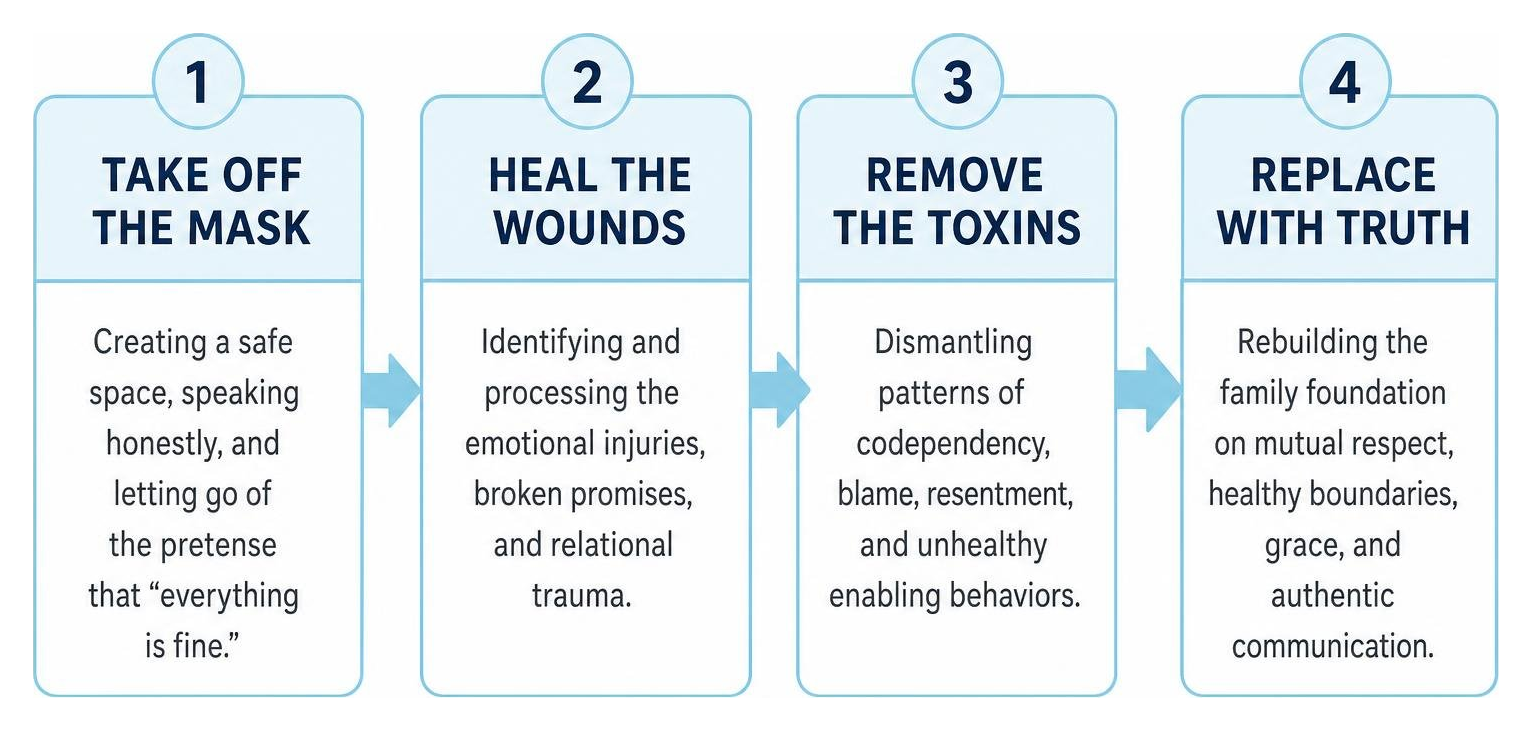
At Grace Recovery Services, we weave our proprietary Counseling Blueprint into outpatient care to guide this healing process:
- Take Off the Mask: Creating a safe space where family members can lay down defensive behaviors, speak honestly about their pain, and drop the pretense that “everything is fine.”
- Heal the Wounds: Identifying and processing the emotional injuries, broken promises, and relational trauma caused by substance use.
- Remove the Toxins: Dismantling patterns of codependency, blame, resentment, and unhealthy enabling behaviors.
- Replace with Truth: Rebuilding the family foundation on mutual respect, healthy boundaries, grace, and authentic communication.
Who Attends and When to Seek Help
A common question families ask is who should participate in therapy sessions. The answer depends on your unique household and support network. Family therapy is not limited to spouses or biological parents; it can include:
- Immediate caregivers and life partners
- Adult children and adolescent siblings
- Co-parents working together to maintain consistency for children
- Extended family members, such as grandparents, who play an active role in the home
Knowing when to seek help is equally important. Families often reach out for professional counseling when daily interactions become overwhelming or when healthy communication breaks down completely. Common indicators that your family could benefit from structured support include:
- Persistent Emotional Withdrawal: Family members avoiding one another, walking on eggshells, or living in perpetual isolation within the same house.
- Frequent, Unresolved Conflict: Arguments that quickly escalate into shouting, blame shifting, or lingering silence without resolution.
- Significant Behavioral Changes: Drastic shifts in mood, school or work attendance, sleeping habits, or sudden secrecy.
- Overwhelming Caregiver Fatigue: Feeling mentally, emotionally, and physically exhausted from managing a loved one’s challenges.
If your family is navigating these difficulties, exploring a structured framework for family addiction recovery can help clarify your next steps toward meaningful support.
Evidence-Based Modalities in Outpatient Care
Effective family therapy combines clinical expertise with structured interventions. Outpatient clinicians utilize several evidence-based modalities tailored to the specific needs of each family:
- Cognitive Behavioral Therapy (CBT): Helps family members identify negative thought patterns, challenge unhelpful assumptions, and replace destructive reactions with constructive coping mechanisms.
- Dialectical Behavioral Therapy (DBT): Teaches practical skills for distress tolerance, emotional regulation, and interpersonal effectiveness, helping members de-escalate high-stress situations.
- Systemic and Structural Family Therapy: Focuses on the organization of the family unit, helping to restore appropriate parental hierarchy, strengthen partner alliances, and establish healthy boundaries.
- Internal Family Systems (IFS) Principles: Assists individuals in understanding their internal emotional “parts”—such as protectors or wounded parts—fostering greater self-compassion and empathy for others.
- Trauma-Informed Relational Care: Ensures that underlying trauma is recognized and addressed gently, preventing re-traumatization while promoting emotional security.
Benefits of Outpatient Family Therapy Over Other Formats
Outpatient family counseling allows clients and their loved ones to practice communication skills directly in their everyday environment. Rather than receiving care in an isolated setting, outpatient therapy integrates healing into the natural rhythm of work, school, and home life.
This structure provides critical advantages for families navigating recovery:
- Real-Time Skill Application: Families can immediately implement communication tools, boundary settings, and conflict-resolution strategies at home, bringing real-world observations to their next therapy session.
- Routine Stability: Outpatient scheduling enables participants to maintain employment, childcare responsibilities, and educational goals without prolonged disruption.
- Community Connection: Clients and their families build sustainable support networks within their local area, fostering accountability that endures long after structured therapy concludes.
For those seeking regional community resources, exploring Allegheny County addiction support can offer additional context on local outpatient networks and support systems.
| Feature | In-Person Outpatient Counseling | Telehealth Outpatient Counseling |
|---|---|---|
| Best For | High conflict, emotional reconnection, hands-on activities | Geographically dispersed members, tight work schedules |
| Nonverbal Cues | Full visibility of body language, posture, and presence | Visible facial expressions and tone of voice |
| Convenience | Requires travel to local Western PA offices | Join from home, office, or separate locations |
| Privacy Needs | Neutral, confidential office setting away from home distractions | Requires a secure, private room at home |
| Family Inclusion | Ideal for bringing children and parents into one room | Easily includes college students or distant relatives |
In-Person vs. Virtual Family Sessions
Choosing between in-person and telehealth sessions depends on your family’s logistical needs and comfort level.
In-Person Counseling: Meeting directly in an office setting provides a dedicated, neutral environment free from household distractions. In-person care is particularly effective when working through deep-seated relational trauma or when therapists need to observe subtle nonverbal cues, physical posture, and spontaneous interactions between family members.
Virtual Telehealth Sessions: Virtual counseling offers exceptional convenience for families with busy work schedules, transportation limitations, or members living in different parts of Western Pennsylvania. Telehealth allows extended family, such as a sibling away at college or a co-parent working across town, to join sessions seamlessly while maintaining continuity of care.
Integrating Faith and Clinical Healing
For many families, lasting recovery is deeply intertwined with their spiritual foundation. Integrating Christian principles with evidence-based clinical practices offers a holistic path forward, addressing the mind, body, and spirit together.
At Grace Recovery Services, we believe that clinical excellence and spiritual truth work hand in hand. Scriptural principles of grace, forgiveness, and redemption provide the emotional safety needed to heal relational wounds. We encourage families to look beyond past mistakes and focus on renewal, offering gentle guidance on how to support someone in recovery while maintaining personal boundaries.
Our team approaches every session with empathy, recognizing that faith can be a powerful source of resilience. For a broader understanding of how spiritual care supports relational restoration, explore our resources on faith and family healing.
Navigating Pittsburgh Community Resources and Specialized Services
Western Pennsylvania offers a rich network of behavioral health and community resources designed to support families through every stage of life. When seeking outpatient care, connecting with programs that understand the unique needs of our local communities ensures comprehensive, coordinated support.
Families exploring care options across the region can review local Pittsburgh Christian outpatient rehab options to understand how specialized outpatient centers operate across Allegheny and Westmoreland counties.
Accessing Specialized Family Counseling Pittsburgh Services for Youth and Caregivers
Different developmental stages require specialized therapeutic interventions. Across the greater Pittsburgh area, specialized services address the needs of children, young adults, and dedicated caregivers:
- Parent-Child Interaction Approaches: Evidence-based parent-child strategies help caregivers establish consistent, nurturing routines while addressing behavioral challenges in young children and pre-teens.
- Youth and Adolescent Support: Young people ages 12–22 often benefit from age-appropriate counseling, teen peer mentorship, and accessible chat platforms that allow them to express emotional distress in a safe, judgment-free space.
- Caregiver and Bereavement Groups: Specialized support groups help family members manage the emotional weight of caring for a loved one experiencing a chronic condition, processing grief, and learning practical stress-reduction techniques.
Key Questions to Ask When Choosing Family Counseling Pittsburgh Providers
Finding the right therapeutic fit is essential for meaningful progress. When reaching out to outpatient providers across Western Pennsylvania, consider asking the following questions during your initial consultation:
- What are your credentials and clinical experience? Ensure the clinician is a Licensed Professional Counselor (LPC), Licensed Clinical Social Worker (LCSW), or Licensed Marriage and Family Therapist (LMFT) with specific experience in family systems and substance use disorders.
- How do you integrate family members into the recovery plan? Ask how frequently family sessions occur and what role loved ones play in ongoing outpatient treatment goals.
- What therapeutic modalities do you utilize? Inquire whether they employ evidence-based approaches like CBT, DBT, or trauma-informed care.
- Do you offer flexible scheduling or telehealth options? Confirm whether evening hours or virtual sessions are available to accommodate work and school commitments.
- How do you incorporate spiritual or faith-based values? If faith is an important component of your family’s life, ensure the provider respects and integrates these values appropriately.
Navigating the daily challenges of recovery requires patience, and reading about finding grace in the grind of recovery can offer encouragement as you search for the right provider.
Frequently Asked Questions About Family Counseling
How much does family counseling typically cost and will insurance cover it?
Outpatient family therapy costs vary based on session length, the provider’s credentials, and specific treatment plans. Many health insurance policies offer behavioral health benefits that help cover family therapy sessions when tied to the treatment of a diagnosed mental health or substance use disorder. Coverage often depends on your specific plan’s deductibles, co-pays, and out-of-network provisions. We recommend reaching out directly to our administrative team for a personalized assessment of your benefits.
What can our family expect during our first outpatient therapy session?
During your initial intake session, the counselor focuses on creating a comfortable, safe environment where every participant feels heard. The therapist will:
- Review confidentiality, safety guidelines, and respectful communication ground rules.
- Gather background information on family history, current stressors, and relational dynamics.
- Identify key goals that the family hopes to achieve through therapy.
- Begin developing a collaborative outpatient treatment plan tailored to your family’s specific needs.
How long does family counseling last during addiction recovery?
The duration of family counseling depends on the complexity of the challenges being addressed and the family’s unique goals. Some families achieve meaningful breakthroughs in a few months of regular weekly or bi-weekly outpatient sessions, while others benefit from ongoing support to maintain healthy boundaries and navigate life transitions. Treatment plans are continually reviewed and adjusted to ensure they match the family’s evolving progress.
Conclusion
Restoring family relationships in the wake of substance use is a journey that takes time, intentional effort, and grace. Addiction can disrupt trust and strain communication, but with professional outpatient guidance, families can rediscover emotional safety, mutual respect, and authentic connection.
At Grace Recovery Services, our outpatient programs in Western Pennsylvania—with offices serving the Penn Hills, Pittsburgh, and North Huntingdon areas—are dedicated to walking alongside your family. By combining evidence-based clinical practices with Christ-centered compassion, we provide the tools needed to heal wounds and build a lasting foundation for recovery.
If your family is ready to take the next step toward relational healing, please contact our team today to schedule a confidential assessment. For additional guidance, educational articles, and encouragement, explore our family recovery insights and resources.
This article was researched with AI and heavily edited by Stephen Luther for accuracy and relevance.
Stephen Luther is the Executive Director and Founder of Grace Christian Counseling, Grace Recovery Services, WPA Counseling, NuWell Online Counseling and Coaching, and NuWell Health. He holds a Master’s degree in Education from the University of Georgia and a Master’s degree in Marriage and Family Therapy from Duquesne University. He is a licensed professional counselor in Pennsylvania.
Since 1997, Steve has been helping children, adolescents, and adults overcome a wide range of emotional and relational challenges. He specializes in working with hurting families, including those with foster, adopted, or traumatized children. Steve uses Attachment-Based Therapy, Splankna Healing, and Therapeutic Parent Coaching to support healing and restoration.
This guide is for educational and spiritual encouragement and is not a substitute for personalized professional counseling. If you are in crisis, please reach out for immediate help.