
Why Bible-Based Trauma Recovery in North Huntingdon Offers Real Hope for Lasting Healing
If you or someone you love is searching for Bible-based trauma recovery in North Huntingdon, here is what you need to know right away:
Quick Answer: What Is Bible-Based Trauma Recovery in North Huntingdon?
- It combines clinical, evidence-based therapy (like CBT and trauma-informed care) with Christian principles and biblical truth
- It treats the whole person — mind, body, and spirit — not just symptoms
- It is available through outpatient and intensive outpatient programs in the North Huntingdon / Western PA area
- You do not need to be a committed Christian to benefit from faith-integrated care
- Insurance is accepted, including Medicaid and major commercial plans
- Telehealth options may be available — contact Grace Recovery Services directly to confirm
Trauma runs deep. For many people in Western Pennsylvania, it is the hidden root beneath addiction, anxiety, broken relationships, and a persistent sense of shame. The pain can feel impossible to name — let alone heal.
Scripture acknowledges this reality honestly. “The LORD is close to the brokenhearted and saves those who are crushed in spirit.” — Psalm 34:18
At Grace Recovery Services, we believe healing is possible. Not just managing symptoms, but genuine restoration — the kind that touches every part of who you are.
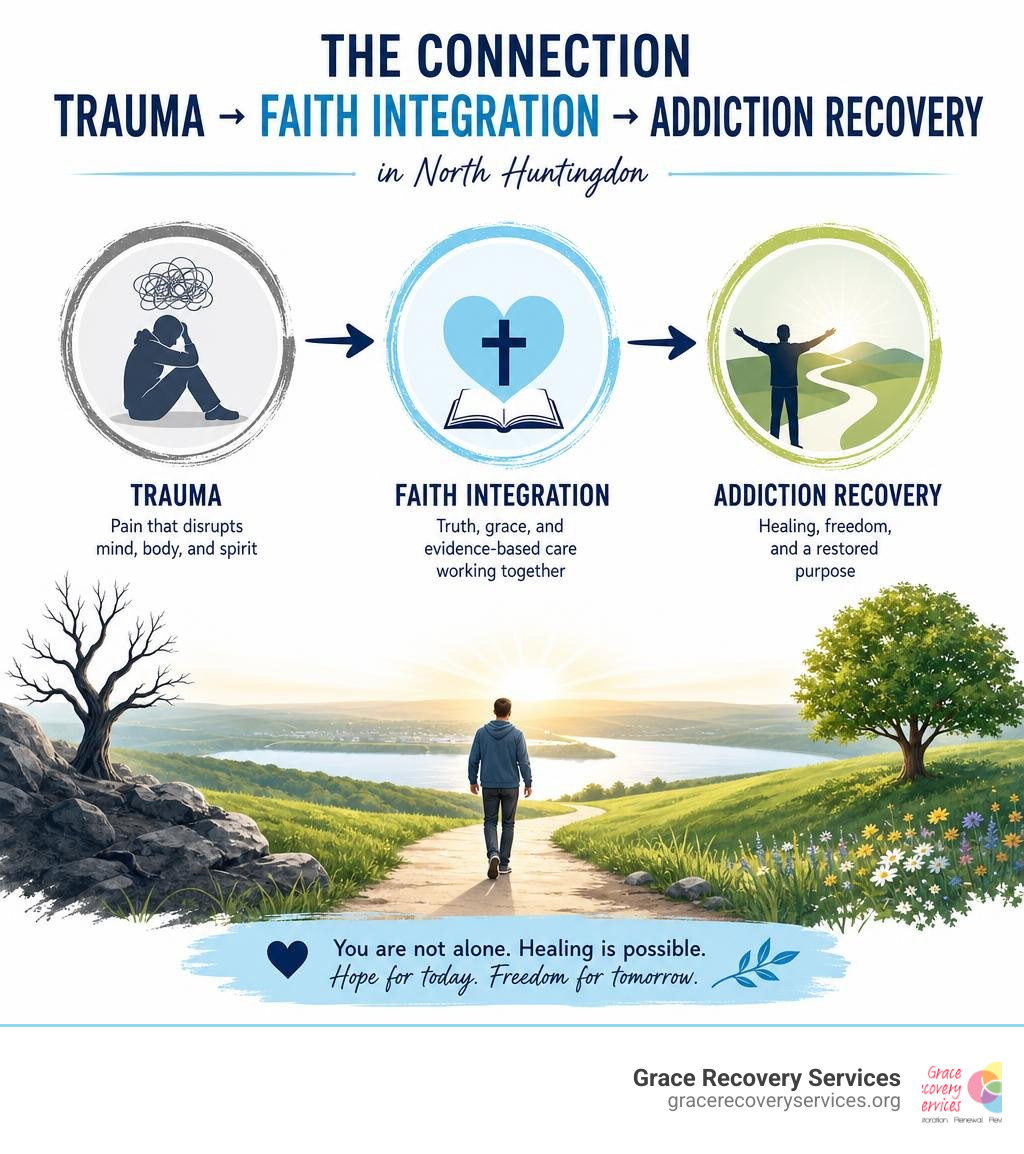
Bible-based trauma recovery brings together the best of clinical science and the enduring hope found in biblical truth. It is not about replacing good therapy with prayer, or replacing faith with psychology. It is about both, working together, in a safe and compassionate environment where you are met with grace — not judgment.
Research supports this integrated approach. Studies suggest that faith-based interventions can meaningfully improve recovery outcomes for individuals dealing with trauma and addiction, particularly when spiritual care is combined with evidence-based clinical treatment.
Whether you are struggling with the weight of childhood trauma, addiction, grief, or wounds from a faith community, you do not have to carry this alone.
Easy Bible-based trauma recovery North Huntingdon glossary:
Understanding Bible-Based Trauma Recovery North Huntingdon
When we experience a traumatic event, the impact is felt across our entire being. It alters our thoughts, affects our physical health, and can leave us feeling deeply disconnected from God and our loved ones.
Traditional trauma therapy focuses primarily on the psychological and somatic symptoms of trauma. While this clinical care is incredibly valuable, it often leaves the spiritual dimension unaddressed.
By contrast, Bible-based trauma recovery North Huntingdon programs offer a faith-integrated approach. We recognize that true healing requires clinical excellence and spiritual reconciliation. By combining evidence-based clinical psychology with robust spiritual support, we walk with clients as they process their pain through both a psychological and biblical lens.
This dual approach is designed to help clients experience deep, lasting transformation. For a clearer picture of how these two approaches compare and complement each other, consider the table below:
| Feature | Traditional Trauma Therapy | Bible-Based Trauma Recovery |
|---|---|---|
| Primary Focus | Psychological symptoms, emotional regulation, and behavioral patterns. | Holistic restoration of mind, body, and spirit, including relationship with God. |
| Core Tools | Evidence-based modalities (CBT, EMDR, Somatic Experiencing). | Evidence-based modalities integrated with Scripture, prayer, and faith principles. |
| View of Identity | Built on self-actualization, personal coping skills, and resilience. | Rooted in being made in the image of God, finding worth in Christ, and grace. |
| Addressing Guilt & Shame | Cognitive restructuring and self-compassion techniques. | Combining clinical tools with biblical forgiveness, grace, and redemption. |
| Community Integration | Support groups, family therapy, or peer networks. | Faith-integrated peer support, local church healing, and relational restoration. |
To explore this comprehensive approach further, you can read about Faith-Based Trauma Recovery and how it bridges these two worlds.
The Core Principles of Bible-Based Trauma Recovery North Huntingdon
At the heart of our program are several foundational pillars that guide clients from a state of survival to one of abundant life:
- A foundation of biblical truth: We believe that God’s Word is a powerful tool for transformation. When trauma distorts how we view ourselves and the world, Scripture provides a steady anchor.
- Active Mind Renewal: Trauma can trap our brains in negative, repetitive loops of fear and self-blame. We emphasize cognitive renewal, helping clients to study and apply scriptures that restore peace. You can read more on this in our guide to Renew Your Mind with These Powerful Bible Verses.
- Grace Over Shame: Shame tells us that we are the mistake. Grace reminds us that we are loved, valued, and redeemable. Our environment is completely non-judgmental, emphasizing that your past does not define your future.
- Redemption and Purpose: We don’t just want to help you stop hurting; we want to help you find your God-given purpose. God can take the broken pieces of our stories and turn them into a beautiful testimony of hope.
Integrating Clinical Science with Biblical Truth
Some people worry that seeking faith-based counseling means ignoring modern medicine or science. We take the opposite approach. We believe that clinical science and biblical truth are entirely complementary. After all, God designed the human brain and body!
We utilize highly effective, evidence-based practices such as Cognitive Behavioral Therapy (CBT) and trauma-informed principles. These clinical tools help us understand the neurobiology of trauma—how the brain reacts to overwhelming stress, how the nervous system gets stuck in a “fight, flight, or freeze” response, and how memories are stored.
By understanding the science of trauma, we can apply biblical truths more effectively. For instance, knowing how trauma affects emotional regulation allows our counselors to introduce calming techniques alongside prayer and scripture reflection. This clinical integration is a key part of our commitment to Trauma-Informed Care.
The Impact of Trauma on Mind, Body, and Spirit
Trauma is not just a memory; it is a physical and spiritual reality. When we go through an overwhelming event, our brain’s alarm system—the amygdala—goes into overdrive. If the trauma is chronic or occurs during childhood, it can permanently alter how our brain processes stress, safety, and relationships.

This impact is why we emphasize The Whole Person Approach to Faith-Based Trauma Recovery. When we treat trauma, we must address the physical body, the cognitive mind, and the spiritual soul. If we ignore any of these areas, the root causes of our pain remain, often leading to co-occurring disorders like substance use, severe anxiety, or depression.
Childhood Trauma and Neurological Development
Research in neuroscience shows that childhood trauma can significantly impact brain development. Specifically, early trauma can alter the default mode network (DMN)—which is responsible for our self-focus and internal thoughts—and the central executive network (CEN), which handles problem-solving and emotional regulation.
When these networks are disrupted, a person may struggle to stay calm, process emotions, or make decisions under pressure. They might feel constantly on edge, as if danger is always around the corner.
In a trauma-informed care setting, we understand that these behaviors are not personal failures; they are neurological responses to past wounds. Our goal is to create an environment of complete safety and empowerment, allowing your brain and nervous system to finally settle, heal, and rebuild.
The Spiritual Dimension of Trauma, Shame, and Forgiveness
Beyond the physical and mental impacts, trauma inflicts deep spiritual wounds. It often introduces a heavy burden of shame and guilt. Survivors of trauma, abuse, or addiction frequently ask themselves: Why did God let this happen? Is this my fault? Am I too broken to be loved?
These spiritual struggles require compassionate, faith-filled care. We help clients navigate these complex emotions by pointing them toward God’s grace. In recovery, we learn that forgiveness—both forgiving others and accepting forgiveness for ourselves—is a journey that takes time.
For those navigating the intersection of trauma and substance use, we offer specialized biblical encouragement. You can find strength in these Scriptures to Help with Addiction and Reclaim Your Life and discover comfort in Finding Grace in the Grind of Recovery.
Healing from Church Hurt and Spiritual Abuse
Unfortunately, some of the deepest trauma people experience happens within the very place that should offer safety: the church. Spiritual abuse, leadership betrayal, toxic religious environments, or harsh judgment from a faith community can leave people feeling completely disoriented.

When those who represent God cause harm, it can damage a person’s faith and make it incredibly difficult to trust God or other believers. If you have experienced this, please know that your pain is valid. We offer dedicated Church Hurt Counseling – Grace Christian Counseling to help you process these unique spiritual wounds in a safe, non-judgmental space.
Recognizing the Signs of Spiritual Trauma
Spiritual trauma can manifest in several ways. You might benefit from specialized counseling if you experience:
- Anger or grief toward God: Feeling abandoned, angry, or deeply disappointed with God.
- Isolation from believers: Withdrawing completely from church communities, Christian friendships, or fellowship due to fear of being hurt again.
- Anxiety about Scripture: Feeling triggered, anxious, or guilty when reading the Bible or hearing religious language.
- Distrust of spiritual authority: Struggling to trust pastors, ministry leaders, or counselors.
If you are carrying these heavy burdens, God’s heart is for your healing. Learn more about His compassion in God Is Close to the Brokenhearted and These Verses Prove It.
Rebuilding Trust and Faith After Leadership Betrayal
Healing from spiritual abuse does not mean you have to rush back into a church building or pretend the harm didn’t happen. True healing begins by separating the human failures of leaders from the character of God.
In our counseling sessions, we work with you to:
- Establish healthy boundaries to protect your emotional and spiritual well-being.
- Unpack and challenge toxic religious beliefs that have caused fear or shame.
- Walk through the process of biblical forgiveness at your own pace (which does not mean forcing reconciliation or trusting unsafe people).
- Reconnect with a safe, loving community of faith when you feel ready.
For comfort and guidance during this process, we encourage you to explore Finding Your Way Back with Healing Scriptures.
The Counseling Blueprint: Our Four-Stage Healing Journey
At Grace Recovery Services, we use a structured, compassionate framework called the Counseling Blueprint. This four-stage journey is designed to guide you step-by-step from pain to lasting freedom, combining professional clinical methods with biblical truth.
Whether you participate in individual counseling or join our Get Your Spirit in Gear with North Huntingdon Christian IOP, this blueprint ensures you receive personalized, holistic care right here in Westmoreland County and the wider Western Pennsylvania area.
Stage 1 and 2: Taking Off the Mask and Healing the Wounds
- Stage 1: Take Off the Mask: Many of us have spent years pretending we are okay, hiding our trauma or addiction behind a smile. In this initial stage, we focus on building genuine rapport and trust. You don’t have to perform or have it all together here. It is a safe space to lay down your guard.
- Stage 2: Heal the Wounds: Once the mask is off, we gently begin to explore the deep emotional and relational hurts of your past. We look at childhood trauma, losses, and family dynamics, using trauma-informed therapies to help process these memories without re-traumatizing you.
During these early stages, finding daily encouragement is vital. You can find spiritual support in these Bible Verses That Provide Strength in Recovery.
Stage 3 and 4: Removing Toxins and Replacing with Truth
- Stage 3: Remove the Toxins: Trauma often leaves behind “toxins”—unhelpful beliefs, lingering lies, and negative self-talk (e.g., “I am unlovable,” “This was my fault,” or “I will always be broken”). We help you identify these toxic thought patterns and understand how they drive anxiety, depression, or substance use.
- Stage 4: Replace with Truth: Finally, we work to install empowering, accurate perspectives about who you are, who God is, and how you fit into the world. By replacing lies with biblical truth and clinical cognitive restructuring, you experience true spiritual renewal and a restored sense of identity.
Practical Steps to Healing and Recovery
Beginning a recovery journey can feel overwhelming, but taking the first step is the most important part. We offer flexible, outpatient options in Western Pennsylvania, including intensive outpatient programs (IOP) that allow you to receive deep, structured care while continuing to live at home and manage your daily responsibilities.
How to Access Bible-Based Trauma Recovery North Huntingdon Services
If you live in North Huntingdon, Irwin, Penn Hills, or Westmoreland County, local, faith-integrated care is close by.
Getting started is simple:
- Reach Out: Contact us to schedule an initial, confidential conversation.
- Clinical Assessment: We will conduct a thorough assessment of your psychological, physical, and spiritual needs.
- Personalized Plan: We will design a customized recovery plan that fits your life, utilizing our Counseling Blueprint to guide your healing.
Navigating Insurance, Telehealth, and Outpatient Care
We believe that high-quality, faith-based care should be accessible. We accept several insurance plans, including Allegheny County Medicaid, Highmark, Optum, UnitedHealthcare (UHC/UBH), and UPMC Health Plan. We also offer out-of-network options.
Our services are designed to fit your schedule:
- Outpatient & IOP: Flexible daytime or evening sessions.
- Telehealth Options: Receive professional, Christian counseling from the comfort of your home anywhere in Pennsylvania.
- Session Details: Contact our office directly to confirm current session lengths, age ranges served, and telehealth availability.
Frequently Asked Questions
What is the difference between traditional trauma therapy and Bible-based recovery?
Traditional trauma therapy focuses on clinical diagnoses, coping skills, and cognitive processing. While we utilize these exact same evidence-based tools, Bible-based recovery goes a step further by integrating a biblical worldview. We address spiritual wounds, help you rebuild your relationship with God, tackle toxic shame with the gospel of grace, and support your spiritual identity.
How long does the healing process typically take?
Healing is a highly individual journey. Some clients experience significant relief and clarity within 8 to 12 sessions. For others with deep-seated childhood trauma, spiritual abuse, or co-occurring substance use, the process may take several months of consistent work. We always move at a pace that feels safe and supportive for you.
Do I have to be a Christian to receive trauma-informed care?
Absolutely not. We welcome individuals of all backgrounds, beliefs, and faiths. Our counselors provide a compassionate, non-judgmental, and safe environment. While our framework is rooted in Christian principles, we respect your personal values and will never force our faith beliefs on you. We are simply here to support your healing journey.
Conclusion: Take Your First Step Toward Restoration
Trauma can make you feel as though your story has already been written—that you are bound to a cycle of pain, fear, or addiction. But with God, restoration, renewal, and revival are always possible.
You do not have to carry the weight of the past by yourself. Whether you are dealing with childhood wounds, the struggles of addiction, or the pain of church hurt, our team at Grace Recovery Services is here to come alongside you with professional, clinical expertise and deep, Christ-centered compassion.
If you are ready to experience the freedom and peace God desires for you, we invite you to take that courageous first step today.
Are you ready to begin your healing journey? Explore Our Services or contact our Western Pennsylvania office directly to schedule your discovery call. Let us walk with you from brokenness to lasting peace.
This article was researched with AI and heavily edited by Stephen Luther for accuracy and relevance.
Stephen Luther is the Executive Director and Founder of Grace Christian Counseling, Grace Recovery Services, WPA Counseling, NuWell Online Counseling and Coaching, and NuWell Health. He holds a Master’s degree in Education from the University of Georgia and a Master’s degree in Marriage and Family Therapy from Duquesne University. He is a licensed professional counselor in Pennsylvania.
Since 1997, Steve has been helping children, adolescents, and adults overcome a wide range of emotional and relational challenges. He specializes in working with hurting families, including those with foster, adopted, or traumatized children. Steve uses Attachment-Based Therapy, Splankna Healing, and Therapeutic Parent Coaching to support healing and restoration.
This guide is for educational and spiritual encouragement and is not a substitute for personalized professional counseling. If you are in crisis, please reach out for immediate help.