
Finding Hope: Your Guide to Drug Rehab in Pittsburgh
If you’re looking for drug rehab in Pittsburgh, here is a quick overview of what’s available in the area:
- Outpatient programs (standard, IOP, and PHP) offer flexible, community-based treatment you can attend while living at home
- Dual diagnosis programs address both addiction and co-occurring mental health conditions
- Faith-based options integrate Christian counseling with evidence-based clinical care
- Medicaid (HealthChoices), private insurance, and sliding-scale fees are widely accepted across Allegheny County
- Crisis support is available 24/7 through Resolve Crisis Services at 1-888-796-8226
Addiction touches every corner of Western Pennsylvania. In 2024, Allegheny County recorded 432 fatal overdoses — a heartbreaking number, and yet also the largest year-over-year drop on record, down 35% from 665 deaths in 2023. That progress is real. And it is being driven, in part, by more people finding the courage to reach out for help.
But statistics only tell part of the story. Behind every number is a person — a son, a daughter, a parent, a friend — who deserves compassion, not judgment. Addiction is not a moral failure. It is a complex condition shaped by trauma, pain, and circumstances that no one chooses.
At Grace Recovery Services, we believe recovery is possible for everyone. Our faith-centered, trauma-informed approach meets people exactly where they are — with grace, not shame. Whether you are navigating this for yourself or walking alongside someone you love, this guide will help you understand your options across Pittsburgh and the wider Western Pennsylvania region.
Understanding the Substance Use Landscape in Allegheny County
To understand the current need for high-quality drug rehab in Pittsburgh, it helps to look at the regional data. The drug landscape in Western Pennsylvania has shifted dramatically. According to recent public health data, Pennsylvania saw 3,358 drug overdose deaths in 2024, representing an encouraging 31% drop from the previous year.
This local decline mirrors broader national improvements highlighted in the CDC data on drug overdose trends. In Allegheny County, the 35% reduction in fatal overdoses from 2023 to 2024 marked the most significant year-over-year drop on record.
Additionally, the composition of the local drug supply has evolved. In 2024, drug-checking efforts in Pittsburgh revealed that 59% of street drugs sold as fentanyl actually contained fentanyl, a notable drop from 85% three years prior. While this indicates a changing market, the presence of highly potent synthetic substances remains a severe risk.
To combat this crisis, local governments have mobilized significant resources. In 2024, Allegheny County invested $6.05 million in opioid settlement funds directly into treatment, prevention, and emergency overdose response. This funding has expanded access to local services, helping families in Pittsburgh, Penn Hills, and Westmoreland County find life-saving care.
Navigating Outpatient Levels of Care in Western Pennsylvania
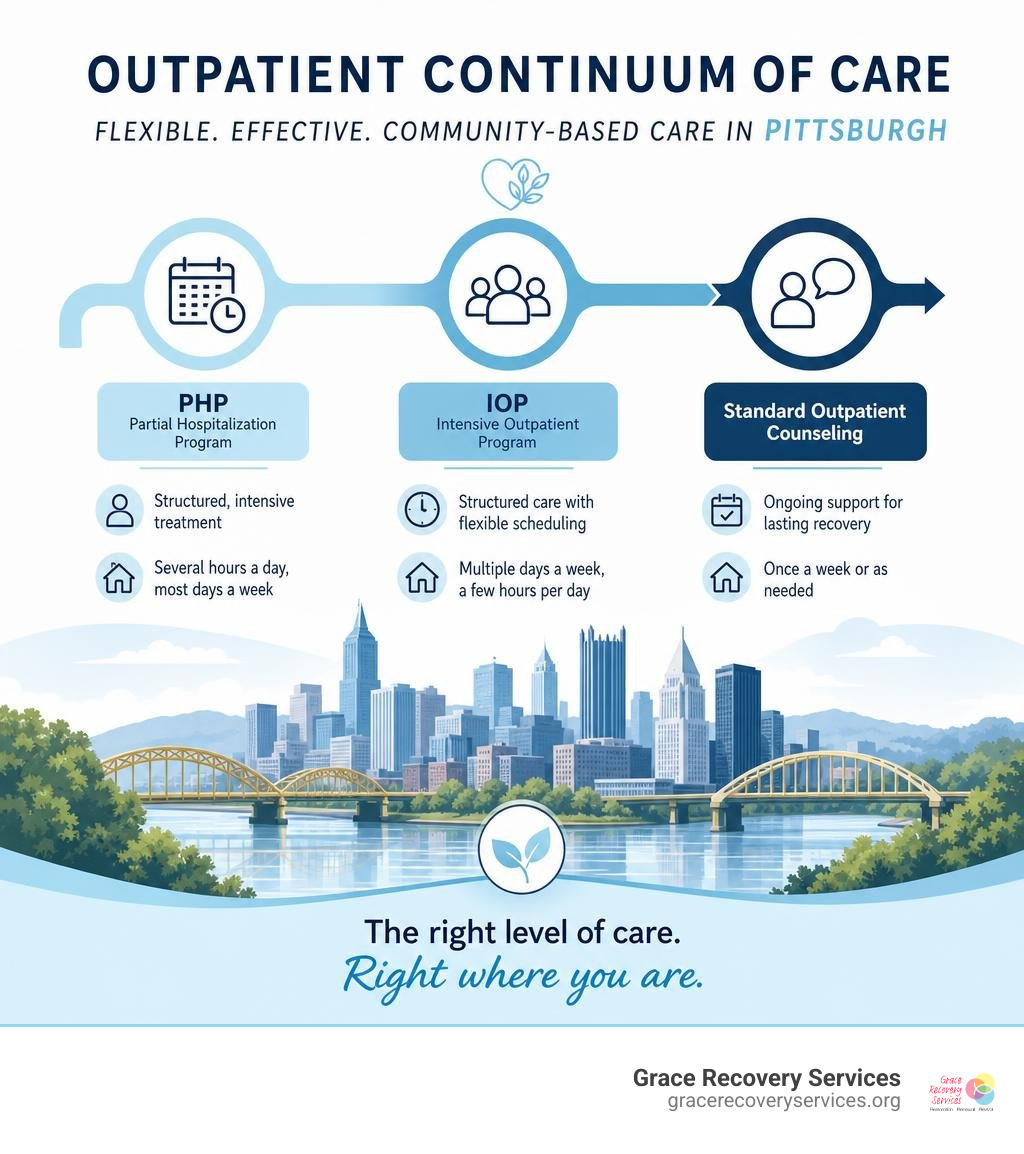
When exploring options for a drug rehab in Pittsburgh, understanding the different levels of outpatient care is essential. Outpatient treatment allows you to receive professional, structured therapy while continuing to live at home, care for your family, and maintain your employment.
Choosing Outpatient Addiction Treatment is highly effective for individuals who have completed higher levels of care or those whose work and family commitments require a flexible schedule. It provides a community-based support system where you can practice recovery skills in real-time.
Finding a Drug Rehab Pittsburgh Program for Outpatient Care
There are three primary levels of outpatient addiction treatment available in the Pittsburgh metro area:
- Partial Hospitalization Programs (PHP): This is the most intensive outpatient option. Clients attend structured clinical therapy sessions for several hours a day, multiple days a week, while returning home in the evening. It offers a highly supportive environment for those needing robust clinical oversight.
- Intensive Outpatient Programs (IOP): An Intensive Outpatient program offers a step down in intensity. It typically involves 9 to 15 hours of therapy per week, split across day or evening sessions. This level of care is perfect for balancing treatment with daily responsibilities.
- Standard Outpatient Program: A standard Outpatient Program consists of weekly or bi-weekly individual and group counseling sessions. It focuses on long-term relapse prevention, developing healthy coping mechanisms, and ongoing spiritual and emotional growth.
Specialty Addiction Treatment Programs in Western Pennsylvania
Every individual’s journey to addiction recovery is unique. Specialty programs are designed to address the specific emotional, physical, and spiritual needs of different populations. In Western Pennsylvania, many facilities offer tailored tracks, including dual diagnosis care for co-occurring mental health conditions, gender-specific groups, and trauma-informed care.
Faith-Based and Christian Drug Rehab Pittsburgh Options
For many individuals, lasting recovery requires healing that goes beyond physical clinical care. Integrating spiritual renewal with evidence-based therapy can provide a profound sense of purpose, hope, and strength.
At Grace Recovery Services, we specialize in Faith-Based Rehab Pittsburgh and Christian Rehab Pittsburgh programs. We walk alongside our clients through our proprietary Counseling Blueprint, a structured four-stage healing journey:

- Take Off the Mask: Building genuine rapport, safety, and trust so you can be honest about your struggles without fear of judgment.
- Heal the Wounds: Exploring deep emotional, psychological, and relational hurts that often drive addictive behaviors.
- Remove the Toxins: Identifying unhelpful beliefs, shame, and lingering lies you may believe about yourself.
- Replace with Truth: Installing empowering, accurate, and biblically grounded perspectives about your worth, your future, and your relationship with God.
If you want to explore how faith and science work hand-in-hand, we encourage you to read about Faith Integrated Recovery in Pittsburgh Where Science Meets Spirit. We provide a variety of local paths, including Christian Addiction Recovery Pittsburgh groups, Faith-Based Recovery Pittsburgh networks, and specialized Christian Intensive Outpatient Treatment programs.
For those searching for local support, you can review our guides on 5 Top Pittsburgh Christian Recovery Centers and Faith-Based Recovery Center Pittsburgh Top Local Options to find the right fit. We also help clients transition back into daily life with Christian Aftercare Programs in Pittsburgh How Faith-Based Options Can Help You to Heal and structured Faith-Based Aftercare in Pittsburgh for Lasting Sobriety.
Specialized Care for Families and Veterans
In addition to faith-integrated paths, Western Pennsylvania offers dedicated programs for families and veterans. Veterans experiencing PTSD alongside substance use can access specialized trauma-informed outpatient care.
Similarly, programs designed for mothers and women with children ensure that family units remain supported during the healing process. By incorporating family counseling, clients can heal relational wounds and build a stable, supportive home environment.
How to Choose the Right Drug Rehab Pittsburgh Facility
With 66 licensed treatment facilities in Pittsburgh and the surrounding Allegheny County area, choosing the right provider can feel overwhelming. To make an informed decision, it is important to look beyond basic listings and evaluate the quality of care provided.
When researching facilities, you can consult resources like Addiction Recovery Pittsburgh The Best Centers Compared to understand how local programs differ. Always prioritize centers that emphasize personalized, client-centered care rather than a one-size-fits-all approach.
Key Factors to Evaluate in Local Centers
- Accreditation: Ensure the facility is licensed by the state of Pennsylvania and holds third-party accreditations from reputable bodies like the Joint Commission or CARF.
- Staff Credentials: Look for programs staffed by Licensed Professional Counselors (LPCs), certified addiction specialists, and clinical directors who specialize in trauma-informed care. If you are seeking spiritual guidance, check for counselors with theological or biblical counseling credentials, or use our guide on Tips for Finding a Christian Counselor in Pittsburgh.
- Holistic and Clinical Approaches: The best programs combine evidence-based therapies (like Cognitive Behavioral Therapy) with holistic healing. To find local holistic practitioners, check out our guide on The Best Holistic Healers in Pittsburgh.
- Outpatient Flexibility: If you are balancing work or family, verify if the center offers flexible scheduling, such as evening IOP sessions.
The Cost of Addiction Treatment and Insurance Coverage
The cost of addiction treatment in Pennsylvania varies based on the level of care required. Outpatient care represents a highly effective, flexible, and affordable path to long-term recovery, allowing you to maintain your daily responsibilities while healing.
| Level of Care in Pennsylvania | Average Cost (Before Insurance) |
|---|---|
| Standard Outpatient Treatment | $8,315 |
| Outpatient Methadone Treatment | $7,388 |
By choosing outpatient care, clients can access high-quality therapy, group support, and psychiatric care while continuing to live at home.
Private Insurance and Medicaid HealthChoices
Most licensed outpatient facilities in the Pittsburgh area accept insurance to help cover the cost of care. Across Allegheny County’s licensed facilities, 49 accept private health insurance and 48 accept Pennsylvania Medicaid (HealthChoices).
Major regional insurers like Highmark Blue Cross Blue Shield and UPMC Health Plan offer robust coverage for outpatient mental health and substance use services. For Medicaid recipients in Allegheny County, behavioral health benefits are administered by Community Care Behavioral Health (CCBH). You can apply for Medicaid benefits online through the state’s COMPASS portal or contact CCBH directly at 1-800-553-7499 for a referral.
Free and Low-Cost Public Resources
If you are uninsured or underinsured, there are still excellent options available. The Allegheny County Office of Behavioral Health provides county-funded substance use assessments and coordinates public funding for outpatient treatment. Many community clinics also offer sliding-scale fees based on your household income to ensure that financial barriers do not stand in the way of your recovery.
Frequently Asked Questions About Drug Rehab in Pittsburgh
What is the average cost of outpatient drug rehab in Pennsylvania?
The average cost of standard outpatient addiction treatment in Pennsylvania is $8,315, while outpatient methadone treatment averages $7,388. These costs are often significantly or fully covered by private health insurance plans and Pennsylvania Medicaid.
How do I access immediate mental health and addiction support in Allegheny County?
For immediate crisis support, you can contact Resolve Crisis Services at 1-888-796-8226. Operated in partnership with UPMC Western Psychiatric Hospital, Resolve is a free, 24-hour service providing phone support, mobile crisis teams, and a walk-in clinic open to all individuals in Allegheny County regardless of insurance.
Does Pennsylvania Medicaid cover outpatient addiction treatment?
Yes. Pennsylvania Medicaid (HealthChoices), administered in Allegheny County by Community Care Behavioral Health (CCBH), covers a full continuum of outpatient services, including standard outpatient therapy, intensive outpatient programs (IOP), and partial hospitalization programs (PHP).
Conclusion
Recovery is not just about stopping a behavior; it is about restoring your life, renewing your mind, and reclaiming your purpose.
At Grace Recovery Services, we are dedicated to providing a safe, compassionate, and clinically excellent environment for your healing journey. Through our outpatient offices in Penn Hills (Pittsburgh) and North Huntingdon (Westmoreland County), we combine evidence-based clinical therapy with the life-changing power of faith.
Our Counseling Blueprint is designed to help you Take Off the Mask, Heal the Wounds, Remove the Toxins, and Replace them with Truth. You do not have to walk this path alone.
If you or a loved one is ready to take the first step toward lasting healing, we invite you to explore our Services, learn more About Us, or read about our commitment to trauma-informed care.
Please reach out to us today through our Contact page to speak with a compassionate member of our team. There is hope, there is grace, and a brighter tomorrow is waiting for you.
This article was researched with AI and heavily edited by Stephen Luther for accuracy and relevance.
Stephen Luther is the Executive Director and Founder of Grace Christian Counseling, Grace Recovery Services, WPA Counseling, NuWell Online Counseling and Coaching, and NuWell Health. He holds a Master’s degree in Education from the University of Georgia and a Master’s degree in Marriage and Family Therapy from Duquesne University. He is a licensed professional counselor in Pennsylvania.
Since 1997, Steve has been helping children, adolescents, and adults overcome a wide range of emotional and relational challenges. He specializes in working with hurting families, including those with foster, adopted, or traumatized children. Steve uses Attachment-Based Therapy, Splankna Healing, and Therapeutic Parent Coaching to support healing and restoration.
This guide is for educational and spiritual encouragement and is not a substitute for personalized professional counseling. If you are in crisis, please reach out for immediate help.